

How to Pay HMRC Corporation Tax: Deadlines and Methods

The accounts are signed off, the CT600 has gone in, and the tax is sitting in the bank. Then the payment date lands in the same fortnight as the VAT bill and the January payroll run, so it slips a day. Then three.
Nothing about that feels dramatic at the time. The money is there, the intent is there, and the banking app says the payment has been sent. What the app doesn't say is when HMRC will treat it as received, and that's the only date that matters for interest.
Working out how to pay HMRC Corporation Tax properly is a short sequence of checks in a fixed order, with the method chosen before the send date rather than on it. The cost of getting it wrong is rarely the tax itself. It's the interest, and the phone call that follows a payment that was sent on time and arrived late.
How to Pay Corporation Tax to HMRC Step by Step
Five checks, in this order, cover a company paying one Corporation Tax bill. Each one exists because of the interest that follows when a director skips it.
The choice is a cash-flow one, and it sits in the diary before anyone opens the banking app. The day the money leaves the bank is not the day HMRC counts the tax as paid. A cheap or familiar method only wins if its arrival time still leaves cleared funds on the deadline. If payroll and VAT already land that week, releasing cash a few days earlier on a slower route is often safer than a same-day habit squeezed against an empty account.
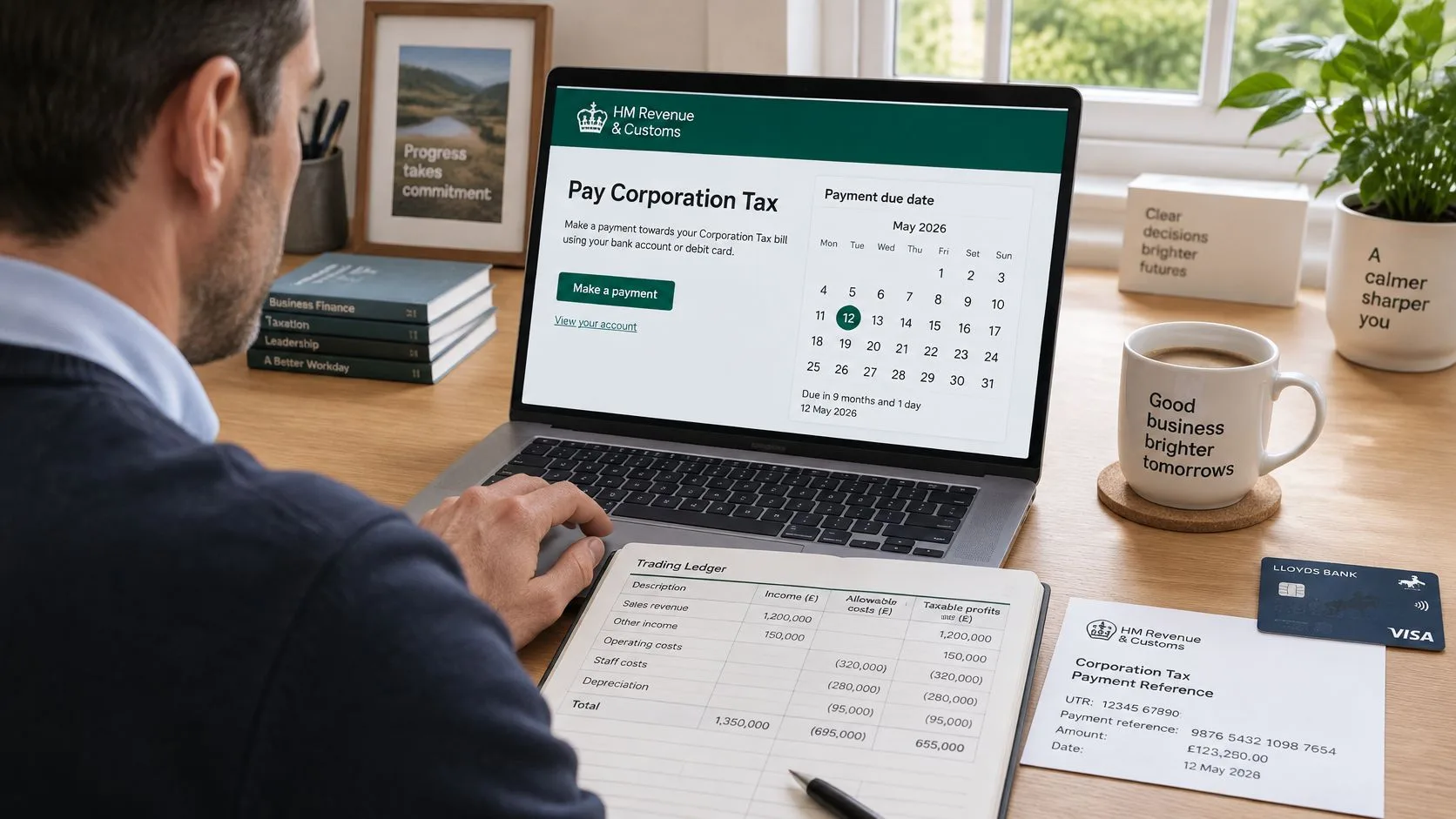
Confirm the liability and the deadline. The accounting period sets the payment date. Filing the accounts on another day does not move it. Companies with taxable profits above £1.5 million pay by quarterly instalments. Below that threshold the tax falls due 9 months and 1 day after the year end, as HMRC's Corporation Tax rates and allowances set out. Count that interval from the period end and diary the result as the date cleared funds must be with HMRC. A 31 March year end falls on 1 January. Take the figure from the computation, not an old estimate. The return has its own timetable, which our guide to the limited company tax return deadline sets out.
Get the 17-character reference for that period. HMRC allocates the money by that reference. The company name and the narrative on the bank line do not steer it. The reference changes with each accounting period, so a prior-year string posts the cash to the wrong period and leaves the open one unpaid.
Choose the method, then the send date. Every electronic method arrives on its own timetable. Look up that time, then count back across weekends and bank holidays to the last day the payment can leave and still clear on the deadline. Picking the day first and the method second is how an instruction made on the due date arrives after it. I would give up a few days of cash in the company account before I would risk late-payment interest on a familiar route that needed longer than the diary allowed.
Send it to HMRC's official bank details with the reference copied exactly. Two errors do most of the damage: a reference lifted from another period, and an instruction started on the due date with a method that needs several working days. Saying afterwards what you meant does not move the cash or stop the interest.
Keep the confirmation and reconcile the account. Save the bank confirmation and the date the money left. Then check online that the Corporation Tax account shows the payment against the right period. Two minutes closes the loop.
Work to the date HMRC holds cleared funds. The send date is only the cash leaving your bank, and every other decision here follows from that gap.
The dated payment plan
Put this on one line of the month-end file, with the dates already worked out, so the person releasing the payment is not rebuilding the logic at 4pm on a Friday.
| Field | What to record |
|---|---|
| Accounting period end | The period end on the computation, for example 31 March |
| Payment deadline | 9 months and 1 day later (1 January where the year end is 31 March) |
| Payment reference | The 17 characters shown against that period on the HMRC account |
| Chosen method and arrival time | Bacs, 3 working days |
| Latest safe send date | The deadline less the arrival time, moved back over weekends and bank holidays |
| Confirmation | Bank reference, date sent, date checked on the HMRC account |
Before you book the payment, ask three questions. Are profits volatile enough that the liability might still move? Is the company part of a group, so the £1.5 million threshold is shared? Is turnover climbing towards seven figures with margin to match?
If the answer to any of those is yes, review the instalment forecast before the payment is diaried. The schedule changes before the bank details do.
Find and Check the 17-Character Payment Reference
The reference lives in one place: the company's Corporation Tax account, shown against each accounting period. Not the company file, not your accountant's email from last year, not the CT600 acknowledgement. If the account shows two open periods, there are two references, and they aren't interchangeable.
The check itself is a matching exercise. The reference should sit against the period end you're paying. A company that has changed its year end can have an 18-month period and a 12-month period open at the same time, and paying the later liability with the earlier reference leaves the later period showing as unpaid while the money lands on a period that may already be settled. HMRC's system does what the reference tells it to, not what the payment was meant to do.
Run this routine before any instruction leaves the bank:
- Copy, don't retype. Paste the reference from the account into the bank instruction. A single wrong character is enough to misallocate the payment, and the payment will still look successful.
- Match the period end. The reference and the period end date are read together. If they don't line up on the screen, stop.
- Get a second pair of eyes. Whoever prepares the payment shouldn't be the only person who has checked the reference and the amount. Dual approval catches the wrong-period copy far more reliably than care does.
- Record it. Reference, period end and amount go in the payment plan, so the reconciliation at step five has something to check against.
The reference is only half of the check. The bank details matter just as much, and they should come from HMRC directly rather than from an email, an attachment or an invoice. Payment diversion fraud works by supplying convincing account details at the exact moment a payment is already in motion. Confirm the sort code and account number on HMRC's own page every time, not from a saved template nobody has reviewed.
Payment Methods, Arrival Times and the Safe Send Date
Choose the method and the send date together. The send date only exists once you know how long the chosen method takes, and picking the day first is how companies pay on time and arrive late.
| Method | Typical arrival | Allow before deadline | Best use |
|---|---|---|---|
| Faster Payments | Same day or next day | Same day, or deadline day if it falls on a weekend or bank holiday | Last-minute payments |
| CHAPS | Same or next working day | Same working day, within the bank's processing window | Large sums close to the deadline |
| Online debit or corporate credit card | Generally same day or next day | One working day as a minimum | Quick payment without a bank transfer |
| Bacs | 3 working days | 3 working days | Planned payments |
| Direct Debit (established instruction) | 3 working days | 3 working days | Companies with an existing instruction |
| Direct Debit (new instruction) | 5 working days | 5 working days | Only where payment is well ahead of the deadline |
Those windows come from HMRC's pay Corporation Tax guidance, which lists the electronic methods and how quickly each is treated as received. The bank details and processing notes confirm the Direct Debit position, including the extra days a first instruction can take to become active.
Working backwards from the deadline
Take the deadline, subtract the arrival time for your chosen method, and you have a send date. Then walk that date back over the calendar, because weekends and bank holidays swallow working days that your cash flow forecast doesn't count.
If a deadline lands on a Saturday, HMRC's guidance says the payment should normally reach the account on the preceding working day, which moves the send date to the Thursday for Bacs with only one day of slack. Faster Payments can generally be used on the deadline itself, and that allowance is the main reason it's safe to leave a Faster Payments transfer late and reckless to leave a Bacs one late.
The send date is the only date you control. The deadline is fixed by statute and the arrival time is fixed by your bank. The day you release the payment is the single variable left.
The gap between leaving your bank and reaching HMRC
Here is the trap for smaller companies. The director watching cash flow sees the money leave on the day the instruction was keyed. HMRC sees it arrive when it clears, and late-payment interest starts on the day after the due date. A Bacs instruction entered on the deadline isn't marginally late. It is late by the full length of the Bacs cycle, every time.
My recommendation is dull and effective. Use Bacs or an established Direct Debit for anything you can plan, released at least three working days before the deadline, because those methods cost less and the schedule never changes. Use CHAPS for large sums close to the deadline, but only after checking your bank's cut-off for same-day processing. Use Faster Payments for the genuine last-minute case, where the payment can be made on the deadline day even when it falls on a weekend or bank holiday.
HMRC also advises allowing 3 working days after an electronic payment before contacting it or attempting a second one. That pause prevents the duplicate payment that takes weeks to unpick, and it's the single most ignored piece of the whole process.
Cash flow forecasting is where the gap opens up, because the forecast tells you the money is available on the deadline rather than in time to clear by it. A founder's guide to managing cash flow helps with the forecasting half, but the payment half needs the opposite of forecasting: a fixed send date, chosen from the deadline, with the method already decided.
Two diary alerts do most of the work. One at 30 days to confirm the liability and the reference, one at 10 days to release the payment. Write the latest safe send date next to the chosen method on both. The firms that get caught out are the ones relying on an accounting software reminder on the due date, which tells them the legal deadline but nothing about arrival.
And the cheapest method is not always the safest. Bacs costs less than CHAPS at most banks, but a Bacs payment started inside the final three working days is a late payment with a lower fee. HMRC treats Faster Payments, CHAPS, online card payments and payments made through a bank or building society as generally same-day or next-day methods, as its guidance on timing a payment explains, which is exactly why an instruction keyed on the legal due date can still arrive after it.
Payment Mistakes That Trigger Late-Payment Interest
Interest isn't a penalty you can argue away with good intentions. It starts on the day after the Corporation Tax due date and runs until HMRC receives the tax, and it applies where the company pays late, pays too little or doesn't pay at all. The guidance on Corporation Tax interest charges sets out that daily basis, and the separate penalties for late tax payments sit on top of it.
| Mistake | Consequence | Fix |
|---|---|---|
| Using a reference from another accounting period | Payment is misallocated and interest may build up on the period that still looks unpaid | Check the reference matches the period before sending |
| Confusing the return deadline with the payment deadline | Payment arrives late even though the CT600 was filed on time | Diary the payment date separately from the filing date |
| Relying on Bacs or a new Direct Debit near the due date | Funds arrive after the deadline | Start Bacs or Direct Debit payments 5 working days early |
| Assuming the CT600 settles the liability | Interest runs from the day after the due date | Pay the tax separately, because filing doesn't pay it |
| Paying twice before HMRC has processed the first payment | Duplicate payment that needs reclaiming | Confirm the first payment has landed before sending another |
The controls that stop it happening
A month-end routine that holds up under pressure has four parts. A tax provision review each month, so the liability is being watched rather than discovered. A 30-day and 10-day diary alert on every payment date. Independent verification of the 17-character reference by someone who didn't prepare it. And post-payment checking that the correct accounting period has been credited, usually within two working days of sending.
Practical rule: if two people can't agree on the reference and the period before the instruction is released, it isn't ready to send.
Copy this into the month-end file: does the reference match the period end? Is the deadline in the diary as a payment date, separate from the filing date? Is the send date earlier than the deadline by at least the arrival time of the chosen method? Has someone checked the account after payment? Four yeses and the payment is done.
Paying in Instalments When Profits Exceed £1.5 Million

A company whose profits run at an annual rate above £1.5 million normally pays Corporation Tax in quarterly instalments, not as one sum after the year-end. HMRC's guidance on paying in instalments sets the pattern. For a 12-month period from 1 January to 31 December, the dates fall like this.
| Payment | Due date | Timing rule |
|---|---|---|
| Instalment 1 | 14 July in the period year | 6 months and 13 days after the period starts |
| Instalment 2 | 14 October in the period year | 3 months after instalment 1 |
| Instalment 3 | 14 January in the following year | 3 months after instalment 2 |
| Final payment | 14 April in the following year | 3 months and 14 days after the period ends |
The date money leaves the bank is not the date HMRC counts the instalment as paid. Each date in that table is a receipt date. If the method you use takes several working days to clear, the safe send date sits earlier than the due date, and the cheapest or most familiar method is not always the one that lands on time. I would rather release the payment early than save a bank charge and miss the receipt date.
Why turnover is not the test
The threshold is an annualised profit rate, and it is reduced where the company has associated companies. A business with several million of turnover and thin margins is not caught. A business with strong margins, or a short accounting period, needs the annualised figure calculated before anyone assumes the ordinary post-year-end payment date still applies. Groups divide the threshold between the companies. They do not apply the full amount to each company.
The first instalment can fall before the year-end accounts exist, so the figure comes from a projection. In a growth year that projection tends to be too low, and the cash has to leave before you know the final liability.
Underpaying in a growth year creates debit interest at HMRC's late-payment rate. A forecasting error then becomes a real cash cost, not a rounding difference. Build the interest into the cash-flow forecast, and time the bank instruction so HMRC has the money on the due date, not merely on the day you pressed send.
Volatile profits, a period longer or shorter than 12 months, and a group structure all move the dates and the amounts. Once the return is prepared, reconcile every instalment to the final Corporation Tax computation. That reconciliation is where an underpayment shows up before HMRC finds it. If the cash will not be there for an instalment, a Corporation Tax payment plan agreed with HMRC before the date is worth far more than one requested afterwards.
Stewart Accounting Services helps limited companies with Corporation Tax, bookkeeping and the cash flow behind each payment, including contractors and freelancers trading through a company. Call 01259 721156 or email mark@stewartaccounting.co.uk with your year-end date and latest management accounts if you want the instalment dates, and the send date for each one, set out before the first falls due.