

A Technical Guide to Bookkeeping for Beauty Salons Stirling

Managing beauty salon finances in Stirling requires balancing daily cash register reconciliations with complex HMRC VAT rules. The choices in front of you are concrete: which setup fits your salon profile, which expenses you can claim, when VAT applies, what bookkeeping fees look like in the UK, and when DIY records stop serving you. Switching to tailored cloud accounting streamlines payroll and expense tracking, freeing up your time while keeping your salon fully compliant. Contact Stewart Accounting Services when you want that load taken off your hands so you can protect more time, more money, and more mind.
Key Takeaways: Effective bookkeeping for beauty salons Stirling requires tracking professional equipment and training as tax-deductible expenses while monitoring the rolling turnover threshold for mandatory VAT registration.
- Integrate your EPOS with Xero or QuickBooks to automate daily transactions and eliminate manual errors.
- Register as self-employed via the HMRC portal before hiring an accountant for your salon records.
- The GOV.UK list of non-compliant employers shows that failing to track staff prep time triggers penalties.
How three salon profiles determine the right accounting setup
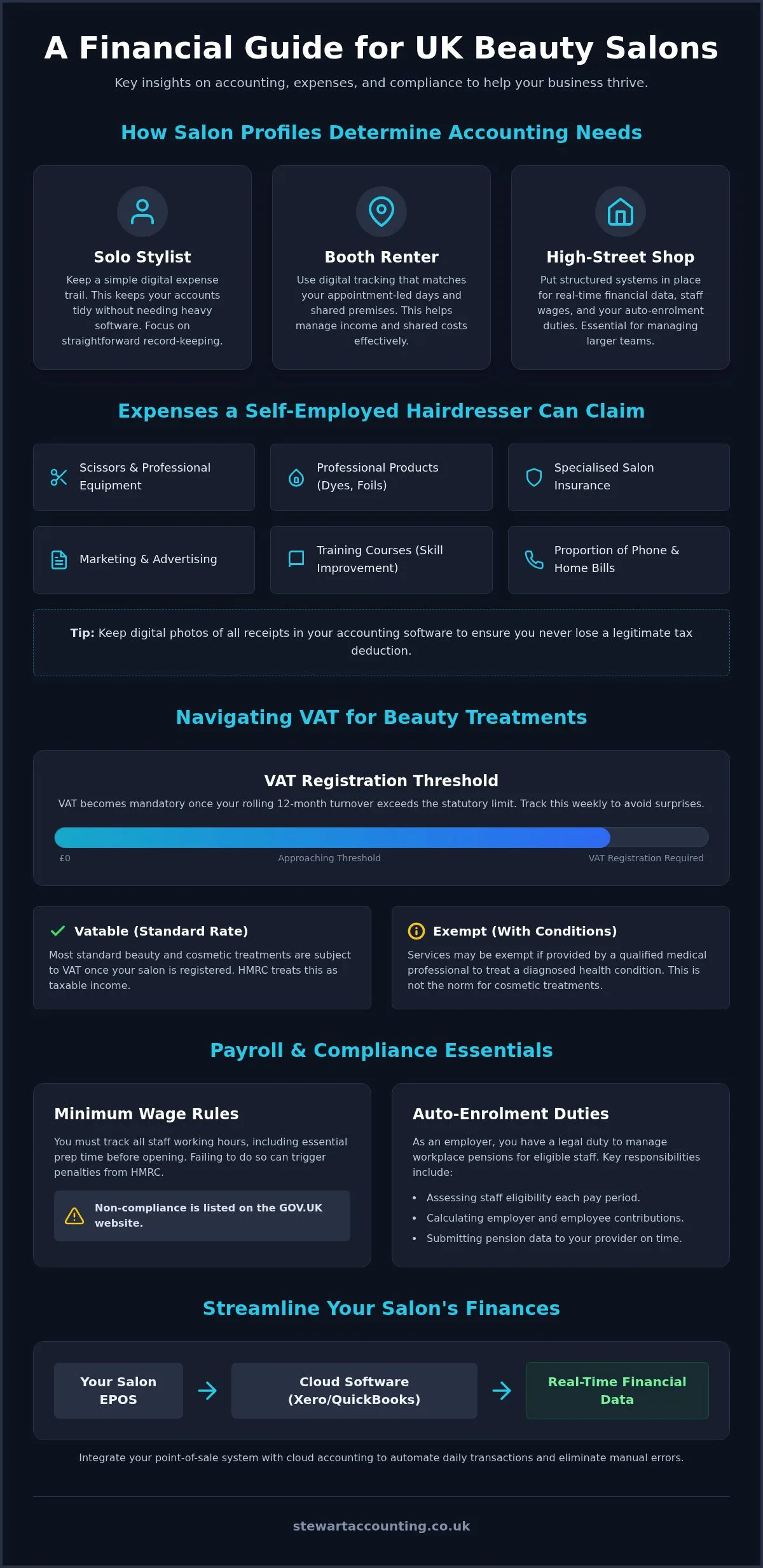
Your salon profile decides whether simple expense tracking is enough or whether you need full payroll support. Three situations come up again and again:
- Solo stylist working alone: keep a simple digital expense trail so your accounts stay tidy without heavy software.
- Booth renter: use straightforward digital tracking that matches appointment-led days and shared premises.
- Busy high-street shop with staff: put structured systems in place for real-time figures, wages, and auto-enrolment duties.
Matching software to your daily appointments keeps your business compliant without adding stress, and stops admin from draining hours you would rather spend with clients. Large teams benefit from integrated platforms; smaller setups stay lighter.
If you need accountants in Alloa and Stirling, the team helps you pick a digital arrangement that fits how you actually trade. Get in touch to talk through your setup.
Expenses a self-employed hairdresser can claim
Tax deductions reduce your bill when you claim routine salon costs: professional products, scissors, insurance, and marketing.
Scissors wear out the way car tyres do, so regular maintenance or replacement is a normal cost of staying sharp. You can also claim hairdryers, dyes, foils, and specialised salon insurance. Training courses that improve skills you already use in the business qualify as allowable expenses.
Local stylists who work flexibly often claim a proportion of phone and home utility bills. Exact records mean you only pay the tax you owe, and legitimate costs stay in the business rather than disappearing into HMRC’s share. Outsourced bookkeeping support can structure those files for you so claims stay defensible.
Tip: Keep digital photos of all stock and consumable receipts directly in your accounting software to ensure you never lose a legitimate tax deduction.
Ask for a review of your expense categories if you want help locking this down.
Are beauty treatments vatable?
Standard beauty treatments carry standard-rate VAT once your salon turnover exceeds the statutory registration threshold.
Salon owners often mistake cosmetic treatments for exempt medical services. Unless a qualified medical professional provides the therapy to treat a diagnosed health condition, HMRC treats it as taxable income, and registered businesses must charge tax on those services.
Gift voucher sales can change your liabilities depending on whether vouchers are single or multi-purpose. Track your rolling twelve-month turnover each week so you spot the threshold early (think of it as a fuel-tank warning, not a surprise empty tank). Registered salons can use outsourced bookkeeping in the UK for quarterly filings, or consider the flat rate VAT scheme to simplify records.
Registering voluntarily can make sense if your client base is mostly VAT-registered businesses, because you may reclaim tax on startup costs. That choice is separate from how you register as self-employed: VAT only becomes mandatory when turnover crosses the statutory line.
A commenter in the bizify.co.uk thread "Stewart Accounting Services Limited, Alloa, Bizify":
"I’ve been using Stewart Accounting Services Limited for bookkeeping and VAT return services for over a year now, and the experience has been smooth from day one." (source)
That experience shows how handing VAT compliance to a professional keeps filings on track without day-to-day operational stress. We can handle the filings for you if you prefer not to manage them in-house.
How Salon Bookkeeping Fees Compare in the UK
UK salon bookkeeping fees vary with business size and transaction volume, so clear fee structures matter when you budget.
Based on top ten UK provider samples, annual fees in that sample run from fifty to twenty-four thousand pounds, with a median rate of three thousand pounds. The upper end sits far above what a typical salon pays; the median is the more useful planning figure. Fixed monthly rates help you budget without surprises.
| Service Level | Typical Onboarding Timeframe | Fee Structure Type |
|---|---|---|
| Entry-level bookkeeping support | 1–2 Weeks | Fixed Monthly |
| Tailored advisory support | 2–4 Weeks | Custom Tailored |
Records can be managed through bookkeeping for small businesses, with setup paced for Stirling salons. Local client feedback points to the value of a personal approach rather than a generic bundle.
Among Stewart Accounting Services’ Google reviews, a client (5★) wrote:
"I highly recommend Stewart Accounting. I really don’t know what I would do without them. Mark and Arlene are so wonderful and helpful in so many more ways than just accounts. It’s a very personal service and I am very grateful to them. Thanks Cat"
That review shows how personal support builds confidence in ongoing accounts. Contact Us if you want a fee structure matched to your chair count and transaction volume.
Connecting Your Salon EPOS to Cloud Software
Linking your salon point-of-sale system to cloud accounting platforms automates daily transaction entries and cuts manual data entry errors.
Syncing your till with software like Xero or QuickBooks changes daily admin: sales totals, card payments, and gift card redemptions can transfer overnight, giving you real-time figures for daily profit checks. Manual reconciliation takes hours; a direct software link removes that grind.
Smaller studios often need simple daily Summaries. Multi-chair salons gain more from detailed inventory mapping. Stewart Accounting Services helps configure these integrations and handles the technical setup so you stay with clients instead of spreadsheets.
A commenter in the stewart-accounting-services.localo.site thread "Stewart Accounting Services":
"Documents and tools are available and easy to use and find, and the team are on hand." (source)
User-friendly tools plus someone on hand means you are not left guessing when a feed fails. Book a Discovery Call if you want the till and the ledger talking to each other cleanly.
5 Steps to Register as Self-Employed in Stirling
You can set up as a self-employed salon trader through the official government portal. Registration gives you a clear basis for tax, though the first pass can feel unclear. Self-employment as a sole trader is not the same as forming a limited company; choose the structure that fits how you want to trade before you file.
- Gather details: Collect your National Insurance number and trading address.
- Submit application: Apply online to register as self-employed with HMRC (this is sole-trader registration, not company formation).
- Receive codes: Wait for HMRC to send your Unique Taxpayer Reference.
- Setup records: Establish your system to track salon income and bills.
- Confirm deadlines: Log key tax submission dates in your calendar.
Open a dedicated business bank account early so personal and trade spending do not mix. Accurate registration and clean records protect you when Self Assessment arrives.
Contact Us today to book a discovery call if you want a second pair of eyes on the sequence.
Payroll Management and Minimum Wage Rules for Staff
Running salon payroll correctly protects you from statutory penalties and legal disputes. Wages, tips, and prep time sit beside daily treatments, and that mix is where stress builds.
Misclassifying assistant duties leads to compliance failures in routine audits. Underpayment findings often trace back to untracked prep time rather than deliberate short-changing.
According to a GOV.UK announcement naming employers who failed to pay the minimum wage, employers can face public naming and financial penalties for underpaying staff. Hair and beauty teams also need solid Real Time Information (RTI) submissions to HMRC.
Outsourced payroll keeps RTI, minimum wage checks, and auto-enrolment in one controlled process. Stewart Accounting Services can run each payroll step so you hold onto the three freedoms: more time, more money, more mind. Reach out when you want wages handled without weekend catch-up sessions.
Why CPD Training Is Vital for Modern Salon Accounting
Ongoing professional training keeps salon accountants current on UK tax legislation and beauty-sector practice. Without it, fresh allowances and rule changes slip past busy owners.
In client work, missed sector allowances often trace back to stale knowledge rather than carelessness. CPD keeps advice tied to accurate, real-time figures and reduces expensive compliance errors.
Stewart Accounting Services maintains up-to-date knowledge through professional development so your records reflect current rules. Ask the team how that feeds into your year-end if you want training-backed advice behind your numbers.
When DIY Bookkeeping Breaks Down: Honest Limits
Handling salon finances yourself works until growth turns admin into a weekend burden. Owners often spend hours untangling mixed tip records and stock receipts; that exhaustion stalls growth.
Hair and beauty accounts need exact tracking of retail inventory, staff commission, and cash. When receipts pile up, small mistakes become unexpected tax bills and fines.
Professional support protects your diary. Outsourcing the figures brings real-time financial data and returns attention to the chair. Contact Us today if DIY has started to cost you more hours than it saves.
Frequently asked questions
What expenses can I claim as a self-employed hairdresser?
You can claim business costs such as styling equipment, salon consumables, insurance, and professional training fees as allowable expenses. A tax deduction reduces taxable profit by subtracting those allowed costs, so you pay tax on net earnings. Digital records make each item easier to evidence when you need it.
Are beauty treatments vatable?
Standard beauty treatments delivered in the United Kingdom are subject to value added tax at the standard rate once your turnover crosses the registration threshold. VAT cash accounting (tax accounted for when cash is received) can help you manage cash flow. Book a discovery call if you want guidance matched to your treatment list and turnover pattern.
How much does it cost to open a hair salon or barber shop?
Setup costs vary with premises size, fit-out, equipment quality, and location. The investment depends on property size and initial inventory, so ask for a personalised quote when you need project numbers. According to current UK industry figures, initial launch outlay spans a broad market price band across top-ten salon samples. Careful startup budgeting protects your working capital.
When should I hand salon bookkeeping to a professional?
Hand it over when mixed tips, stock, commissions, or staff wages start eating weekends, or when rolling turnover nears the VAT threshold and quarterly filings feel risky. That is the point where errors and late penalties cost more than support. A short review of your till, payroll, and receipt flow will show whether DIY still holds.
Do beauticians and barbers have to pay tax?
Beauticians and barbers must pay income tax and National Insurance contributions on profit above their personal allowance. Quarterly obligations and annual filing need steady recordkeeping through the year. Stewart Accounting Services can take charge of the daily books so you keep focus on clients rather than deadlines.
Streamline your salon finances in 2026
Effective bookkeeping for beauty salons in Stirling returns your attention to clients instead of paperwork: the right profile-based setup, defensible expense claims, clear VAT timing, realistic fees, and an honest line between DIY and support. The ICB and CPA qualified team delivers precise help around those same decisions. You can contact Stewart Accounting Services today to get your salon’s financial management organised.