

Accounting Practices for Sales: UK SME Guide
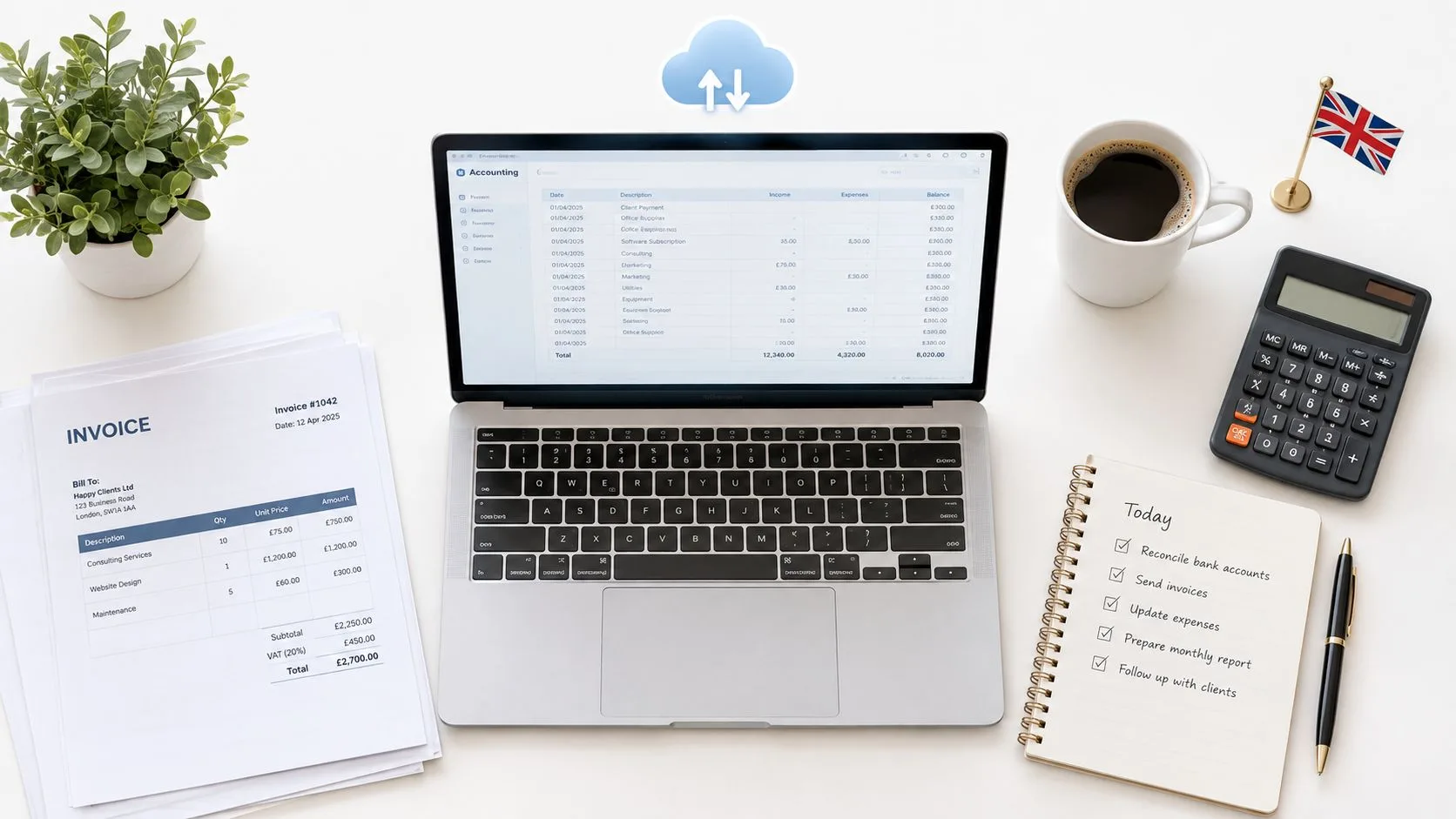
Strong sales can create a misleading sense of security. The pipeline is full, invoices are being raised, and the profit and loss account looks healthy, yet the bank balance keeps tightening because customers haven't paid. For a growing UK SME, the difference between recording a sale and collecting the cash can decide whether growth is funded comfortably or becomes a working-capital crisis.
Good accounting practices for sales connect four things: the customer contract, the invoice, the VAT return, and the bank receipt. That connection must also work when a sale includes ongoing support, staged delivery, discounts, credit notes, or a large corporate customer with slow payment habits. Xero can automate much of the administration, but it can't replace decisions about revenue, credit risk, and control ownership.
The Cash Flow Trap in Growing Sales Ledgers
A business can report rising revenue while its cash position deteriorates. The accounting entry records what the customer owes, not what the business can spend today. If management watches turnover and gross margin but pays little attention to aged debt, disputed invoices, and promised collection dates, the sales ledger becomes a flattering history book rather than a forward-looking cash-flow tool.
The risk is especially visible in B2B sales. UK data for 2025 shows that large businesses paid suppliers in 32 days on average, while 15% of invoices were paid late and 14% of total invoice value was late, according to the UK Government payment practices commentary. Separate UK research cited in the same verified data found that 51% of B2B invoices were overdue, with small businesses owed more than £21,000 on average. These figures describe a cash-flow environment in which a sales forecast is incomplete unless it includes collection risk.
Revenue is not the same as liquidity
Suppose a consultancy completes a substantial project for a corporate customer and raises an invoice immediately. The sale may be properly recorded, but the cash might arrive after the supplier payroll, software renewals, VAT liability, and other operating costs fall due. If the customer then queries the purchase order reference or claims that an acceptance milestone hasn't been met, the business has a debtor balance but no usable cash.
This is why debtor days should sit beside revenue in monthly management reporting. A useful debtor days formula explained for UK businesses helps turn the sales ledger into a management measure. The calculation itself is less important than the discipline behind it: compare outstanding invoices with agreed terms, identify movement by customer, and investigate deterioration before the account becomes seriously overdue.
Practical rule: Treat every new sale as two questions. What revenue has been earned, and when is the cash realistically expected?
Put collection assumptions into the forecast
A cash forecast should distinguish between invoices that are due, invoices that are disputed, and invoices that have a credible payment commitment. A large customer with a strong reputation may still be a poor short-term payer if its procurement process requires several approvals. Conversely, a smaller customer may pay promptly when the invoice is accurate and the relationship is actively managed.
The sales ledger should therefore feed a weekly cash conversation. Review the largest balances, overdue dates, credit notes awaiting approval, and invoices that have been sent to the wrong contact. Don't allow a sales manager to count an order as reliable cash merely because it appears in the pipeline.
The most effective businesses also decide in advance what happens when payment slows. They define credit limits, request deposits where appropriate, pause further work at agreed triggers, and escalate disputes to a named owner. Growth remains valuable only when the business can finance the delivery behind it.
Navigating Revenue Recognition and VAT Timings
Issuing an invoice doesn't automatically mean the full amount belongs in this month's accounting revenue. UK GAAP's updated revenue model under FRS 102 and FRS 105 uses a five-step framework for recognising revenue from contracts with customers, and that framework interacts with HMRC's digital record-keeping and Making Tax Digital requirements, as set out in HMRC's VAT record-keeping guidance.
The practical difficulty arises when one customer arrangement contains several promises. A software or service provider might charge a setup fee, provide access over a contracted period, and include implementation support. The invoice may be raised upfront, while the accounting revenue is earned across different points in the arrangement.

Apply the five steps in plain English
Identify the contract. Confirm that an enforceable customer arrangement exists, document the promised deliverables, and record any termination, renewal, acceptance, or refund terms.
Identify the performance obligations. Separate promises that the customer can benefit from independently. A distinct implementation service may not be the same obligation as ongoing platform access.
Determine the transaction price. Establish the amount the business expects to receive, considering discounts, variable consideration, credits, and contract modifications. Don't treat an uncertain bonus or rebate as guaranteed income without assessing the contract terms.
Allocate the price. Where the arrangement contains separate obligations, allocate the consideration between them using an appropriate measure of relative value. The invoice layout might show one commercial package, but the accounts may need several revenue categories.
Recognise revenue when each obligation is satisfied. Record a completed one-off service when delivery occurs, and recognise a continuing service over the period in which the customer receives it. Amounts billed before they are earned generally sit as deferred income until the relevant work is performed.
This produces a better picture of profitability than posting every upfront invoice directly to sales. In Xero, use separate revenue accounts and a deferred-income account where the arrangement requires it. Attach the contract or order documentation to the transaction, then make a consistent schedule for monthly release. The schedule should explain the accounting entry rather than rely on a memory held by one bookkeeper.
Keep the VAT tax point separate
VAT follows its own timing rules. HMRC's normal approach is to account for output VAT in the period in which the tax point occurs, using the VAT rate in force at that point. The tax point may arise from the supply, an invoice, or payment depending on the circumstances and scheme used, so the finance team must assess the transaction rather than assume that the revenue recognition date controls the VAT return.
That creates a common timing mismatch. An upfront invoice can create a VAT reporting requirement while the corresponding accounting revenue is deferred. A staged project can also produce accounting revenue as work is performed while VAT treatment follows the applicable tax point. The management accounts and VAT return can therefore show different timing without either being wrong.
Control point: Reconcile three dates for complex sales, delivery or performance, invoice issue, and payment receipt. Each date answers a different accounting or cash question.
For subscriptions, retainers, milestones, and mixed bundles, create a contract summary with the obligation, price allocation, revenue release pattern, VAT treatment, and supporting evidence. That summary gives the person preparing the VAT return enough information to avoid copying the profit and loss account into the return. It also helps management understand why invoiced sales, recognised revenue, and cash receipts don't always move together.
Building MTD Compliant Invoicing Workflows
A sales invoice has two jobs. It tells the customer what to pay, and it provides evidence for the business's accounting and VAT records. An incomplete or poorly coded invoice can delay collection, distort the sales ledger, and make the VAT return harder to support.
VAT registration becomes mandatory once taxable turnover is more than £90,000. For VAT-registered businesses selling standard-rated or reduced-rated goods or services to another VAT-registered person, a valid VAT invoice is normally required within 30 days of supply, according to the Value Added Tax Regulations.
Build the invoice from controlled data
A valid VAT invoice should contain the key details HMRC expects, including:
- Sequential numbering: Use a unique, orderly invoice number that can't be casually duplicated or overwritten.
- Supply details: Show the supply date and, where relevant, the invoice date.
- Supplier identity: Include the legal business name, address, and VAT registration number.
- Customer information: Record the customer's details and confirm whether the customer is VAT registered where the transaction requires that treatment.
- Description: Explain what was supplied clearly enough for the customer and reviewer to identify the transaction.
- VAT breakdown: State the applicable VAT rate, net amount, VAT amount, and total payable.
Configure Xero's invoice templates with locked business details, a controlled numbering sequence, payment terms, bank information, and clear VAT rates. Use contact records carefully. A wrong customer address, duplicated contact, or inappropriate tax rate can create avoidable queries and reconciliation work.
For businesses handling a high volume of documents, it can help to understand how workflow tools support a wider guide to invoice processing automation. Automation is useful when it preserves an audit trail, routes exceptions to a person, and keeps source documents connected to the ledger. It isn't useful when it only moves an unchecked error through the system faster.
Make the VAT account explain the return
In Xero, map each sales tax rate to the correct sales account and VAT control treatment. Separate standard-rated, reduced-rated, zero-rated, exempt, and outside-scope transactions where the business makes those supplies. Don't use a generic “sales” code for every transaction if doing so prevents the finance team from explaining the VAT analysis.
The normal VAT accounting approach records output VAT separately from net sales. A business using cash accounting follows a different timing rule, which should be configured deliberately rather than selected because it appears to improve short-term cash flow. The scheme can change when VAT on sales becomes payable, but the debtor ledger must then support that timing.
Review the Making Tax Digital software guidance for UK businesses before choosing the final workflow. The critical question isn't merely whether Xero can submit a return. It's whether the sales process preserves digital links from the original transaction through coding, adjustments, review, and submission.
Automating Credit Control and Debtor Management
A growing B2B sales ledger can look profitable while cash remains trapped in overdue invoices. An invoice raised today may represent revenue under FRS 102 when the goods or services have been delivered, yet the customer may not pay for weeks. If the business uses cash accounting for VAT, the VAT timing follows receipt instead. The result is a timing mismatch between reported revenue, VAT reporting through MTD, and the cash available for wages, suppliers, and tax.
Credit control should therefore begin when the sale is agreed, not when the invoice becomes overdue. Confirm the customer's accounts contact, purchase order requirements, payment terms, and approval route before delivery. A clean invoice reduces disputes, but it cannot solve an unapproved order or a complaint about service quality.
Xero can give each invoice a defined collection route. It can issue reminders before and after the due date, display outstanding balances, and give the finance team a shared view of the debtor ledger. The workflow should support personal contact rather than remove it. For practical guidance on automating invoice reminders in accounting software, set reminders around agreed terms and leave exceptions for a person to review.
Compare the collection options
| Approach | What works | Where it falls short |
|---|---|---|
| Manual chasing | A personal call can resolve a relationship or service issue quickly. | Results depend on memory, availability, and consistent follow-through. |
| Automated reminders | Each customer receives a predictable prompt, and the finance team saves routine effort. | The workflow cannot judge whether the customer disputes quality, scope, or authorisation. |
| Account-owner escalation | The person closest to the customer can address commercial objections. | Sales staff may avoid difficult conversations or prioritise new work over old debt. |
| Formal statutory enforcement | Contractual rights and the Late Payment of Commercial Debts Act can provide structure for serious escalation. | It may strain a valuable relationship and cannot replace accurate invoicing or a documented dispute process. |
Set reminder stages around the customer's contractual terms, not an arbitrary calendar. Send invoices to the correct accounts contact and confirm receipt for larger B2B accounts. When an invoice becomes overdue, assign an owner, a next action, and a date. “Chased” is not an adequate note. Record the customer's response, any disputed amount, the promised payment date, and whether further work should continue.
Businesses trying to stop chasing payments manually still need human review for high-value or sensitive accounts. Automation handles predictable follow-up. Judgement belongs where it can change the result.
Treat cash accounting as a control choice
Under the cash accounting scheme, VAT on sales becomes due when payment is received. That may support cash flow, but it creates reconciliation work because the sales ledger can show earned revenue under FRS 102 while the VAT liability waits for collection. Xero settings, receipt allocation, debtor balances, and MTD records must agree with the chosen scheme.
Use Xero's aged receivables report to segment accounts by risk. A reliable customer with an administrative delay needs a different conversation from one that repeatedly breaks terms, increases its balance, and avoids specific payment dates. Set credit limits, approve exceptions, and review overdue debt in the weekly operating meeting.
A strong reminder workflow is consistent and accurate, with escalation at the point set in the credit policy. That protects customer relationships while preventing optimism about payment dates from distorting the cash forecast.
Executing the Month End Sales Reconciliation
Month end should prove that the sales ledger, bank activity, revenue accounts, and VAT control account tell a consistent story. It shouldn't be a rushed exercise in clicking “reconcile” until the balance looks plausible. The reviewer needs to trace exceptions back to invoices, receipts, credit notes, contracts, or system entries.
For VAT-registered businesses above the £85,000 taxable turnover threshold, the applicable guidance requires digital VAT records and VAT returns through Making Tax Digital-compatible software. The HMRC VAT input tax toolkit highlights the importance of accurate sales and income records, including invoices and till rolls. In practice, incomplete linkage between sales invoices and VAT account entries is a major warning sign.
Use a fixed close sequence
Start with the sales invoice register. Check that invoices raised during the month have a customer, supply date, nominal code, VAT treatment, and supporting order or contract. Then inspect credit notes and cancellations separately. A credit note posted to the wrong period or tax rate can reduce output VAT incorrectly while leaving the customer balance unresolved.
Next, reconcile bank receipts to open invoices. Don't force a payment onto the oldest invoice when the remittance advice identifies another document. Investigate partial payments, overpayments, refunds, and unallocated cash. An unallocated receipt is not a harmless suspense item if it hides a customer who still appears overdue.
Finally, compare the VAT report with the VAT control account and sales ledger. Review unusual tax codes, manual journals, late entries, and transactions posted after the close date. Confirm that the digital link into the MTD submission workflow is intact, then retain the return workings and evidence of review.
| Reconciliation Step | Action Required | Common Pitfall to Avoid |
|---|---|---|
| Sales invoice register | Match invoices to orders, contracts, dates, customers, and VAT codes. | Posting sales from a spreadsheet without checking the source invoice. |
| Credit notes | Confirm authorisation, reason, customer allocation, and VAT treatment. | Using a credit note to hide a disputed invoice without resolving the dispute. |
| Bank receipts | Match receipts to remittance advice and invoices, then clear genuine allocations. | Applying an unidentified receipt to the oldest balance simply to reduce aged debt. |
| Partial payments | Leave the balance open, document the customer commitment, and monitor the remainder. | Treating a part-payment as settlement and losing sight of the outstanding amount. |
| Unallocated cash | Contact the customer or review bank references before closing the period. | Carrying unexplained receipts forward until the audit trail is lost. |
| VAT control account | Tie output VAT to the return, investigate manual adjustments, and review exceptions. | Assuming the VAT return is correct because the software accepted the submission. |
| Digital links | Check that source records, accounting entries, adjustments, and submission software remain connected. | Copying figures manually between systems and creating an unsupported re-keying step. |
The close should end with an exception list, not just a tick box. Assign each issue to a person, state the corrective action, and carry unresolved matters into the next review. That approach catches process failures before they become recurring errors.
Designing Internal Controls for Sustainable Growth
Informal sales administration can work while the owner sees every order and knows every customer. It becomes fragile when several people negotiate deals, issue invoices, approve discounts, manage delivery, and reconcile the bank. Sustainable accounting practices for sales make responsibility visible without slowing ordinary transactions.

Separate authority from verification
The person who agrees a price shouldn't be the only person who can issue a credit note. The person who raises an invoice shouldn't be the sole reviewer of the VAT code. The person who reconciles the bank should have access to the supporting sales information but shouldn't be able to alter customer balances without review.
A workable approval matrix can define:
- Commercial terms: Sales staff can propose prices and payment terms within agreed parameters.
- Credit exposure: A director or finance lead approves customers who exceed the normal credit limit or request unusual terms.
- Discounts: Discounts outside the standard policy require documented approval before invoicing.
- Credit notes: The account owner confirms the commercial reason, while finance verifies the accounting and VAT treatment.
- Write-offs: A senior approver reviews debt write-offs, evidence of collection activity, and the effect on reporting.
The controls should be proportionate. Requiring director approval for every ordinary invoice creates delays and encourages staff to bypass the system. Requiring review for unusual terms, large adjustments, and repeated overdue balances focuses effort where the risk sits.
Management insight: A sales dashboard should show the quality and collectability of sales, not just the volume recorded.
Turn the controls into a routine
Give the bookkeeper a short operating schedule. Daily, review failed invoice deliveries, returned emails, and significant receipts. Weekly, review overdue balances, disputes, new credit exposure, and expected collections. At month end, complete the reconciliation checklist and explain movements in revenue, deferred income, VAT, and debtor balances.
Xero can provide the transaction workflow, invoice history, reminders, bank feed, and reports. A specialist such as Stewart Accounting Services can configure Xero, support bookkeeping and VAT processes, and produce regular reports for SMEs that need clearer KPI information. The system still needs a named owner who reviews exceptions rather than assuming automation has removed risk.
Use the following video as a practical prompt when reviewing how controls and reporting fit into a growing finance function.
The owner should be able to answer which customers owe money, which invoices are disputed, when cash is likely to arrive, why accounting revenue differs from invoicing, and how the VAT return was reconciled. If those answers require searching through personal inboxes or unexplained spreadsheets, the control framework hasn't caught up with the sales operation.
If your sales ledger is growing faster than your finance process, arrange a review of your Xero setup, revenue recognition, VAT coding, debtor controls, and month-end reconciliation with Stewart Accounting Services. Bring your current aged receivables report, recent VAT workings, invoice template, and management accounts so the review can identify the specific timing gaps and collection risks affecting your cash flow.
Recent Posts
15 Oct, 2026
14 Oct, 2026