

Capital Gains Tax in Scotland: A Complete Guide for 2026/26

With Scottish Income Tax now managed separately from the rest of the UK, it’s a question we hear all the time: are the rules for capital gains tax in scotland different too? This uncertainty can cause significant stress, especially when you’re trying to sell a valuable asset like a property or shares. The worry of miscalculating what you owe, or missing out on reliefs you’re entitled to, is a common concern for many who feel overwhelmed by the complexity.
We’re here to take that stress off your hands. In this complete guide for the 2025/26 tax year, we provide clear, straightforward answers. You will learn the key rules for CGT in Scotland, understand exactly how your unique Scottish Income Tax band affects the rate you pay, and discover the essential reliefs and allowances available to legally reduce your bill. Our goal is to give you the confidence and clarity you need to manage your assets effectively and pay the correct amount to HMRC.
Is Capital Gains Tax Different in Scotland? The Simple Answer
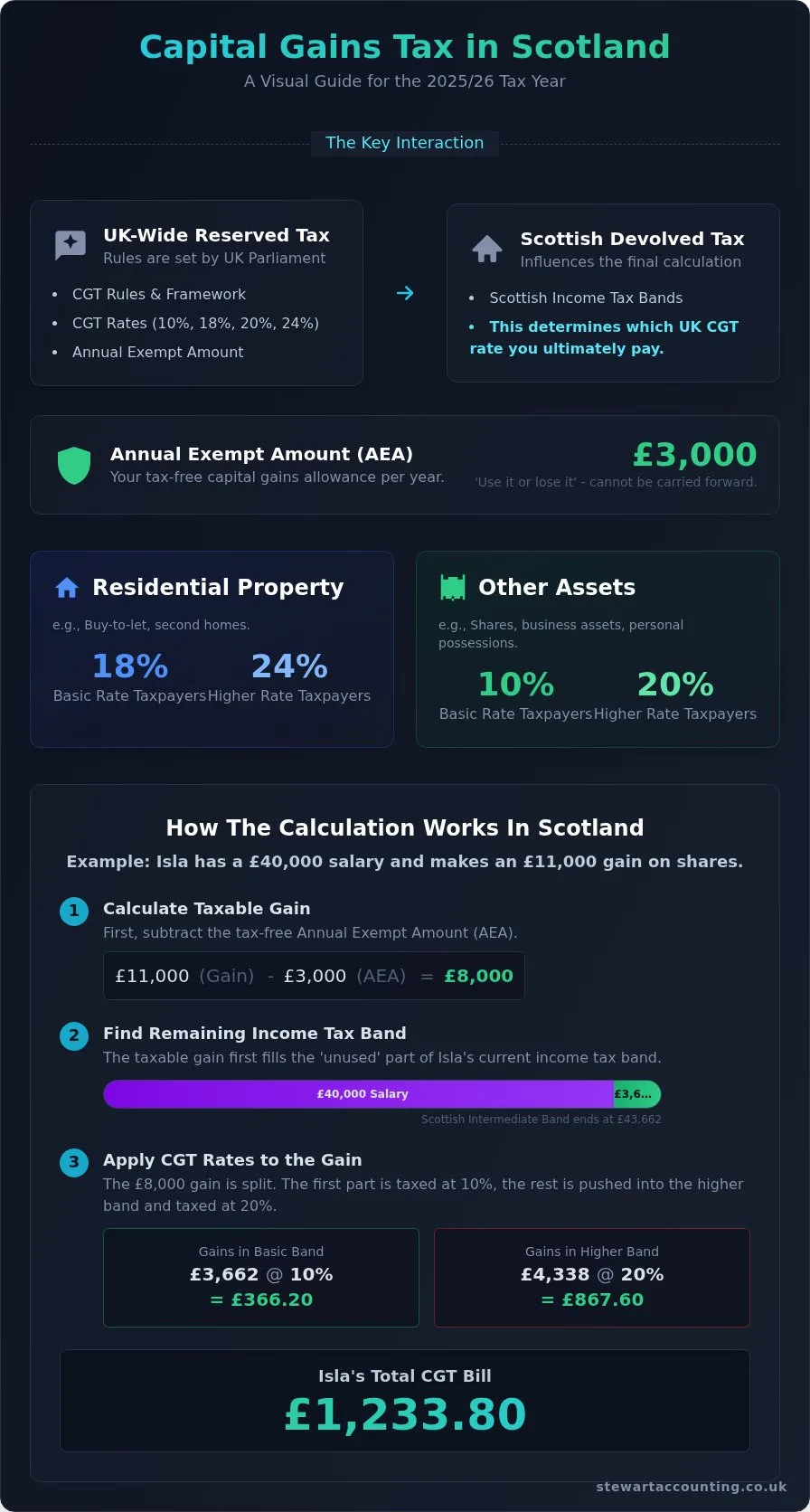
The short answer is both yes and no. While the fundamental rules, allowances, and exemptions for Capital Gains Tax (CGT) are the same across the whole of the United Kingdom, the amount of tax you actually pay can be different if you are a Scottish taxpayer. This might sound complicated, but the reason is surprisingly straightforward and comes down to the unique interaction between UK-wide and devolved Scottish taxes.
The key takeaway is that while the core CGT framework is identical, your personal circumstances as a Scottish taxpayer directly influence the final calculation. We’ll help you understand exactly how this works.
Understanding the UK Reserved Tax System
The UK operates on a system of devolved and reserved powers. Certain taxes are ‘reserved’ for the UK Parliament to set and collect, ensuring consistency nationwide. Capital Gains Tax in the UK is a reserved matter, meaning the rates and annual exemption allowance are set by the UK government for everyone. This is why you report and pay any CGT liability directly to HMRC, not to Revenue Scotland. In contrast, Scottish Income Tax is ‘devolved’, giving the Scottish Parliament the power to set its own rates and bands.
How Scottish Income Tax Bands Impact Your CGT Rate
This is where the key difference lies for Scottish residents. Your CGT rate is determined by your Income Tax band. To calculate your CGT, you add your taxable capital gains to your total taxable income for the year. If this combined total falls within your basic rate Income Tax band, you pay the lower rate of CGT on that portion of the gain. Any part of the gain that pushes you into a higher rate band is taxed at the higher CGT rate.
Because the Scottish Income Tax bands and thresholds are different from the rest of the UK, the calculation for capital gains tax in Scotland can produce a different result. The amount of your basic rate band that is ‘unused’ and available to apply to your capital gains may be larger or smaller than it would be for a taxpayer in England. Understanding this interaction is the most important step in correctly calculating your liability and ensuring you don’t overpay.
CGT Rates and Allowances for Scottish Residents (2025/26)
Understanding the rates and allowances is the first step to calculating your potential Capital Gains Tax (CGT) bill. While Income Tax rates are devolved to the Scottish Parliament, CGT remains a UK-wide tax. However, your Scottish Income Tax band plays a crucial role in determining which CGT rate you’ll pay. Let’s break down the key figures you need to know.
The Annual Exempt Amount: Your Tax-Free Allowance
Every individual in the UK, including Scotland, has a Capital Gains Tax Annual Exempt Amount (AEA). For the 2024/25 tax year, this allowance is £3,000. This is the amount of profit you can make from selling assets in a tax year before any tax is due. It’s important to remember this is a ‘use it or lose it’ allowance; you cannot carry any unused portion forward to a future tax year.
Residential Property vs. Other Assets
HMRC applies different CGT rates depending on the type of asset you have sold. Gains from selling a residential property that is not your main home (e.g., a buy-to-let property or a second home) are taxed at higher rates than gains from other assets like shares, business assets, or personal possessions.
The table below outlines the rates, which are determined by your total taxable income. You can find the most up-to-date figures by checking the official CGT rates and allowances on the GOV.UK website. For CGT purposes, ‘residential property’ includes land with a dwelling on it, rights over such land, and properties that are in the process of being built or adapted for use as a dwelling.
| Asset Type | CGT Rate (Basic Rate Taxpayers) | CGT Rate (Higher/Additional Rate Taxpayers) |
|---|---|---|
| Gains on Residential Property | 18% | 24% |
| Gains on Other Assets (e.g., shares, business assets) | 10% | 20% |
Calculating Your CGT: A Worked Example for Scotland
The interaction with Scottish Income Tax bands is what makes calculating capital gains tax in scotland unique. Let’s see how it works:
- Scenario: Isla lives in Scotland and has a salary of £40,000. She sells some shares and makes a capital gain of £11,000.
- Step 1: Taxable Gain. Isla deducts her Annual Exempt Amount: £11,000 (gain) – £3,000 (AEA) = £8,000 taxable gain.
- Step 2: Remaining Income Tax Band. The Scottish Intermediate Income Tax band for 2024/25 ends at £43,662. Isla has £3,662 (£43,662 – £40,000) of this band remaining.
- Step 3: Apply CGT Rates.
- The first £3,662 of her gain is taxed at the basic rate for ‘other assets’: £3,662 @ 10% = £366.20.
- The remaining £4,338 (£8,000 – £3,662) is pushed into the higher rate band and is taxed at 20%: £4,338 @ 20% = £867.60.
- Total CGT Bill: Isla’s total CGT liability is £366.20 + £867.60 = £1,233.80.
As this example shows, accurately calculating your liability requires a clear understanding of both your income and your capital gains. If you’re unsure, getting professional advice can save you time, money, and stress.
Common Scenarios: When You Might Pay CGT in Scotland
The rules around Capital Gains Tax (CGT) can often feel abstract. To make things clearer, let’s walk through some common, real-world situations where you might encounter capital gains tax in scotland. Understanding these scenarios helps you plan ahead and ensures there are no unwelcome surprises when you dispose of an asset.
Selling a Second Home or Buy-to-Let Property
Many Scots own a second property, perhaps a holiday home in the Highlands or a rental flat in Edinburgh. If you sell a property that is not your main residence and make a profit, that gain is likely subject to CGT. Your main home is typically exempt from this tax due to a relief known as Private Residence Relief (PRR). It’s also important not to confuse CGT, which the seller pays on the profit, with Land and Buildings Transaction Tax (LBTT), a separate tax paid by the buyer in Scotland.
Disposing of Shares and Investments
If you sell assets like shares in a company-whether it’s Apple or a Scottish investment trust-and your total gains for the tax year are above your annual allowance, you will need to pay CGT. To manage your investments efficiently, understanding the official Capital Gains Tax rules and allowances is crucial, especially regarding anti-avoidance rules like ‘bed and breakfasting’ (selling and buying back the same shares within 30 days). The good news is that any gains made on investments held within an ISA or a pension are completely tax-free.
Selling a Business or Business Assets
For many entrepreneurs, their business is their most valuable asset. When you decide to sell your Scottish limited company or dispose of assets from your sole trader business, the profit you make is a capital gain. This is a complex area where professional advice is vital, as reliefs such as Business Asset Disposal Relief (formerly Entrepreneurs’ Relief) can significantly lower your final tax bill by applying a reduced rate of CGT. Selling your business? Let our experts handle the tax complexities.
Key Reliefs to Legally Reduce Your CGT Bill in Scotland
Paying the right amount of tax is your legal duty, but paying more than you need to isn’t. Proactive tax planning is a legitimate and essential part of managing your finances effectively. Fortunately, HMRC provides several valuable reliefs designed to reduce your Capital Gains Tax (CGT) bill. These reliefs are available across the UK, and understanding how they apply to your assets is key to managing capital gains tax in scotland.
Here are some of the most common and impactful reliefs that can help you keep more of your hard-earned money.
Business Asset Disposal Relief (BADR)
If you’re a business owner in Scotland, this is one of the most important reliefs to be aware of. When you sell all or part of your business, BADR allows you to pay a reduced CGT rate of just 10% on qualifying gains, up to a lifetime limit of £1 million. To qualify, you generally must have owned the business for at least two years leading up to the disposal date. This can result in a substantial tax saving compared to the standard CGT rates.
Private Residence Relief (PRR)
For most people, the most valuable asset they own is their home. The good news is that you usually don’t have to pay any CGT when you sell your main residence, thanks to Private Residence Relief. The relief also covers periods where you were absent from the property for specific reasons, such as working abroad. If you have ever rented out part of your home, you may also be able to claim Lettings Relief to reduce the taxable portion of your gain.
Other Important Reliefs and Strategies
Beyond the main reliefs, there are other effective strategies that can help minimise your CGT liability. It’s always best to plan these in advance of any disposal.
- Transfers between spouses/civil partners: You can transfer assets to your spouse or civil partner without triggering a CGT charge. This is known as a ‘no gain, no loss’ transfer and can be a very useful planning tool.
- Using capital losses: If you make a loss on the disposal of an asset, you can deduct that loss from any capital gains you’ve made in the same tax year. Unused losses can even be carried forward to offset gains in future years.
- Gifting assets: While gifting an asset to someone other than a spouse is often treated as a disposal at market value for CGT, specific reliefs like Gift Hold-Over Relief can defer the tax charge, particularly for business assets.
Navigating these rules can feel complicated, but getting it right can save you thousands. If you need help structuring a sale or want to ensure you’re making the most of every available relief, the team at Stewart Accounting is here to take the stress off your hands.
How to Report and Pay Capital Gains Tax from Scotland
Understanding your obligations for reporting and paying Capital Gains Tax is crucial to avoid costly penalties. Although you live in Scotland, it’s important to remember that all CGT matters are handled by the UK government’s tax authority, HMRC, not Revenue Scotland. The process depends on the type of asset you have sold.
Reporting Property Sales to HMRC
If you’ve sold a residential property in the UK that results in a CGT liability, you must adhere to a strict deadline. You are required to report the gain and pay any tax owed within 60 days of the completion date. This is done through HMRC’s online ‘Capital Gains Tax on UK property’ service, which requires a Government Gateway account. This is a separate process from your annual tax return and must be completed in real-time.
Using the Self Assessment Tax Return
For gains made on other assets, such as shares, business assets, or personal possessions, you typically report them on your annual Self Assessment tax return. If you don’t already file a tax return, you will need to register for Self Assessment by 5th October following the tax year in which you made the gain. The deadline for filing your return online and paying the tax due is 31st January of the following year.
Why Use an Accountant for CGT?
Navigating the rules for capital gains tax in scotland can be complex, and mistakes can be expensive. Working with a qualified accountant ensures everything is handled correctly, giving you complete peace of mind. We take the complexity off your hands so you can be confident that you are:
- Accurate: Ensuring your calculations are correct and submitted on time.
- Efficient: Identifying and applying all eligible reliefs to minimise your tax bill.
- Stress-free: We manage the deadlines and paperwork, saving you time and worry.
Don’t leave it to chance. Get expert help with your Capital Gains Tax return today.
Take Control of Your Capital Gains Tax Obligations
Navigating the rules for capital gains tax in scotland can feel complex, but it doesn’t have to be a source of stress. The key is understanding that while CGT is a UK tax, your Scottish Income Tax band directly impacts your rate. Furthermore, strategically using the available allowances and reliefs is essential for legally minimising what you owe and avoiding costly mistakes.
Instead of trying to piece it all together yourself, let our team of Fully Qualified Chartered Accountants provide the clarity you need. With deep expertise in Scottish tax nuances and local offices in Alloa, Stirling, and Falkirk, we specialise in taking the complexity off your hands so you can focus on what matters most.
Achieve peace of mind and ensure you’re not paying a penny more than necessary. Take the stress out of tax. Contact our Scottish accountants for a free consultation.
Frequently Asked Questions about Capital Gains Tax
Is Capital Gains Tax different in Scotland than in England?
This is a common point of confusion. Unlike Income Tax, which has different rates and bands in Scotland, Capital Gains Tax (CGT) is a UK-wide tax. This means the rates, rules, and annual exempt amount are set by the UK Government in Westminster. Therefore, the regulations for capital gains tax in Scotland are exactly the same as they are in England, Wales, and Northern Ireland. We can help you navigate these UK-wide rules from our offices in Central Scotland.
Do I have to pay Capital Gains Tax on my main home in Scotland?
In most cases, you will not have to pay CGT when you sell your main home. This is thanks to a relief called Private Residence Relief (PRR). However, you might have a partial CGT liability if you have let out part of your home, used part of it exclusively for business purposes, or if you have owned it for a period while it wasn’t your main residence. It’s important to get professional advice if your situation isn’t straightforward.
How does Inheritance Tax interact with Capital Gains Tax in Scotland?
When an individual inherits an asset, there is no Capital Gains Tax to pay at that point. Instead, the asset’s value is ‘re-based’ to its market value at the date of death for CGT purposes. The estate itself may be liable for Inheritance Tax. If the beneficiary later sells the asset, CGT will be calculated on the gain from the date of inheritance, not the original purchase date. This interaction can be complex, and we can assist in planning for both taxes.
What happens if I make a capital loss on an asset in Scotland?
Making a capital loss isn’t ideal, but it can be used to reduce your tax bill. You can offset a capital loss against any capital gains you’ve made in the same tax year. This reduces your total taxable gain, potentially lowering the amount of CGT you owe. If your losses are greater than your gains, you can carry forward the unused losses to offset gains in future tax years. Reporting these losses to HMRC is crucial to be able to use them.
Can I transfer an asset to my children to avoid CGT in Scotland?
Simply gifting an asset to your children, or any ‘connected person’, does not automatically avoid a CGT charge. For tax purposes, HMRC treats this transfer as a disposal at the asset’s market value at the time of the gift. This means you could still face a CGT bill on the ‘deemed’ gain, even though no money has changed hands. There are specific reliefs that may apply, so seeking professional advice before making any transfer is highly recommended.
Who do I pay my Capital Gains Tax to if I live in Scotland?
As Capital Gains Tax is a reserved UK tax, any liability is paid directly to HM Revenue & Customs (HMRC), not to the Scottish Government or Revenue Scotland. You report and pay CGT through your Self Assessment tax return or, for UK residential property, through HMRC’s specific online service within 60 days of the sale. We can take care of these filings for you, ensuring everything is reported correctly and on time, taking the worry off your hands.
Do I need a separate accountant in Scotland to handle my CGT?
Any qualified UK accountant or tax advisor can handle your Capital Gains Tax affairs, regardless of where you live. However, working with a local, Scottish-based firm like ours means you have a partner who understands the complete financial landscape you operate in. We provide a tailored, supportive service that considers all your circumstances, helping you manage your UK-wide tax obligations efficiently and with less stress, right from our offices in Alloa, Stirling, and Falkirk.
Recent Posts
12 Oct, 2026
12 Oct, 2026
10 Oct, 2026