

The Difference Between Ltd and Plc A UK Business Guide

For any UK business owner, getting to grips with the difference between an Ltd and a Plc isn't just a box-ticking exercise—it’s a fundamental strategic decision. The choice you make will shape your company's future. At its heart, the distinction comes down to how you raise money and who can own a piece of your business. A Private Limited Company (Ltd) keeps its shares within a closed circle, while a Public Limited Company (Plc) can offer its shares to the wider public on a stock exchange.
Choosing Your Business Structure: Ltd vs Plc Explained

Settling on the right legal structure is one of the first, and most important, decisions you'll make. It’s a choice that ripples through everything—from your tax bill and personal liability to your fundraising potential and the sheer amount of paperwork you'll face. In the UK, the two most common incorporated options are the Private Limited Company (Ltd) and the Public Limited Company (Plc).
On the surface, it seems straightforward: one's private, the other's public. But the real-world implications of that single difference are enormous. The Ltd structure is tailor-made for small to medium-sized enterprises (SMEs). It gives you the protection of limited liability while keeping control firmly in the hands of a small group of shareholders—often the founders themselves.
A Plc, on the other hand, is built for a completely different scale. It's designed for massive operations that need to raise serious capital by selling shares to the public. That access to funding, however, comes at a cost: a much heavier burden of regulatory oversight, public transparency, and compliance.
Ltd vs Plc At a Glance: Key Differences
To put things in perspective, let's break down the most critical distinctions between these two structures. This table gives you a quick, high-level overview.
| Feature | Private Limited Company (Ltd) | Public Limited Company (Plc) |
|---|---|---|
| Share Trading | Shares are sold and transferred privately. | Shares can be offered to the general public on a stock exchange. |
| Company Name | Must end in "Limited" or "Ltd". | Must end in "Public Limited Company" or "Plc". |
| Minimum Directors | Minimum of one director is required. | Minimum of two directors are required. |
| Company Secretary | Optional, but often recommended. | A qualified Company Secretary is mandatory. |
| Minimum Share Capital | No minimum share capital requirement. | Minimum of £50,000, with at least 25% paid up. |
As you can see, the choice is far from just an administrative detail; it sets the entire trajectory for your company's growth and governance. It’s no surprise that the vast majority of UK businesses are registered as Ltd companies, favouring their flexibility and lower administrative load.
Choosing an Ltd structure is the default, practical path for over 99% of UK entrepreneurs. It provides the ideal balance of liability protection and operational simplicity needed to establish and grow a business without the intense regulatory pressures faced by a Plc.
The official numbers tell the same story. At the end of the 2025 financial year, private limited companies numbered over 5.2 million, making up a staggering 92.6% of all corporate bodies on the UK Companies Register. This sheer volume confirms why SMEs almost universally opt for the Ltd status, valuing its contained risk and manageable compliance. You can explore more insights on UK company formations and their resilience at e-accounts.co.uk.
Now, let's dive deeper into what these differences really mean for your business.
Comparing Formation and Ownership Structures

The moment you decide to set up a company, you’re laying the groundwork for its entire future. It’s right here, at the very beginning, that the paths of a Private Limited Company (Ltd) and a Public Limited Company (Plc) diverge sharply. The rules around capital, leadership, and ownership are fundamentally different, shaping who can start the business and how it will be structured from day one.
For most entrepreneurs, freelancers, and small business owners in the UK, the Ltd company is the natural first choice. Why? Because it’s built for accessibility. The process is designed to be quick and simple, allowing a business to become a separate legal entity without facing a mountain of upfront complexity or cost.
Share Capital: A Tale of Two Minimums
One of the clearest dividing lines is the amount of money you need to get started. A Private Limited Company is incredibly flexible—it has no minimum share capital requirement. In practice, you could form an Ltd with a single share worth just £1. This makes it the ideal structure for startups and SMEs who need the protection of limited liability but don’t have, or need, a huge pot of initial capital.
A Public Limited Company, on the other hand, operates in a different league entirely and must meet a hefty statutory minimum before it can even think about trading.
- Minimum Capital for a Plc: The company must have an allotted share capital of at least £50,000.
- Paid-Up Requirement: Before getting a trading certificate from Companies House, a Plc must prove that at least 25% of this amount (£12,500), plus any share premium, has been paid up.
This significant financial barrier immediately positions the Plc as a vehicle for larger, well-established businesses with serious financial backing. It’s a safeguard, really, ensuring the company is on solid financial footing before it can invite the public to invest. Getting to grips with these financial foundations is crucial, and you can explore our detailed breakdown of limited companies' share capital to understand the full implications.
The £50,000 minimum share capital for a Plc isn't just a number—it’s a clear signal to the market, regulators, and potential investors that the company operates at a scale that warrants public trust and scrutiny. For an SME, this is a major financial leap.
Directors and Company Secretary Requirements
The required leadership structure also tells you a lot about the different levels of governance and administration involved. An Ltd company allows for a much leaner setup, which is perfect for a sole founder or a small founding team.
- Ltd Company: Needs only one director. Appointing a company secretary is optional, and since the Companies Act 2006 came into effect, most Ltds skip it to keep admin to a minimum.
- Plc Company: Must have at least two directors. It’s also legally required to appoint a qualified company secretary—someone with the specific knowledge and experience to handle the company’s much more complex statutory duties.
The mandatory, qualified company secretary for a Plc highlights the much heavier compliance burden these companies carry. Their responsibilities are extensive, covering everything from maintaining statutory registers to ensuring the company complies with corporate governance codes.
The rulebook for any company is its memorandum and articles of association, which essentially acts as its constitution. These documents lay out all the rules for directors, shareholders, and share capital, and as you might expect, they are far more detailed and restrictive for a Plc to reflect the stricter legal framework it operates within.
How Governance and Reporting Demands Differ
Once you're up and running, the real day-to-day differences between an Ltd and a Plc start to bite. This is where you feel the practical impact of your choice, particularly in the governance and annual reporting duties you'll need to manage. For a growing SME where time and resources are precious, the administrative load is a massive consideration, and the two structures are worlds apart. An Ltd is built for simplicity; a Plc operates under a constant public and regulatory spotlight.
For an Ltd, the compliance journey is pretty manageable. The core obligations to Companies House are filing your annual accounts and a confirmation statement. These simply provide a snapshot of your company’s financial position and confirm that its official details (like the registered office and director information) are correct. For most small businesses, this level of paperwork is entirely reasonable and lets them get on with growing the business.
A Plc, on the other hand, faces a much heavier compliance burden. Because it can sell shares to the public, it has a profound duty of transparency to its shareholders and the wider market. This isn't just about filing accounts once a year; it’s about constant, detailed disclosure.
Life Under the Public Microscope
The reporting requirements for a Plc are rigorous, and they're all designed to ensure total transparency. It's a huge departure from the privacy an Ltd director is used to.
Here are some of the key obligations a Plc must handle:
- Tighter Financial Reporting: Accounts have to be filed within six months of the financial year-end, which is a much stricter deadline than the nine months an Ltd gets. The audit is also usually far more intensive.
- Half-Yearly Updates: Listed Plcs must publish interim financial reports, keeping shareholders in the loop on performance throughout the year.
- Mandatory Annual General Meetings (AGMs): A Plc is legally required to hold an AGM every single year. This gives shareholders a formal platform to quiz the board of directors and vote on crucial company decisions.
Juggling these duties is a serious undertaking for any director. To get a handle on the foundational duties that apply to both company types, it’s a good idea to review the fundamental responsibilities of company directors.
Sticking to Corporate Governance Codes
For Plcs with a listing on the London Stock Exchange, the rules get even stricter. They are expected to follow the UK Corporate Governance Code, which sets out best practice principles for everything from board leadership and director pay to accountability and shareholder engagement.
While the code works on a 'comply or explain' basis, any decision not to follow its principles has to be publicly justified to shareholders. This adds yet another layer of public accountability. This entire framework is there to make sure the company is run responsibly and for the benefit of all its owners. For an SME director who is used to making quick, autonomous decisions, this highly structured and formal way of working is a major cultural shock.
The heart of the matter is a trade-off: public capital versus operational privacy. A Plc gains the power to raise huge sums of money from the public, but in return, it must give up the confidentiality that an Ltd takes for granted. Every significant decision and financial figure is laid bare for public inspection.
Ultimately, these governance and reporting rules reflect the very nature of each company type. An Ltd is a private affair, accountable to a small group of internal stakeholders, and its compliance burden is sized accordingly. A Plc is a public entity, accountable to the public, financial markets, and regulators. Its administrative machinery is built to withstand that intense level of scrutiny and maintain trust.
For any business owner thinking about making the jump from Ltd to Plc, getting ready for this surge in operational intensity is just as critical as raising the required share capital.
Analysing Fundraising Potential and Financial Strategy
When you get down to it, the way you plan to raise money is probably the biggest factor in the Ltd vs Plc decision. It really forces you to think about your long-term ambitions. Are you aiming for steady, controlled growth funded by a close circle of supporters, or are you gearing up for a massive expansion that needs serious capital from the public markets? Your answer will point you clearly towards one structure or the other.
A Private Limited Company (Ltd) operates in a closed-off, personal funding world. This means any money you raise comes from private sources, giving you, as the director, tight control over who gets a piece of the pie. It’s a great setup for most SMEs who want to grow at their own pace without the constant pressure from external market forces.
Private Funding for Ltd Companies
For an Ltd, the fundraising landscape is all about private relationships. You get to be picky about who you partner with, which means you can maintain a firm grip on the company's direction and culture.
The most common routes for private funding include:
- Angel Investors: These are usually successful entrepreneurs or high-net-worth individuals who invest their own money. They often provide not just cash but invaluable advice and contacts in exchange for an equity stake.
- Venture Capital (VC): Think of VCs as institutional investors looking for the next big thing. They offer much larger sums than angel investors but expect rapid growth and have a clear exit strategy in mind from day one.
- Bank Loans and Overdrafts: This is your traditional debt financing. You borrow from a bank, keep 100% of your company, but you'll have to make regular repayments with interest.
- Director's Loans: A straightforward way to inject cash is for the founders or existing directors to lend personal funds to the business. It’s quick, flexible, and keeps things internal.
Getting this kind of backing is a huge milestone. Your ability to sell your vision can make or break a deal, so learning how to effectively pitch to investors is a skill every founder needs to hone. If you’re exploring your options, our guide on the different ways you can raise funding for your business is a great place to start.
The real beauty of the private funding route for an SME is control. You hand-pick your investors, hash out terms directly, and build a base of shareholders who are genuinely invested in your long-term vision, not just the next quarterly report.
Public Capital for Plc Companies
So why would a successful Ltd ever go through the hassle of becoming a Plc? The answer is almost always to unlock the public capital markets via an Initial Public Offering (IPO). This means listing your company on a stock exchange—like the London Stock Exchange—and selling shares to the general public.
An IPO can bring in vast sums of money, far more than you could ever hope to raise privately. This kind of capital can fuel game-changing moves like buying out a major competitor, expanding across continents, or funding groundbreaking R&D. But this power comes at a steep price. The IPO process itself is incredibly expensive and demanding, and once you're public, your every move is scrutinised by the market. The pressure to deliver short-term results for shareholders can be intense.
What’s more, issuing new shares to the public inevitably means shareholder dilution. The ownership percentage of the original founders and early investors shrinks. While the value of their shares might rocket, their influence and control diminish. It's a massive cultural shift, moving from a small, tight-knit team to a sprawling, anonymous base of shareholders.
The table below gives a quick snapshot of how the funding options stack up.
Fundraising Options Ltd vs Plc
| Funding Method | Available to Ltd? | Available to Plc? | Key Considerations |
|---|---|---|---|
| Angel Investment | Yes | Yes (pre-IPO) | Private negotiation, often includes mentorship. |
| Venture Capital | Yes | Yes (pre-IPO) | Requires high growth potential and an exit plan. |
| Bank Loans | Yes | Yes | Retains ownership but creates debt obligations. |
| Initial Public Offering (IPO) | No | Yes | Raises substantial capital but is costly and complex. |
| Public Share Issues | No | Yes | Ongoing access to capital but dilutes ownership. |
Ultimately, your choice boils down to your ambition and how much complexity you’re willing to take on. An Ltd offers a controlled, strategic path to funding that’s perfect for the vast majority of UK businesses. A Plc, on the other hand, offers a shot at unparalleled financial firepower, but it demands a level of transparency and public accountability that completely transforms how a company is run.
Making the Right Choice for Your Business Stage
Deciding between a Private Limited Company (Ltd) and a Public Limited Company (Plc) isn't just a legal formality. It’s a crucial strategic move that needs to align with where your business is today and where you plan to take it tomorrow.
For the vast majority of businesses in the UK, the journey starts—and often stays—as an Ltd. It’s the go-to structure for good reason. It hits the sweet spot, offering the protection of limited liability without burying you in complex compliance. This makes it perfect for startups, contractors, and established SMEs who are focused on steady, manageable growth. The administrative side is straightforward, and control stays exactly where you want it: with the founders or a small group of shareholders.
When the Ltd Structure Is Your Best Fit
So, how do you know if an Ltd is right for you? It almost certainly is if you want to shield your personal assets from business risks while keeping a firm grip on the company's direction.
You're probably a perfect fit for an Ltd if you are:
- A startup founder gearing up for a first round of private funding from angel investors or venture capitalists.
- A successful sole trader or contractor who's ready to incorporate for better tax efficiency and legal protection.
- A family-run business with a plan to pass ownership down through the generations, keeping it private.
- An SME prioritising organic growth by reinvesting profits to build a stable, long-term venture.
For businesses in these situations, the enormous cost and complexity of becoming a Plc simply don't make sense. The focus is on building a strong, profitable company, not preparing for an initial public offering (IPO).
An Ltd isn't just a legal wrapper; it's a strategic tool for a growing SME. It gives you the legal shield to take calculated risks and the agility to adapt quickly, all while keeping your financial and operational business private.
Identifying the Triggers for a Plc Conversion
When does the conversation ever shift towards becoming a Plc? It’s rarely part of the initial business plan. It’s a deliberate, high-stakes pivot, usually driven by the need for a huge injection of capital that the private markets just can't provide. A highly successful Ltd might only consider this monumental step when it hits a growth ceiling that only public money can smash through.
This flowchart boils the decision down to its core: your funding ambition.
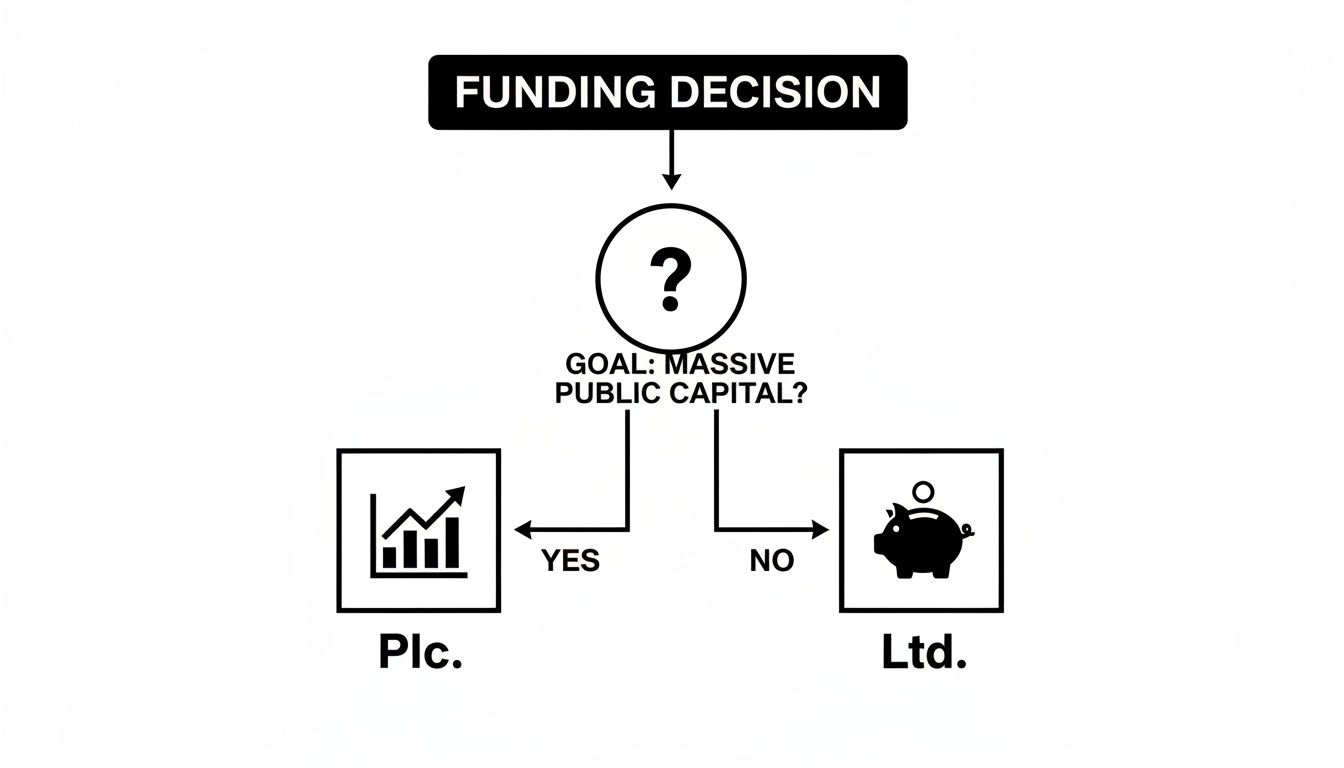
As you can see, the main road to becoming a Plc is paved with the ambition to raise capital on public stock markets.
The key triggers that would force this kind of change are significant. We're talking about situations like:
- Global Expansion: You need hundreds of millions of pounds to set up shop in several international markets at once.
- Major Acquisitions: You're planning to buy out a large competitor, requiring funds far beyond what banks or private equity can offer.
- Large-Scale Infrastructure Projects: You need to finance massive investment in new factories, proprietary technology, or groundbreaking R&D.
Moving from an Ltd to a Plc isn't just a change of letters; it’s a total transformation. It fundamentally alters the company’s culture, governance, and its relationship with its owners. This is a path for the tiny fraction of businesses that have already scaled up and now need truly colossal financial resources to evolve.
Getting the Right Professional Advice for Your Company Structure
Choosing your company structure isn't just a box-ticking exercise. It's a critical decision that will shape your company's obligations, potential, and future. Getting your head around the crucial difference between an Ltd and a Plc requires serious thought, and this is where getting some proper guidance really pays off. Expert support makes sure your business is built on solid legal and financial ground from the very beginning.
A good accountant is more than just a number-cruncher. Think of them as a strategic partner who helps you map out your long-term ambitions. They'll help you weigh up whether the privacy and flexibility of an Ltd suits you better, or if the powerful fundraising capability of a Plc is what you need to achieve your goals. This kind of early advice helps you sidestep expensive errors down the line and sets you on a clear path for growth.
Making Sense of the Complexity
Whether you’re running a well-established Ltd or have your sights set on becoming a Plc, the compliance burden is real and unforgiving. A missed Companies House deadline or a simple mistake on a tax return can result in hefty penalties and a world of stress you just don't need.
This is where professional accountancy services act as a vital safety net, handling these essential tasks with the precision they require.
- Getting Set Up Correctly: We ensure your company is registered properly from day one, with the right share structure and articles of association in place.
- Managing Your Statutory Accounts: We’ll prepare and file accurate year-end accounts that tick every legal box, whether you're an Ltd or a Plc.
- Handling All the Red Tape: We manage all the necessary filings and communications with HMRC and Companies House, so you can rest easy knowing you’re fully compliant.
- Planning for the Future: We offer practical, forward-looking advice on everything from cash flow and tax efficiency to growth strategies that fit your specific company structure.
When you work with a skilled accountant, compliance stops being a headache and simply becomes a smooth, background process. It frees you up to pour your energy into what you’re best at—running and growing your business—confident that all the administrative details are in expert hands.
Ultimately, getting professional help is about minimising risk and giving you peace of mind. For an Ltd owner, that means efficient, stress-free compliance and strategic advice to fuel steady growth. For a business thinking about the leap to a Plc, it means having an expert guide to navigate the much tougher regulatory world you’re about to enter.
By bringing in professional support, you reclaim your valuable time and lighten the mental load of staying compliant. This partnership ensures that whichever structure you choose, your business is protected, compliant, and ready to chase its long-term ambitions. If you’re unsure which way to go, a personalised consultation is the best way to secure your company's future.
Frequently Asked Questions About Ltd vs Plc Companies
When you're trying to figure out the right company structure, a few common questions always seem to pop up. Let's tackle some of the most frequent queries we hear from business owners weighing up the differences between a Private Limited Company (Ltd) and a Public Limited Company (Plc).
Can an Ltd Company Have More Than One Shareholder?
Yes, it certainly can. An Ltd company only needs a single shareholder to get started, but there’s actually no upper limit on the number you can have.
The crucial difference, however, lies in how those shares are handled. They can't be sold to the general public on a stock exchange. Instead, shares are transferred privately, following the specific rules laid out in your company's articles of association.
Is It Expensive to Change From an Ltd to a Plc?
In a word, yes. Making the leap to a Plc, especially if you're planning an Initial Public Offering (IPO), is a serious financial undertaking. The costs go well beyond a simple re-registration fee.
You’ll need to budget for a whole range of expenses:
- Legal fees for the complex re-registration process and drafting the prospectus.
- Underwriting fees if you're issuing shares to the public.
- Marketing and PR to build interest in the share offering.
- Higher ongoing costs for auditing, compliance, and more detailed reporting.
It’s a major strategic decision that demands meticulous planning and a substantial budget.
Do Ltd Companies Need a Company Secretary?
No, not anymore. It’s no longer a legal requirement for a private limited company in the UK to have a company secretary. Many smaller Ltd companies decide against it to keep their administrative load a little lighter.
On the other hand, a Plc must appoint a suitably qualified company secretary. It's not optional. That said, many larger Ltd companies still choose to have one to ensure their compliance and administrative duties are managed professionally.
Which Structure Gives Better Protection for My Personal Assets?
This is a great question, but the answer is that both offer the exact same core benefit: limited liability. This is one of the biggest advantages of incorporating in the first place.
Limited liability means the company is a distinct legal entity, separate from you. So, your personal assets—like your house or savings—are shielded if the business runs into debt or faces legal action. The level of this protection is identical whether you’re an Ltd or a Plc.
Deciding on the right company structure can feel overwhelming, but you don't have to figure it out on your own. At Stewart Accounting Services, we provide expert, practical advice to make sure your business is set up for success from day one. To chat about the best path forward for your company, get in touch with us at Stewart Accounting Services.