

How long does vat registration take? A Fast UK Guide

So, you’re ready to register for VAT and the big question on your mind is: how long is this going to take?
The short answer from HMRC is that a standard online application usually takes about 10 to 14 working days. But, and it's a big but, that's the best-case scenario. The reality can be quite different depending on the specifics of your business.
The Official Timeline for UK VAT Registration
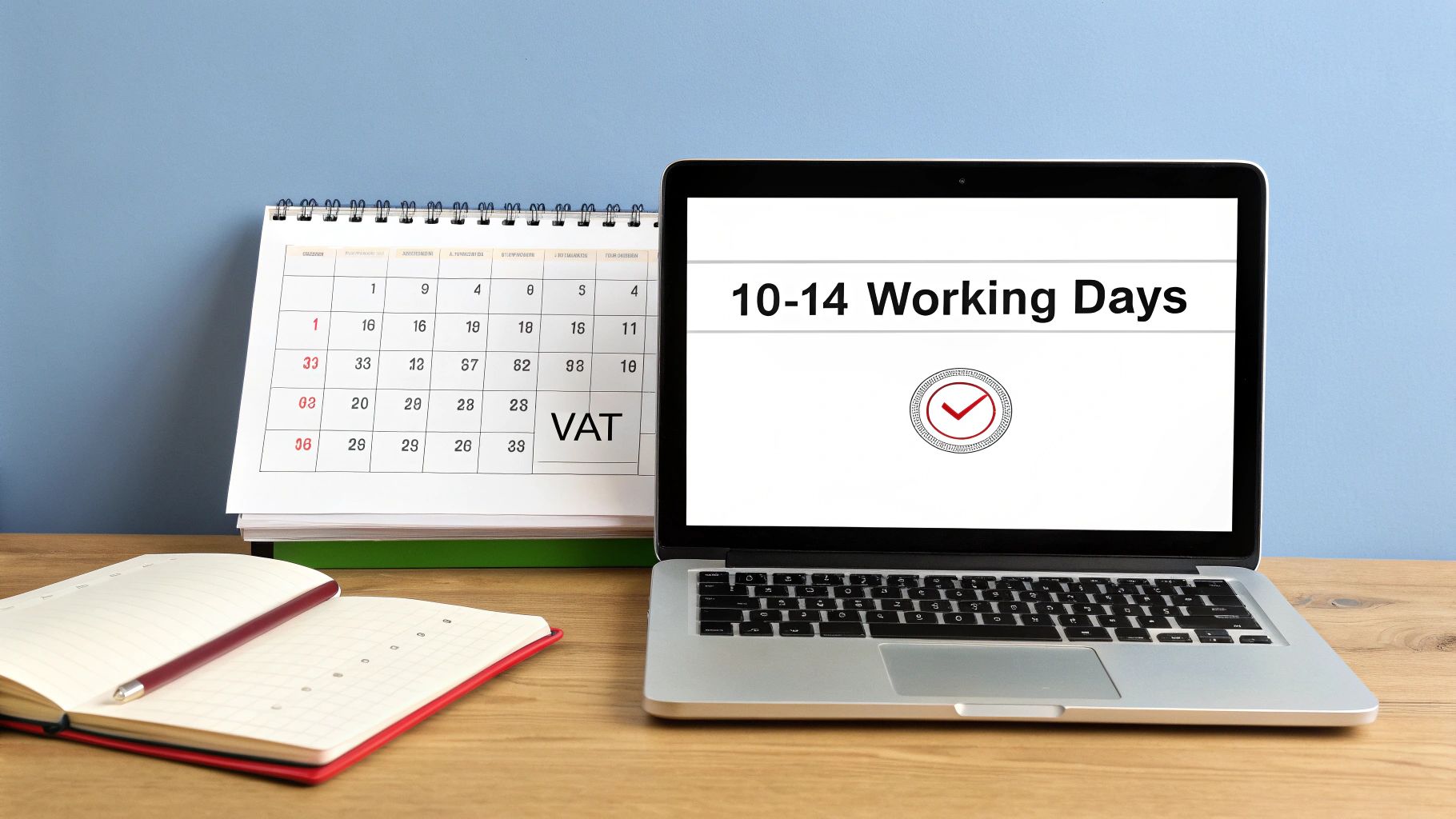
Think of it like getting through airport security. If you’ve packed everything perfectly and have all your documents ready, you'll likely fly through. If you’ve got something unusual in your bag or your paperwork is a mess, you’re getting pulled aside for a much closer look. It’s the same with VAT registration.
HMRC’s own figures show that around 70% of applications get through within that speedy two-week window. These are typically straightforward, UK-based businesses that have submitted everything correctly through the Government Gateway portal from the get-go.
VAT Registration Timelines at a Glance
For businesses here in Central Scotland, from Alloa to Stirling, knowing what to expect can make a real difference to your planning. Getting it right means you can start charging VAT and managing your returns without any unexpected delays.
To give you a clearer picture, we've put together a table summarising the typical waiting times. It's a useful starting point, and if you want more detail, you can also check when you can expect a reply from HMRC.
| Application Scenario | Typical Waiting Time | Potential Delays Up To |
|---|---|---|
| Standard Online Application (UK Resident) | 10-14 working days | 30 working days |
| Voluntary Registration (Online) | 10-14 working days | 30 working days |
| Application Requiring Manual Review | 30+ working days | 8 weeks or more |
| Complex Cases (e.g., TOGC, Non-UK) | 4-8 weeks | 12 weeks or more |
As you can see, anything that deviates from a simple, standard application can push your wait time from a couple of weeks to a few months.
The lesson here is simple: preparation is everything. Double-checking your details and making sure your application is crystal clear is the best way to stay in the fast lane and get your VAT number as quickly as possible.
Understanding What Slows Down Your Application
Ever wondered why one business gets its VAT number in a couple of weeks, while another is left hanging for over a month? It's not just luck of the draw. The reasons are nearly always found in the small details of the application itself.
Think of it like this: HMRC has two processing lanes. There's an express lane for straightforward, squeaky-clean online applications that fly through the automated checks. Then there's the slow lane for anything that needs a real person to step in and review it manually. Getting diverted to that slow lane is what adds weeks to your wait time.
Application Method And Quality
The first big fork in the road is how you apply. Submitting your application digitally through the Government Gateway is by far the quickest route. Paper forms, which are now only for very specific circumstances, are slow by nature and can add weeks to the process just from the physical handling and data entry involved.
But it’s not just about online versus paper. The quality of the information you provide is absolutely critical. In my experience, the number one reason an application gets flagged is vague or incomplete details. For instance, describing your business activity simply as "consulting" is too generic for HMRC. A much better description would be "specialised IT security consulting for the UK financial services sector." That gives them the clarity they need.
An application with clear, precise, and verifiable information is an application that moves quickly. Any ambiguity forces a manual check, which is the single biggest cause of delays in the VAT registration process.
Your Business Structure And Complexity
The type of business you run also has a massive impact on the timeline. A UK-based sole trader with a simple business model will almost always have the fastest journey to approval. Their details are easy for HMRC to verify, and their tax affairs are usually pretty straightforward.
On the other hand, more complex business structures demand more detailed checks, which naturally takes longer. If you need a refresher on the basics, our guide on understanding the VAT registration limit in the UK is a great place to start.
Certain business types are almost guaranteed to get a closer look from HMRC:
- Limited Companies: HMRC will immediately check your details against the Companies House register. Any tiny mismatch in addresses, director names, or company numbers will bring everything to a grinding halt.
- Partnerships: The details for every single partner must be completely accurate and consistent across the board.
- Businesses with International Links: If you trade overseas, import goods, or have directors who aren't UK residents, you can expect a more thorough review of your application.
- Special Cases: Things like a Transfer of a Going Concern (TOGC) or applying for a group VAT registration are inherently complex and will always take longer than a standard application.
By getting ahead of these potential roadblocks, you can put together a much stronger application from day one, giving yourself the best possible chance of staying in that express lane.
How to Avoid Common VAT Registration Delays
Let's be frank: many businesses accidentally trip themselves up during the VAT application process. What should be a straightforward task can quickly turn into a frustrating waiting game. Knowing how long VAT registration takes often boils down to steering clear of a few common, yet critical, mistakes. This is your roadmap to avoiding the snags that get applications flagged for a manual review.
Think of your VAT application like a puzzle HMRC has to put together. If all the pieces are there and fit perfectly, it's solved in a flash. But if there are missing or mismatched pieces, someone has to step in and investigate, and that's when the delays really begin.
Mismatched Company Details
The single biggest reason for delays is surprisingly simple: inconsistency. When you apply for VAT as a limited company, the very first thing HMRC does is check your details against the records at Companies House.
- The Problem: Your application might list your day-to-day trading address, but your official registered office at Companies House is your accountant’s address. Or perhaps a director's name has a minor spelling variation.
- The Solution: Before you even think about starting the application, do a quick internal audit. Check your Companies House record and your Government Gateway account. Your registered office, director details, and company name must be 100% identical everywhere. Even the smallest difference acts as a red flag.
Vague Descriptions of Your Business
Another classic delay trigger is a vague description of what your business actually does. HMRC needs a clear picture of your activities to assess your case and make sure you're categorised correctly. A lazy, generic description just raises questions.
Your application is a conversation with HMRC. Vague answers invite more questions, while clear and detailed information provides the confidence they need to approve your registration swiftly.
For instance, simply writing "business services" is far too broad. Be specific. A much better description would be: "A provider of digital marketing services, including SEO and PPC campaigns, for UK-based retail businesses." This kind of clarity removes all doubt and helps keep your application on the fast track.
While most applications go smoothly, about 20-25% get held up, often stretching the wait beyond 40 or even 60 days. The culprits are usually these simple mistakes—like vague activity descriptions or mismatched details—which create a back-and-forth that kills your momentum. You can find more insights on VAT registration processing times in the UK from Creative Accountants.
Applying Too Far Ahead of Time
It might feel like good planning to apply for VAT registration long before you start trading, but this can actually work against you. HMRC needs to see that you have a genuine intention to make taxable sales in the near future. If you apply months before you're ready to trade, they may question whether your application is speculative.
The best time to apply is when you're genuinely close to making your first taxable sale, or when you have contracts, purchase orders, or draft invoices that prove your intent to trade. Getting these simple things right from the start is the most effective way to get your VAT registration approved without any needless and frustrating hold-ups.
Your Step-by-Step VAT Application Walkthrough
Navigating the VAT registration portal can feel a bit like putting together flat-pack furniture without the instructions. It looks simple enough on the surface, but one small mistake can bring the whole thing to a grinding halt. Let's break the process down into clear, manageable steps to get you from start to finish without any hiccups.
Think of it as your pre-flight checklist. Getting all your documents in order before you even log in will save you a world of frustration later. When everything is right there at your fingertips, you can get the application done in one go, which dramatically cuts down the risk of making a mistake.
Preparing for Your Application
Before you dive into the online form, there are a couple of housekeeping bits to sort out. Getting these done first lays the groundwork for a smooth application.
-
Set Up Your Government Gateway Account: This is your secure login for pretty much all government services, including VAT. If you haven't got one already, you’ll need to create one. It involves an identity check, so give yourself a bit of time to get it sorted.
-
Gather Your Essential Documents: You’ll need a specific list of details to fill out the form correctly. It’s best to have these ready to go:
- Your Unique Taxpayer Reference (UTR) for self-assessment.
- Your company registration number and the date of incorporation if you’re a limited company.
- Full details of all your business bank accounts.
- Information on any other businesses you’ve been associated with in the last two years.
- Your business turnover for the last 12 months and what you expect it to be over the next 12 months.
Completing the Online Form
Right, with all your paperwork gathered, you’re ready to tackle the application itself. The online portal will walk you through a series of questions about your business, what it does, and its finances.
Pay very close attention to the section on your business activity. As we’ve mentioned, being vague here is one of the biggest reasons for delays. Be specific and crystal clear about what your business actually does.
Another crucial part is your effective date of registration. This is the date from which you officially have to start accounting for VAT. You can usually pick a date up to four weeks in the future, which is handy for getting your invoicing software and pricing updated. Our guide on applying for a VAT number has a few more pointers on getting this spot on.
The online VAT form is logical, but it’s incredibly unforgiving. Every single detail you enter, from your UTR to your turnover figures, must be 100% accurate and match what HMRC already knows about you.
The image below shows some of the most common tripwires we see people fall over.
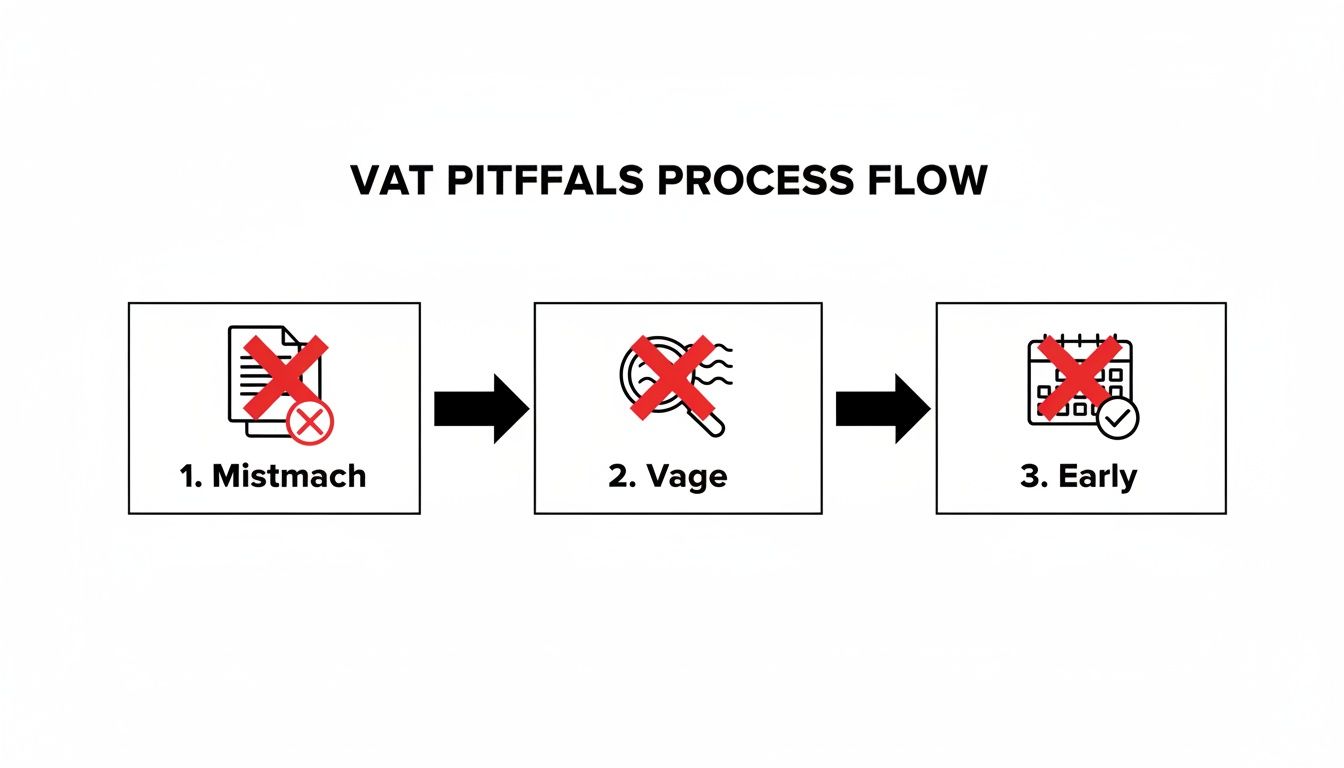
As you can see, it’s often simple errors that cause the biggest problems – things like mismatched company details, a woolly business description, or applying before you really need to. Once you've filled everything in, give it all one final read-through before you hit that submit button. That last check could be the difference between a two-week wait and a two-month headache.
Navigating Complex Cases and Special Scenarios
While most VAT registrations are fairly straightforward, some situations are naturally more complicated and will get a closer look from HMRC. If your business falls into one of these categories, the standard timeline flies out the window. These applications require a much deeper level of scrutiny, mainly to prevent fraud and ensure everything is above board.
Think of it like getting a standard driving licence versus one for a heavy goods vehicle (HGV). Both let you drive, but the HGV application involves more checks, extra paperwork, and a longer wait because the stakes are higher. In the same way, HMRC applies a more rigorous process to applications it considers higher risk or just plain complicated.
Overseas and E-commerce Businesses
One of the most common hold-ups involves businesses based outside the UK, especially e-commerce sellers using platforms like Amazon or eBay to sell to UK customers. If this is you, expect a manual review and extra questions – it’s almost a given. HMRC needs to be absolutely sure that your business has a legitimate trading presence in the UK and will handle its tax obligations correctly.
The landscape for this has really shifted since Brexit. A 2023 analysis showed that while UK-based applications might take 14-30 working days, non-UK businesses are now routinely sent follow-up questionnaires. This can easily push their registration time to 40 working days or more. HMRC will often ask for solid proof that you’re about to start trading, like supplier contracts or live marketplace listings, before they’ll approve the application. You can learn more about how VAT registration timelines have shifted for overseas businesses on Avalara.com.
Transfer of a Going Concern (TOGC)
Another tricky area is the Transfer of a Going Concern (TOGC). This is the official term for when you buy an existing business, assets and all, with the plan to carry on the same trade. When done correctly, the sale itself isn't subject to VAT, which is a massive benefit.
But the VAT registration side of things gets complicated.
If the business you're buying is already VAT registered and you aren't, you'll almost certainly need to register for VAT from the very day the transfer happens. This isn't optional; it's a compulsory registration, even if your turnover is well below the usual threshold.
Because a TOGC involves multiple parties and requires careful checking to make sure all the rules are followed, HMRC will always take longer to process these. Getting a single detail wrong won’t just delay your VAT number; it could make the entire business sale liable for VAT, landing you with a huge, unexpected tax bill. It’s in specialised cases like these that getting expert guidance really pays off.
So, your VAT number has finally landed. It’s a big milestone, but that certificate in your hand isn't the finish line—it's the starting pistol for your new tax responsibilities. What you do next is crucial for staying on the right side of HMRC.
The first thing to do is give that VAT registration certificate a proper once-over. This document isn’t just a confirmation; it’s your rulebook. You'll find your unique nine-digit VAT number, but the most important detail is your effective date of registration.
Understand Your Effective Date
This date is everything. It's the official moment your business becomes VAT-registered, and it’s the exact day you must start charging VAT on your taxable sales. Not a day before, and not a day after.
This means your pricing and invoicing need an immediate update. From this date forward, your invoices have to be proper VAT invoices, which come with a specific set of legal requirements.
A compliant VAT invoice is more than just a request for payment; it's a legal document. It has to clearly show your VAT number, the date of supply (the tax point), the net price, the VAT rate applied, and the total VAT amount. Getting this wrong can cause real headaches with HMRC.
Key Actions to Take Immediately
With your certificate in hand, it's time to get your house in order. Don't put this off—getting organised now will save you a world of pain later.
Here’s a practical checklist to work through right away:
- Update Your Invoicing System: First things first, get your new VAT number onto all your invoice templates. Make sure your software can correctly calculate and itemise VAT for everything you sell.
- Tell Your Customers: Give your regular clients a heads-up. Let them know you're now VAT registered and that VAT will be added to future invoices. A bit of clear communication goes a long way in preventing queries and delayed payments.
- Get Your Digital Records Straight: Remember, Making Tax Digital (MTD) rules mean you have to keep digital records of your sales and purchases. If you're not already using it, this is the perfect time to get set up with cloud accounting software like Xero or QuickBooks.
- Diarise Your First VAT Return: Your certificate will tell you when your first VAT period ends and the deadline for filing your return. Get that date in your calendar immediately. Missing it is not an option.
Finally, now is a great time to think about which VAT accounting scheme best suits your business. Things like the Cash Accounting Scheme or the Flat Rate Scheme can really simplify your bookkeeping, but they aren't right for everyone. This is the perfect moment to have a chat with your accountant to make sure you're set up in the most efficient way from the get-go.
Got Questions About Your VAT Registration? We've Got Answers
Waiting for your VAT number from HMRC can feel like being in limbo, and it almost always brings up a few pressing questions. Knowing how to handle this waiting period is crucial for keeping your business on the right track.
Let’s dive into the most common queries we get from business owners in your position.
Can I Charge VAT Before My Number Arrives?
This is the big one. The short answer is no, you cannot issue a proper VAT invoice until you have your VAT registration number. But here’s the tricky part: you're still responsible for the VAT from your effective date of registration.
So, how do you manage this? The best approach is to increase your prices to account for the VAT you'll need to pay. For now, show this as one inclusive price on your invoices. Just let your clients know that your VAT registration is pending and that a full VAT invoice will follow once your number is confirmed. As soon as it lands, you can reissue the invoices, properly breaking down the VAT. This allows your VAT-registered clients to reclaim the input tax they've paid.
Don't make the mistake of thinking the waiting period is a VAT-free holiday. You must account for VAT from your effective registration date. Start collecting that extra amount from day one, even if the paperwork has to catch up later.
What If My Application Is Taking Forever?
If you've been waiting longer than the typical 30 working days, it's definitely time to check in. Before you pick up the phone to HMRC, make sure you have your application acknowledgement reference number handy.
A little patience is needed, of course, but if weeks are turning into a month or more with complete radio silence, it could signal a problem. This is often when getting a professional involved can make all the difference. We can chase things up and get to the bottom of any hold-ups on your behalf.
Should I Register If I'm Below the Threshold?
Thinking about registering for VAT even if you don't have to? This is known as voluntary registration, and it can be a really smart move for some businesses.
Registering allows you to reclaim the VAT on your business expenses and purchases, which can lead to significant savings. It can also give your business a boost in credibility, as being VAT-registered often makes you appear more established to potential partners and clients.
Navigating the ins and outs of VAT is much simpler when you have an expert in your corner. The team at Stewart Accounting Services can manage your VAT registration from start to finish, making sure the process is smooth and that you're making the best strategic decisions for your business.
Let us handle the red tape so you can get back to what you do best. Find out more at https://stewartaccounting.co.uk.
Recent Posts
24 Aug, 2026
21 Aug, 2026
21 Aug, 2026