

vat registration limit uk: Your UK VAT threshold explained

Right now, the VAT registration limit in the UK is £90,000. This is the magic number for your taxable turnover in any rolling 12-month period. Once your business's turnover crosses this line, you are legally required to register for Value Added Tax (VAT) with HMRC.
What Is the UK VAT Registration Threshold?
Think of the UK VAT registration threshold as a financial tripwire. Once your business’s turnover hits it, a whole new set of tax responsibilities kicks in. It’s a critical figure every business owner needs to keep a very close eye on to stay compliant and avoid any nasty surprises from HMRC.
For a long time, this figure didn't budge, but it finally saw a change recently. As of 1 April 2024, the VAT registration threshold was increased to £90,000 from the £85,000 that had been in place since 2017.
So, if your total taxable turnover for the last 12 months hits £90,000, or you believe it will in the next 30 days alone, it’s time to register.
Defining Taxable Turnover
One of the biggest trip-ups for business owners is figuring out what ‘taxable turnover’ actually means. It’s not your profit; it's the total value of everything you sell that isn't specifically exempt from VAT.
This is important: it even includes items that are zero-rated, like most food and children's clothing.
To be crystal clear, when you're adding things up, your taxable turnover includes:
- Sales of standard-rated goods and services (like your consultancy fees or adult clothing).
- Sales of zero-rated items.
- The value of any goods you've hired or loaned out to customers.
- Any business goods you’ve used for personal reasons.
What you don’t include is any income from VAT-exempt sales, like insurance or certain financial services. Keeping a running total of your taxable turnover is absolutely essential, as it determines when your legal obligations start. For a more detailed breakdown, our guide on what you need to know about Value Added Tax is a great place to start.
UK VAT Thresholds At a Glance
To make it simple, here are the core figures that form the bedrock of VAT compliance for any UK business.
| Threshold Type | Amount | Effective From |
|---|---|---|
| VAT Registration | £90,000 | 1 April 2024 |
| VAT Deregistration | £88,000 | 1 April 2024 |
You'll notice the deregistration threshold is slightly lower. This is the point your turnover needs to fall below before you can apply to cancel your VAT registration. It’s set just under the registration limit to stop businesses from constantly hopping in and out of the VAT system if their turnover is hovering right around the £90,000 mark.
How to Calculate Your Taxable Turnover
Getting your head around taxable turnover is probably the most important part of managing your VAT obligations, but it’s an area where many businesses trip up. Forget about your annual profit or what your business made in its last financial year. For VAT, you need to be looking at your turnover on a rolling 12-month basis.
Think of it like a moving window, not a fixed calendar year. At the end of every single month, you need to look back over the last 12 and add up the total value of your taxable sales. So, at the end of May, you’d calculate your total turnover from 1st June of the previous year right up to 31st May of the current one.
This constant monitoring is what stops you from getting caught out. A single bumper month could be all it takes to push you over the £90,000 threshold, even if the rest of your year has been pretty steady.
What Counts Towards Your Turnover
To get your calculation right, you need to be absolutely clear on what to include. Your taxable turnover is the total value of everything you sell that isn't VAT-exempt.
This means you need to add up:
- Standard-rated sales: This covers most of the goods and services you’re likely to sell.
- Zero-rated sales: Think of things like most food or children's clothes. Even though your customer doesn't pay any VAT, the value of these sales still counts towards your turnover for the registration threshold.
- Business goods used personally: If you take stock or assets from your business for your own use, you have to include their value.
- Items you’ve hired or loaned to customers: The income from these also adds to your total.
What you don’t include is any money from VAT-exempt sales, like providing insurance or certain financial services. Getting this wrong is a classic mistake that can throw your calculations way off.
It’s easy to forget that zero-rated sales count. Just because you don’t add VAT to the final bill doesn’t mean HMRC ignores the sale. Its value absolutely contributes to your turnover and could be the very thing that tips you over the £90,000 threshold.
A Practical Example of Tracking Turnover
Let's imagine a freelance graphic designer, Alex. He isn't registered for VAT yet, but he’s smart and keeps a close watch on his income each month.
Here’s a snapshot of his rolling 12-month turnover at the end of each month in a busy quarter:
| Month End | 12-Month Rolling Turnover | Status |
|---|---|---|
| March | £84,500 | Below Threshold |
| April | £87,000 | Still Below |
| May | £91,200 | Threshold Crossed |
At the end of March, Alex looks back and sees his turnover for the past 12 months was £84,500. A strong April brings that figure up to £87,000, so he’s still in the clear. But then he lands a huge project in May, which pushes his 12-month rolling total to £91,200.
Because he crossed the £90,000 limit during May, he now has a legal obligation to register for VAT by the end of June. For a more detailed look at the numbers, you can learn more about how to calculate VAT accurately in our detailed guide.
Meeting Registration Deadlines and Avoiding Penalties
Hitting the UK VAT registration threshold is more than just a business milestone; it’s a legal trigger that demands swift action. HMRC has very specific deadlines for when you need to register, and getting it wrong can lead to some hefty financial penalties.
So, let's break down the two main scenarios that force you to register for VAT, as each has its own timeline.
The "Backward Look" Test
This is the most common way businesses find themselves needing to register. The "backward look" test is all about your historical sales. You need to register if your total VAT taxable turnover for the last 12 months has gone over the £90,000 threshold.
The clock starts ticking the moment you cross that line. You have 30 days from the end of the month in which you exceeded the limit to tell HMRC.
Let's say your turnover tipped over £90,000 at some point in May. That means your deadline to register is the 30th of June. Your official registration date then becomes the first day of the second month after you went over—in this case, the 1st of July.
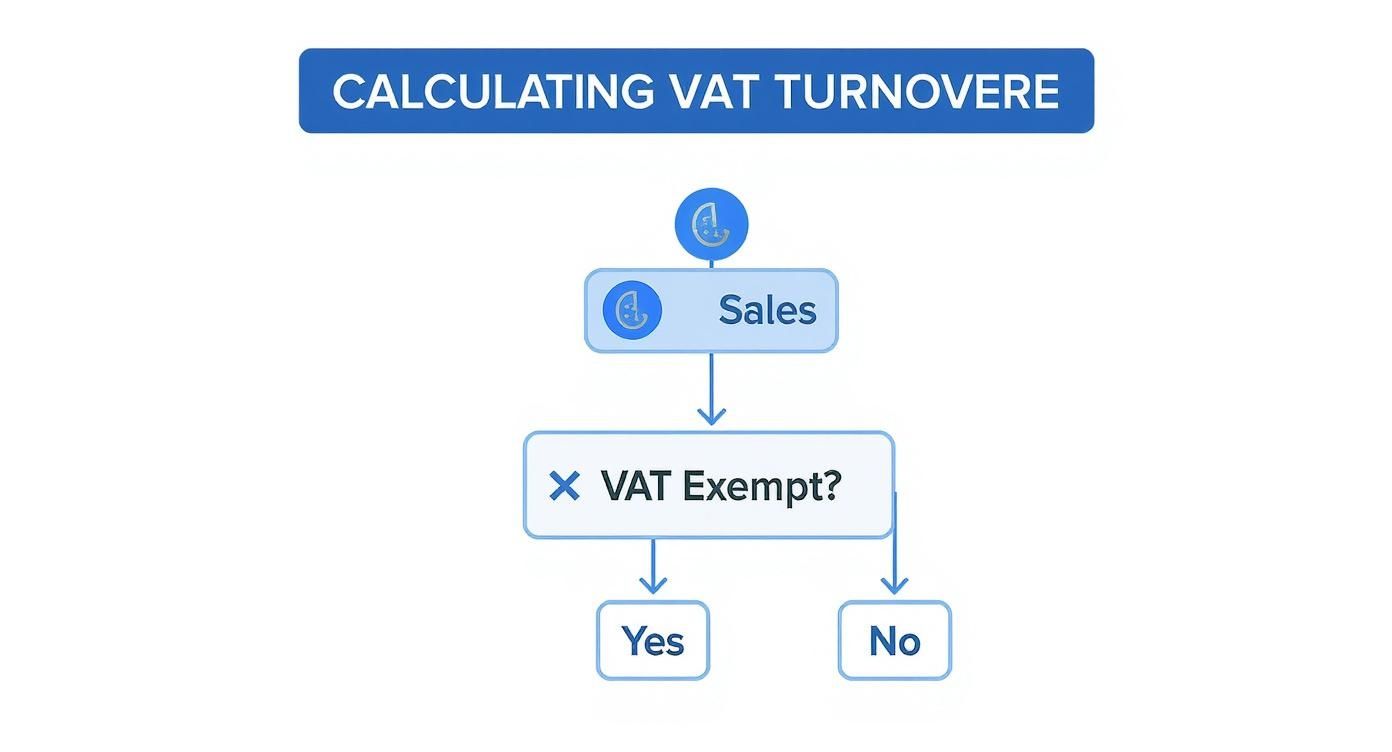
It’s crucial to remember you must count all sales towards your turnover unless they are specifically VAT-exempt. This is a common trip-up for many business owners, so it pays to be certain about what counts.
The "Forward Look" Test
The second trigger is a bit different because it’s about what’s coming up. The "forward look" test applies if you have good reason to believe your taxable turnover will shoot past £90,000 in the next 30 days alone. This usually happens when you land a single, massive contract or order.
If this is your situation, the timeline is much tighter. You have to notify HMRC within 30 days of the date you realised you were going to exceed the threshold. Your registration is then effective from that date of realisation, not from when the work actually starts.
Don't make the mistake of thinking HMRC will be lenient if you miss these deadlines. The penalties for late registration are based on a percentage of the VAT you should have paid, calculated from the day you were meant to be registered.
The penalty rate gets steeper the longer you wait:
- Up to 9 months late: 5% of the VAT due
- Between 9 and 18 months late: 10% of the VAT due
- Over 18 months late: 15% of the VAT due
As you can see, these charges can escalate quickly, turning into a significant and completely avoidable cost. To get a fuller picture of how this works, check out our guide to VAT late filing penalties. The bottom line is simple: acting promptly is always your best defence.
When Does it Pay to Register for VAT Early?
For many small businesses, hitting the £90,000 VAT threshold feels like a chore—another layer of admin to deal with. But what if I told you that for some, registering before you're legally required to is actually a smart strategic move?
This is called voluntary VAT registration. It means you choose to sign up with HMRC even though your turnover is well below the £90,000 limit. It’s definitely not for everyone, but in the right circumstances, it can give your business a real financial and operational edge.
Think of it less as a compliance headache and more as a business tool. By opting in early, you can start reclaiming VAT on your costs and even boost your professional standing.
Getting Your Money Back: The Power of Reclaiming VAT
The single biggest reason to register voluntarily is to reclaim the VAT you pay on your business expenses. If your company has hefty start-up costs or regularly buys from other VAT-registered suppliers, this can make a huge difference to your cash flow.
Let's imagine you're launching a new video production company. You'll be spending thousands on cameras, editing software, and studio lighting right from the get-go. All those purchases will include 20% VAT.
By registering for VAT from day one, you can claim back that 20% VAT you paid on all that essential kit. It’s a direct cash boost right when your new business needs it most.
And it doesn't stop with the initial setup. You can continue to reclaim VAT on all sorts of ongoing costs:
- Stock and raw materials from your suppliers.
- Professional fees for your accountant or solicitor.
- Overheads like your business mobile phone contract or office utilities.
- Marketing costs, such as a Google Ads campaign or printed flyers.
Suddenly, a significant portion of your running costs becomes cheaper because you can get the VAT element back from HMRC.
Looking the Part: Boosting Your Business Credibility
Beyond the purely financial upside, being VAT registered can make your business look more established and professional. This is particularly true if you're working with larger, corporate clients.
In fact, some big companies have a policy of only working with VAT-registered suppliers. It’s a signal to them that you’re a serious, legitimate business. Showing a VAT number on your invoices can remove a subconscious barrier and put you on a level playing field with bigger competitors, potentially helping you land contracts you might otherwise have missed.
Of course, it’s not all upside. Once you register, you must start charging VAT on your own sales. This can make your pricing less attractive to customers who aren't VAT registered themselves (like the general public). You'll also have the new responsibility of keeping accurate records and filing regular VAT returns.
It's a classic case of weighing the pros and cons for your specific situation.
Voluntary VAT Registration Pros vs Cons
To help you figure out if registering early is the right call for your business, this table breaks down the main advantages and disadvantages.
| Aspect | Advantages of Registering | Disadvantages of Registering |
|---|---|---|
| Costs | You can reclaim VAT paid on business purchases and expenses, effectively lowering your costs. | You must charge VAT on your sales, which might make you more expensive for non-VAT-registered customers. |
| Admin | It forces you into good bookkeeping habits right from the start. | It adds the regular task of preparing and filing VAT returns with HMRC. |
| Credibility | It enhances your professional image, which is a big plus when dealing with larger B2B clients. | There’s no real credibility disadvantage, but the benefit is less pronounced if you only sell to the public. |
Ultimately, the decision comes down to your business model. If you sell mainly to other VAT-registered businesses and have significant costs, voluntary registration is a powerful tool. If you sell directly to the public and have very few expenses, it might be an administrative burden you don't need just yet.
How the VAT Threshold Impacts Business Growth
The UK’s VAT registration threshold is far more than just a number on a government webpage. It's a powerful force that actively shapes the decisions of thousands of small business owners, often acting as an unintentional brake on their growth.
For many entrepreneurs, getting close to the £90,000 turnover mark brings a tough choice. Crossing that line means taking on the administrative load of charging VAT, filing regular returns, and possibly putting your prices up. This creates a surprisingly strong incentive for businesses to pump the brakes and keep their turnover just below the limit.
The "Bunching" Phenomenon
This behaviour is so widespread it’s earned its own nickname: "bunching." You can see it in the official data—a suspiciously large number of businesses reporting turnover that sits just under the VAT registration threshold. To stay there, owners might have to turn down new projects, reduce their opening hours, or even shut up shop for a few weeks.
While this tactic sidesteps the immediate headache of dealing with VAT, it can throttle a business's long-term potential. A company that has the demand to scale up, hire more people, and boost the economy is instead kept artificially small.
For years, the UK government tended to raise the VAT threshold in line with inflation. That changed when it was frozen at £85,000 back in April 2017. This long freeze really brought the "bunching" effect into sharp focus, as many business owners deliberately capped their growth to avoid the VAT system. You can read more about this trend from the Chartered Institute of Taxation.
Strategic Considerations for Your Business
Knowing how the threshold can influence behaviour is crucial for your own planning. For anyone involved in e-commerce for small businesses, for instance, understanding this dynamic is key to managing growth successfully.
Instead of automatically slamming the brakes as you approach the threshold, it's worth thinking through a few strategic points:
- Who are your customers? If you mainly sell to other VAT-registered businesses (B2B), registering won't make your prices seem higher. Your customers can simply reclaim the VAT you charge them.
- What are your costs? If you buy a lot of supplies or services that have VAT on them, registering allows you to claim that VAT back. This can actually lower your operating costs.
- What's the long-term plan? Does staying small fit with your ultimate goals? Or is avoiding VAT registration just a short-term fix that could hold you back from where you really want to be?
The decision to cross the threshold shouldn't be a panicked reaction. It should be a conscious, strategic choice that fits your specific business model and your ambitions for the future.
What to Do After You Register for VAT

Getting your VAT registration number is a big milestone, but it’s really just the starting line. From this point on, the way you handle your finances needs a serious update to stay on the right side of HMRC.
Your first job is to start charging the correct rate of VAT on your sales. This means you’ll also need to issue proper VAT invoices to your customers, detailing the VAT you’ve added.
At the same time, your record-keeping has to go digital. Thanks to the Making Tax Digital (MTD) initiative, all VAT-registered businesses must now use MTD-compatible software. This isn't just a suggestion; it’s a legal requirement for keeping your records and filing returns.
Choosing a VAT Accounting Scheme
To help you get to grips with all this, HMRC has created several VAT accounting schemes. Think of them as different ways to manage your VAT that can simplify your admin and, crucially, help with your cash flow. It’s well worth taking a moment to figure out which one suits your business best.
Two of the most popular schemes are:
- The Flat Rate Scheme: This one lets you pay a fixed percentage of your turnover to HMRC. While you still charge the standard VAT rate to your customers, you pay a lower, industry-specific rate to HMRC, which makes your calculations much simpler.
- The Cash Accounting Scheme: Instead of paying VAT when you send an invoice, you only account for it once your customer actually pays you. This is a game-changer for cash flow, as you’re not forking out money to HMRC that you haven’t even received yet.
While the UK's £90,000 VAT registration limit is one of the highest in the OECD to shield small businesses from these complexities, once registered, choosing the right scheme is crucial for efficient management. This high threshold does create a competitive disadvantage for non-registered firms who can't reclaim VAT on their costs. You can find out more about the ups and downs of the VAT registration threshold and its economic impact.
Each scheme has its own rules and eligibility criteria. Taking the time to understand which one clicks with your business can turn VAT from a headache into just another part of your routine.
Still Have Questions About the VAT Limit?
Once you start digging into the details of VAT, it’s natural for a few tricky questions to pop up. Let’s tackle some of the most common ones we hear from business owners.
What Happens If My Turnover Dips Back Down?
It’s a classic scenario: a big project pushes you over the threshold, but you know your sales will settle down again. If your taxable turnover drops below the deregistration threshold of £88,000, you aren't stuck.
You can ask HMRC to cancel your VAT registration. It's not an automatic process—you have to apply for it. This is particularly useful if that spike in sales was a one-off and you don’t expect to exceed the limit again in the coming year.
Do My Sales to Customers Abroad Count?
Yes, they almost always do. This is a big one that often catches people by surprise.
Your VAT taxable turnover isn't just your UK sales; it includes most sales made outside the UK, too. Even if those sales are zero-rated for VAT (like many exports), the value still adds to your total turnover when calculating if you’ve hit the £90,000 registration threshold.
Can I Register for VAT From an Earlier Date?
Absolutely. If you’ve realised you should have registered sooner, you can ask HMRC to backdate your registration. The upside is you can then reclaim VAT on business costs you incurred during that period. The downside? You’ll also have to pay the VAT due on all your sales from that backdated point, which might mean chasing clients with new VAT invoices.
Backdating can be a smart move, especially if you had hefty start-up expenses, but it demands careful and organised bookkeeping.
Navigating these VAT complexities is exactly what we do day-in, day-out at Stewart Accounting Services. If you need a bit of expert guidance to stay compliant and make sure you're not missing a trick, get in touch with our team today.