

Management Accounts Reporting That Drives Growth
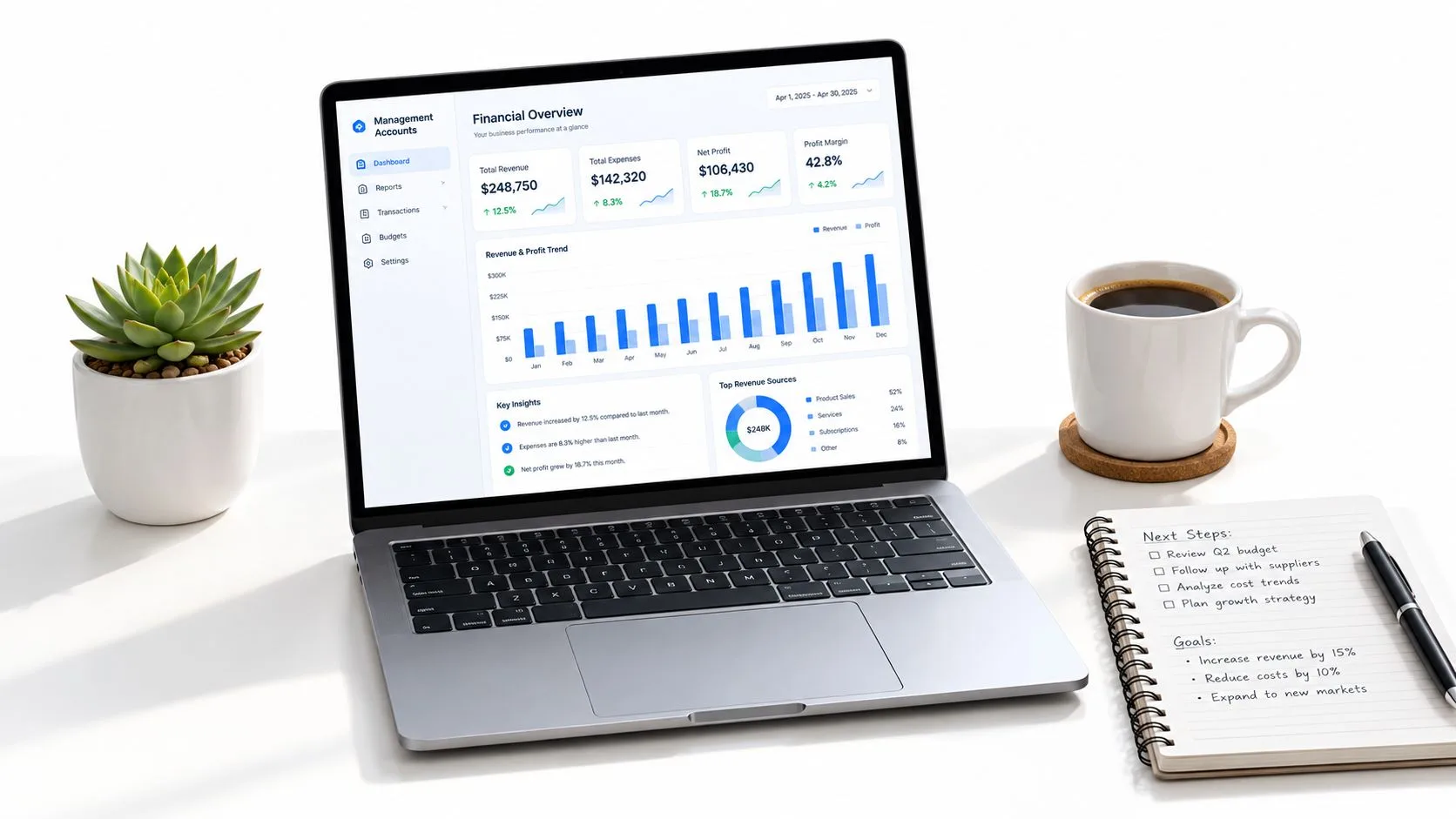
You've just finished another month with a healthy-looking bank balance, a busy sales pipeline and a growing team. Then a supplier payment lands, a major customer pays late, payroll is due, and you realise the profit in your bookkeeping system doesn't explain the cash in the bank. That's the point at which many owners discover that annual accounts are accurate, but not timely enough to run the business.
Management accounts reporting turns accounting data into a monthly operating system for decisions. It shows whether margins are holding, customers are paying, staffing costs are moving faster than sales and planned growth can be funded. For a UK SME, that discipline matters in a business environment where the government recorded 5.5 million SMEs at the start of 2024, representing 99.8% of the business population (UK government SME statistics).
Why Management Accounts Reporting Beats Annual Accounts
A year-end set of accounts can show that a company made a profit. It cannot tell an owner on a Tuesday morning whether the business can afford another hire, a lower-margin contract, more stock or a second premises commitment.
Statutory accounts are prepared annually, filed at Companies House and used in the tax process. Management accounts reporting is internal, usually monthly or quarterly, and is not filed. The distinction is set out in the UK government's guidance on the difference between statutory and management reporting. Management reporting supports compliance, while giving directors information soon enough to act.
Annual figures can reveal that gross margin weakened over the year. By then, the company may have renewed an unprofitable contract, hired staff for low-margin work and committed cash to activity that appeared to be growth. A monthly view gives the director time to change pricing, chase overdue invoices or stop discretionary spending before those choices become expensive.
The decision gap is where cash is lost
The report is only useful if it shortens the time between a business event and a management response. A monthly cadence also creates the discipline needed to compare KPIs consistently, automate reliable data from Xero and build a funding case from records that lenders or investors can follow.
A working pack should help directors:
- Spot margin erosion: Compare actual gross margin with the budget or forecast, then investigate changes by service line, customer or project.
- Control working capital: Review debtor ageing, expected receipts and supplier commitments before a healthy-looking bank balance becomes misleading.
- Test growth plans: Check whether an employee, vehicle, premises or marketing commitment fits the forward cash position.
- Explain performance: Attach a clear reason to each material variance instead of leaving directors to guess.
- Prepare for funding conversations: Present consistent historical results alongside forecasts and the cash assumptions behind them.
The same principle appears in larger public-sector reporting. HM Treasury describes the Government Financial Reporting Manual 2025 to 2026 as the technical accounting guide for annual reports and accounts in the UK, while monthly management accounts support board reporting for ministers, boards and Permanent Secretaries. The practical lesson applies to a growing SME: figures create value when leaders receive them regularly and connect performance with cash and decisions.
Practical rule: If a number arrives after the decision it should have informed, it belongs in a historical archive, not in your management system.
Companies House recorded 3,895,053 annual accounts filed between April 2023 and March 2024, according to its management information. Filing deadlines matter, but they do not provide monthly control. A business scaling from six figures towards seven figures needs a reporting rhythm that supports pricing, hiring and cash decisions before the annual compliance process catches up.
What to Include in a Monthly Management Accounts Pack
A useful monthly pack should be short enough for directors to read within days of month end and detailed enough to support a decision. For most growing SMEs, four components form the core: profit and loss account, balance sheet, cash flow forecast and variance commentary. The UK good-practice guidance for month-end reporting supports showing the actual financial position at month end and using contribution analysis where it adds value (Companies House monthly accounts data guidance).

Start with reliable numbers
Don't generate the pack from an unreconciled ledger. The close process should follow a repeatable order:
- Close the books: Confirm the reporting period and stop late postings from changing figures without a clear audit trail.
- Reconcile bank accounts: Match transactions and investigate unreconciled items rather than carrying them forward indefinitely.
- Reconcile control accounts: Check sales ledger, purchase ledger, VAT, payroll and other balances against supporting records.
- Review accruals and prepayments: Record costs and benefits in the period they relate to, so performance isn't distorted by invoice timing.
- Generate the statements: Produce the profit and loss account, balance sheet and cash flow forecast.
- Compare actuals with budget or forecast: Identify material differences in revenue, gross margin, overheads and cash.
- Assign actions: Add an owner and deadline to each important variance.
The profit and loss account tells you whether the business generated a surplus during the period. The balance sheet shows what sits behind that result, including receivables, payables, loans, stock and retained funds. The cash flow forecast then answers the question that profit cannot: when will money enter and leave the bank?
Commentary turns reporting into management
A report without commentary is a data dump. Each significant variance needs a plain-English explanation, the commercial cause and a decision or next action. “Travel costs over budget” isn't enough. “Additional site visits increased mileage, the project manager will reprice future work and review the contract before the next invoice” is usable.
Add contribution analysis when the business sells different products, services or project types. It can reveal that revenue growth is coming from work with weaker margins, or that a small service line is producing a disproportionate contribution after direct costs.
Working-capital measures belong in the pack even when the accounts look profitable. Include debtor ageing, expected receipts, supplier commitments and upcoming payroll or tax payments. Directors don't need every ledger transaction. They need the handful of facts that change what they do next.
Essential KPI Dashboards That Predict Cashflow Problems
A business can report a profitable month and still struggle to pay wages or suppliers. The statements record what happened. A KPI dashboard highlights the operating signals that may affect cash and margin next, including slow collections, supplier pressure, payroll growth and weakening unit economics. For a company moving from six figures towards seven, that monthly view becomes part of the growth operating system, not a compliance exercise.
Research from ACCA on UK small businesses links regular management accounts with capabilities such as formal planning and financially trained staff. The practical lesson is clear: useful reporting depends on disciplined processes, agreed definitions and consistent review, not on software alone.
Build a one-page view
A dashboard should earn its space by supporting a decision. Show the current result, compare it with a budget or internal target, display the direction of travel and record the action required when performance moves outside tolerance.
| KPI | What It Signals | Healthy Target |
|---|---|---|
| Gross margin | Whether pricing, direct costs and sales mix are protecting contribution | Set an internal target by product or service line |
| Debtor days | How quickly customers convert invoices into cash | Set a target based on agreed terms and actual collection behaviour |
| Creditor days | Whether supplier payments are controlled and sustainable | Align with supplier terms and cash commitments |
| Staff cost as a percentage of sales | Whether payroll is rising faster than earned revenue | Set a target that reflects the operating model |
| Cash runway | How long available cash can support planned outgoings | Define a minimum reserve appropriate to the business |
| Revenue by service or product line | Whether growth is coming from the work you want to scale | Set targets for profitable, strategically important lines |
These measures do not have universal healthy thresholds. A consultancy, wholesaler and transport business carry different working-capital patterns. Directors should agree each target, document the assumption behind it and revise it when the operating model changes.
Debtor days needs close attention. Profit can increase while unpaid invoices consume the cash required for wages, tax and suppliers. Use this practical explanation of debtor days and the formula behind it to calculate and interpret the measure. Then pair it with an aged receivables report, a named collection owner and an expected payment date for each material balance.
A dashboard earns its place when a movement causes someone to make a call, change a price, delay a cost or collect an invoice.
Cash runway must reflect the coming weeks, not just the bank balance divided by average spending. Include committed payments, expected receipts, VAT and payroll timing, loan repayments and planned investment. Businesses with complex routes or delivery schedules can apply the practical principles in this resource on cash flow management for route operators, particularly the connection between scheduling, collections and cash visibility.
Review the dashboard in the same monthly meeting as the accounts. A falling gross margin should trigger a review of pricing and direct costs. Rising debtor days should produce a collection plan. Staff costs ahead of revenue should prompt a forecast-based hiring decision. That cadence also creates a clearer evidence trail for lenders or investors, because funding discussions can be supported by consistent KPIs rather than a one-off annual result.
How to Build a Reliable Reporting Process With Xero
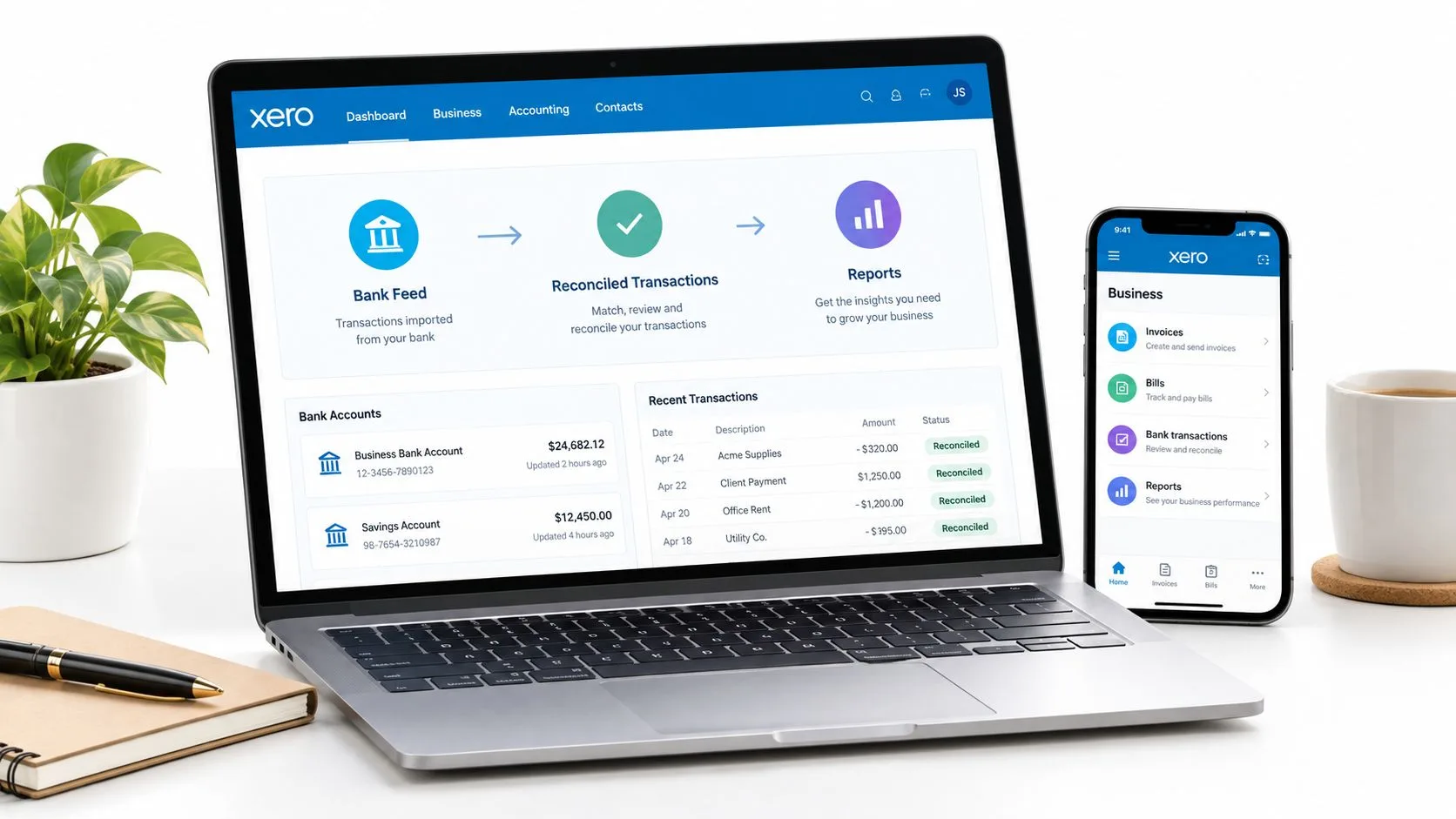
Xero can provide a strong accounting base, but automation doesn't remove the need for judgement. It makes accurate processing repeatable when the chart of accounts, bank feeds, sales invoicing, purchase approvals and reconciliation rules are designed properly.
Design the workflow before adding apps
Start with the information flow:
- Capture transactions: Use Xero bank feeds, digital invoices and receipt capture to reduce manual entry.
- Classify consistently: Use a controlled chart of accounts, tracking categories and customer or project references where they support decisions.
- Reconcile frequently: Clear bank and control-account differences before month end, not during a rushed reporting session.
- Control approvals: Make invoice approval and payment responsibility explicit, especially when several people can spend company money.
- Lock the period: Once the close is complete, restrict changes or record them transparently.
- Distribute one version: Give directors one dated pack, with the same definitions and reporting period each month.
Complementary apps can help with expenses, payroll, inventory, time recording or payment collection, but every additional system creates a data hand-off to control. Before adopting an app, decide which system owns the information, who checks the integration and what happens when a feed fails.
A migration also needs more than copying balances. Review the chart of accounts, tracking structure, opening balances, bank rules and historical comparatives. This guide to professional Xero migration support is relevant when an existing ledger has become inconsistent or the business is moving from spreadsheets or another platform.
Automate the routine, review the exceptions
Set a monthly timetable with named owners. One person prepares reconciliations, another reviews unusual transactions, and a director signs off the final pack. The right division depends on the team, but “someone in finance will sort it” isn't a control.
Xero can automate recurring invoices, bank rules and report production. It can't decide whether a margin movement reflects a genuine commercial change, a coding error or an omitted accrual. That review is where professional judgement belongs.
Use the following demonstration as a prompt for discussing how a cloud workflow can support close discipline and management reporting:
A dependable process produces a single source of truth for internal decisions and later statutory work. It also makes exceptions visible. If the bank won't reconcile, an invoice is missing, or payroll doesn't agree to the ledger, the pack should show that limitation rather than presenting false precision.
Using Reports to Scale From Six Figures to Seven Figures
Growth creates more decisions, not just more sales. At six-figure scale, an owner may still know most customers, suppliers and projects personally. As the business expands, that informal visibility weakens. Management accounts reporting replaces memory with a shared view of performance, liquidity and responsibility.
The monthly review should be a working meeting, not a presentation ceremony. Start with the largest variances, then move to cash commitments, debtor ageing and the rolling forecast. For each issue, agree the commercial response, the owner and the date for review.

Turn variances into funded decisions
Suppose a service line has growing revenue but falling contribution. The response might be a price review, tighter scope control or a change in delivery. If debtor ageing shows that a major customer is paying later than agreed, the action may be a staged invoice, a credit-control call or a revised payment arrangement.
Hiring decisions need the same treatment. The question isn't just whether the business can afford the salary in a profitable month. It is whether expected revenue, collection timing and existing commitments support the additional payroll through the forward forecast.
A rolling 13-week cash forecast is especially useful because it puts receipts and payments into a near-term sequence. Use it to test a new vehicle, equipment purchase, recruitment plan or marketing commitment. The forecast should show assumptions, not just a single optimistic outcome.
Funding readiness starts before the application
UK Finance reported SME gross lending of £17,545 million in 2024-25, up year on year, with 61,438 loan approvals in that period (UK Finance Business Finance Review 2025 Q4). The figures show an active finance market, but they don't guarantee that every applicant will receive the facility requested.
Lenders want evidence that the directors understand performance, cash conversion and repayment capacity. A consistent pack can support that conversation by connecting historical results with current debtor ageing, margin movements, committed costs and forward cash assumptions. A spreadsheet produced specially for a lender, with figures that don't reconcile to the accounting records, creates doubt rather than confidence.
For owners preparing for expansion, business growth services can sit alongside internal reporting when the business needs help translating financial information into a practical growth plan. The important point is ownership. An adviser can improve the process, but directors still need to decide which risks they're willing to accept.
Make Your Reporting Stick and Avoid Costly Mistakes
A reporting system fails when the pack becomes a monthly ritual without decisions attached. It arrives late, commentary repeats itself, nobody owns the dashboard measures, and directors fall back on the bank balance. The business collects information without gaining control.
Set a recurring close date, publish the pack to an agreed timetable, and reserve time to decide what happens next. Keep KPI definitions stable, so a change in gross margin or debtor days has the same meaning each month. The pack should support the operating rhythm of a growing company, not sit in a folder until year end.
Audit the current process
Use this review before the next close:
- Check the pack: Does it include the profit and loss account, balance sheet, cash flow forecast and useful variance commentary?
- Check the close: Have bank accounts, control accounts, accruals and prepayments been reviewed?
- Check the dashboard: Are gross margin, debtor days, creditor days, staff cost as a percentage of sales and cash runway visible?
- Check accountability: Does every material variance have an owner, action and deadline?
- Check the forecast: Does it show expected receipts and committed payments, rather than relying on profit alone?
- Check the audience: Can directors understand and use the pack during the same reporting cycle?
Internal reporting should also reflect changes in external reporting requirements. The UK government has confirmed that abridged accounts are planned to be removed for accounting periods beginning on or after 1 April 2028 (company annual requirements guidance). That affects statutory disclosure, not the requirement to produce management accounts. It still makes organised records and clear ownership more important.
Annual accounts support statutory compliance and tax reporting. They cannot provide the monthly view needed to manage margin, cash conversion, hiring or investment as the company grows.
Choose the next month-end close date, assign responsibility for each reconciliation, and agree the five KPIs directors will review. If regular reports need to track performance, cash and operational KPIs, contact Stewart Accounting Services to discuss a management accounts reporting process built around the business.
Start the next cycle with a dated close timetable, a reconciled Xero ledger and a one-page dashboard. Use the pack to make one specific decision about cash, margin or growth, then review the result at the following month end.