

Sustainability Reporting Standards Explained for UK SMEs

It's late on a Friday, you're trying to close the month in Xero, and an email lands from your biggest customer. They aren't querying an invoice. They're asking for your Scope 1 and Scope 2 emissions, your energy use for the last financial year, and a copy of any sustainability policies you hold.
You don't have a sustainability department. You have a bookkeeper, a drawer of energy bills, and a vague worry that new rules might already apply to you. That confusion is common for owner-managed firms in Central Scotland, because legal duties, voluntary standards and customer requests are now arriving through the same inbox. The good news is that you don't need a listed-company report to respond well. You need to know which rule is which, what a lender or buyer could reasonably ask for, and how to build a small, auditable trail from records you already keep.
What Sustainability Reporting Standards Actually Ask For
Two bakeries can each claim they've had a good year, but a lender can't compare them without shared accounting rules. Sustainability reporting standards do the same job for non-financial information, telling a company what to disclose, how to measure it and how to present it so readers can compare like with like.
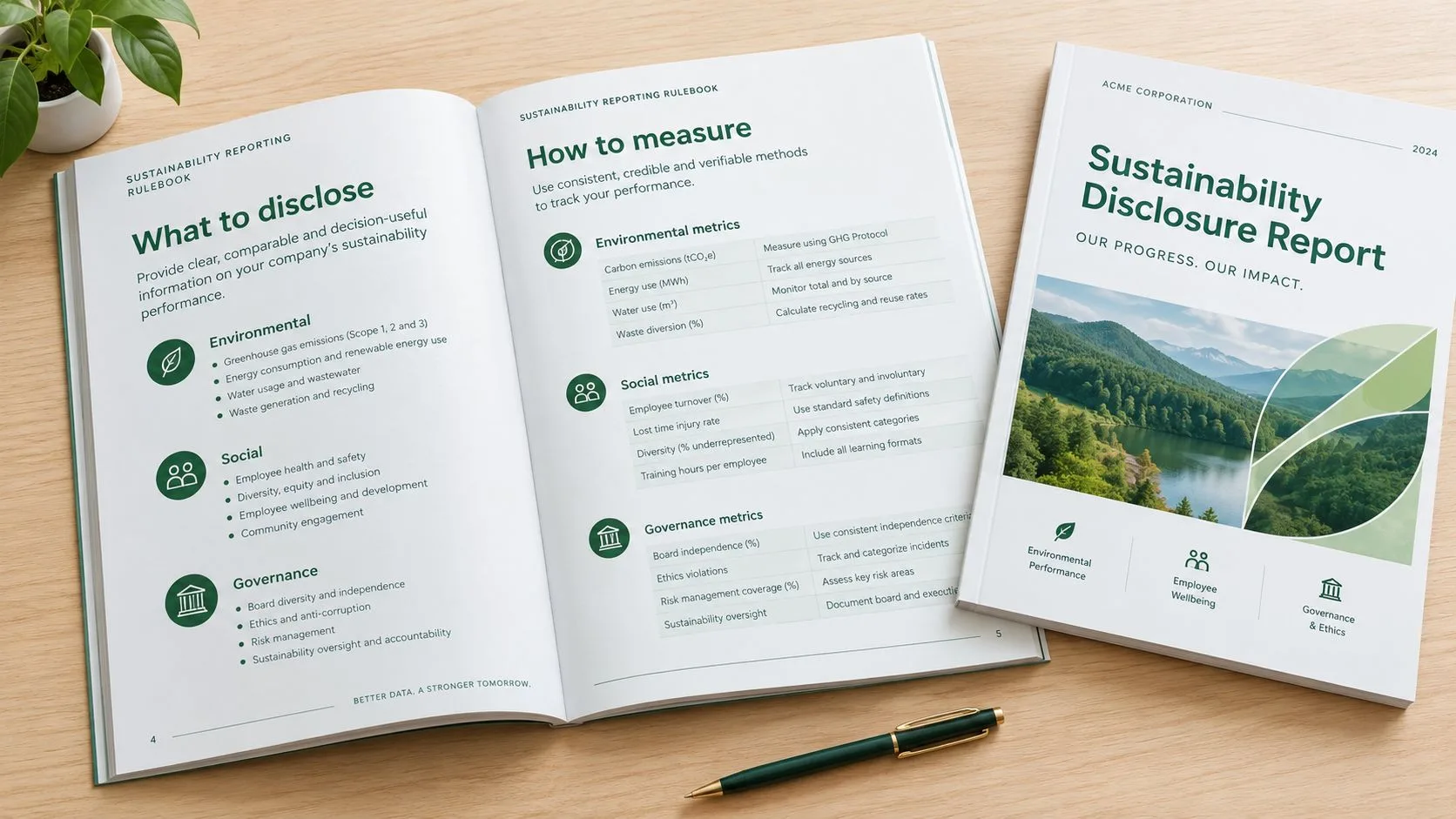
Three Building Blocks to Hold in Mind
- What to disclose: Topics such as climate risk, resource use, workforce matters and governance. For a small manufacturer, that could mean energy costs, reliance on one material supplier, and who in the business owns climate-related decisions.
- How to measure: A defined method, rather than a guess. Emissions are commonly counted using the Greenhouse Gas Protocol, which separates direct, purchased-energy and supply-chain emissions into Scope 1, 2 and 3.
- How to present: Figures for the same period as the financial accounts, with prior-year figures where available so a reader can see a trend instead of one isolated number.
This marks a shift away from a glossy narrative about good intentions. Modern standards treat sustainability information as financially relevant, because energy prices, supply disruption, insurance exposure and customer requirements can all affect a business's prospects. A haulier that can't show its fuel use, for example, may struggle to explain its margins or keep a contract with a large buyer.
It's also important not to confuse a standard with a single report. You might be legally bound by one framework, asked by a customer to answer questions based on another, and still use a third method internally just to count emissions consistently. Guidance on connecting sustainability reports to ITAD shows how one practical topic, disposing of IT equipment responsibly, can sit inside a wider report rather than form the report on its own.
If a customer, lender or buyer could reasonably ask you for a figure, the logic of these standards already applies to you, even if the law doesn't name you yet.
That simple test helps you separate decoration from useful work. Start with information someone might rely on, and you'll avoid producing pages nobody reads.
Frameworks, Status and How UK Rules Reached Standards
A Central Scotland supplier may receive a sustainability questionnaire before any law requires it to file a sustainability report. To understand why, separate three things: the rules a company must follow, the standards it may choose to use, and the information a customer asks for to manage its own reporting.
How the UK Position Developed
The UK developed its sustainability reporting standards from an international baseline. The milestones show how that process unfolded:
- 26 June 2023: The International Sustainability Standards Board issued IFRS S1 and IFRS S2, covering general sustainability-related financial disclosures and climate-related disclosures. The UK Government framework for developing UK Sustainability Reporting Standards explains the UK's approach to assessing those standards.
- December 2024: The UK Technical Advisory Committee recommended endorsing both standards for UK use, subject to minor amendments, according to the Government framework.
- 2025: The Government consulted on draft UK standards and related questions, including transition plans and assurance. These consultations informed the decisions about how the standards could be applied.
- 2 February 2026: The Government published UK SRS S1 and UK SRS S2. They provide a UK framework for sustainability-related and climate-related disclosures, based on the international standards.
Publication does not, by itself, mean every UK business has a legal duty to report under UK SRS. For an SME, a customer's request can matter commercially before a reporting rule applies by law. PwC UK reporting on FTSE 350 sustainability disclosures provides context on how larger companies approach sustainability reporting. Their reporting needs can flow down supply chains as requests for information from smaller suppliers.
Sustainability Reporting Frameworks Compared
| Standard | Issued by | Core purpose | Who it targets | Status in 2026 |
|---|---|---|---|---|
| UK SRS S1 and S2 | UK Government, based on ISSB standards | Investor-focused sustainability and climate disclosures | UK companies, initially voluntary | Published, voluntary for now |
| IFRS S1 and S2 | International Sustainability Standards Board | General and climate-related financial disclosures | Companies in jurisdictions adopting ISSB | Issued 26 June 2023, adopted in a growing number of jurisdictions |
| ESRS under CSRD | European Commission, with EFRAG | Broad EU double-materiality reporting | Large EU companies and certain non-EU groups | Revised in 2025, scope narrowed by EU simplification |
| VSME | EFRAG | Voluntary baseline for SME sustainability data | SMEs answering customer, bank or investor requests | Voluntary, published as a standard for SMEs |
| GRI Standards | Global Reporting Initiative | Impact-based reporting on economic, environmental and social topics | Any organisation, common in procurement | Voluntary, widely used |
| TCFD recommendations | Financial Stability Board task force | Climate governance, strategy, risk and metrics | Companies disclosing climate risk | Monitoring moved to ISSB in 2023, pillars carried into IFRS S2 |
| SECR | UK Government, via Companies Act rules | Energy use, emissions and energy-efficiency actions | Large unquoted companies and LLPs meeting thresholds | Statutory in the UK |
| GHG Protocol | World Resources Institute and WBCSD | Method for measuring Scope 1, 2 and 3 emissions | Used inside most frameworks | Voluntary method, aligned with UK SRS S2 |
Read the table in three layers. Disclosure frameworks, such as UK SRS, ESRS and GRI, set out what information to report. Measurement methods, such as the GHG Protocol, explain how to calculate it. Statutory triggers, such as SECR, determine which organisations have a legal duty to comply.
This distinction also helps when considering financial reporting changes, including the planned revisions to FRS 102. Those revisions and sustainability reporting standards affect annual reporting, but they do not create identical duties for the same businesses. Sector-specific rules can add another layer. Practical guidance can help firms navigate sector-specific ESG rules, particularly where waste, electronics or regulated activities are involved.
A common confusion: UK public-sector sustainability guidance applies to central-government bodies, not every private SME. It may indicate the direction of policy, but it is not your legal checklist.
For many SMEs, the first request will come through a customer questionnaire, tender or bank review rather than a statutory filing. That request is not automatically a legal duty, but ignoring it can have commercial consequences if an important buyer needs the information to complete its own reporting. Start by identifying who is asking, what figures they need, and whether the request is contractual or required by law.
Which Trigger Applies to Your Business and Why
For a Central Scotland business with a handful of employees, a customer's carbon questionnaire may arrive long before any legal reporting duty applies. Start by separating the two: statutory rules set duties by company type and size, while customers, lenders and tender buyers can request information for their own decisions.
Reporting Triggers and What Each One Requires
| Trigger | Test or signal | What it requires | Who it reaches |
|---|---|---|---|
| SECR | Quoted status, or meeting at least two of three size tests | Energy use, associated emissions and energy-efficiency actions | Quoted companies and qualifying large unquoted companies or LLPs |
| TCFD-aligned disclosure | A separate climate disclosure duty applies to the company | Climate governance, strategy, risk management, metrics and targets | UK premium-listed companies, large UK companies and LLPs meeting the relevant Companies Act size tests |
| UK SRS S1 and S2 | Voluntary unless adopted or requested | Sustainability-related risks, opportunities, governance, metrics and targets | Companies adopting early or responding to stakeholder requests |
| Customer or supplier questionnaire | A buyer requests emissions data or policies | The information specified by the buyer, often emissions data and supporting evidence | SMEs in supply chains |
| Lender or bank review | A loan or facility review asks about climate or energy risk | Information relevant to the lender's assessment, such as energy costs or exposure | Energy-intensive or asset-heavy SMEs |
| Public-sector tender | Procurement documents ask for environmental evidence | The evidence required by the tender | SMEs bidding for public contracts |
| EU CSRD (ESRS) | A UK group falls within the EU rules through its EU operations | ESRS disclosures for the in-scope EU group | UK groups with substantial EU activity |
SECR is a useful starting point for an owner checking statutory duties. The UK sustainability reporting guidance for 2026 to 2027 says it generally covers quoted companies and unquoted companies or LLPs that meet at least two of three tests: more than 250 employees, turnover above £36 million, or a balance sheet total above £18 million. A rise from six-figure to seven-figure turnover alone does not trigger SECR.
For unquoted companies and LLPs, the large-company size tests generally need to be met across consecutive financial years before the classification changes. So a single year above two thresholds does not automatically mean the reporting duty starts at once. Check the rules against your financial-year history, rather than treating a year-end snapshot as the whole test.
Where SECR applies, the company needs records supporting its UK energy use, associated emissions and energy-efficiency actions. If a low-energy exemption applies, keep a written record of the basis for using it. That exemption concerns SECR; it does not, by itself, settle whether a separate climate disclosure duty applies.
For TCFD-aligned reporting, the relevant question is whether the company has its own Companies Act climate disclosure duty. This includes UK premium-listed companies and large UK companies and LLPs that meet the applicable size tests. The 2026-27 guidance makes clear that an exemption from SECR's minimum requirements does not remove a separate TCFD-aligned duty where the company meets those tests. In other words, check the company's legal status and size independently for each duty.
The Triggers That Actually Reach Most SMEs
For many smaller firms, the first request is commercial, not statutory. A large customer may need supplier emissions for its own reporting; a lender may ask about energy costs when reviewing a facility; or a public-sector tender may score carbon evidence. These requests do not automatically make the SME subject to SECR, but they can affect whether it wins work or secures finance.
Before year-end, review employee numbers, turnover and balance sheet totals for the relevant consecutive financial years. Keep supplier energy records and the assumptions used to convert them into emissions, and write down any exemption relied on. This is a practical first data trail, not a requirement to commission a full carbon consultancy project.
How to Run a Materiality Assessment in Five Steps
Materiality sounds technical, but the idea is plain. You report sustainability information that could reasonably influence how a lender, customer, investor or buyer judges your business's prospects, and you don't bury them in topics that make no financial difference.
The photo below captures the right scale for most SMEs. This is a focused working session with the people who know your costs and customers, not a consultancy project.

Under the UK SRS S1 and S2 publication, UK SRS S1 covers general sustainability-related risks and opportunities and UK SRS S2 covers climate-related risks and opportunities, organised around governance, strategy, risk management, and metrics and targets. Materiality is the filter that stops that structure becoming a list of disconnected statistics.
Five Steps You Can Run in an Afternoon
- List your topics: Write down energy, fuel, materials, key suppliers, staff, waste and climate exposure, then add anything specific to your trade.
- Link each topic to money: Note the financial effect if it went wrong, such as a cost rise, a lost contract, a higher insurance premium or tighter loan terms.
- Score likelihood and size: Use simple one-to-five scales, multiply or compare the scores, and keep topics above a threshold you set and record.
- Decide the audience: Mark which topics customers, lenders or owners need to see, and which you'll keep internal to protect margin and efficiency.
- Record and review: Write down the decision, your reasons and a review date, then repeat the exercise each year before budgets are set.
Consider a 30-person joinery firm in Clackmannanshire. It scores diesel for delivery vans highly because fuel prices directly squeeze job margins, and timber sourcing highly because supply problems delay work and customers ask where timber comes from. Office waste scores low, not because waste doesn't matter, but because it doesn't materially affect prospects or win contracts.
The short video below is a useful pause point before you score anything, because it helps owners separate topics that sound important from topics that change a decision.
That joinery firm's result decides its first data collection. It tracks van fuel and timber suppliers before it counts office recycling. The same fuel data can also serve two purposes, supporting disclosure to a customer and helping the owner price delivery costs properly.
Materiality for disclosure and operational data for cost control aren't rivals. Collected once, good energy data does both jobs.
Building the Data Trail and Controls in Xero
A supplier asks for your energy use, a tender requests travel figures, and you have monthly bills but no organised record. You can start with the documents already in your bookkeeping system. The aim is to make each reported figure traceable to a source, a calculation and a person who checked it. A figure without those steps is an estimate, not a controlled reporting record.
Data Sources, Xero Locations and Evidence to Keep
| Data area | Source document | Where it sits in Xero | Frequency | Evidence to keep |
|---|---|---|---|---|
| Electricity and gas | Supplier bills and statements | Bills, coded to an energy tracking category | Monthly | Bill PDFs and conversion factor version |
| Fuel and vehicle use | Fuel card statements and mileage logs | Bank feed or expense claims with a fuel category | Monthly | Statements, mileage logs and receipts |
| Business travel | Flight, rail and hotel bookings | Expense claims tagged travel | Monthly | Itineraries and booking confirmations |
| Purchased goods and services | Supplier invoices | Purchase bills with supplier and category tags | Monthly | Invoices and supplier codes |
| Headcount and home working | Payroll reports | Payroll records in Xero | Quarterly | Payroll exports and headcount notes |
| Supplier emissions data | Supplier questionnaires or certificates | Supplier contact record with attachments | Annual | Declarations and a short method note |
Set up tracking categories for energy, fuel, travel and supplier spend, then use bank rules to apply them consistently. Attach bills and receipts to their transactions. If you are changing your coding structure, a chart of accounts for waste management can illustrate how clearly named accounts organise costs, though your energy and travel categories should reflect your own purchases.
Controls a Bookkeeper Can Actually Follow
Assign an owner to each data area. One person can manage several areas, but make the responsibility clear. Reconcile energy and fuel totals to supplier bills each month. Keep the conversion factor and its version with the calculation, and label spend-based figures as estimates. These simple checks create a traceable audit trail from source document to reported figure.
Customer requests and legal duties are different. A customer may ask for emissions data as a condition of a tender, even when your business has no matching legal reporting obligation. You can answer proportionately with records you already hold, without commissioning a full carbon consultancy project. Start with the categories that matter to your costs or customer requests, and record what you can support.
The 2025 UK business survey report reports that 55% of respondents experienced sustainability-related cost increases during the previous year. It also identifies limited resources and specialist expertise as barriers for SMEs undertaking Scope 3 reporting and lifecycle assessments. That is a reason to keep the first system manageable, not to buy expertise before you know what information is required.
More detail does not automatically mean better evidence. A precise supplier figure without supporting records may be less credible than a clearly labelled estimate with its method documented. Build the checks into ordinary bookkeeping. Then, when a customer asks for figures, you can show where they came from and explain what remains an estimate.
Start a Staged Roadmap Before Year-End
A customer's carbon-data request can arrive before any legal duty to publish a sustainability report applies. For a Central Scotland owner-manager, the practical question is what information to start collecting now, using existing bills and records, so a future deadline does not mean searching through years of paperwork.
A modest internal dashboard can help answer customer and lender questions while showing where energy and fuel costs are changing. Link those measures to your wider strategic planning process so the figures inform pricing, investment and growth decisions. A customer request is a commercial requirement, not automatically a legal reporting duty.
A Four-Stage Roadmap for Owner-Managed Firms
- Baseline, first three months: Record energy, fuel, headcount and measurable Scope 1 and 2 emissions, starting with bills and records already available.
- Evidence, months three to nine: Ask key suppliers for relevant information, document your controls and assumptions, and label spend-based estimates clearly.
- Internal dashboard, years one to two: Review a small group of KPIs quarterly against your financial year. Add prior-year figures as they become available to show trends.
- External disclosure or assurance, only when required: Publish information or seek limited assurance when a customer, lender or regulator asks. Check whether the cost is justified by the commercial need.
Start with measures your business can support. Scope 3 estimates and product lifecycle assessments may require specialist expertise and can be costly. For an SME, it can be sensible to defer that work until a customer specifically requests that level of detail. First collect data that helps protect contracts and identify costs you can manage.
A lean rule to follow: Measure what is material, keep evidence for each claim, and pay for specialist help when a customer or other relevant party requires it.
Before year-end, confirm whether your business falls within SECR requirements by checking the applicable thresholds. Set up Xero tracking categories for energy, fuel and travel, then agree who records each data area and when. These steps establish a practical routine without committing to a full carbon consultancy project.
If a customer email has already arrived, or a tender requests carbon figures you cannot yet provide, Stewart Accounting Services in Alloa, Stirling or Falkirk can review your SECR position, help configure Xero tracking categories and bank rules, and map a staged reporting roadmap to your year-end. The aim is to help you respond to customers and lenders with figures you can evidence, while keeping specialist costs proportionate.
Recent Posts
22 Oct, 2026