

What Is Strategic Planning? a Guide for UK SME Growth
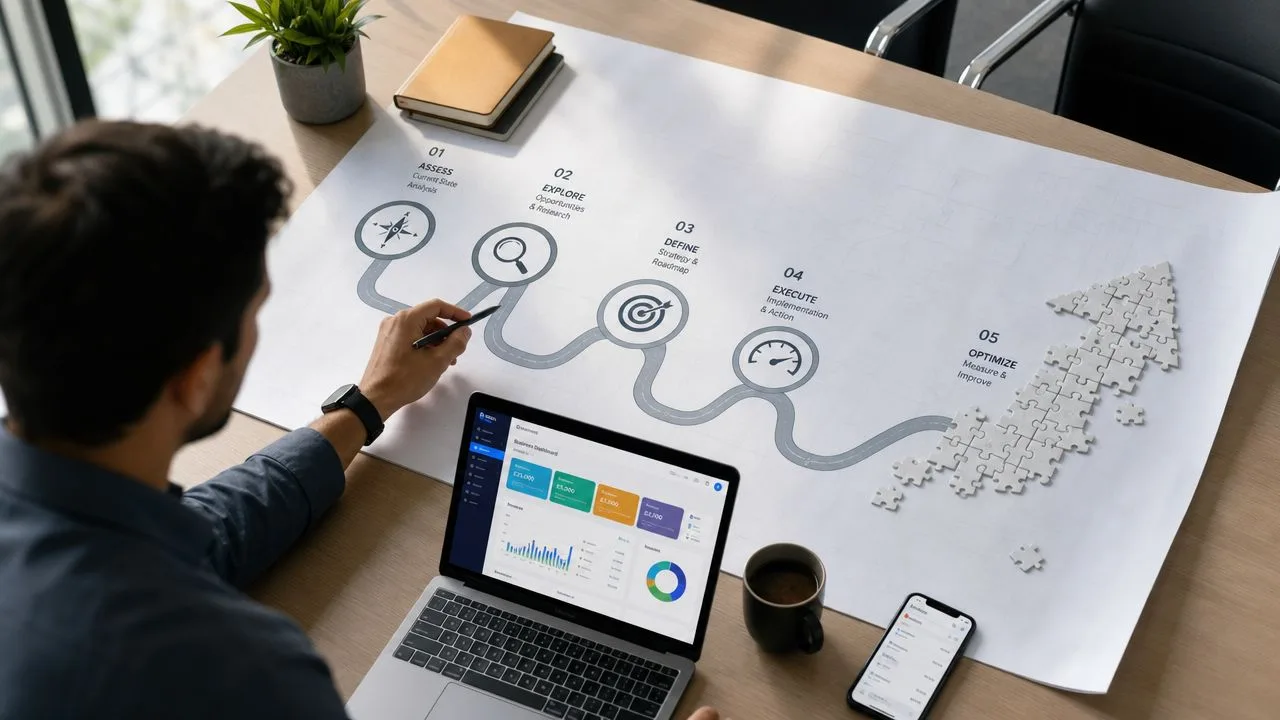
At its heart, strategic planning is about deciding where you want your business to go and then drawing the most effective map to get there. It’s far more than a formal document that sits on a shelf; think of it as a living, breathing guide that turns your long-term ambitions into concrete actions.
What Strategic Planning Means for Your Business
Have you ever felt like you're just firefighting, lurching from one urgent task to the next? That's what running a business without a strategic plan feels like. It's like setting off on a long journey with a vague destination in mind but no satnav or A-to-Z. You’ll probably take some wrong turns, waste a lot of fuel, and get completely stressed out.
A good strategic plan is your business’s satnav. It helps you shift from being reactive to being proactive, making deliberate choices about where to invest your time, money, and energy. For any small or medium-sized business owner in the UK, it’s the foundation for building predictable and sustainable growth.

From Concept to Action
The idea of strategic planning isn't new—it has been a staple of business management since the 1960s. What has changed is how it's used. Today, it’s a hands-on process where leaders use real data from their accounts and the market to create a clear, actionable roadmap. It’s not about predicting the future with a crystal ball, but about preparing for it.
To get started, you can explore WeekBlast for strategic goals. The process boils down to answering a few fundamental questions:
- Where are we going? What’s your big-picture vision? Maybe it's hitting that first seven-figure revenue year or expanding into a new market.
- How will we get there? This is about outlining the key strategies you'll use to make your vision a reality.
- How will we measure success? This involves defining the specific Key Performance Indicators (KPIs) that tell you if you're on track.
The real power of a strategic plan is the clarity it creates. When everyone, from the founder to the newest team member, knows the destination and the route, they can all pull in the same direction.
This shared focus is a game-changer. It gives you a framework for making decisions, making it easier to say "no" to distractions and a confident "yes" to the opportunities that truly matter. You can read more about the link between planning and progress right here on our blog.
Ultimately, it's about putting yourself back in the driver's seat and taking control of your business's future.
Why a Strategic Plan Is Your Strongest Growth Engine
If you feel like you’re constantly fighting fires and just trying to survive the day-to-day, you’re not alone. But to move from just surviving to truly thriving, you need a different approach. Working harder isn't the solution; working smarter is. That's where a strategic plan comes in.
Think of your business as a ship. Without a plan, you're at the mercy of the market's unpredictable waves. With one, you're the captain, charting a clear course to a specific destination, ready to navigate whatever comes your way. This isn't about creating a document to file away and forget. It's a living tool for growth. The evidence is clear: businesses that take the time to create a formal plan consistently outperform those that run on instinct alone.

From Ambition to Achievement
A strategic plan is the bridge between your big ambitions and the small decisions you make every single day. It gives you a framework to turn hopeful goals into measurable results. For UK SMEs, the benefits are very real.
First, it fuels faster growth. The connection between planning and execution is undeniable. One widely cited statistic shows that businesses with a written plan grow 30% faster than those without. What's more, 71% of fast-growing companies use a strategic plan to guide their journey. For an owner, this process is far from just paperwork; it helps you make better commercial decisions on everything from pricing and staffing to managing your cash flow. You can dig into the numbers yourself over at Funding for Good.
Second, a clear plan makes it easier to get funding. When you approach lenders or investors, they need to see more than just a good idea. They want to see a credible roadmap for growth and proof that you have a firm grip on your finances.
A well-articulated strategic plan demonstrates that you are a serious, forward-thinking leader who understands how to build a sustainable and profitable business. It is your most compelling argument for investment.
Finally, strategic planning gives you a crucial competitive edge. It allows you to take control of your growth story rather than being a passive character in it. In a crowded marketplace, the businesses that succeed aren't just the ones working the hardest. They're the ones who know exactly where they're going and how they plan to get there. This clarity is what separates a business that’s treading water from one that’s built for sustainable, accelerated growth.
The Building Blocks of a Winning Strategic Plan
A powerful strategic plan is much more than a document filled with grand ideas. Think of it like building a house – you can't just throw up a roof and hope for the best. You need solid foundations, strong walls, and a clear blueprint. Each part has to connect and support the others.
The same principle applies to your business strategy. To turn your big-picture ambition into real, measurable actions, you need to assemble the right building blocks. This isn't just theory; it’s the practical work of mapping out your company's future, piece by piece.

Defining Your Direction and Purpose
Everything starts at the top with your vision and mission statements. It's easy to dismiss these as corporate fluff, but when done right, they act as your business's North Star and its compass.
Your Vision Statement is your destination. It’s a clear, exciting picture of where you want your business to be in the future. For a local artisan bakery in the UK, a vision might be: "To be the most beloved supplier of handcrafted sourdough in the South East." It’s aspirational and gives everyone something to strive for.
Your Mission Statement is the route you’ll take to get there. It explains what you do, who you do it for, and how you do it every single day. The same bakery’s mission could be: "To enrich our community by baking exceptional, locally sourced bread with traditional techniques and outstanding customer service." It’s grounded, focused, and defines your purpose.
Together, these statements answer the 'why' behind every business decision.
To see how these elements cascade into one another, here’s a simple framework that connects your high-level vision to the actions you'll take on the ground.
From Vision to Action: A Strategic Planning Framework
| Component | Description | Example for a UK SME |
|---|---|---|
| Vision | The ultimate, long-term goal; what you aspire to become. | "To be the go-to sustainable fashion brand for young professionals in London." |
| Mission | Your core purpose; what you do, for whom, and how you do it. | "We create stylish, high-quality workwear from ethically sourced materials." |
| Goal | A broad, long-term outcome that moves you toward your vision. | "Achieve brand recognition and a 20% market share in our target demographic within 5 years." |
| Objective | A specific, measurable step to achieve a goal. | "Increase online sales by 40% in the next 12 months through targeted digital marketing." |
| Action | A precise task or initiative to meet an objective. | "Launch a social media campaign on Instagram and LinkedIn in Q1 targeting professionals aged 25-40." |
This table shows there's a clear line of sight from the top of the pyramid right down to the daily tasks your team works on. It ensures everyone is pulling in the same direction.
Analysing Your Current Position
Before you can plan your journey, you need to know exactly where you're starting from. This is where a SWOT Analysis is invaluable. It forces you to take an honest look at your business and the market by examining four key areas:
- Strengths: What are you good at? These are your internal advantages, like a unique recipe, a skilled team, or a fantastic reputation.
- Weaknesses: Where do you need to improve? These are internal challenges, such as inefficient processes, a small marketing budget, or a key person dependency.
- Opportunities: What external factors could you take advantage of? This might be a growing trend for local produce, a competitor closing down, or a new housing development nearby.
- Threats: What external challenges could cause problems? Think about a new supermarket opening, rising ingredient costs, or changing consumer habits.
A frank and honest SWOT analysis is critical. It stops you from building a plan on wishful thinking and grounds your strategy in the reality of your market. It’s the difference between a guess and a calculated plan of action.
Translating Vision into Action
With your destination set and your starting point clear, it's time to build the roadmap. This is where you break down your grand vision into smaller, manageable, and trackable steps.
Long-Term Goals: These are the major milestones you aim to hit over the next three to five years. For our bakery, a goal might be to "Increase annual revenue to £500,000 within three years."
SMART Objectives: These goals need to be broken down further. By making them Specific, Measurable, Achievable, Relevant, and Time-bound (SMART), you create clear targets. An objective for the bakery could be to "Secure three new wholesale café contracts in the next six months."
Key Performance Indicators (KPIs): These are the numbers you'll track to monitor your progress towards an objective. For the bakery, relevant KPIs would be the "number of new wholesale enquiries per month" and the "average order value from new clients."
This cascade from a high-level vision all the way down to daily KPIs ensures that every single activity is contributing to your overarching strategy. If you need help structuring the financial elements of your plan, our guide on how to get business plan help in the UK offers more practical advice.
How to Create Your Strategic Plan in 90 Days
The thought of creating a strategic plan often brings to mind long, drawn-out projects that seem to have no end in sight. But it doesn’t have to be that way. In fact, when planning drags on for too long, you risk losing momentum and your team’s focus.
For most UK businesses, the most effective path is a sharp, focused process. A 90-day cycle is the perfect timeframe—it’s long enough for thorough research and reflection but short enough to keep a sense of urgency. This rhythm also aligns beautifully with other key business activities, like your quarterly financial reviews or VAT reporting.
Think of it less as a monumental task and more as a manageable, three-stage sprint. Let's walk through how you can get from initial ideas to a finished, actionable plan in just one business quarter.
Month 1: The Preparation and Discovery Phase
The first 30 days are all about building a solid foundation based on facts, not feelings. The goal here is to get past your assumptions and gather the hard data that will shape every decision you make later. This is the reconnaissance mission for your entire strategy.
Here are your key actions for month one:
- Financial Deep Dive: This is where you work closely with your accountant. Pull together your Profit & Loss statements, Balance Sheets, and Cash Flow Statements from the last two to three years. You’re looking for trends in your revenue, profitability, and overall financial health.
- Market and Customer Insights: Now, look outside the business. Start gathering customer feedback, see what your competitors are up to, and research the key market trends affecting your industry here in the UK.
- Internal Review: Don't forget to talk to your team. They have a frontline view of what’s working and what isn’t. Ask them about the biggest operational headaches and successes—their insights are pure gold for the SWOT analysis to come.
By the end of this month, you won’t be guessing anymore. You’ll have a clear, data-driven picture of where your business stands today.
Month 2: The Strategy Workshop and Drafting Phase
With all that research in hand, the second month is where your strategy really starts to take shape. It’s time to bring your key people together and turn all those insights into clear, ambitious goals.
A dedicated half-day or full-day workshop isn't just a nice-to-have; it's essential. This is your chance to collaboratively run your SWOT analysis, sharpen your Vision and Mission, and start setting the high-level goals that will guide you for the next one to three years.
After the workshop, your focus will shift to getting everything down on paper. You’ll draft the core sections of your plan, defining your main goals and breaking them down into specific SMART objectives. Each objective needs a clear KPI so you know exactly how you’ll track progress.
Month 3: The Finalisation and Implementation Phase
The last 30 days are all about polishing the plan, getting everyone on board, and preparing for launch. Share the draft with your key stakeholders to get their feedback and make sure everyone understands the part they’ll play in making it happen.
Now is the time to finalise the document. It should be clear, concise, and easy for the whole company to understand. A great plan isn't just something you write; it's something your business lives and breathes. To make sure that happens, go ahead and schedule the first of your regular quarterly meetings to review progress against your brand-new plan.
This time-bound approach is fast becoming the standard in the UK. Leading frameworks suggest that a full strategic planning cycle should take no more than 90 days to keep the team energised and the process focused on results, a point echoed by experts in the field. You can find more practical advice on how to build your strategic plan on OnStrategyHQ.com. This keeps your strategy dynamic and firmly pointed toward real-world outcomes.
Turning Your Accountant into a Strategic Partner
For many business owners, the accountant is the person you call once a year to sort out your tax return. It's a relationship based on compliance and looking backwards. But treating your accountant this way is a huge missed opportunity. They should be one of your most valuable allies in making your strategic plan happen.
Think about it: a strategic plan without solid financial data is really just wishful thinking. To turn your ambitions into a predictable reality, you need someone who can ground those big ideas in cold, hard numbers. This is where the role of the modern accountant has changed, especially for those using cloud tools like Xero. They've moved from being historical record-keepers to proactive partners in your growth.

From Compliance to Clarity
The financial information you need for strategic planning is already flowing through your business every day. The problem is, it’s often messy or not organised in a way that helps you look forward. An accountant can fix this, and it’s the first crucial step.
By managing your books on a platform like Xero, your accountant makes sure your financial data is always accurate, up-to-date, and available at your fingertips. This isn't just about making tax time less painful; it's about creating a single, reliable source of truth for your entire operation. This real-time insight is the bedrock of any credible strategic plan.
Using Financial Data to Drive Strategy
Once that reliable data is in place, your accountant can help you use it to navigate your strategic journey. Their role shifts from just bookkeeping to offering the critical, data-driven insights that shape your decisions and measure what’s working.
Here’s how they turn numbers into meaningful action:
- Setting Realistic KPIs: A goal like "increase profitability" is too vague to be useful. Your accountant can help you pin that down to a specific KPI, like "achieve a 15% net profit margin," and then track progress against it every month.
- Modelling Financial Scenarios: Thinking about hiring someone new or investing in equipment? An accountant can model the financial impact, helping you answer the question, "Can we actually afford this?" before you take the plunge.
- Monitoring Cash Flow: They can build cash flow forecasts that align with your plan, flagging potential shortfalls months ahead of time so you can act before it becomes a crisis.
- Creating Management Reports: Forget dusty year-end accounts. They can provide you with regular reports that show exactly how you’re performing against the goals and objectives laid out in your strategic plan.
Your accountant should be the person who translates your vision into a financial reality. They provide the objective, data-backed perspective that keeps your plan grounded, achievable, and on track.
An Example in Action
Let’s say a digital marketing agency in Stirling has a strategic goal to "expand into a new service offering within 12 months." Working with their accountant, they start breaking this down.
First, they turn it into a SMART objective: "Launch a new video production service and secure five retainer clients, generating £100,000 in new revenue within the first year."
Now, the accountant gets to work:
- Cost Analysis: They figure out the upfront investment needed for cameras, software, and hiring a skilled videographer.
- Pricing Strategy: They look at the agency's current financial health to help set a pricing model for the new service that is genuinely profitable.
- Cash Flow Modelling: They build a forecast that shows the initial cash drain and projects the point where the new service will start paying for itself.
- KPI Tracking: They set up the chart of accounts in Xero specifically to track revenue and direct costs for the new video service, giving a crystal-clear view of its profitability.
This partnership transforms a vague idea into a well-defined, financially sound project with a clear road to success. If you're keen to learn more, discover how accountants support growing businesses in our detailed guide. It's this kind of collaboration that is fundamental to what strategic planning should be for any ambitious business.
Common Questions About Strategic Planning for SMEs
Even after seeing why a strategic plan is so important, it’s completely normal to have a few nagging questions. In my experience, these are often the practical little doubts that stop business owners from ever getting started. So, let’s clear up some of the most common queries we hear and get you ready to move forward.
How Often Should I Update My Strategic Plan?
One of the biggest mistakes is treating a strategic plan as a document you create once and then file away. It’s not a relic for a shelf; it’s a living guide for your business. While your core vision and mission might not change for years, the path you take to get there definitely will.
For most UK SMEs, a good rhythm is to schedule a major review and update once a year. This is the perfect time to step back, analyse what worked (and what didn’t) over the last 12 months, and set your main objectives for the year ahead.
That said, you need to be looking at it far more frequently than that.
- Quarterly Check-ins: These are non-negotiable. I always advise clients to align them with their quarterly financial reporting. It’s the ideal moment to review your KPIs, check progress against your goals, and make any course corrections needed.
- When Big Things Happen: Don’t wait for your scheduled meeting if the world suddenly shifts. A new competitor, a major change in customer habits, or a sudden economic swing are all reasons to pull out the plan. A great plan is agile and built to respond to reality, not ignore it.
Is My Business Too Small for Strategic Planning?
We get this question all the time, particularly from sole traders and micro-businesses. The answer is a firm and simple no. In fact, I’d argue that when your business is small, every single decision has a bigger impact, which makes having a clear strategy even more critical.
Forget the idea of a 100-page corporate binder. For a sole trader, a powerful strategic plan might just be a couple of pages covering:
- Your financial goal: e.g., "Achieve a turnover of £80,000 this year."
- Your ideal client: Who are you really trying to help?
- Your key service: What's the one thing you are brilliant at?
- A single priority: e.g., "Secure two new retainer clients this quarter."
Strategic planning for a small business isn't about creating bureaucracy; it's about creating focus. It gives you the confidence to say "no" to distractions and ensures your precious time and money are spent on the things that will truly grow your business.
What Is the Difference Between a Business Plan and a Strategic Plan?
This is a crucial distinction, and getting it wrong can cause a lot of confusion. They are related, yes, but they do very different jobs and work on different timelines.
A business plan is usually a static document written for a specific, near-term purpose, like starting the business or securing a loan. It’s highly detailed, tactical, and packed with in-depth financial projections to prove the business model is viable. It fundamentally answers the question: "Is this a workable idea that can make money?"
A strategic plan, on the other hand, is an internal, dynamic roadmap for a business that's already up and running. It’s your guide for the next three to five years, focusing on growth, beating the competition, and navigating change. It answers a different question: "We have a business that works; now where do we want to go, and how are we going to win?"
Here’s a simple way to look at it:
| Aspect | Business Plan | Strategic Plan |
|---|---|---|
| Purpose | To secure funding or launch a new venture. | To guide the growth and direction of an existing business. |
| Audience | Primarily external (investors, lenders). | Primarily internal (leadership, team). |
| Timeline | Short-term (1-3 years), often static. | Long-term (3-5 years), reviewed and updated regularly. |
| Focus | Operational details and financial viability. | Vision, competitive advantage, and high-level goals. |
Think of it like this: a business plan helps you get the keys to the car, while a strategic plan is the satellite navigation that guides you on a long and successful journey. Both are essential, but you use them at different times for different reasons.
Recent Posts
15 Oct, 2026
14 Oct, 2026