

Self Assessment Deadline 2026: Your Complete UK Tax Return Guide

Did you know that more than 1.1 million taxpayers missed the HMRC filing cut-off last year, triggering an instant £100 automatic penalty? We understand that keeping track of your tax obligations often feels like a constant battle against messy paperwork and confusing regulations. It’s natural to feel a sense of anxiety as the self assessment deadline 2026 approaches, especially when you’re trying to distinguish between the 2024/25 and 2025/26 tax years while facing the pressure of new digital reporting rules.
We’re here to take that burden off your hands by providing a clear map of every critical HMRC date you need to know. This guide ensures you stay ahead of the game, covering the 31 January cut-off and the specific Making Tax Digital (MTD) requirements that affect your business. You’ll gain the peace of mind that comes from knowing exactly how to remain compliant while protecting your finances from unnecessary fines. We’ve provided a straightforward checklist of what to prepare and a breakdown of the upcoming changes so you can reclaim your time and focus on your business goals.
Key Takeaways
- Mark your calendar for the critical self assessment deadline 2026 on 31 January to ensure both your online return and tax payments are submitted on time.
- Identify if your self-employed turnover or rental income necessitates a filing and discover how specific Scottish tax rates apply to residents in Stirling, Alloa, and Falkirk.
- Get ahead of the significant shift to Making Tax Digital (MTD) for Income Tax, which becomes mandatory in April 2026 for those with qualifying income over £50,000.
- Learn how professional support can “take it off your hands,” allowing you to achieve the “three freedoms” of more time, more money, and far less stress.
Key HMRC Self Assessment Deadlines for 2026
Managing your tax affairs shouldn’t feel like a constant weight on your shoulders. At Stewart Accounting Services, we focus on giving you the “three freedoms”: more time, more money, and more mind. To achieve that third freedom (less stress!), you need to be crystal clear on the self assessment deadline 2026. Missing these dates leads to unnecessary costs that eat into your hard-earned profits and creates avoidable friction with HMRC.
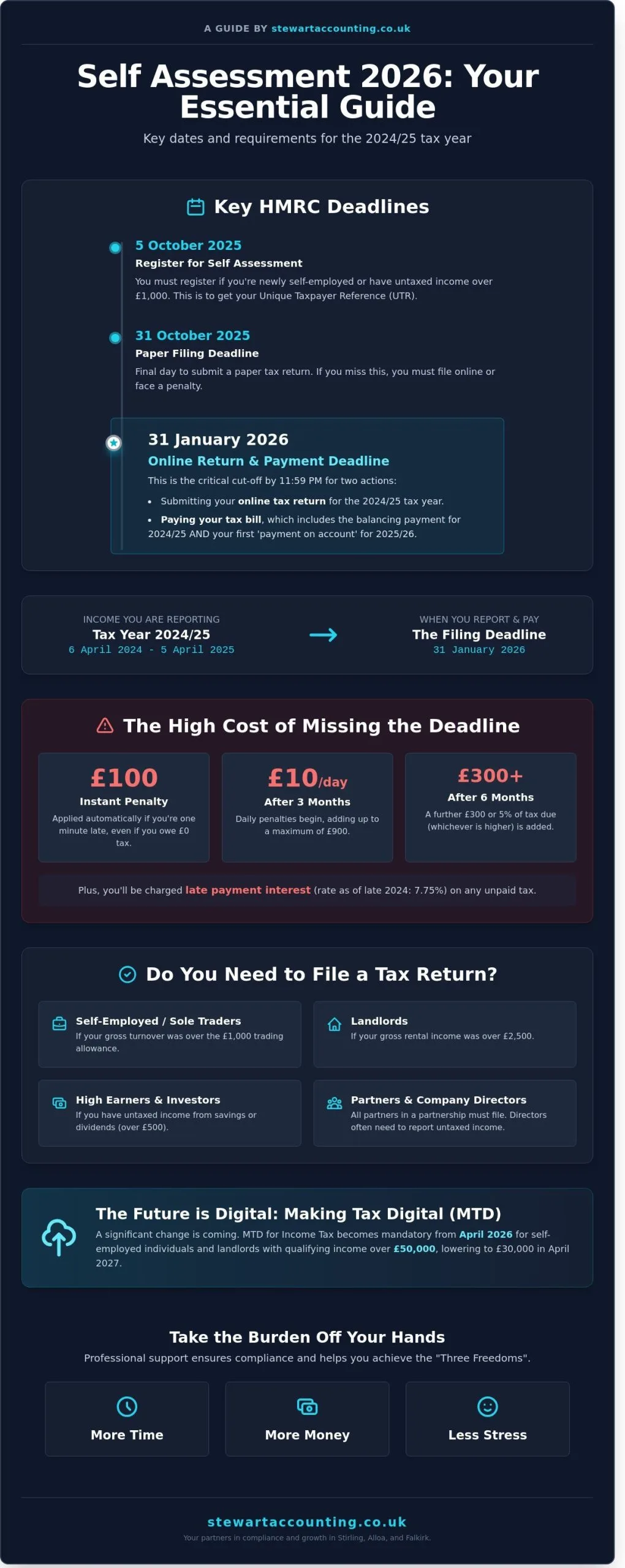
The most critical date for your calendar is 31 January 2026. By 11:59pm on this day, you must have submitted your online tax return for the 2024/25 period. It’s also the final date to pay any balancing payment for that year, along with your first payment on account for the following year. We’ve seen many sole traders in Alloa and Stirling get caught out by this double payment, so planning your cash flow early is vital. If you prefer to file by post, your window is much shorter. The paper filing deadline is 31 October 2025. If you miss that, you must file online or face an immediate fine.
If you’re new to being self-employed or have started receiving untaxed income over £1,000, you must register for Self Assessment by 5 October 2025. This gives HMRC time to set up your records and send your Unique Taxpayer Reference (UTR). Without this 10-digit code, you can’t file your return. Waiting until January to request it is a recipe for a penalty. Our team of Chartered Accountants often takes this registration process off your hands to ensure you’re set up correctly from the start.
Understanding the 2024/25 vs 2025/26 Tax Years
The UK tax return system operates on a backward-looking cycle. The return you file in January 2026 covers income earned between 6 April 2024 and 5 April 2025. This system allows you to calculate your total liability after the year has ended, but it can be confusing for new business owners in Central Scotland. While you’re working in the 2025/26 year, you’re actually paying for the previous one. This lag is why we recommend keeping digital records throughout the year. It makes the transition between tax years smooth and predictable.
The Consequences of Missing the 31 January Cut-off
HMRC doesn’t have a sense of humour about lateness. If you’re even one minute past the midnight deadline, an automatic £100 penalty is issued. It doesn’t matter if you owe £10,000 or £0; the fine remains the same. After three months, the costs escalate quickly. HMRC charges £10 for every additional day you’re late, up to a maximum of £900. At the six-month mark, you’ll be hit with another £300 fine or 5% of the tax due, whichever is higher.
Beyond the flat penalties, you’ll pay interest on any unpaid tax. As of late 2024, the HMRC late payment interest rate sits at 7.75%, which can significantly increase your debt over just a few months. Reasonable excuses like your computer failing or being too busy are rarely accepted. HMRC expects you to have a backup plan. By letting us handle your filing, you remove that risk entirely. We ensure everything is submitted accurately and on time, protecting your money and your peace of mind.
Who Must File a Self Assessment Tax Return in 2026?
Identifying whether you need to submit a return is the first step in avoiding penalties. While many people assume their employer handles everything through PAYE, thousands of taxpayers fall into categories that require manual reporting. If you’ve had a change in circumstances between 6 April 2024 and 5 April 2025, you might be surprised to find yourself on the list.
The primary groups required to file include:
- Self-employed individuals and sole traders: If your gross turnover exceeded £1,000 during the tax year, you must register. This £1,000 limit is your “trading allowance”; anything above this requires a formal report to HMRC, even if your expenses meant you didn’t actually make a profit.
- Landlords: If you received more than £2,500 in rental income from a property, or between £1,000 and £2,500 if you’ve asked HMRC to collect it through your tax code, you’ll need to file. This applies to holiday lets and long-term residential rentals alike.
- High earners: For the 2024/25 tax year, HMRC removed the requirement for individuals earning up to £150,000 to file a return if their only income is through PAYE. However, if you have untaxed interest, dividends, or other complex income, you remain within the scope of the self assessment deadline 2026.
- Partners and Directors: All partners in a business partnership must file. Directors of limited companies usually need to file if they receive income that isn’t taxed at source, such as dividend payments exceeding the current £500 tax-free allowance.
Common Triggers You Might Not Expect
You might be surprised by what triggers a tax return requirement. Since January 2024, online platforms like eBay, Vinted, and Airbnb share data directly with HMRC. If your “side hustle” income exceeds the £1,000 threshold, you’re officially a trader in the eyes of the law. Additionally, the High Income Child Benefit Charge threshold changed on 6 April 2024. If you or your partner earned over £60,000 while claiming Child Benefit, you must file to pay the charge. Selling assets like a second home or cryptocurrency also requires a return if the gains exceed your annual Capital Gains Tax allowance.
The Registration Process for New Taxpayers
If you’ve never filed before, don’t wait until the last minute. You need to register for Self Assessment to receive your Unique Taxpayer Reference (UTR) number. This ten-digit code is essential for every piece of correspondence with the tax office. Once you apply, HMRC sends an activation code through the post, which can take up to 10 working days to arrive. During peak periods, these delays often stretch longer, potentially causing you to miss the self assessment deadline 2026.
Wait times for UTR numbers often peak in December. We recommend starting this process at least three months before the deadline to ensure you aren’t stuck waiting for the postman while the clock ticks. To make things easier, we can help you get registered and filed without the usual stress. You can find the full list of official HMRC Self Assessment Deadlines on the government website to stay on track and avoid unnecessary fines.
Scottish Tax Rates and Allowances: What is Different in 2026?
Living in Central Scotland means your tax return follows a specific set of rules. Whether you are based in Alloa, Stirling, or Falkirk, you pay Scottish Income Tax on your earnings. This system uses more bands than the rest of the UK. For the 2025/26 tax year, which you will report on by the self assessment deadline 2026, the Scottish Government has maintained its distinct six-band structure. While the UK Basic Rate sits at a flat 20%, Scottish taxpayers navigate a ladder that starts at 19% for the Starter Rate and climbs to 48% for the Top Rate.
Most residents still benefit from the UK-wide Personal Allowance of £12,570. This means you don’t pay tax on your first £12,570 of earnings unless your total income exceeds £100,000. For the 2025/26 period, the Scottish Government confirmed that the Higher Rate threshold remains frozen at £43,662. This creates a “fiscal drag” where more taxpayers find themselves in the 42% bracket as their earnings grow. Understanding these specific numbers is vital for your cash flow planning before the 2026 filing season begins.
Why Your Postcode Matters for Your Tax Bill
HMRC identifies your tax status based on your main place of residence. If you spend more than half the year in Scotland, your tax code will usually feature an “S” prefix. This indicates that your tax is calculated using the rates set at Holyrood. The Scottish Rate of Income Tax is a devolved power of the Scottish Parliament. Even though your rates differ from someone in London, the actual Official HMRC Self Assessment Deadlines apply to everyone across the UK equally. Missing these dates leads to automatic £100 penalties, which grow the longer you wait.
Maximising Allowable Expenses in Scotland
Reducing your tax bill legally is the best way to keep more money in your pocket. To do this, you must understand the “wholly and exclusively” rule. This means any cost you claim must be purely for business purposes. If an expense has a dual purpose, like a mobile phone used for both work and personal calls, you can only claim the business portion. For sole traders in Central Scotland, common deductible expenses include:
- Home office costs: Calculated by room usage or a simplified flat rate.
- Travel expenses: Fuel, parking, and train fares, excluding your regular commute.
- Equipment: Laptops, software, or specialist tools needed for your trade.
- Professional fees: Insurance, marketing costs, and accounting subscriptions.
Identifying every possible relief is where the most significant savings are found. A local Chartered Accountant understands the specific interaction between Scottish rates and UK-wide allowances. We take this complex task off your hands, ensuring you don’t overpay while meeting every requirement for the self assessment deadline 2026. This gives you more time to focus on your business and less time worrying about HMRC. Our goal is to provide the freedom of more time, more money, and less stress for every client we support.
Preparing for Making Tax Digital (MTD) for Income Tax 2026
While you focus on the self assessment deadline 2026 on 31 January, a much larger shift in the UK tax system is approaching. From 6 April 2026, Making Tax Digital (MTD) for Income Tax officially begins. This isn’t just a minor update to how you submit forms; it’s a total overhaul of the relationship between small businesses and HMRC. For many, the 2026 tax return represents the final time they’ll use the traditional annual filing method before moving to a quarterly digital system.
The new rules apply to self-employed individuals and landlords with a total qualifying income of more than £50,000. HMRC estimates that roughly 1.6 million taxpayers will fall into this first wave of the rollout. Instead of one single filing per year, you’ll be required to send four quarterly updates of your business income and expenses. This change aims to provide a more real-time view of tax liabilities, helping you avoid the shock of a large, unexpected bill at the end of the year.
At Stewart Accounting, we understand that this transition feels daunting. Our goal is to give you more time, more money, and more mind by stripping away the stress of these new regulations. We’ve spent years helping clients in Alloa, Stirling, and Falkirk transition to digital systems, and we’re ready to do the same for you. Preparing well before the self assessment deadline 2026 ensures you aren’t caught out when the mandatory digital window opens in April.
The 2026 MTD Roadmap for Small Businesses
The rollout follows a strict timeline based on your annual turnover. On 6 April 2026, those earning over £50,000 must comply. Just one year later, in April 2027, the threshold drops to £30,000. You must use “functional compatible software” like Xero or QuickBooks to record every transaction. These tools allow you to submit quarterly summaries directly to HMRC. This new rhythm means your bookkeeping must be kept up to date every month, rather than being a once-a-year task in January.
Getting Your Records Ready Now
Success under MTD requires moving away from spreadsheets and paper receipts immediately. Keeping digital records is now a legal requirement for those above the threshold. We provide tailored Xero training and ongoing support to ensure your transition is smooth and easy. Making Tax Digital aims to reduce the “tax gap” by minimising manual entry errors. By automating your bank feeds and using receipt-scanning apps, we help you achieve greater accuracy while taking the administrative burden off your hands.
If you’re worried about how these changes will impact your business operations, we can help you get ahead of the curve. Contact Stewart Accounting today to discuss how we can manage your transition to MTD and secure your financial peace of mind.
How Stewart Accounting Takes the Tax Burden Off Your Hands
Managing your own taxes often feels like a second full-time job that you never applied for. At Stewart Accounting Services, we believe you should focus on what you do best while we handle the complex numbers. Our mission is built around the “Three Freedoms” that every business owner deserves. We want to give you more time to spend with your family, more money in your pocket through efficient tax planning, and more mind by removing the anxiety of HMRC compliance. For many small business owners, the stress of the self assessment deadline 2026 can begin months in advance; we aim to eliminate that worry entirely.
We provide a tailored service specifically for sole traders and landlords across Central Scotland. Whether you are based in Alloa, Stirling, or Falkirk, you get a dedicated partner who understands the local economic environment. While “DIY” accounting software is popular, it cannot replace the professional insight of a Fully Qualified Chartered Accountant. Software might help you record a transaction, but it won’t tell you if you’re overpaying tax or missing out on vital reliefs. We have seen clients save an average of 15% more on their tax bills simply by switching from basic software to our professional oversight.
Beyond Compliance: Tax Planning and Business Growth
We don’t just look at your receipts once a year. Our team takes a “big picture” approach to help you achieve your personal and business goals. By maintaining year-round support, we identify growth opportunities and tax-saving strategies long before the year ends. Our local presence in the Alloa Business Centre and Stirling means you can always drop in for a face-to-face chat. We aren’t a faceless online firm; we are a community-based partner invested in your success. This proactive approach ensures you never face a surprise bill when the tax season arrives.
Your 2026 Tax Return Checklist
To ensure you meet the self assessment deadline 2026 without any last-minute panic, you should start gathering your documentation as early as possible. Having these items ready allows us to take the entire process off your hands, ensuring accuracy and peace of mind. You should prepare:
- P60 or P45 forms from any employment held during the tax year.
- Bank interest certificates and dividend vouchers.
- Detailed records of business expenses and digital copies of receipts.
- Records of personal pension contributions and gift aid donations.
- Details of any rental income or capital gains from property sales.
By letting us manage these details, you gain the freedom to run your business without HMRC’s calendar dictating your life. We’ve helped over 500 local clients navigate their tax obligations since our inception, ensuring they stay compliant while maximising their take-home pay. Don’t leave your finances to chance or basic software that doesn’t understand your unique situation. Book your Self Assessment consultation today for a free, no-obligation discussion about your requirements in Alloa, Stirling, or Falkirk.
Take Control of Your Finances Before the 31 January Deadline
Missing the self assessment deadline 2026 results in an immediate £100 penalty from HMRC. With Making Tax Digital (MTD) requirements launching for many in April 2026, the complexity of managing your records is set to increase. Our Fully Qualified Chartered Accountants specialise in supporting small businesses and landlords across Central Scotland, ensuring every allowance is claimed and every regulation is met. We operate from our dedicated offices in Alloa, Stirling, and Falkirk to provide a personal, local service that removes the weight of compliance from your shoulders.
By letting our experts handle your filings, you gain the “three freedoms” we promise every client: more time, more money, and much less stress. We’ll take the tax burden off your hands, allowing you to focus on growing your business while we ensure your 2026 submission is accurate and on time. Don’t wait until the January rush to sort your paperwork. Let us take the stress out of your 2026 tax return. Contact Stewart Accounting today.
You’ve worked hard for your money; we’re here to help you keep more of it while staying completely compliant.
Frequently Asked Questions
What is the exact date for the Self Assessment deadline 2026?
The final self assessment deadline 2026 for online submissions is midnight on 31 January 2026. If you prefer to submit a paper return, you must ensure it reaches HMRC by 31 October 2025. We recommend filing your return well before these dates to give you more mind and less stress as the new year approaches.
What happens if I miss the 31 January 2026 tax deadline?
You’ll face an immediate £100 fixed penalty from HMRC if you miss the 31 January 2026 deadline, even if you’ve no tax to pay. If your return is 3 months late, HMRC adds daily fines of £10 for up to 90 days, totalling £900. Our team helps you avoid these charges by taking the compliance burden off your hands early.
Can I file my tax return early and do I have to pay immediately?
You can file your return as early as 6 April 2025, but you don’t have to pay your tax bill until 31 January 2026. Filing early gives you more time to budget for your payment and removes the last-minute January panic. It’s a simple way to gain one of our three freedoms: more peace of mind.
Do I need to file a tax return if I only have a small side hustle?
You only need to file a return if your side hustle gross income exceeds £1,000 during the 2024/25 tax year. This “Trading Allowance” means you don’t need to report smaller amounts to HMRC. If you earn £1,001 or more, you must register for Self Assessment and submit your figures by the self assessment deadline 2026.
What information do I need to provide to my accountant for my 2026 return?
You should provide your P60, P11D, business expense receipts, and bank statements covering 6 April 2024 to 5 April 2025. Include details of any pension contributions or charitable donations to ensure we claim all available tax relief. Having these documents ready allows us to file your return efficiently and maximize your “more money” freedom.
How much does it cost to have a Chartered Accountant file my Self Assessment?
Our fees for a standard Self Assessment start from £250 plus VAT, depending on the complexity of your financial affairs. For a bespoke quote tailored to your business in Alloa, Stirling, or Falkirk, we’ll review your specific requirements. Investing in a Chartered Accountant ensures accuracy and often saves you more than the fee through professional tax planning.
Is the Scottish tax rate higher than the rest of the UK for 2026?
Yes, Scottish taxpayers often pay different rates, such as the 21% intermediate rate or the 42% higher rate for income above £43,662. These thresholds differ from the rest of the UK where the basic rate remains 20%. We’ll calculate your exact liability based on current Scottish Government legislation to ensure you pay the correct amount.
What is Making Tax Digital and does it affect my 2026 tax return?
Making Tax Digital (MTD) for Income Tax starts on 6 April 2026 for individuals with qualifying income over £50,000. While it won’t change your 2026 filing process for the 2024/25 year, you’ll need to prepare for quarterly digital updates shortly after. We’re already helping clients in Central Scotland transition to compatible software to make this shift smooth.
Recent Posts
22 Oct, 2026
21 Oct, 2026