

VAT Bad Debt Relief: A Practical Guide for UK SMEs
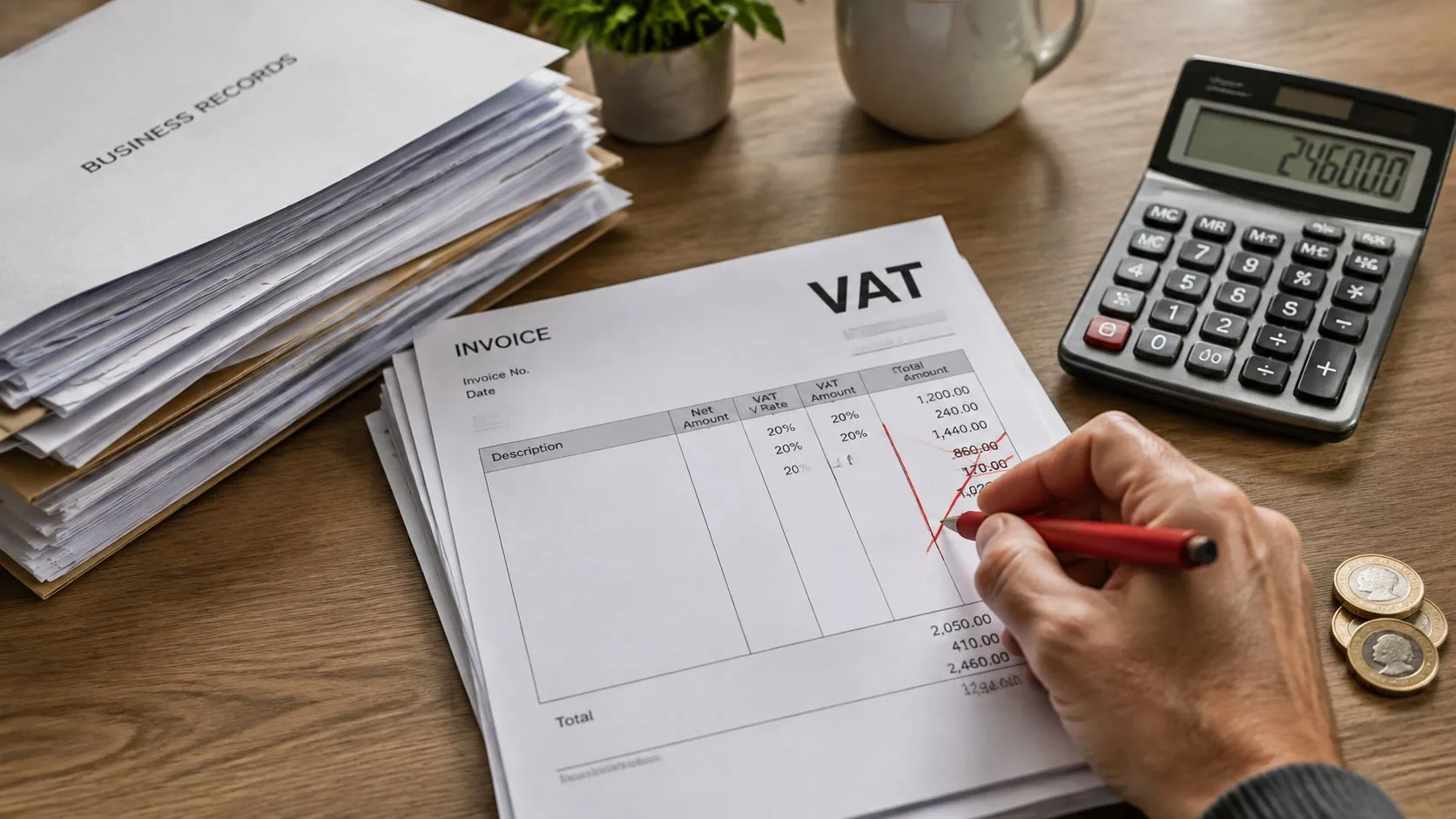
An unpaid invoice doesn't become harmless just because you've stopped chasing it. A customer may have failed to pay, yet your business could already have funded the VAT on that sale. For a VAT-registered SME working with tight cash reserves, that can turn one bad commercial decision into a direct working-capital problem.
VAT bad debt relief exists to recover the VAT you've already accounted for on a qualifying unpaid supply. HMRC's rules are procedural, with strict conditions, deadlines, accounting records and VAT Return treatment. The relief isn't automatic, and a careless journal entry or premature claim can create an avoidable compliance problem.
Why Unpaid Invoices Cost You More Than the Invoice Amount
A £12,000 invoice can leave your business funding £2,000 of output VAT before the customer pays a penny. Once collection efforts fail and the debt is written off, the loss includes the missing sale proceeds and the tax already paid to HMRC.
That is the cash-flow consequence of standard VAT accounting. Your business accounts for output VAT when the supply is made, while the customer may pay much later, or never. Before writing off the full balance, check whether VAT bad debt relief can return the VAT element on a qualifying unpaid supply. HMRC's bad debt relief notice explains the claim mechanism.
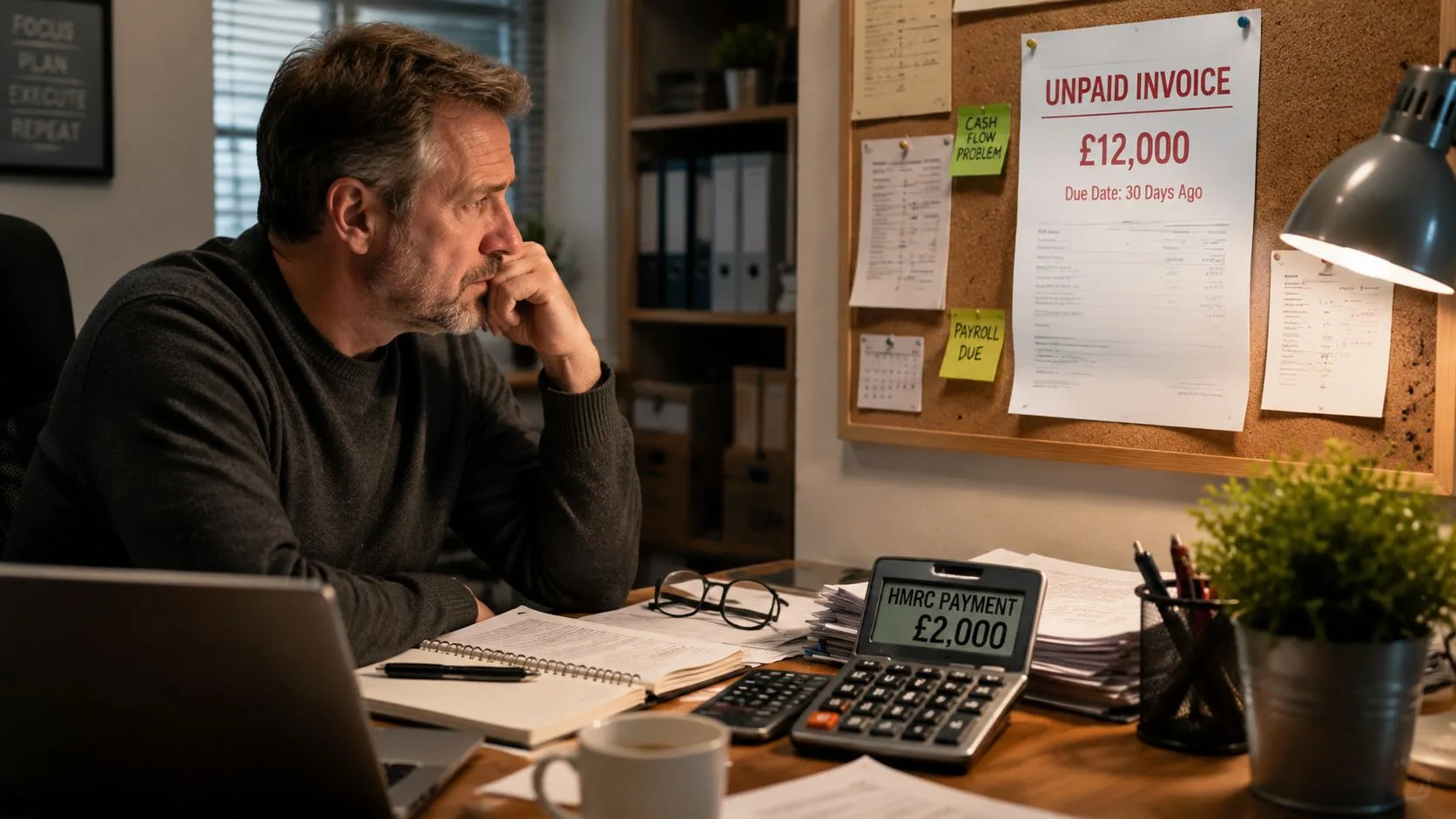
The relief reduces a two-part loss to the unpaid net sales value. It does not recover the customer's debt, but it can return VAT that your business funded without receiving the related payment.
Cash-flow principle: If your business paid VAT on money it never received, review bad debt relief before treating the entire invoice as irrecoverable.
The claim depends on precise records and timing. The debt must remain unpaid for at least six months, measured from the later of the due date or the date of supply. The claim generally must be made within four years and six months of that same later date, as HMRC confirms in Notice 70018. Your business must also have accounted for and paid the VAT, written off the debt in its day-to-day VAT accounts, and transferred the amount to a separate bad debt account.
Those journal entries matter. Keep the original customer balance identifiable, post the VAT adjustment to the bad debt relief account, and retain the invoice, payment history and write-off evidence. A general provision or an unexplained ledger reduction does not show that the required process was followed.
Statutory entitlement requires precise compliance. A written-off invoice does not automatically produce a VAT repayment, and an incomplete accounting trail can delay or undermine the claim.
Recovered VAT can help fund wages, supplier payments or the next VAT liability. If unpaid invoices are putting wider pressure on working capital, review collection and funding options, including the HireAccountants cash flow solution. Ensure your bookkeeping team also understands input VAT versus output VAT so the adjustment is posted to the correct tax account.
Eligibility Criteria You Must Meet Before Claiming
Eligibility requires satisfying every listed condition before any adjustment is submitted. Check the evidence first, then post the accounting entries and prepare the VAT Return adjustment.
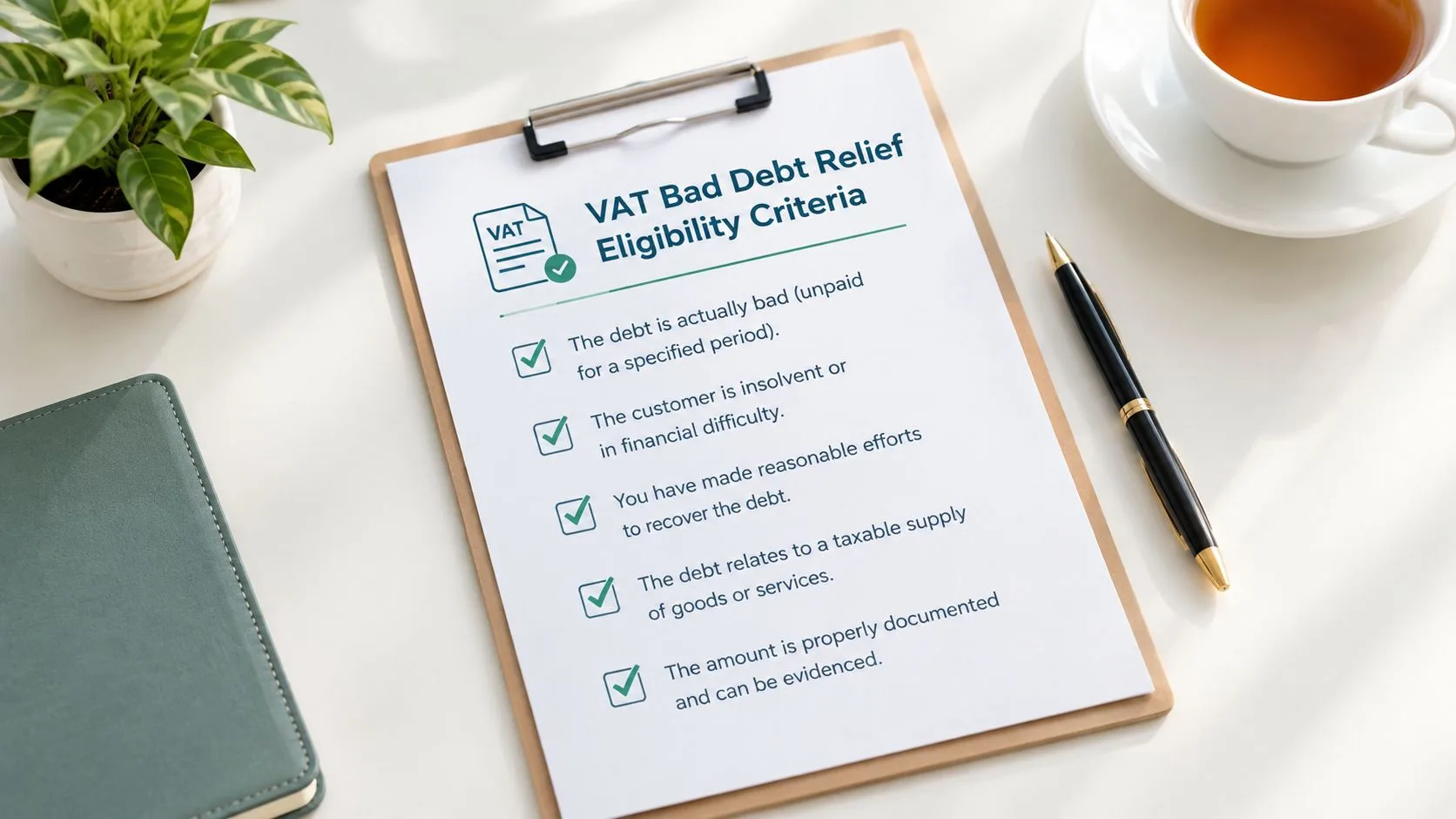
Confirm the original VAT treatment
The supply must have taken place, and your business must have accounted for and paid the VAT to HMRC. You cannot reclaim VAT that was never declared as output tax on a submitted VAT Return.
Begin with the original invoice and the VAT Return on which it was declared. Retain the sales ledger entry, invoice, payment history and evidence that the VAT was included in your accounts. If the invoice was never correctly declared, bad debt relief cannot correct that error.
Measure the waiting period correctly
The debt must have remained unpaid for at least six months, calculated from the later of:
- The payment due date, stated or established under the agreed terms.
- The date of supply, if that date falls later.
Counting from the invoice date alone can produce an early claim. If the invoice was issued before the agreed payment date, the six-month period does not necessarily start on the invoice date. Record the later date, calculate the waiting period from it and retain the working paper.
The claim generally must be made within four years and six months of that same later date. Your aged-debt review should record both the earliest claim date and the final date for submission. Keep this timetable with the invoice and write-off approval, following the requirements in HMRC's official bad debt relief guidance.
Write off the debt in the correct accounts
A sales ledger reduction alone does not meet the accounting requirement. Write the debt off in your day-to-day VAT accounts and transfer it to a separate bad debt account. The separate account should identify the customer, invoice, gross debt, VAT element and write-off date.
Use a clear journal entry:
- Debit: Bad Debt Relief Account, gross unpaid amount.
- Credit: Sales Ledger Control Account, gross unpaid amount.
This creates the audit trail needed to connect the VAT adjustment with the original transaction. An HMRC officer should be able to trace the return figure to the bad debt account, invoice, payment history and proof that the VAT was declared and paid. Do not use a vague general provision or an unexplained ledger reduction.
Check assignment and debtor circumstances
The debt must not have been sold or factored under a valid legal assignment. If another party acquired the legal right to collect it, the normal relief conditions may not apply.
Investigate whether the customer was insolvent at the time of supply. Insolvency can change the evidence available and disrupt the usual claim process, so document the administrator, liquidator or other relevant correspondence. Deregistration can also complicate contact and records, making your invoice, payment history and write-off evidence more important.
A claim should proceed only after the complete set of conditions is documented. If any requirement remains unresolved, hold the adjustment and obtain advice before submitting it.
How to Claim VAT Bad Debt Relief on Your VAT Return
The claim succeeds or fails in the bookkeeping. Before adjusting the VAT Return, gather the original invoice, payment history, collection correspondence, write-off approval and the return period in which the conditions were met. Keep these records together so an HMRC officer can trace the claim without reconstructing your files.
Post the write-off before touching the return
Move the gross unpaid balance from the sales ledger to a separate bad debt account. Use a journal entry that records the full amount:
- Debit: Bad Debt Relief Account, gross unpaid amount.
- Credit: Sales Ledger Control Account, gross unpaid amount.
Record the customer, invoice number, supply date, due date, gross debt, VAT element and write-off date in that account. A vague provision or an informal spreadsheet note does not satisfy HMRC's record-keeping requirement for a separate bad debt account. Your bookkeeping system must also let you reconcile the entry to the customer ledger and original invoice.
This journal proves the commercial write-off. It does not, by itself, recover the VAT.
Calculate only the VAT element
For a VAT-inclusive invoice charged at the standard 20% VAT rate, calculate the VAT element using the 1/6 fraction. Check the result against the original invoice, especially where the invoice includes supplies with different VAT treatments.
For example, a £5,000 gross invoice including £1,000 VAT contains £1,000 of claimable VAT, provided the full balance qualifies. The gross debt is removed from the sales ledger, while the VAT element is entered in Box 4.
| Step | Action | Debit | Credit | VAT Return Impact |
|---|---|---|---|---|
| 1 | Write off the unpaid gross invoice | Bad Debt Relief Account, £5,000 | Sales Ledger Control Account, £5,000 | No immediate VAT Return entry |
| 2 | Identify the VAT previously paid to HMRC | Review original VAT records, £1,000 | Not applicable | Confirm the claimable VAT |
| 3 | Submit the eligible claim | Not applicable | Not applicable | Add £1,000 to Box 4 |
| 4 | Reconcile the claim | Match invoice, write-off and return | Not applicable | VAT liability falls by the claimed VAT amount |
Put the claim in Box 4
Enter the eligible amount in Box 4 of the VAT Return for the period in which the conditions are met. Box 4 is the input tax box. Keep the original output tax figure and sales invoice unchanged.
A standard claim does not require a separate application or prior HMRC approval. Retain the supporting records for four years from the claim, in line with HMRC's bad debt relief guidance.
Bookkeeping rule: The journal entry proves the write-off. Box 4 records the VAT recovery. Keep both records aligned.
Submit the claim on the first VAT Return after every condition is satisfied. Before filing, check the write-off date, the VAT originally declared and paid, the amount still outstanding, and the Box 4 adjustment. For the distinction between different forms of input VAT recovery, see this explanation of whether businesses can reclaim input VAT. If the VAT treatment sits within a wider tax issue, Wisely's tax expertise may help you review the position.
Handling Partial Payments Credit Notes and Insolvency
When a customer pays £2,000 of a £6,000 invoice before default, the relief calculation changes entirely. Claim only against the unpaid balance, and make the accounting trail show how you reached it.
Partial payments
An invoice of £6,000 including £1,000 VAT with a £2,000 payment leaves £4,000 outstanding. Applying the original VAT-inclusive proportions, the unpaid balance contains £666.67 of VAT. The payment must be allocated consistently against the invoice, rather than leaving the full VAT figure available for recovery.
Your working paper should show the original gross amount, payment received, balance written off and VAT fraction used. The journal should transfer the eligible debt to a separate bad debt account, while the customer ledger records the payment and remaining balance. Do not claim the original £1,000, because that would recover VAT on value the business has already received.
Credit notes and later recoveries
A credit note reduces the amount owed. If you issue one after claiming relief, recalculate the eligible debt and correct the VAT adjustment. The credit note, revised customer ledger, journal and VAT Return correction must agree.
A later payment reverses part of the relief. Return the VAT relating to the recovered amount to HMRC as output tax. Keep post-claim receipts on a separate schedule, with the invoice, receipt date and VAT restored, so the adjustment is not missed during a busy VAT period.
Insolvency and deregistration
Administration or liquidation does not automatically block a claim. Preserve insolvency correspondence, statements of affairs, creditor notices and the customer ledger. Those records support the write-off and explain why the balance remained unpaid.
HMRC's internal manual confirms that a creditor can claim on its VAT Returns while its VAT registration remains open. Deregistration changes the route. Form VAT426 applies where a VAT-registered business has deregistered and is claiming bad debt relief after cancellation. Form VAT427 applies where the business is still registered but cannot include the claim on a VAT Return because the registration is being cancelled or has otherwise ended, subject to the form's stated circumstances. Check the current form instructions before filing, and do not assume both forms are interchangeable.
The claim window also needs precise treatment. The debt must remain unpaid for the required six months from the later of the payment due date or the date of supply. The claim must then be made within four years and six months from that later date. The six months is the eligibility waiting period, not an extra six-month extension added to the four-year claim deadline. Confirm the calculation against paragraph 7.7 of HMRC's Notice 70018.
| Scenario | Impact on Claim | Required Action |
|---|---|---|
| Partial payment received | Relief is limited to the unpaid balance | Recalculate the VAT proportion and retain the payment allocation |
| Credit note issued after claim | The eligible debt and relief may be reduced | Adjust the customer ledger and correct the VAT treatment |
| Debtor enters insolvency | A claim may still be possible | Retain insolvency evidence and follow the eligibility process |
| Creditor remains VAT-registered | Claim can generally be made on the VAT Return | Use Box 4 and retain the supporting records |
| Creditor deregisters before claiming | The standard VAT Return route is unavailable | Confirm whether VAT426 or VAT427 applies |
| Customer pays after relief | VAT on the recovered amount becomes payable | Include the relevant output tax in a later VAT Return |
If customers pay at different points in the sales cycle, assess whether VAT cash accounting would improve cash-flow timing for future invoices. It cannot rewrite an existing bad debt claim.
Three Documentation Failures That Prompt HMRC Enquiries
An unpaid invoice becomes a risky VAT claim when the dates, ledger and VAT calculation cannot be reconstructed. HMRC can trace a Box 4 entry through the VAT Return, nominal ledger, customer account and original supply, so prepare the evidence before submitting the claim.

1. The dates do not support the claim
Do not claim until the debt has remained unpaid for the required six months, measured from the later of the contractual due date or the supply date. Counting from the invoice date is a common error, particularly where payment terms were agreed separately. Keep the contract, invoice and calculation together so the qualifying date is clear.
The claim also has a four-year-and-six-month deadline. An aged-debt report should identify both the date when relief becomes available and the final date for claiming. The timing rules and calculation method are set out in HMRC's Notice 70018.
2. The accounting trail is incomplete
HMRC expects a dedicated bad debt account, not a vague provision or an informally marked ledger entry. Post the transfer in the nominal ledger, record the date of the write-off, and link the gross debt and VAT amount to the original invoice.
Retain:
- Original VAT evidence: The invoice and VAT Return showing the output tax declared and paid.
- Payment history: The customer ledger and evidence of any partial settlement.
- Recovery records: Reminders, correspondence and collection activity.
- Write-off approval: The journal entry and approval supporting the transfer to the separate account.
- Return reconciliation: A schedule tying each invoice and VAT calculation to the Box 4 claim.
3. The VAT figure is unsupported
Claim only VAT that was declared and paid on the relevant supply. Review debts sold or factored under a valid legal assignment, and check whether a later customer payment or credit note changes the amount claimed.
Deregistration creates a separate process issue. HMRC's VBDR3100 guidance explains that a business unable to claim through a VAT Return may need to use the prescribed post-deregistration claim route, rather than treating deregistration as permission to make a normal Box 4 adjustment. Confirm the correct form and retain the records supporting eligibility.
A clean schedule should explain every invoice, calculation and journal entry. If another accountant cannot reproduce the claim from the ledger and invoice file, the documentation is not ready.
When to Seek Professional Help With Your Claim
Handle a straightforward claim internally when one invoice has clear payment terms, no partial payment, no credit note, no assignment and a complete accounting trail. Before filing, confirm the later qualifying date, post the transfer to a separate bad debt account, and reconcile the VAT adjustment with Box 4.
Bring in a specialist when insolvency proceedings, partial settlements, disputed balances, connected invoices or impending VAT deregistration complicate the facts. These events can disrupt the standard claim process, change the recoverable amount or require a route outside an ordinary VAT Return adjustment.
A specialist should test the dates, separate eligible from ineligible balances, review the journal entries and assemble the supporting evidence. Ask for a schedule that links each invoice, payment, write-off and VAT calculation to the ledger. The adviser must also confirm that the claim remains available if the customer enters insolvency or your business deregisters before the adjustment is made.
Stewart Accounting Services can handle VAT Return preparation, bookkeeping and cash-flow support for SMEs, including the accounting records behind a bad debt relief claim. A CPA firm newsletter agency may help organise compliance updates, but it does not replace the invoice file, journal evidence or eligibility review.
Review aged receivables before the next VAT Return. Flag cases involving insolvency, partial payment or deregistration early, and have an accountant verify the schedule and entries before submission. This protects the recovery and reduces avoidable HMRC correspondence.
Recent Posts
04 Oct, 2026
04 Oct, 2026
04 Oct, 2026