

What Business Insurance Advice Do Startups Need to Protect Their Future?

What if the £50 you decided to “save” this month by skipping a policy ended up costing your business £50,000 in legal fees next year? Starting a new venture in Central Scotland is an exciting journey, but it’s completely normal to feel overwhelmed by the mountain of legal requirements and confusing industry jargon. Whether you’re based in Alloa, Stirling, or Falkirk, the fear of missing a mandatory regulation or getting tangled in “PI vs PL” terminology can keep any ambitious founder awake at night. We understand that you want to focus on your vision, not on the stress of potential litigation or unexpected costs.
Getting the right business insurance advice for startups early on is the best way to move from a place of worry to a place of total confidence. You’ve worked hard to build your foundation, and you deserve the peace of mind that comes with being fully protected. This guide will strip away the complexity to show you exactly which covers are legally required, which ones protect your growth, and how to claim these costs as tax-deductible expenses. We’ll provide a clear roadmap of mandatory versus optional insurance so you can protect your future while keeping your finances lean and efficient.
Key Takeaways
- Identify which legal coverages, such as Employers’ Liability, are mandatory for UK startups to ensure immediate compliance and avoid costly penalties.
- Understand how to treat premiums as a “wholly and exclusively” business expense to maximize tax efficiency and keep your bookkeeping accurate.
- Discover why tailored business insurance advice for startups is the key to navigating the critical regulatory changes arriving in 2026.
- Learn how to assess your unique risk profile to secure high-quality, A-rated protection that fits your budget without paying for unnecessary extras.
- Find out how professional guidance helps you achieve the “Three Freedoms” by taking the stress of the unknown off your hands so you can focus on growth.
What Is the Essential Business Insurance Advice for UK Startups in 2026?
Starting a new venture in Scotland is an exciting journey, but it comes with a unique set of financial and operational hurdles. Business insurance acts as a vital risk management tool, designed to protect your assets and future earnings from unexpected events. As we move into 2026, the regulatory environment in the UK has tightened, making early adoption of the right policies essential for staying compliant. At Stewart Accounting Services, we focus on giving you more time, more money, and more mind (less stress!!!!!!) by providing the practical business insurance advice for startups you need to thrive. We believe in taking these complex tasks off your hands so you can focus on building your brand.
The 2026 business landscape requires a proactive approach. Digital record-keeping and real-time reporting mean that gaps in your protection are easier for authorities to spot. Getting your insurance right from day one isn’t just about safety; it’s about building a foundation of professional credibility. When you can prove you’re fully covered, you become a much more attractive partner for larger contracts and high-value clients.
The Legal Reality: What You Cannot Ignore
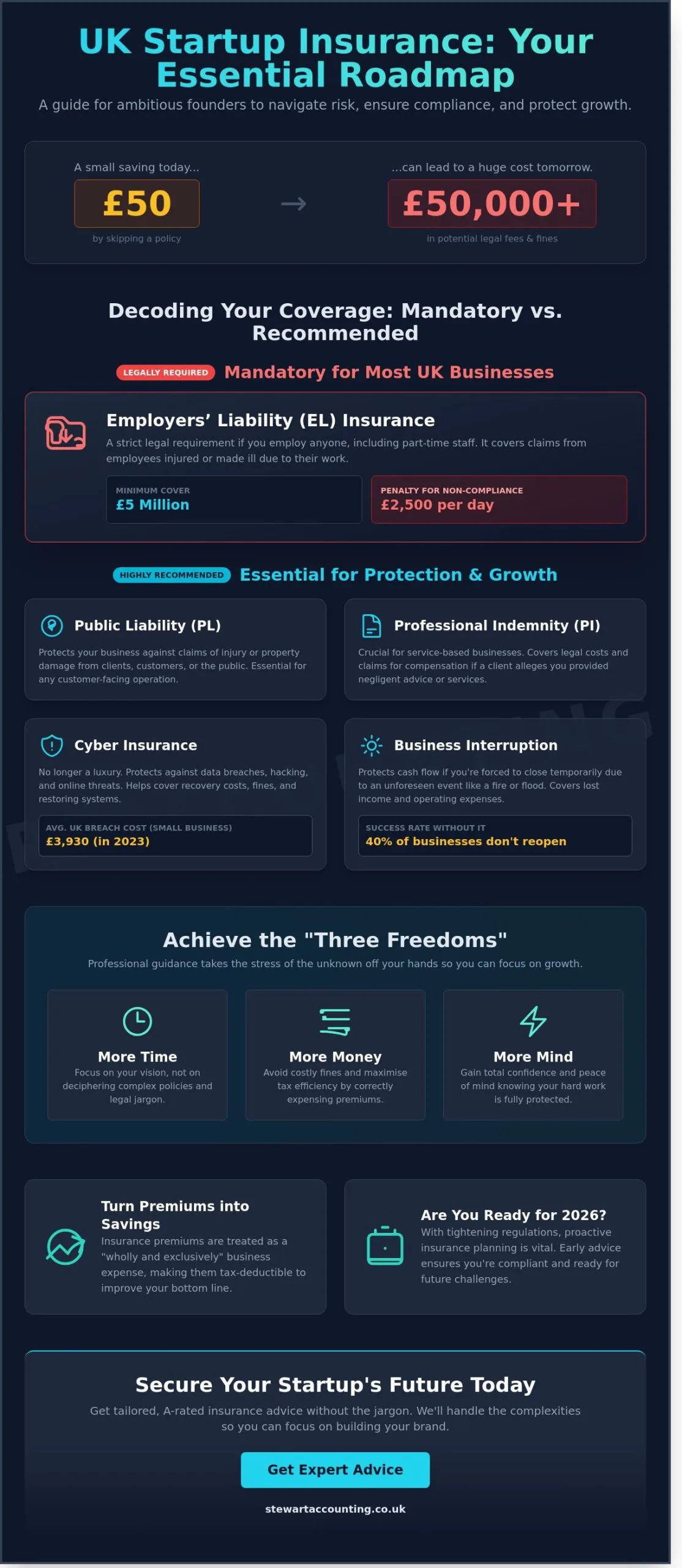
While many types of cover are optional, Employers’ Liability (EL) insurance is a strict legal requirement for almost every UK business with employees. If you hire even one person, including part-time staff or contractors, you must have EL insurance to cover claims from employees who are injured or become ill because of their work. Failure to comply leads to devastating financial consequences. HMRC and the Health and Safety Executive (HSE) can issue fines of up to £2,500 for every single day you aren’t properly insured. In 2026, the legal requirement for EL insurance remains the most critical compliance hurdle for any new UK employer.
Commercial Risk vs. Legal Compliance
There’s a significant difference between what the law mandates and what your clients expect. For many Scottish startups in Stirling and Falkirk, having robust professional indemnity or public liability cover acts as a “seal of quality” that builds immediate trust. It shows you take your responsibilities seriously. Beyond legal requirements, you should consider Business interruption insurance to protect your cash flow if an unforeseen event stops you from trading. While not legally required, industry data suggests that roughly 40% of small businesses fail to reopen after a major disaster without this specific protection. Our local offices in Stirling and Falkirk see these risks firsthand, and we help you distinguish between them to ensure you get the right business insurance advice for startups without over-complicating your budget.
We know you’re busy growing your business. That’s why our approach is always about simplification. We help you identify which risks are worth covering and which ones you can manage internally. By getting the right protection early, you’re not just following the law; you’re securing the future of everything you’ve worked to build.
Which Types of Coverage Are Mandatory for a New Business?
Starting a new venture in Central Scotland is an exciting milestone, but the legalities often feel like a heavy burden. Getting the right business insurance advice for startups early on helps you avoid massive fines and protects your “three freedoms”: your time, money, and peace of mind. While it’s tempting to cut costs, certain protections aren’t optional. For most lean startups, the hierarchy of importance starts with legal mandates, followed by contractual requirements, and then risk-based digital protection.
Employers’ Liability (EL) is the only cover specifically required by UK law for any business with staff. Under the Employers’ Liability (Compulsory Insurance) Act 1969, you must have at least £5 million in cover. Failing to do so can result in Health and Safety Executive (HSE) fines of £2,500 for every single day you’re uninsured. Beyond EL, Public Liability (PL) is essential for customer-facing businesses, while Professional Indemnity (PI) protects consultants against claims of negligence or poor advice. For digital-first firms, Cyber Insurance is no longer a luxury. With the average cost of a UK cyber breach reaching £3,930 for small businesses in 2023, protecting your data is protecting your solvency.
Protecting Your People and the Public
Public Liability insurance is vital if you have a physical office in Stirling or Falkirk where clients visit. Imagine a visitor trips over a loose cable in your workspace; PL covers the legal fees and compensation costs. This SBA guide to business insurance provides a helpful overview of how these basic policies function to shield your assets. You must also remember that EL is required even if you only hire short-term contractors, part-time interns, or students on work placements. If you sell physical goods, Product Liability is your safety net against claims of injury or damage caused by a faulty item you’ve supplied.
Sector-Specific Specialized Cover
How Does Business Insurance Impact Your Startup’s Accounts and Tax?
Managing your startup’s finances effectively is about more than just tracking sales; it’s about protecting your hard-earned profit. This aligns directly with our “More Money” pillar of the Three Freedoms. When you seek business insurance advice for startups, you’ll find that insurance isn’t just a safety net. It’s a strategic financial tool that influences your tax position and cash flow management.
Insurance Premiums as Tax-Deductible Expenses
HMRC allows you to deduct business insurance premiums from your total income when calculating your taxable profit, provided the expense is “wholly and exclusively” for business purposes. For a limited company, this reduces your Corporation Tax bill. If you’re a sole trader, these costs lower your profits subject to Income Tax and National Insurance. Most business insurance is a tax-deductible expense because it protects the revenue-generating assets of the firm.
It’s vital to categorize these correctly in your bookkeeping software, such as Xero. Instead of grouping them with general “sundries,” create a specific “Insurance” account code. This clarity helps your accountant identify savings and ensures your year-end accounts are accurate. Unlike many other business purchases, you won’t see VAT on your insurance invoice. Instead, you’ll pay Insurance Premium Tax (IPT), which is currently 12% for most policies. Because IPT isn’t VAT, you can’t reclaim it on a VAT return, so the full amount you pay is recorded as the cost to the business.
Budgeting for Premiums in Your Cash Flow Forecast
Startups often face a choice between paying an annual lump sum or spreading the cost through monthly instalments. While paying annually is usually cheaper because it avoids interest charges, monthly payments can help maintain a healthier balance in your bank account during those lean early months. We always recommend including these figures in a detailed cashflow forecast to see which option suits your current runway.
How Can You Choose the Right Level of Protection Without Overspending?
Finding the balance between total safety and a lean budget is a major challenge for new founders. You don’t want to pay for “ghost” coverage that you’ll never use, but being underinsured is a gamble that could end your business before it starts. Getting the right business insurance advice for startups means looking beyond the monthly premium and focusing on your actual exposure.
Start by assessing your unique risk profile before you even look at a quote. You should compare at least three quotes from different providers, but always check that they are “A-rated” by agencies like A.M. Best or Fitch. This rating ensures the insurer has the financial strength to pay out if you make a claim. Review your levels every 12 months. A startup that grows its turnover from £50,000 to £500,000 in a year has a completely different risk profile that an old policy won’t cover.
Assessing Your Startup’s Unique Risk Profile
Your niche dictates your needs. A digital consultant in Falkirk has different liabilities than a manufacturer in Stirling. Use this checklist to identify your needs:
- Turnover: Higher revenue often leads to higher settlement expectations in legal disputes.
- Employee Count: If you have even one part-time staff member, Employers’ Liability insurance is a legal requirement in the UK with fines of up to £2,500 per day for non-compliance.
- Contractual Obligations: Check if your clients require a specific level of Professional Indemnity (often £1 million or £2 million) before signing.
According to Aviva’s 2023 Risk Insights Report, 40% of UK small businesses are underinsured. Using professional advice helps you avoid this trap by ensuring your “sums insured” actually reflect the current replacement cost of assets and potential legal fees.
Common Pitfalls: Jargon and Hidden Exclusions
Insurance jargon can be a headache. You’ll often see “Claims Made” versus “Claims Occurred” policies. A “Claims Made” policy must be active when the claim is filed, while “Claims Occurred” covers anything that happened during the policy period, even if you’ve since cancelled it. Choosing the wrong one can leave a gap in your history.
Don’t fall for the “doubling up” trap where your office insurance and professional indemnity both cover the same equipment. It’s wasted money. The cheapest quote is rarely the best value because it often hides high excesses or exclusions for specific types of work. Read the “Statement of Fact” document carefully. If it contains errors about your business activities, the insurer can void your entire policy.
Why Is Professional Advice the Key to Achieving the Three Freedoms?
At Stewart Accounting Services, our goal is to help you achieve the Three Freedoms: more time, more money, and more mind. For a new founder, “more mind” simply means less stress. You’ve already got enough on your plate without worrying about whether a single liability claim could wipe out your hard work. Seeking professional business insurance advice for startups isn’t just about compliance. It’s about building a safety net that lets you focus on what you do best. We want to ensure you aren’t bogged down by the “stress of the unknown” that haunts so many early-stage ventures.
Reducing Stress Through Comprehensive Risk Management
Having the right cover allows you to sleep better at night. We see our role as a proactive partner, not just a service provider. We want to take the administrative burden off your hands. When you know your risks are managed, you can stop reacting to potential emergencies and start focusing on sales and strategy. A 2023 study by the British Insurance Brokers’ Association highlighted that 40% of SMEs are underinsured. This often happens because founders guess their needs rather than consulting experts. We help you avoid being part of that statistic by ensuring your policies match your actual business activities and UK legal requirements, such as the Employers’ Liability (Compulsory Insurance) Act 1969. By letting us handle the technical details, you reclaim the mental energy needed to scale.
How Stewart Accounting Services Supports Your Growth
We don’t view insurance as a standalone cost or a “set and forget” task. Instead, we integrate it into our wider business growth services. When we prepare your year end accounts, we look at your overheads and risk profile holistically. This ensures your protection scales as your revenue grows. You won’t find yourself with outdated policies that no longer cover your expanded team or new equipment. Our local presence in Central Scotland provides a reassuring expert voice when you need it most. We aren’t a faceless call centre; we’re your neighbours in Alloa, Stirling, and Falkirk who understand the local market conditions.
Protecting your startup’s future shouldn’t be a guessing game. Our expert team is ready to help you audit your needs and streamline your financial health. Let’s make sure you have the right business insurance advice for startups to support your long-term ambitions. Book a free discovery call today at our offices in Alloa, Stirling, or Falkirk to get started. We’ll help you take the next step with confidence.
Secure Your Startup’s Path to Long-Term Success
Safeguarding a new venture requires a strategy that aligns with UK regulations and your specific financial goals. Remember that Employers’ Liability insurance is a legal necessity under the 1969 Act for almost every UK business with staff, with potential fines reaching £2,500 per day for non-compliance. Beyond legalities, the right coverage acts as a vital shield for your balance sheet. It ensures unexpected claims don’t derail your cash flow or complicate your tax planning during your first critical years of growth.
Navigating these complex choices alone is often stressful and time-consuming. Expert business insurance advice for startups helps you strike the perfect balance between comprehensive protection and cost efficiency. As Fully Qualified Chartered Accountants with local offices in Alloa, Stirling, and Falkirk, we specialize in helping owners achieve the “Three Freedoms” of more time, more money, and less stress. We’ll take the financial burden off your hands so you can focus on building your brand with confidence.
Book a free consultation with our Chartered Accountants in Alloa, Stirling, or Falkirk to start protecting your business today. Your future success is well within reach.
Frequently Asked Questions
Is business insurance a legal requirement for startups in the UK?
Employers’ Liability insurance is the only cover legally required for most UK startups if they employ at least one person. Under the Employers’ Liability (Compulsory Insurance) Act 1969, you must have a minimum of £5 million in cover or face fines of up to £2,500 per day. While other types aren’t legally mandated, many clients or commercial landlords will require Professional Indemnity or Public Liability before they sign contracts with you.
Can I claim business insurance as a tax-deductible expense?
You can claim business insurance premiums as an allowable expense to reduce your Corporation Tax or Self Assessment bill. HMRC considers these costs to be “wholly and exclusively” for business purposes, so they’re fully deductible from your turnover before profit is calculated. This is a simple way to gain one of the three freedoms: more money. We help our clients identify these deductions to ensure they aren’t overpaying on their tax returns.
How much does startup business insurance typically cost in 2026?
Insurance costs vary based on your sector and risk level, but 2024 data from industry providers suggests small businesses pay an average of £200 to £500 annually for basic cover. While we can’t predict exact 2026 premiums, inflation and market capacity typically drive modest year on year increases. Seeking tailored business insurance advice for startups early helps you budget accurately and keeps your overheads predictable as you scale your operations.
Do I need insurance if I work from home as a sole trader?
You generally need specific business cover because standard home insurance policies often exclude business activities or equipment. If a client visits your home and trips, your domestic policy won’t cover the claim. Professional Indemnity is also vital for sole traders providing advice, as it protects you from claims of negligence. Getting this sorted takes the worry off your hands so you can focus on your growth.
What is the difference between Public Liability and Professional Indemnity?
Public Liability covers physical damage or injury to third parties, while Professional Indemnity covers financial losses caused by your professional mistakes or advice. For example, if you spill coffee on a client’s laptop, Public Liability applies. If you give incorrect technical advice that costs a client £10,000, Professional Indemnity is required. Both are essential components of sound business insurance advice for startups looking to protect their long term stability.
Do Scottish startups have different insurance requirements than the rest of the UK?
Insurance requirements for Scottish startups are largely identical to those in England and Wales because the relevant legislation applies across the UK. However, if your business involves Scottish property law or specific local authority contracts in Stirling or Falkirk, you might need specific indemnity levels. We recommend checking your contract terms to ensure your cover meets the specific demands of Scottish procurement frameworks and local council regulations.
What happens if I don’t have Employers’ Liability insurance?
Failure to hold Employers’ Liability insurance can result in the Health and Safety Executive fining your business £2,500 for every day you are uninsured. You can also be fined £1,000 if you don’t display your insurance certificate or refuse to make it available to inspectors. Beyond these fines, you would be personally liable for any compensation claims from injured staff, which could easily bankrupt a new venture before it starts.
Should I buy an insurance package or individual policies?
Buying a combined business owner’s policy is often more cost-effective and easier to manage than purchasing individual policies. These packages usually bundle Public Liability, Contents, and Employers’ Liability into one monthly payment. This streamlined approach gives you more time and less stress by reducing your monthly admin. It ensures there are no gaps in your cover, which is vital for protecting your startup’s future and your peace of mind.
Recent Posts
17 Oct, 2026
17 Oct, 2026
16 Oct, 2026
15 Oct, 2026