

When should my small business register for VAT?

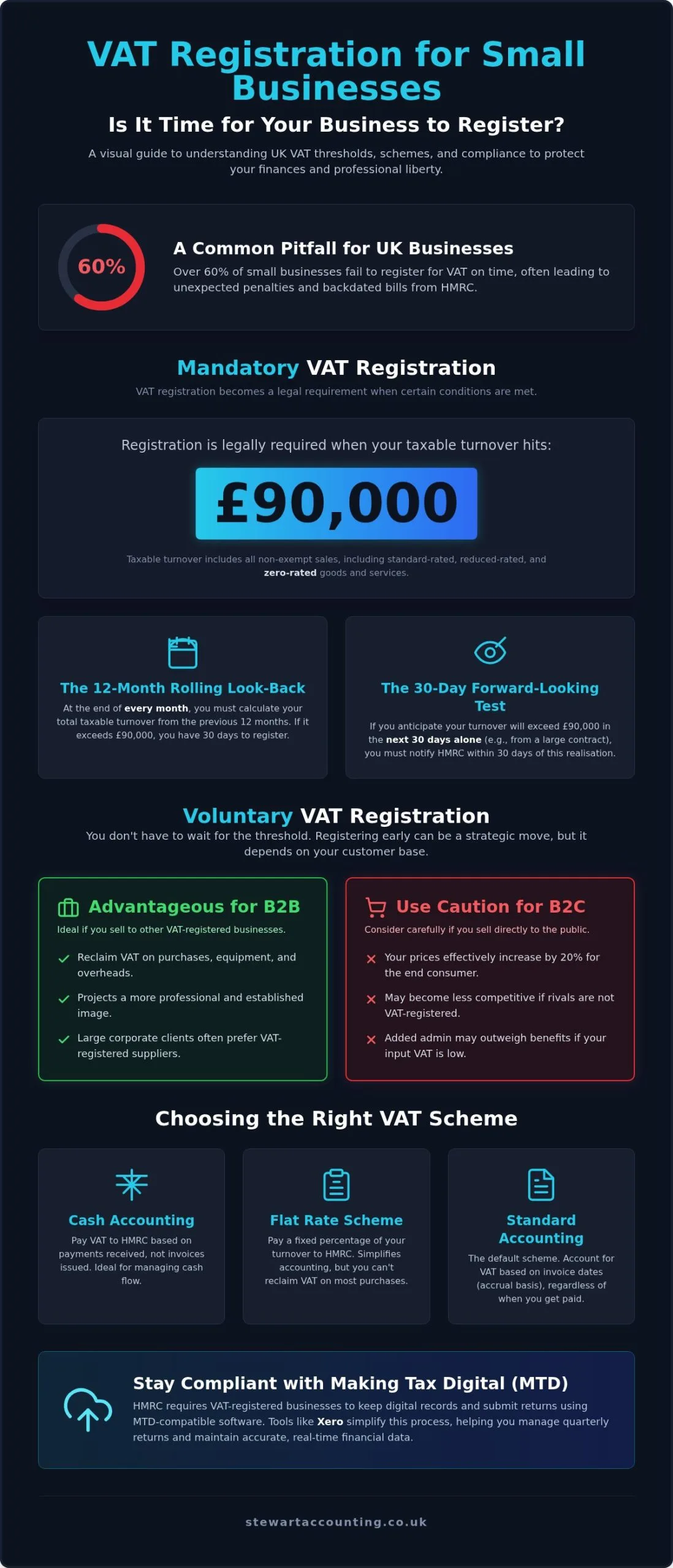
Over 60% of small UK businesses fail to register for VAT on time, which often leads to unexpected penalties and backdated bills. If you’re feeling a sense of dread as your sales climb, you aren’t alone. It’s natural to worry about the confusing definitions of taxable turnover or the administrative burden of VAT registration for small business. We understand that your time is your most valuable asset, and we’re here to help you regain your professional liberty.
This guide provides a comprehensive answer to your questions, ensuring you stay compliant while protecting your finances. You’ll learn about the mandatory £90,000 threshold, the financial advantages of voluntary registration, and how our expert team in Central Scotland can handle every detail for you. We’ll explore which VAT schemes save the most money and show you how to delegate the entire process so you can focus on growing your business with total confidence. By the end of this post, you’ll have a clear roadmap for navigating HMRC requirements without the stress.
Key Takeaways
- Learn how the mandatory £90,000 threshold works and why tracking your rolling 12-month turnover is vital to avoid HMRC penalties.
- Discover the strategic advantages of voluntary VAT registration for small business, such as reclaiming tax on your equipment, stock, and overheads.
- Identify which accounting scheme, from Flat Rate to Cash Accounting, offers the best protection for your specific cash flow needs.
- Understand the digital record-keeping requirements under Making Tax Digital and how tools like Xero can simplify your quarterly returns.
- Find out how delegating the entire VAT process to an expert can restore your mental well-being and free up your time for business growth.
Understanding the VAT threshold: Is registration mandatory for your business?
Does your business turnover feel like a moving target? For many entrepreneurs across Central Scotland, tracking the exact point where VAT registration for small business becomes a legal requirement is a source of significant anxiety. Currently, the mandatory threshold is £90,000 in taxable turnover. If your business reaches this figure, you have a legal obligation to notify HMRC. Gaining a clear Understanding Value-Added Tax (VAT) in the UK helps you stay ahead of these requirements and protects your professional liberty.
To better understand the fundamentals of this process, watch this helpful video guide:
Taxable turnover is the total value of non-exempt sales, including those that are standard-rated, reduced-rated, or zero-rated. It’s a common trap to assume that zero-rated goods don’t count toward the threshold, but they do. Failing to register on time can result in backdated tax bills and hefty HMRC penalties. These costs can appear suddenly, draining the cash reserves you’ve worked hard to build. Our team in Alloa, Stirling, and Falkirk specializes in removing this administrative weight from your shoulders by accurately tracking these figures for you.
The 12-month rolling look-back
HMRC doesn’t wait for your financial year end to check if you’ve crossed the threshold. Instead, they use a rolling 12-month rule. This means at the end of every single month, you must calculate your total taxable turnover for the previous 12 months. It’s a continuous cycle that catches many off guard. If the total hits £90,000 at the end of any month, you’ve triggered the requirement. You then have 30 days to register. We recommend using Xero to automate this monitoring, ensuring you never miss a trigger point while you focus on your daily operations.
The 30-day forward-looking test
The forward-looking test is the second way you might be forced to register. If you realize at any point that your turnover will exceed £90,000 in the next 30 days alone, you must take action. This often happens when a business secures a significant new contract or a large one-off project. You must notify HMRC within 30 days of realizing this will happen, not 30 days after the money hits your account. For those navigating these growth spurts, our expertise in limited company accounting provides the pragmatic support needed to manage these transitions smoothly. We ensure your registration is handled correctly from day one, restoring your peace of mind.
Should you register for VAT voluntarily?
While reaching the £90,000 VAT registration threshold makes the process mandatory, you don’t have to wait until you hit that figure. Many business owners choose to register early as a strategic move to improve their cash flow and market position. This decision often hinges on whether the financial benefits of reclaiming tax outweigh the extra paperwork. Voluntary VAT registration for small business can be a powerful tool when used correctly, but it requires a clear understanding of your specific market.
One primary reason to register early is the professional image it projects. In the B2B world, having a VAT number suggests that your business is established and successful. Large corporate clients often prefer working with VAT-registered suppliers because they can reclaim the VAT you charge them. If you don’t have a VAT number, it may signal that your turnover is relatively low, which could impact your perceived reliability or scale.
However, you must consider your customer base. If you sell directly to the general public, they cannot reclaim the VAT you charge. This means your prices effectively rise by 20% overnight. If your competitors aren’t registered, you might find yourself priced out of the market. Balancing these pros and cons is essential for protecting your profit margins. If you’re ready to explore how this could benefit your finances, reach out to our expert team for a consultation.
Benefits for B2B vs. B2C businesses
Contractors and consultants serving other VAT-registered firms usually find registration a “no-brainer.” Since your clients can claim back the VAT, the extra charge on your invoice doesn’t cost them anything extra. Meanwhile, you gain the ability to reclaim VAT on your own business expenses like software, travel, and equipment. If you’re managing a sole trader business that deals mostly with retail customers, the decision is more complex. We often help clients run the numbers to see if the tax savings on expenses justify the potential impact on customer pricing.
Reclaiming VAT on past purchases
Choosing the right accounting method is a critical step after completing your VAT registration for small business. It isn’t just about following rules. It’s about protecting your cash flow and reducing administrative stress. Most businesses start on Standard Accounting. Here, you report VAT to HMRC based on the date you issue or receive an invoice. While this is the default, it can create a financial gap if you’re waiting weeks for a client to pay. You might find yourself paying tax on money that hasn’t hit your bank account yet.
Cash Accounting and your cash flow
Cash Accounting is often the most pragmatic choice for small service-based businesses in Stirling. Under this scheme, you only pay VAT to HMRC once your customer has actually paid you. Similarly, you only reclaim VAT on purchases once you’ve paid your supplier. This provides an immediate layer of protection. If a client becomes a “bad debt” or pays late, you aren’t left out of pocket by paying tax on money you haven’t received. To be eligible, your estimated VAT taxable turnover must be £1.35 million or less. It’s a straightforward way to align your tax liabilities with the actual cash in your bank.
The Flat Rate Scheme (FRS) pros and cons
The VAT Flat Rate Scheme was designed to simplify life for small firms. Instead of calculating the difference between every single sale and purchase, you pay a fixed percentage of your gross turnover to HMRC. You still charge your customers the standard 20% VAT, but you keep the difference between what you charge and the lower flat rate you pay. It significantly reduces bookkeeping time, which is a major win for busy owners. However, there’s a catch known as the “Limited Cost Trader” trap. If your expenditure on relevant goods is less than 2% of your turnover, or less than £1,000 per year, you must use a high rate of 16.5%. This often makes the scheme more expensive than standard accounting. Our VAT return services include a detailed analysis of these schemes. We ensure you’re on the most tax-efficient path for your specific industry, restoring your peace of mind.
How do I register for VAT and stay compliant with Making Tax Digital?
Applying for a VAT number through HMRC is primarily an online process. You’ll need to gather several key pieces of information before you begin. This includes your National Insurance (NI) number, your Unique Taxpayer Reference (UTR), and your business bank details. You must also provide a summary of your turnover history to prove you’ve reached the threshold or are registering voluntarily. Once you submit your application, you’re officially in the system, but the legal requirements don’t stop there.
Making Tax Digital (MTD) is now mandatory for all VAT-registered businesses. This means you can no longer rely on simple spreadsheets or paper records for your tax affairs. You must keep digital records and use MTD-compatible software to submit your returns. This shift aims to reduce manual errors, but it can feel like a heavy administrative burden when you’re already busy. Our team specializes in making this transition smooth and efficient.
The registration timeline
It usually takes around 30 working days to receive your VAT certificate, though this can vary. While you wait, you’re in a bit of a “grey zone.” You must account for VAT from your date of registration, but you cannot legally issue VAT invoices until you have your number. The pragmatic solution is to increase your prices by 20% immediately but don’t show the VAT as a separate line yet. You should explain this to your customers so they aren’t surprised when you reissue their invoices later. Setting up your Government Gateway account securely is the first step in this journey, and it’s something we can guide you through with total confidence.
Bridging the gap with Xero
Transitioning from manual entries to digital links is the core of MTD compliance. We recommend Xero as the most efficient tool for online accounting services. Xero connects directly to your bank and HMRC, ensuring that every transaction is recorded accurately without the need for manual re-typing. This “digital link” is a legal requirement under MTD rules. It removes the risk of typos and ensures your quarterly returns are submitted correctly every time. By delegating the technical setup to us, you remove the anxiety of software integration. We provide the training needed to make the move from spreadsheets as easy as possible. If you’re worried about the initial VAT registration for small business, contact us today for expert VAT support. We’re here to lift the weight of compliance so you can focus on your professional growth.
How can Stewart Accounting simplify VAT for your business?
Are you tired of spending your weekends buried in receipts and spreadsheets? VAT registration for small business often feels like a full-time job on top of your actual work. At Stewart Accounting Services, we believe your focus should be on growth and innovation, not tax administration. We provide the professional expertise needed to lift this weight from your shoulders. Our team serves businesses across Alloa, Stirling, and Falkirk, offering a local, human touch that national online portals simply cannot match.
Having a Chartered Accountant handle your HMRC correspondence provides a level of reassurance that DIY software can’t provide. We don’t just submit numbers; we interpret them. We ensure you’re using the most tax-efficient scheme for your specific industry, whether that’s Cash Accounting or a Flat Rate option. This proactive approach protects your cash flow and ensures you never pay more than you legally owe. We act as your dependable partner, grounding our expert voice in the real-world challenges you face every day.
Total delegation: Our VAT Return service
Our VAT Return Services are designed for complete peace of mind. We take your raw records and turn them into accurate, on-time submissions. This total delegation removes the “quarterly panic” that many business owners face as deadlines approach. By physically removing these burdens, we restore your mental well-being and allow you to reclaim your personal time. It’s a lifestyle improvement that starts with trusting an expert with your compliance.
We are committed to identifying every possible VAT reclaim. Many owners miss out on thousands of pounds by failing to claim for business-use utilities, home office costs, or pre-registration expenses. We scrutinize your accounts to ensure every legitimate penny stays in your business. This isn’t just about compliance; it’s about optimizing your financial resources and ensuring your business remains pragmatic and profitable.
The Stewart Accounting promise
Our mission is built around a specific promise to liberate your time, your finances, and your mental well-being. We understand the unique challenges faced by contractors, sole traders, and SMEs in Central Scotland. You aren’t just another client number to us. You’re a partner in our local business community. We use tools like Xero to ensure everything is smooth and efficient, but we’re always available for a face-to-face chat when you need clarity.
By choosing to work with us, you gain a partner who is as invested in your success as you are. We combine high-level expertise with an approachable, supportive style. Whether you’re just starting the process of VAT registration for small business or looking to switch to a more efficient service, we’re here to help. Book a free consultation with our Alloa or Stirling team today and take the first step toward restoring your professional liberty.
Take control of your business growth today
Understanding the mandatory £90,000 threshold is the first step toward staying compliant with HMRC. Whether you decide to register early to reclaim tax or find yourself crossing the limit due to a rolling 12-month turnover, managing VAT registration for small business doesn’t have to be a source of anxiety. By choosing the right accounting scheme and utilizing digital tools, you can transform a complex administrative requirement into a strategic advantage for your cash flow.
We are here to help you navigate these requirements with total confidence. As Chartered Accountants with local offices in Alloa, Stirling, and Falkirk, we provide the expert support you need right on your doorstep. As Xero Platinum Partners, we ensure your Making Tax Digital compliance is seamless and error-free. Our fixed-fee VAT services mean you can plan your finances with no hidden surprises.
Let us handle your VAT registration and returns so you can focus on growing your business. We are ready to restore your mental well-being and liberate your time today.
Frequently Asked Questions
What counts as taxable turnover for VAT registration?
Taxable turnover includes the total value of all goods and services you sell that aren’t exempt from VAT. This includes items rated at the standard 20% rate, the reduced 5% rate, and even zero-rated items. It’s a common mistake to exclude zero-rated sales, but these must be counted toward the £90,000 threshold. Only truly exempt items, such as certain educational or health services, are left out of your turnover calculations.
Can I register for VAT if I am a sole trader in Scotland?
Yes, sole traders in Scotland can absolutely register for VAT. The process for VAT registration for small business is the same whether you’re a limited company or a sole trader. Many freelancers in Stirling and Falkirk register voluntarily to reclaim tax on their business expenses. This can be especially beneficial if you primarily serve other VAT-registered businesses, as it allows you to appear more established while recovering costs on equipment and software.
What is the penalty for late VAT registration with HMRC?
If you register late, HMRC may charge a “failure to notify” penalty. This is calculated as a percentage of the VAT due from the date you should have registered until you actually did. The percentage depends on whether HMRC thinks the delay was accidental or deliberate. You’ll also have to pay all the backdated VAT you should have collected from customers, which can cause a significant financial strain on your cash flow.
How do I reclaim VAT on expenses I paid before I registered?
You can reclaim VAT on goods purchased up to four years before your registration date, provided you still have the items and they’re used for business. For services, the time limit is much shorter at just six months. You must have valid VAT invoices for every claim. This “back-claiming” can provide a significant initial refund, helping to offset the administrative costs of joining the scheme and boosting your initial working capital.
Do I need to register for VAT if my turnover is exactly £90,000?
The law states you must register if your taxable turnover exceeds £90,000 in a rolling 12-month period. If your turnover is exactly £90,000, you haven’t technically crossed the line yet. However, you should monitor your sales extremely closely every month. Missing the trigger point by even a single pound can lead to penalties. Many owners choose VAT registration for small business just before hitting the limit to ensure they stay safely within HMRC rules.
Can I cancel my VAT registration if my turnover drops below the threshold?
You can apply to cancel your registration if you can prove your taxable turnover in the next 12 months will be £88,000 or less. This is known as voluntary deregistration. It’s often a pragmatic choice if your business model changes or your sales naturally decrease. However, you must remember that you’ll no longer be able to reclaim VAT on your expenses. We can help you calculate if deregistering will truly benefit your bottom line.
What is Making Tax Digital (MTD) and does it apply to me?
Making Tax Digital is a government initiative requiring businesses to keep digital accounting records and submit returns using compatible software. It applies to every VAT-registered business, regardless of turnover. You can no longer use manual spreadsheets or paper ledgers for your final submissions. We specialize in helping local firms in Alloa and Stirling transition to MTD-compliant tools like Xero, ensuring your quarterly returns are submitted smoothly and without the stress of manual errors.
Is the Flat Rate Scheme still worth it for small businesses in 2026?
The Flat Rate Scheme remains a popular choice for businesses with turnover under £150,000 because it simplifies bookkeeping. You pay a fixed percentage of your gross turnover to HMRC instead of tracking VAT on every individual purchase. However, it’s less beneficial for “limited cost” businesses that spend very little on goods. In these cases, you’re stuck with a 16.5% rate. We provide expert analysis to determine if this scheme still saves you money.
Recent Posts
06 Oct, 2026
04 Oct, 2026