

What Taxes Do Landlords in Scotland Need to Pay in 2026?

Could a simple oversight in your digital record-keeping lead to an unexpected bill from HMRC in 2026? Managing a property portfolio is demanding enough without the added stress of shifting regulations and complex filing requirements. It’s completely natural to feel a sense of unease when balancing unique Scottish Income Tax bands against UK-wide compliance rules. You want to ensure you aren’t overpaying, yet the fear of missing a critical update often lingers in the back of your mind.
In 2026, landlords in Scotland will primarily be responsible for Land and Buildings Transaction Tax (LBTT) on new purchases, Income Tax on rental profits at Scottish rates, and Capital Gains Tax upon sale. This guide is designed to restore your peace of mind by providing a clear, step-by-step roadmap of your liabilities. We’ll explore these core taxes alongside the specific digital requirements you’ll face under the 2026 Making Tax Digital rollout. By the end of this article, you’ll know exactly how to handle landlord tax scotland efficiently, allowing you to focus on your personal and professional liberty while we help manage the technical burden. We’ll cover essential tax bands, allowable expenses, and the practical steps needed to stay ahead of the curve.
Key Takeaways
- Understand how Land and Buildings Transaction Tax and the Additional Dwelling Supplement impact your initial property investment costs in Scotland.
- Learn to navigate unique Scottish tax bands to accurately calculate your landlord tax scotland liabilities on annual rental earnings.
- Discover how to maximize your take-home profit by correctly identifying “wholly and exclusively” allowable expenses, such as factor fees and repairs.
- Prepare for the April 2026 Making Tax Digital deadline to ensure your digital record-keeping meets HMRC requirements for income over £50,000.
- Master the 60-day reporting rule for Capital Gains Tax to avoid unexpected penalties when you choose to sell your rental property.
The Cost of Entry: LBTT and the Additional Dwelling Supplement
Your journey into the Scottish rental market begins with a tax that differs significantly from the rest of the UK. While landlords in England and Wales pay Stamp Duty, those in Scotland deal with Land and Buildings Transaction Tax (LBTT). This is managed by Revenue Scotland rather than HMRC. Understanding this initial cost is vital for your cash flow planning. It represents the first major financial hurdle in your landlord tax scotland journey.
Calculating Your LBTT Liability
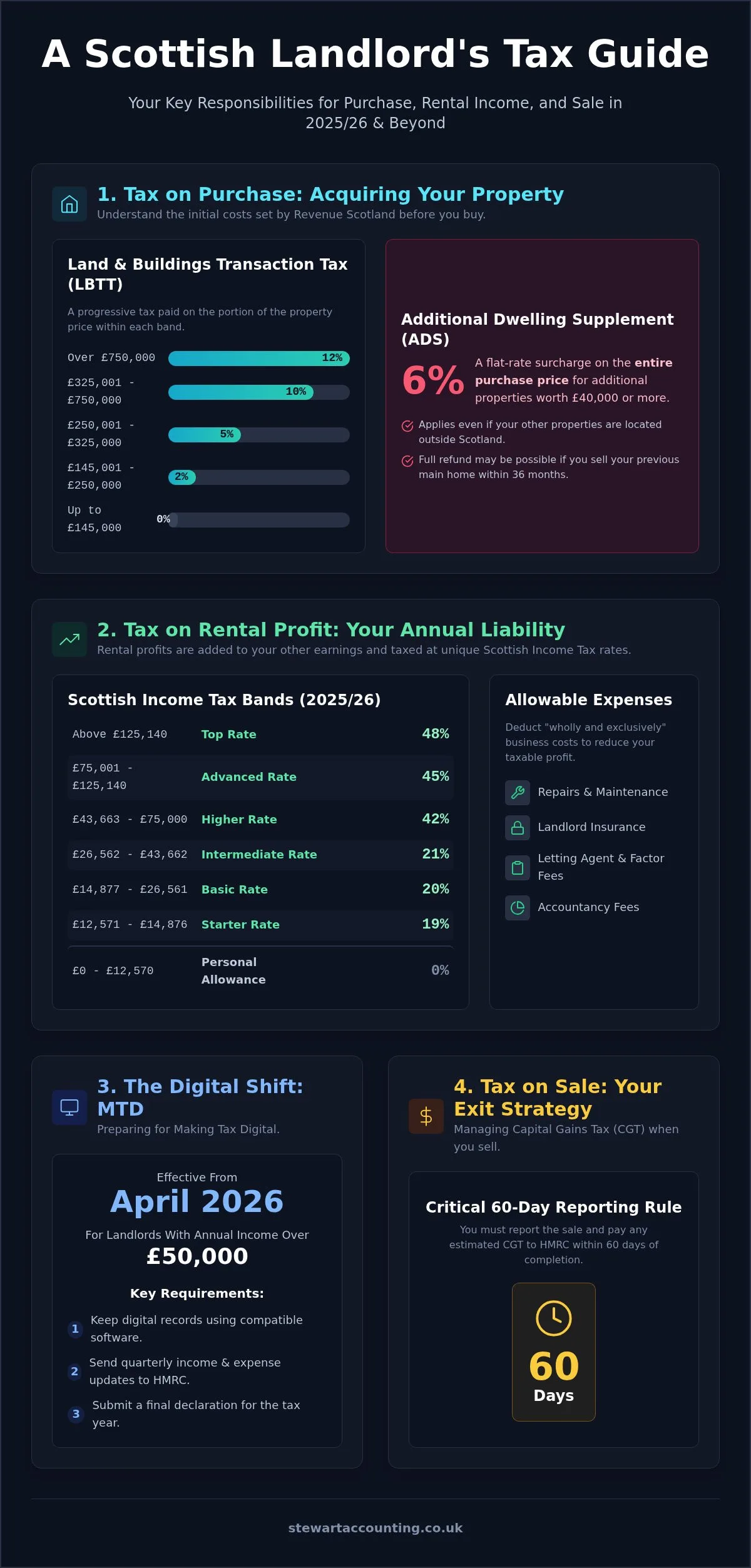
The system operates on a tiered basis. You only pay the specific rate on the portion of the price that falls within each band. This progressive structure ensures that smaller investments are taxed less heavily than high-value estates. LBTT in Scotland starts at a 2% rate for properties over £145,000, with higher tiers reaching 12%. Because these rates are part of a devolved system alongside Scottish income tax bands, they reflect the unique economic priorities of the Scottish Parliament. For a typical investment in Stirling or Falkirk, calculating these tiers correctly prevents you from overpaying at the very start of your venture.
The ADS: A 6% Surcharge You Must Factor In
Most investors will also face the Additional Dwelling Supplement (ADS). This is a flat 6% surcharge on the total purchase price, not just the portion above a threshold. It applies to any purchase of an additional residential property worth £40,000 or more. A common trap for many is assuming that if their first home is in England or abroad, the ADS won’t apply to their Scottish purchase. This isn’t the case. If you own any other property anywhere in the world, the 6% surcharge usually triggers.
Understanding the nuances of ADS can save you significant sums. Here are a few key points to remember:
- The 6% rate applies to the entire purchase price of the property.
- Limited companies generally pay ADS on every residential purchase they make.
- You can often claim a full refund of the ADS if you sell your previous main residence within 36 months of the new purchase.
Managing these entry costs requires precision and foresight. At Stewart Accounting Services, we help landlords navigate these initial levies to ensure their investment remains profitable from day one. By delegating the complex calculations to us, you can focus on finding the right property while we handle the technical burden and provide the clarity you need.
Income Tax on Rental Earnings: Navigating Scottish Bands
Once you have cleared the initial hurdles of Land and Buildings Transaction Tax (LBTT), your ongoing focus shifts to Income Tax. It’s a common misconception that rental income is taxed in isolation. In reality, HMRC adds your rental profits to your other income, such as a salary or pension, to determine your total taxable earnings. Because you’re a resident in Scotland, you pay Income Tax based on the specific bands set by the Scottish Parliament. These differ significantly from the rates used in England and Wales.
Being a landlord in Stirling or Alloa often results in a different tax liability than a landlord in London. While the UK-wide Personal Allowance remains at £12,570, the rates applied above that threshold are unique to our region. This localized system means your landlord tax scotland obligations require a tailored approach to ensure you aren’t paying more than necessary. It’s about understanding how your property portfolio interacts with your total financial picture.
Scottish Income Tax Bands for 2025/26
Scotland uses a six-band system for the 2025/26 tax year. This includes a 19% Starter rate for those on lower incomes, a 20% Basic rate, and a 21% Intermediate rate. This Intermediate band is a crucial distinction; it applies to income between £26,562 and £43,662. Many Scottish middle-earners find their rental profits pushed into this 21% bracket, which is slightly higher than the UK basic rate. For those with larger portfolios or high salaries, the Higher rate jumps to 42%. The Advanced and Top rates sit at 45% and 48% respectively. Knowing exactly where your total income sits helps prevent surprises when your Self Assessment is due.
The Property Allowance vs. Actual Expenses
If your gross rental income is under £1,000, you can utilize the tax-free Property Allowance. This is a simple way to earn a small amount of rent without the need for complex reporting, as long as you don’t have other rental expenses to claim. However, a strict rule exists: you cannot claim both the £1,000 allowance and your actual business costs. For most landlords in Stirling or Falkirk, actual expenses like factor fees, repairs, and insurance usually exceed £1,000. In these cases, claiming the actual costs is far more tax-efficient. We suggest a simple decision framework: if your annual costs are higher than £1,000, ignore the allowance and keep every receipt. If you’re unsure which path maximizes your profit, you might find it helpful to speak with a Scottish tax expert to clarify your position.
Maximizing Profit Through Allowable Expenses and Reliefs
To protect your rental profits, you must understand the “wholly and exclusively” rule. This is the cornerstone of managing landlord tax scotland effectively. It means you can only deduct costs that are purely for your property business. By correctly identifying these costs, you can significantly reduce your taxable profit and keep more of your rental income. Our goal at Stewart Accounting Services is to restore your professional liberty by handling these complex calculations, ensuring you never overpay due to missed reliefs.
Day-to-Day Running Costs You Can Deduct
Operating a rental property in Scotland involves several recurring costs that HMRC allows you to deduct from your gross rent. These expenses reduce your total taxable income, which is especially beneficial if your earnings fall into the higher Scottish tax bands. Common deductible expenses include:
- Letting agent fees and commission.
- Advertising for new tenants.
- Legal fees for drafting lease agreements.
- Landlord insurance and specific Scottish compliance costs, such as your Landlord Registration fees.
- Factors fees, which are common in Scottish tenement buildings.
- Utility bills and Council Tax paid during void periods when no tenant is present.
You should also distinguish between repairs and improvements. A repair restores the property to its original state, like fixing a leaking roof or painting a room. These are revenue expenses you can deduct immediately. An improvement adds value, such as installing a brand-new conservatory. Improvements are capital expenses. You can’t deduct them from your annual income, but they can reduce your Capital Gains Tax bill when you eventually sell.
Mortgage Interest Relief (Section 24)
The way you claim tax relief on mortgage interest changed significantly with the “Section 24” rules. You no longer deduct mortgage interest from your rental income before calculating your tax. Instead, you receive a 20% tax credit. For higher-rate taxpayers in Scotland, this change can be quite costly. It means you’re taxed on the full rental profit and then get a small reduction, rather than paying tax on a smaller net figure.
Replacement of Domestic Items Relief is another vital tool for landlords in Scotland. If you replace a sofa, bed, or fridge-freezer, you can claim the cost of the new item. As you prepare for the upcoming shift toward Making Tax Digital for Income Tax, keeping precise digital records of these replacements is essential. We help our clients transition to digital tools like Xero to ensure every receipt is captured, removing the administrative burden from your shoulders and providing total peace of mind.
Making Tax Digital (MTD): The 2026 Shift for Landlords
The landscape for landlord tax scotland is about to undergo its most significant transformation in decades. From April 2026, the traditional once-a-year Self Assessment will be replaced by Making Tax Digital for Income Tax Self Assessment (MTD ITSA). This change isn’t just about using a computer; it’s a fundamental shift in how you interact with HMRC. Instead of submitting a single annual return, you’ll be required to provide quarterly digital updates of your income and expenses. This new rhythm aims to provide a more accurate, real-time view of your tax liabilities, but it can also feel like a heavy administrative burden if you’re unprepared.
Are You Ready for the 2026 Deadline?
The first wave of MTD ITSA begins on April 6, 2026. This deadline applies to landlords with a total qualifying business and property income over £50,000. If your income sits between £30,000 and £50,000, you’ll join the system in April 2027. For many, the era of keeping receipts in a shoebox or using basic spreadsheets is coming to an end. HMRC will require you to use functional compatible software to maintain your records and send updates directly. Learn how our online accounting services prepare you for MTD and ensure you don’t fall foul of these new digital mandates. Transitioning early helps eliminate the last-minute panic that often accompanies major regulatory shifts.
Steps to Transition to Digital Landlord Accounting
Transitioning doesn’t have to be a source of anxiety. We recommend choosing HMRC-compatible software like Xero early. This allows you to get comfortable with the interface long before the mandatory start date. A crucial first step is setting up a dedicated business bank account. When your personal and rental transactions are separate, digital tracking becomes much smoother and less prone to error. This separation is vital for maintaining the “clean” data that digital software requires to function efficiently.
The reward for this shift is total financial visibility. You’ll no longer have to wait until the end of the tax year to know your profit margins. Real-time data helps you make better investment decisions for your Stirling or Falkirk properties. By delegating the setup and quarterly submissions to a professional, you restore your personal liberty. You can trust that the technical requirements are met while you focus on managing your tenants. If the upcoming changes feel overwhelming, you can book an MTD consultation with our team to start your digital transition today.
Capital Gains Tax and Exit Strategies for Scottish Property
When the time comes to sell your investment, your landlord tax scotland focus shifts from annual income to the profit made on the sale. Capital Gains Tax (CGT) applies to the growth in value of your property from the day you bought it to the day you sell it. For residential properties, the rates are often higher than for other assets. It’s essential to realize that this isn’t something you can simply wait to declare on your next annual Self Assessment return. The process requires immediate action to avoid penalties.
Calculating Your Gain
To find your taxable gain, you subtract your original purchase price from the final sale price. You can also deduct specific costs to lower your bill. These include the Land and Buildings Transaction Tax (LBTT) you paid at the start, estate agent fees, and legal costs. Crucially, you can also deduct the cost of capital improvements, such as an extension or a full kitchen replacement, which we distinguished from basic repairs in earlier sections. Utilizing your annual CGT allowance effectively can further reduce the amount you owe. Read our full guide on Capital Gains Tax in the UK for a deeper look at these specific calculations.
HMRC enforces a strict 60-day rule for residential property sales. You must report the gain and pay the tax due within 60 days of the completion date. Missing this window leads to immediate penalties and interest charges. You handle this reporting through your HMRC digital account, which requires precise figures and documentation. This tight deadline often causes significant anxiety for landlords who are already busy managing the logistics of a property sale.
Professional Support for Landlords in Central Scotland
Delegating this final step to a Chartered Accountant in Alloa or Stirling is more than just a business decision; it’s a lifestyle choice. At Stewart Accounting Services, we provide our “Thematic Triad” by liberating your time, optimizing your finances, and protecting your mental well-being. We handle the HMRC digital reporting directly, ensuring every allowable expense is claimed and every deadline is met. Our regional expertise allows us to ground our advice in the specific challenges faced by property owners in the Forth Valley.
By removing this burden from your shoulders, we allow you to enjoy the fruits of your investment without the stress of complex compliance. We act as your reliable partner, managing the technical details so you don’t have to. If you’re planning an exit from the rental market, contact our expert team for landlord tax support to ensure your transition is smooth, efficient, and fully compliant.
Securing Your Property Portfolio for the 2026 Digital Shift
Managing a rental business in Scotland involves more than just collecting rent. It requires staying ahead of a unique set of regional rules. From the initial 6% ADS surcharge to the nuances of the 21% Intermediate tax band, your landlord tax scotland obligations are complex. As the April 2026 Making Tax Digital deadline approaches, moving to digital systems like Xero is no longer optional for many investors.
By understanding your allowable expenses and mastering the 60-day Capital Gains Tax rule, you protect your hard-earned profits. You don’t have to carry this administrative burden alone. Our team of Chartered Accountants in Alloa, Stirling, and Falkirk specializes in providing expert Xero and MTD guidance. We focus on the technical details so you can restore your personal and professional liberty. Our specialist support ensures you stay compliant while maximizing your tax efficiency through every stage of the property lifecycle.
Let us handle your landlord tax returns so you can reclaim your time. With the right support in place, you can look forward to 2026 with total confidence and peace of mind.
Frequently Asked Questions
Do Scottish landlords pay different Income Tax than English landlords?
Yes, Scottish landlords pay Income Tax according to the specific rates and bands set by the Scottish Parliament. While the Personal Allowance remains consistent across the UK, the thresholds for the Starter, Intermediate, and Higher rates are unique to residents here. This means your landlord tax scotland liability is calculated differently than it would be in England or Wales, reflecting local economic policies.
Can I claim my mortgage payments as an expense in Scotland?
You cannot deduct the full capital repayment of your mortgage as an expense. Instead, you receive a 20% tax credit on the mortgage interest you pay. This change, often called Section 24, means the interest isn’t a direct deduction from your rental income. It’s a vital distinction for your tax planning, particularly if your total income pushes you into the Higher rate Scottish tax band.
What is the Additional Dwelling Supplement (ADS) rate in 2026?
The Additional Dwelling Supplement (ADS) rate is 6% for the 2026 tax year. This surcharge applies to the total purchase price of any additional residential property worth £40,000 or more in Scotland. It’s a significant cost. Landlords must factor this into their initial investment budget alongside the standard Land and Buildings Transaction Tax (LBTT) calculations to avoid unexpected cash flow issues.
How do I register as a landlord in Scotland for tax purposes?
For tax purposes, you must register for Self Assessment with HMRC as soon as you start receiving rental income. Separately, you must register with the local council for Landlord Registration to comply with Scottish housing laws. We can assist with your HMRC registration and authorization to ensure your landlord tax scotland records are established correctly. This removes the administrative burden and ensures you’re compliant from day one.
When is the deadline for filing my landlord tax return?
The final deadline for filing your online Self Assessment tax return remains 31 January. However, the 2026 Making Tax Digital rollout introduces a new schedule for those with income over £50,000. You’ll need to submit digital updates every quarter, followed by a final declaration. Missing these windows can result in automatic fines, so moving to a digital-first approach early is a very sensible strategy for property owners.
Do I need to pay National Insurance on my rental income?
Rental income is typically treated as investment income rather than earned income, so you usually don’t pay National Insurance on it. National Insurance generally only applies if your property activity is classified as a business for NI purposes. If you’re unsure whether your portfolio meets the specific “running a business” criteria, we can help you determine your exact National Insurance obligations and avoid overpaying.
What happens if I make a loss on my rental property?
If your property business makes a loss, you can carry that loss forward to offset against future rental profits. This helps reduce your tax bill in later years when the property becomes profitable again. You cannot usually offset property losses against other types of income like your salary. Maintaining precise digital records ensures every penny of loss is tracked for future relief and long-term tax efficiency.
How does Making Tax Digital affect me if I only have one rental property?
Making Tax Digital (MTD) is based on your total income rather than your property count. If your total gross income from rental properties and any self-employment exceeds £50,000, you must comply starting April 2026. For those earning between £30,000 and £50,000, the digital reporting requirements begin in April 2027. Even with one property, if the rent is high, you’ll likely need to adopt HMRC-compatible software.
Recent Posts
24 Aug, 2026