

What are the allowable expenses for self-employed individuals in the UK?
Did you know that small businesses are responsible for approximately 60% of the UK’s £46.8 billion tax gap? It’s a startling figure that explains why HMRC is tightening the rules. If you feel a sense of anxiety about upcoming audits or the shift to Making Tax Digital for Income Tax in 2026, you aren’t alone. Many sole traders in Central Scotland struggle to distinguish between personal and business costs for home offices or car travel. Understanding the specific allowable expenses for self employed individuals is essential to ensuring you don’t pay a penny more than you owe.
We know you’d rather spend your time growing your business than worrying about receipts and spreadsheets. This guide provides a comprehensive answer to which business costs you can deduct from your tax bill in 2026, helping you maximize your take-home pay while staying fully compliant. We’ll preview the updated 55p mileage rates, the £50,000 MTD threshold, and the “wholly and exclusively” rule to give you total clarity. Our goal is to liberate your time, money, and mental well-being by making tax deductions straightforward and manageable.
Key Takeaways
- Master the “wholly and exclusively” rule to confidently identify which business costs are eligible for tax relief and which are not.
- Identify the full range of allowable expenses for self employed individuals, including office equipment, marketing costs, and business insurance.
- Compare simplified flat rates against actual cost methods to determine which approach offers the greatest reduction in your tax liability.
- Stay ahead of the 2026 Making Tax Digital transition by understanding the specific income thresholds that require digital record keeping.
- Learn how professional delegation can protect your mental well-being while ensuring your Self Assessment is accurate and compliant.
Understanding the HMRC rules: What does ‘wholly and exclusively’ actually mean?
Are you struggling to figure out which receipts belong in your tax folder? Put simply, allowable expenses are business running costs you can deduct from your turnover to calculate taxable profit. HMRC has one golden rule for these claims: they must be “wholly and exclusively” for business purposes. This means if a cost doesn’t serve your trade, it shouldn’t be on your tax return. Mastering these allowable expenses for self employed professionals is the first step in our thematic triad. By getting this right, you start to liberate your finances, protect your time, and reduce the mental weight of tax season.
Your business structure dictates exactly what and how you claim. For self-employed individuals operating as sole traders, the process is often more direct than for those running a limited company. While the core principles remain similar, the administrative requirements and specific tax reliefs can vary significantly. If you’re working for yourself, our sole trader accounting services can help you navigate these nuances. We ensure you don’t miss out on legitimate allowable expenses for self employed work or fall foul of HMRC’s strict definitions.
The difference between personal and business use
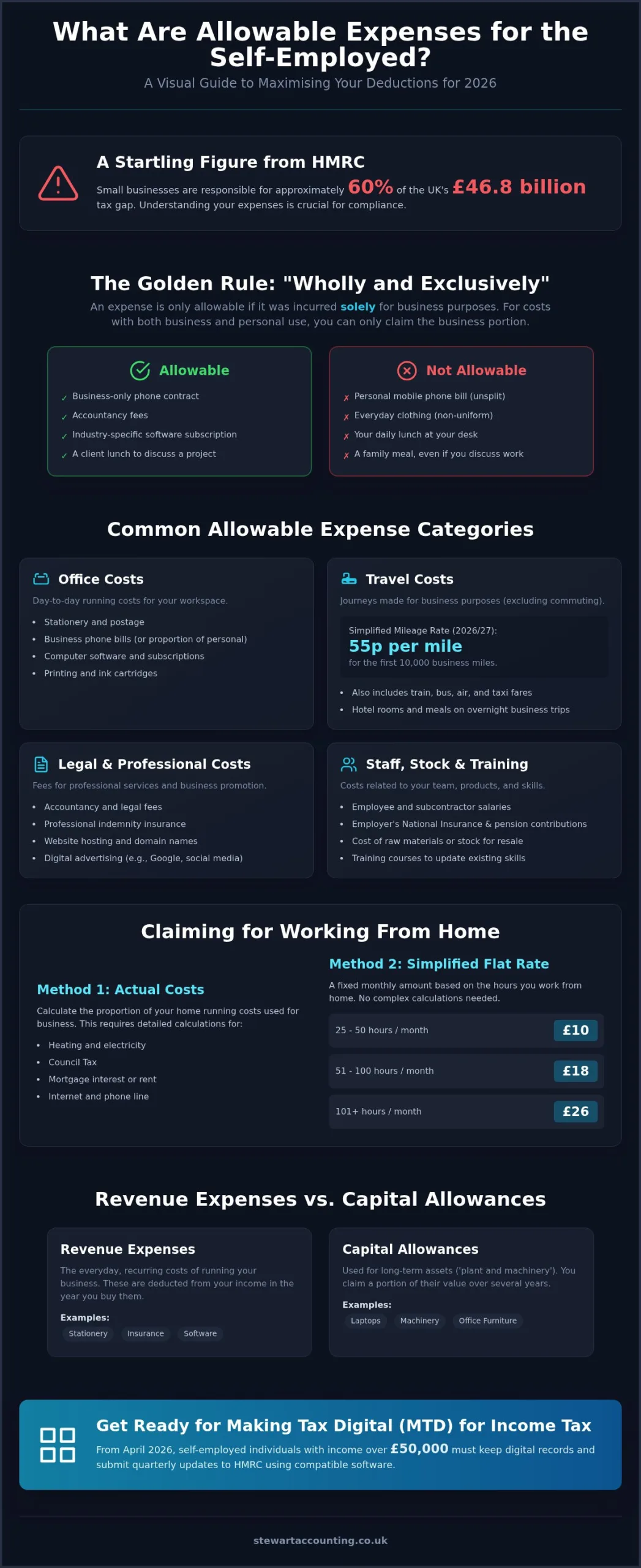
Managing costs that serve both your life and your work requires a careful approach. HMRC uses the “proportionate” rule for mixed-use items like your mobile phone or home broadband. You can only claim the percentage of the bill that relates to business activity. For example, if 60% of your data usage is for client work, you claim 60% of the cost. Common pitfalls often arise with items like everyday clothing or non-business meals. Unless it’s a specific uniform or protective gear, your clothes are personal. Similarly, your lunch isn’t a business expense just because you’re working; you have to eat regardless of your job.
Capital Allowances vs. Revenue Expenses
It’s vital to distinguish between day-to-day revenue expenses and capital assets. Revenue expenses are the recurring costs of keeping your doors open, such as stationery or insurance. Capital allowances are the method for deducting the cost of long-term business assets. If you buy a laptop, machinery, or office furniture, you typically claim these as capital allowances rather than simple expenses. This distinction ensures your bookkeeping reflects the long-term value these items bring to your business. Delegating this complex tracking to experts removes the burden from your shoulders, letting you focus on your actual work. Capital Allowances are the method for deducting the cost of long-term business assets.
A comprehensive list of self-employed allowable expenses for 2026
Identifying the full range of allowable expenses for self employed professionals is easier when you group costs by how your business actually operates. According to HMRC’s rules on allowable expenses, most day-to-day costs are deductible. Office essentials like stationery, business phone usage, and software subscriptions form the foundation of your claims. For travel, you can choose between actual costs or the simplified mileage method. For the 2026/27 tax year, the approved mileage rate is 55p per mile for the first 10,000 miles. Marketing costs, including your website hosting and digital advertising, are also fully allowable. You can even deduct professional costs like indemnity insurance and your accountancy fees.
Premises and working from home
If you work from home, you can claim a proportion of your rent, mortgage interest, and utility bills based on the number of rooms used for business. Calculating these percentages can be complex, so many choose the “Flat Rate” method. For 2026, if you work 25 to 50 hours a month from home, you can claim £10 per month. This rises to £18 for 51 to 100 hours, and £26 for 101 hours or more. For those with dedicated premises in places like Alloa or Falkirk, business rates and premises insurance are standard deductions. If these calculations feel overwhelming, you can speak with our team in Central Scotland to simplify the process.
Staff, stock, and training
Your team and inventory are significant outgoings. You can deduct subcontractor fees and employee salaries, including employer National Insurance and pension contributions. If you sell physical products, the cost of raw materials and stock is fully deductible to reach your gross profit. Training is a common area of confusion. HMRC allows you to claim for courses that update or improve your existing professional skills. However, training to learn a completely new skill or expand into a different field is generally not allowed as a revenue expense. This distinction is vital for maintaining compliance while maximizing your take-home pay.
Simplified expenses vs. actual costs: Which method saves you more?
Choosing how to claim allowable expenses for self employed work often comes down to a trade-off between maximum tax relief and ease of management. HMRC provides two distinct paths. You can either track every single receipt for actual costs or use “simplified expenses” based on flat rates. This choice is significant because it impacts both your final tax bill and the amount of time you spend on bookkeeping each month. By understanding the HMRC rules on allowable expenses, you can select the method that best supports your financial liberty and mental well-being.
For many sole traders in Central Scotland, the vehicle mileage rate is the most common simplified expense. For the 2026/27 tax year, this stands at 55p per mile for the first 10,000 miles and 25p thereafter. If you work from home, you can also use a monthly flat rate based on your hours. This ranges from £10 to £26 per month depending on whether you work 25 or over 101 hours in your home office. There is even a flat rate for those living in their business premises, such as B&B owners or care home operators, which simplifies the process of deducting personal living costs from total business outgoings.
When to choose the flat rate method
The primary benefit of the flat rate method is a significant reduction in administrative burden. You don’t need to calculate the exact split of your electricity bill or track the depreciation of your van. Instead, you keep a simple log of miles or hours worked. This approach supports our goal of restoring your personal liberty by removing the stress of complex record keeping. Simplified expenses are best for those with low overheads who want to minimise time spent on calculations. If your business travel involves an older, fuel-efficient car, the 55p per mile rate often exceeds your actual running costs, providing a better tax outcome with less effort.
When actual costs are worth the effort
Actual cost calculations are often more beneficial if you have high overheads or a large, dedicated workspace. If your home office occupies a significant percentage of your property, or if your utility bills have soared, the “room method” may yield a much higher deduction than the standard flat rate. This involves dividing your bills by the number of rooms you use for work and the amount of time you use them. Similarly, if you run a heavy goods vehicle or a brand-new van with high insurance and repair costs, tracking actual expenses might save you more money. We always recommend seeking professional advice before committing to a method, as your choice can affect your tax liability for years to come.
Managing your records and MTD for Income Tax in 2026
Are you ready for the biggest shift in UK tax history? From April 2026, the way you track allowable expenses for self employed income changes forever. Making Tax Digital (MTD) for Income Tax requires digital record keeping for those with a qualifying income over £50,000. For those earning over £30,000, the requirement begins in April 2027. This isn’t just about new software; it’s a fundamental change in how you interact with HMRC, requiring a more consistent approach to your bookkeeping throughout the year.
You must still adhere to the 5-year rule regardless of these digital changes. HMRC requires you to keep all invoices and receipts for at least five years after the 31 January tax return deadline. Transitioning to online accounting services now ensures you aren’t scrambling when the 2026 deadlines arrive. Digitizing your workflow today prevents a last-minute rush and helps you maintain a clear audit trail that protects you in the event of an HMRC enquiry.
Digital record keeping and software
Paper receipts are no longer sufficient for the 2026 tax year. Digital records are now the mandatory standard for those meeting the MTD thresholds. Using software like Xero or QuickBooks allows for real-time expense tracking, which significantly reduces the “anxiety of complexity” often felt by small business owners in Stirling and Falkirk. Instead of a shoebox of faded receipts, you have a clear, digital trail that proves every claim. This transparency provides peace of mind that you are fully compliant with the latest regulations. Real-time data also means you can see your tax liability as it grows, avoiding nasty surprises when it’s time to pay.
The ‘Delegation’ strategy for MTD
Many business owners feel overwhelmed by the new MTD rhythm. Instead of one annual filing, you’ll need to provide quarterly updates to HMRC. For the 2026/27 tax year, these deadlines are 7 August, 7 November, 7 February, and 7 May. Our bookkeeping service handles this entire digital transition for you, removing the burden from your daily schedule. We take care of the technical requirements and submissions, allowing you to focus on your clients. For more details on the traditional dates, see our guide on UK Self Assessment for filing deadlines.
If the thought of quarterly digital filing causes you stress, contact our team in Central Scotland to discuss how we can manage this transition for you and restore your professional liberty.
Why delegating your tax return to a Scottish Chartered Accountant makes sense
Managing your own tax affairs often feels like a heavy physical weight that never quite goes away. Our signature promise is to remove that burden entirely through a complete transfer of responsibility. By delegating your allowable expenses for self employed claims to us, you engage our thematic triad of benefits. We work to liberate your time, optimize your finances, and restore your mental well-being. This isn’t just about data entry; it’s about having a solid, reliable partner who understands the deep complexities of the UK tax system.
Choosing a Chartered Accountant provides a level of professional authority that standard tax preparers simply cannot match. Our formal qualifications and professional credentials build a foundation of competence you can trust. We don’t just file your return; we proactively look for ways to reduce your tax liability while ensuring you remain fully compliant. This expert oversight is especially crucial as HMRC increases its focus on the small business tax gap. We provide the reassurance you need to sleep soundly, knowing your financial affairs are in expert hands.
Tailored support for Central Scotland’s sole traders
Are you confused by how Scottish Income Tax bands differ from the rest of the UK? As a regional expert, we understand these local nuances intimately. We serve sole traders across Alloa, Stirling, and Falkirk, offering the kind of geographically grounded support that national firms lack. You can drop into our local offices for a face-to-face chat about your specific business challenges. Our approach is always pragmatic, focusing on tangible resource optimization and stress reduction for every client we help. We pride ourselves on being accessible, community-based partners for the region’s small business owners.
Your next steps to financial freedom
Achieving peace of mind starts with knowing that every legitimate expense has been claimed correctly. We ensure your records are robust and your deductions are legally sound. This level of detail-oriented support is exactly why your Scottish business needs a Chartered Accountant. You shouldn’t have to spend your weekends worrying about HMRC audits or the complexities of dual-purpose items. We take care of the technicalities so you can focus on your actual work.
Getting started is straightforward. We offer a consultation to discuss your needs and how we can best support your long-term objectives. Let us handle the anxiety of your tax return while you enjoy the personal and professional liberty you deserve. Our team is ready to provide the expert, empathetic support you need to thrive in the 2026 tax environment and beyond.
Take Control of Your Tax Future
Mastering the rules around allowable expenses for self employed professionals is more than just a compliance task; it’s the first step toward reclaiming your time and mental energy. By understanding the “wholly and exclusively” principle and preparing for the 2026 MTD transition, you position your business for sustainable growth. Whether you opt for simplified flat rates or detailed actual cost calculations, the goal remains the same: maximizing your take-home pay while staying fully compliant with HMRC.
You don’t have to face these changes alone. Our team of Chartered Accountants in Alloa, Stirling, and Falkirk specializes in the unique challenges facing Scottish small businesses. We offer a complete transfer of responsibility, handling everything from your quarterly updates to complex tax planning. This professional delegation allows you to focus on your actual work while we safeguard your financial interests. As experts in MTD for Income Tax 2026, we ensure your transition to digital record keeping is smooth and stress-free.
Are you ready to experience the financial liberty you deserve? Let Stewart Accounting Services handle your Self Assessment and maximise your allowable expenses. We’re here to support your journey every step of the way.
Frequently Asked Questions
Can I claim for my mobile phone if I use it for both business and personal calls?
Yes, you can claim for your mobile phone, but only for the proportion used for business. If your monthly bill is £40 and 50% of your usage relates to client work, you claim £20. It’s essential to have a clear method for calculating this split to satisfy HMRC. For many, having a dedicated business handset simplifies the process. We help our clients in Central Scotland determine these percentages accurately to maximize their allowable expenses for self employed returns.
Are training courses an allowable expense for the self-employed?
Training courses are allowable if they update or reinforce your existing professional skills. For example, a plumber taking a course on a new boiler model can claim the cost. However, you cannot claim for courses that teach you a completely new skill or trade. HMRC views this as a capital investment in yourself rather than a day-to-day running cost. Understanding this distinction is vital for maintaining a compliant and efficient tax position.
Do I need to keep physical receipts for all my business expenses?
You don’t need to keep physical paper receipts, as digital copies are perfectly acceptable and often more practical. With the 2026 Making Tax Digital requirements, keeping digital records is becoming the mandatory standard for many sole traders. Software like Xero allows you to snap a photo of a receipt and store it securely online. This approach reduces the risk of losing records and ensures you meet the five-year record-keeping rule effortlessly.
Can I claim for clothing as a self-employed person?
You can only claim for clothing if it is a specific uniform, protective gear required for your work, or a costume for an entertainer. Everyday clothing that you also wear for business, such as a suit for meetings, is not an allowable expense. HMRC applies the “wholly and exclusively” rule here; since you need clothes for warmth and decency, they serve a dual purpose and are therefore excluded from your tax deductions.
What happens if I use the £1,000 tax-free trading allowance?
If you use the £1,000 tax-free trading allowance, you cannot claim any other allowable expenses for self employed activity. This allowance is designed for those with very low business costs. If your actual expenses exceed £1,000, it’s almost always better to claim the actual costs instead of the allowance. We can help you compare these two options to ensure you choose the path that results in the lowest possible tax liability.
Can I claim the cost of my commute to my regular place of work?
You cannot claim for the cost of commuting between your home and your regular place of business. HMRC considers this a personal journey. However, travel to a temporary work site or between different business locations is fully deductible. For the 2026/27 tax year, using the approved mileage rate of 55p per mile for these business trips is often the most efficient way to claim for your vehicle costs while reducing admin.
Is my accountancy fee an allowable expense?
Yes, your accountancy fees are a fully allowable business expense. You can deduct the costs related to preparing your year-end accounts and your Self Assessment tax return. This means the professional support you receive effectively pays for itself by reducing your taxable profit. Delegating these tasks to a Chartered Accountant in Stirling or Falkirk ensures your returns are accurate while freeing up your time to focus on generating more income for your business.
Recent Posts
24 Aug, 2026