

What Are Year End Accounts and How Do They Impact Your Small Business?

What if the most stressful month of your business year could actually be the one that gives you the most peace of mind? For many directors in Central Scotland, the arrival of the financial year end brings a wave of anxiety over HMRC deadlines and potential penalties. You might be searching for a reliable year end accounts checklist for small business to ensure you don’t fall foul of the 2026 rules, especially since the initial late filing penalty has now doubled to £200. It’s frustrating when complex paperwork pulls you away from the growth and day to day operations of your company.
We understand that you want total compliance without the mental exhaustion. This guide explains exactly what year end accounts are and why they’re a vital pulse check for your business health. We will walk you through the 2026 filing process, covering everything from the closure of the WebFiling service to new identity verification requirements. By the end of this article, you’ll see how delegating these tasks can liberate your time, protect your finances, and give you the clarity needed to focus on your future goals.
Key Takeaways
- Understand why year-end accounts are a vital pulse check for your business health and a legal necessity for Companies House.
- Follow our year end accounts checklist for small business to organize your records and ensure a smooth submission process.
- Master the 2026 deadlines for filing accounts and paying Corporation Tax to protect your finances from avoidable penalties.
- Learn how total delegation to a Chartered Accountant in Central Scotland can liberate your time and restore your mental well-being.
What Are Year End Accounts: Defining Statutory Financial Statements
At its simplest, year end accounts are a comprehensive summary of your company’s financial activity over a twelve month period. In the UK, these are officially known as statutory accounts. They provide a transparent snapshot of your financial position to three main groups: your shareholders, Companies House, and HMRC. For many directors, the process of gathering this data feels like a heavy burden. Using a clear year end accounts checklist for small business helps to break this down into manageable steps, ensuring you don’t miss vital details while trying to run your day to day operations.
It’s vital to remember that these accounts are distinct from your Corporation Tax return (CT600). While your final accounts report on your overall performance and financial health, the tax return is the specific document used to calculate exactly what you owe the taxman. As a director, you’re personally responsible for the accuracy of these filings. This responsibility often causes unnecessary stress. By delegating the preparation to experts, you ensure every figure aligns with accounting standards, protecting your personal and professional reputation.
Why Your Small Business Needs Accurate Annual Filing
Accuracy isn’t just about being tidy; it’s about legal protection and business growth. In 2026, filing even one day late results in an automatic £150 penalty from Companies House. If left for more than six months, that fine climbs to £1,500. Beyond avoiding these avoidable costs, professional year end accounts build massive credibility with external partners. For businesses with international reach, ensuring all legal paperwork is handled with precision by experts like Stellar Konsulting further strengthens this professional image. Banks and suppliers in Central Scotland look at these records to judge your stability before offering credit or loans. This data also serves as the bedrock for robust business plans that help you secure funding and scale your operations with confidence.
Do Sole Traders Need Year End Accounts?
If you run your business as a sole trader in Alloa, Stirling, or Falkirk, you aren’t legally required to file statutory accounts with Companies House. However, you still need to compile your year end figures to complete your Self Assessment tax return accurately. Even without the same formal filing rules as a limited company, many local business owners find that following a year end accounts checklist for small business is a smart move. It allows you to track your growth year on year and ensures you’re claiming every allowable expense to keep your tax bill as low as possible.
The Core Components: What Exactly Goes Into Your Year End Report?
Understanding the jargon in your annual report is the first step toward financial clarity. For a limited company in Stirling or Falkirk, your year end report isn’t just a random pile of numbers. It’s a structured set of documents that must meet specific standards. If your turnover and employee count are low enough, you might qualify for micro-entity exemptions. This allows for simplified filing, which significantly reduces the complexity of your report. Regardless of your company size, using a year end accounts checklist for small business ensures you have all the necessary data ready for your accountant.
Digital tools have transformed this once-tedious process. When you use online accounting services such as Xero, the software tracks your transactions in real time. This makes compiling your annual report much smoother and more accurate. However, technology doesn’t replace the director’s responsibility. You must personally review and sign off the documents before we file accounts with Companies House on your behalf. Under 2026 regulations, you’ll also need to ensure your identity verification is up to date as a director. If you’re feeling overwhelmed by the terminology, you can speak with our team for expert guidance.
The Balance Sheet: Your Business Snapshot
Think of the balance sheet as a financial snapshot taken on the final day of your accounting period. It’s the ultimate indicator of your company’s solvency and overall health. Unlike other reports, it shows the cumulative position of your business from the day you incorporated. It primarily focuses on two areas:
- Assets: Everything the business owns, including cash in the bank, equipment, and money owed by your customers.
- Liabilities: Everything the business owes, such as supplier bills, bank loans, and taxes due to HMRC.
The Profit and Loss Account (P&L)
The P&L tracks your performance over the full 12 month period. It subtracts your running costs from your total sales to reveal your net profit. This statement is vital for identifying expenditure trends that may be draining your resources. Are your software subscriptions creeping up? Is your marketing spend delivering a tangible return? It’s important to realize that accounting profit isn’t the same as cash in the bank. You might show a profit on paper while still waiting for clients to pay their invoices. Managing this timing gap is a key part of our year end accounts checklist for small business strategy.
Navigating Deadlines: When Are Your Accounts Due in 2026?
Managing the various deadlines for a UK limited company is often the biggest source of stress for directors. It’s easy to get confused because the dates for filing and paying don’t always align. For most businesses, you have exactly nine months after your financial year end to submit your accounts to Companies House. However, the deadline for your HMRC Company Tax Return (CT600) is twelve months after your accounting period ends. This three month gap creates a common trap for the unwary. A robust year end accounts checklist for small business is essential to ensure you don’t miss these critical windows.
The most important date to remember is actually for your tax payment. Corporation Tax must be paid within nine months and one day of the end of your accounting period. This means you often need to pay your tax bill before you’ve even filed your tax return. For a business in Stirling with a year end of December 31, 2025, your accounts are due by September 30, 2026. You must pay your tax by October 1, 2026, even though your return isn’t due until the end of the year. Keeping track of these moving parts is vital for maintaining a healthy business compliance checklist and avoiding unnecessary friction with the authorities.
Penalties for Late Filing: What You Need to Know
Missing a deadline is an expensive mistake in 2026. Companies House uses a sliding scale for late filing that starts at £150 for being one day late. This climbs to £375 after a month, £750 after three months, and reaches £1,500 if you’re more than six months late. These penalties double if you’re late two years in a row. HMRC is equally strict. As of April 1, 2026, the initial penalty for a late CT600 return has doubled to £200. An additional £200 is added if the return is still outstanding after three months. The authorities don’t accept “forgetting” or “being too busy” as valid excuses. Total delegation to a professional firm removes this risk entirely; for a detailed breakdown of how these charges are applied, Coombs Chartered Accountants provides a helpful guide on the subject.
Setting Your Financial Year End Date
Your accounting reference date is usually set automatically during company formation, typically falling on the last day of the month your business was incorporated. You aren’t stuck with this date forever. Many businesses in Central Scotland choose to change their year end to align with the tax year on April 5th or the calendar year end on December 31st. This can simplify your personal tax planning but might mean your accountant is busier during those peak periods. You can apply to Companies House to shorten or lengthen your accounting period once every five years, allowing you to find a rhythm that suits your specific growth cycle.
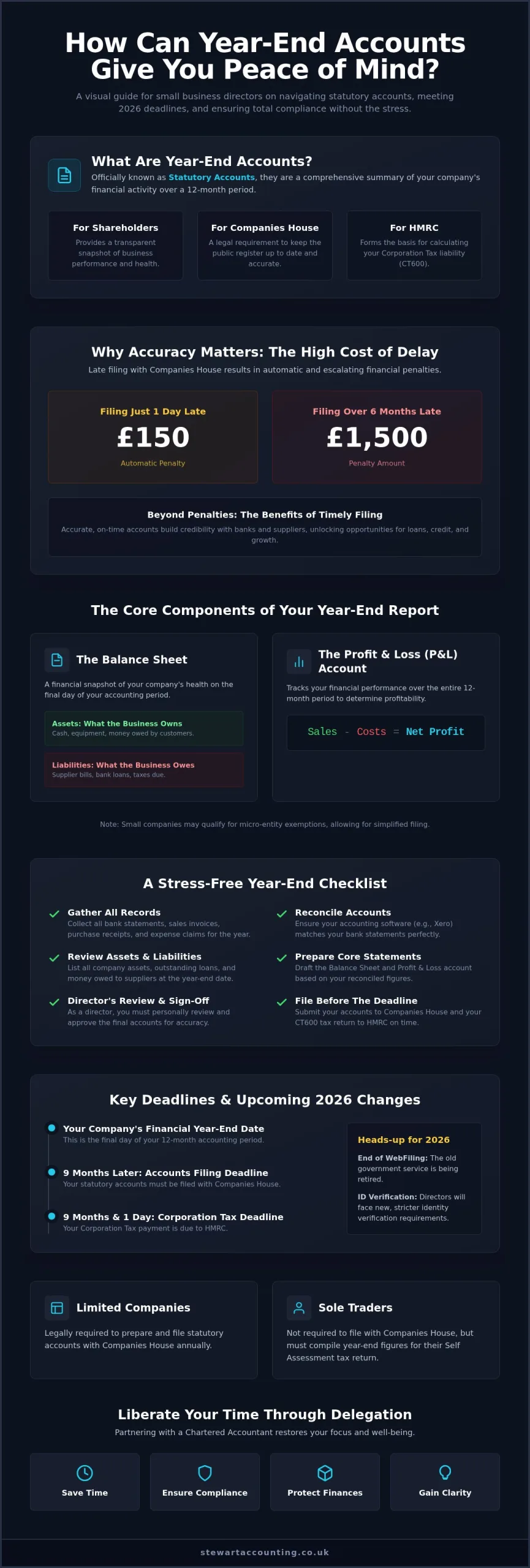
A Stress-Free Year End Checklist for Small Businesses
Third, review your Aged Creditors and Aged Debtors reports for accuracy. If there are old debts you’ll never collect, write them off now to ensure your profit isn’t artificially inflated. Fourth, conduct a physical stocktake if you hold inventory. This valuation is a legal requirement for your balance sheet and directly affects your taxable profit. Don’t guess these figures; a precise count on the final day of your year ensures your accounts are beyond reproach. Finally, hand over the entire burden to your Chartered Accountant in Scotland. By transferring this responsibility, you restore your mental well-being and free up your schedule to focus on the 2026 growth of your business.
Using online accounting services like Xero simplifies this process immensely. Instead of a shoebox of receipts, you have a tidy digital archive that is accessible from anywhere. If you find missing receipts or unexplained transactions, address them now rather than waiting for the filing deadline. It’s also the time to double check that your VAT-related entries are correct. Accurate record keeping ensures that when you delegate your year end tasks, the transition is smooth and efficient, leaving no room for HMRC queries.
Common Pitfalls to Avoid
HMRC looks closely at directors who mix personal and business expenses. This is a major red flag that can lead to a tax investigation and potential fines. Another common error is failing to account for accruals and prepayments, which can significantly distort your profit figures. The biggest pitfall, however, is leaving everything to the last minute. Procrastination is the enemy of clarity and often leads to simple mistakes that could have been avoided. If you’re ready to remove the weight of compliance from your shoulders and focus on your passion, reach out to our expert team today.
Liberating Your Business: The Value of Professional Year End Support
Completing a year end accounts checklist for small business is a vital part of your compliance, but it shouldn’t be the ceiling of your ambitions. While software like Xero provides the raw data, it cannot offer the strategic foresight needed to scale a company. Many directors find themselves trapped in “hindsight accounting,” looking at what happened months ago rather than planning for what happens next. Stewart Accounting Services changes this dynamic by restoring your personal and professional liberty. Our approach is built on a specific triad of promises: we protect your finances, optimize your time, and safeguard your mental well-being.
We believe in the power of total delegation. This isn’t just about sending an email; it’s about physically removing the weight of compliance from your shoulders and transferring it to our experts. Whether you visit our offices in Alloa, Stirling, or Falkirk, or work with us digitally across Central Scotland, the result is the same. You move from being a stressed administrator to a focused business leader. A Chartered Accountant provides a layer of security that software alone cannot match. We don’t just file numbers; we ensure those numbers are accurate, compliant, and structured to support your long term goals.
Total Delegation: Restoring Your Personal Liberty
The psychological relief of knowing your year end is in expert hands is transformative. Instead of spending your evenings or weekends wrestling with spreadsheets and HMRC portals, you can reclaim that time for what truly matters. This might mean spending more time with your family or finally focusing on that strategic growth project you’ve been putting off. As a dependable regional partner, we understand the specific challenges faced by SMEs in our local community. We act as a solid, reliable extension of your team, ensuring that your year end accounts checklist for small business is handled with precision while you focus on your passion.
Beyond Filing: Tax Planning and Business Growth
Your year end accounts are a goldmine of information if you know how to read them. We help limited companies interpret their financial data to identify tax-saving opportunities for the coming year. This foresight allows you to make informed decisions about investments, hiring, and cash flow management. Compliance is the baseline, but growth is the objective. Additionally, we provide professional Tax Investigation Protection, giving you total peace of mind that you are protected should HMRC ever raise a query. By moving beyond the basic filing requirement, we help you turn a mandatory task into a powerful tool for business liberation.
Secure Your Business Future Beyond the 2026 Deadlines
Navigating your annual filings doesn’t have to be a source of constant worry. By understanding the core components of your financial statements and staying ahead of the 2026 deadlines, you protect your business from doubled penalties and unnecessary stress. While a year end accounts checklist for small business provides a solid foundation for organising your records, the true value lies in how you use that data to drive future growth. Professional oversight ensures you aren’t just looking at past performance but are preparing for what’s next.
Our team of Chartered Accountants in Alloa, Stirling, and Falkirk specialises in supporting SMEs, contractors, and landlords across Central Scotland. We focus on total delegation, removing the weight of compliance so you can reclaim your time and mental well-being. Whether you’re managing a growing limited company or a local sole trader business, we’re here to ensure your finances are optimised and your personal liberty is restored. We believe accounting should empower you, not exhaust you.
Let us take the burden of year end accounts off your shoulders; contact our Scottish experts today.
You’ve built something great. Let’s work together to ensure its financial health is just as impressive as your vision for the future.
Frequently Asked Questions
What is the difference between year end accounts and a tax return?
Year end accounts summarize your company’s financial activity for shareholders and Companies House, while a tax return is a specific document used by HMRC to calculate your Corporation Tax. Although they use the same underlying data, they serve different purposes and have different deadlines. Your accounts show the overall health of the business. The tax return focuses on taxable profit and specific reliefs available to your company.
Can I prepare my own year end accounts for a limited company?
You can legally prepare your own accounts, but it’s rarely the best use of a director’s time. Small business accounting involves complex standards and strict formatting that must be followed to avoid rejection by Companies House. Most directors find that attempting this themselves leads to significant stress and potential errors. Delegating this task to a professional ensures total compliance and frees you to focus on growth and strategy.
How long do I need to keep my financial records after the year end?
You must keep your business records for at least six years from the end of the last company financial year they relate to. This includes receipts, bank statements, and invoices. HMRC can request to see these during a tax investigation. Keeping digital records via software like Xero makes this storage much easier and more secure. It’s a vital part of your year end accounts checklist for small business to ensure your archive is complete.
What happens if I miss the Companies House filing deadline?
Missing the deadline results in an automatic financial penalty from Companies House. In 2026, these fines start at £150 for being one day late and can escalate to £1,500 for delays over six months. These penalties are doubled if you’re late for two consecutive years. Beyond the cost, late filing is visible on the public record, which can damage your credibility with lenders, suppliers, and potential customers in Central Scotland.
Do dormant companies still need to file year end accounts?
Yes, even if your company hasn’t traded, you must still file dormant accounts and a confirmation statement with Companies House every year. Failing to do so can lead to your company being struck off the register or receiving late filing penalties. While dormant accounts are simpler than trading accounts, they still require accuracy and timely submission to maintain your company’s standing and avoid unnecessary administrative burdens that can cause mental fatigue.
How much does it cost to have a Chartered Accountant prepare my accounts?
The investment for professional accountancy services depends on the complexity of your business and the volume of transactions. A landlord with one property will have different requirements compared to a contractor or a growing SME. Rather than a flat fee, we focus on providing a customized service that delivers tangible value through tax planning and time restoration. Contacting our offices in Stirling, Alloa, or Falkirk allows us to provide a tailored quote for your needs.
Can I change my company financial year end date?
You can change your financial year end by applying to Companies House. This is often done to align your business year with the tax year or to find a quieter period for your internal admin. You can shorten your accounting period as many times as you like, but you can usually only lengthen it once every five years. This flexibility allows you to optimize your reporting cycle to suit your business growth and personal schedule.
What is an ‘abridged’ account and does my small business qualify?
Abridged accounts contain less information than full accounts, making them a popular choice for small businesses wanting to keep certain financial details private. To qualify, your business must meet at least two of three criteria: a turnover of £10.2 million or less, a balance sheet total of £5.1 million or less, or 50 employees or fewer. Using a year end accounts checklist for small business helps determine if you qualify for these simplified filing standards.
Recent Posts
22 Oct, 2026
21 Oct, 2026
1 comment