

Your Essential Small Business Checklist for a Stress-Free Financial Year End

TL;DR: Complete your small business year-end by reconciling bank statements, counting inventory, and filing statutory accounts to avoid immediate £100 late filing penalties.
- HMRC penalties start at £100 and escalate after 3 months for late Corporation Tax.
- Except when using simple spreadsheets for basic sole trader transactions, DIY bookkeeping often misses deductions.
- Best-for growing firms to outsource payroll finalization and P60 issuance to ensure statutory compliance.
- GOV.UK Notice 700/21 requires businesses to retain complete digital records for six years.
Completing your small business year-end requires balancing statutory accounts with strict HMRC filing deadlines to avoid immediate £100 late penalties. By systematically preparing your financial statements, reconciling bank ledgers, and calculating tax liabilities, you ensure full compliance and clear financial foresight. The decisions that shape this process are practical ones: which filings your structure triggers, how you sequence the checklist, and when DIY work starts to cost more than it saves.
Your business structure decides which year-end duties apply
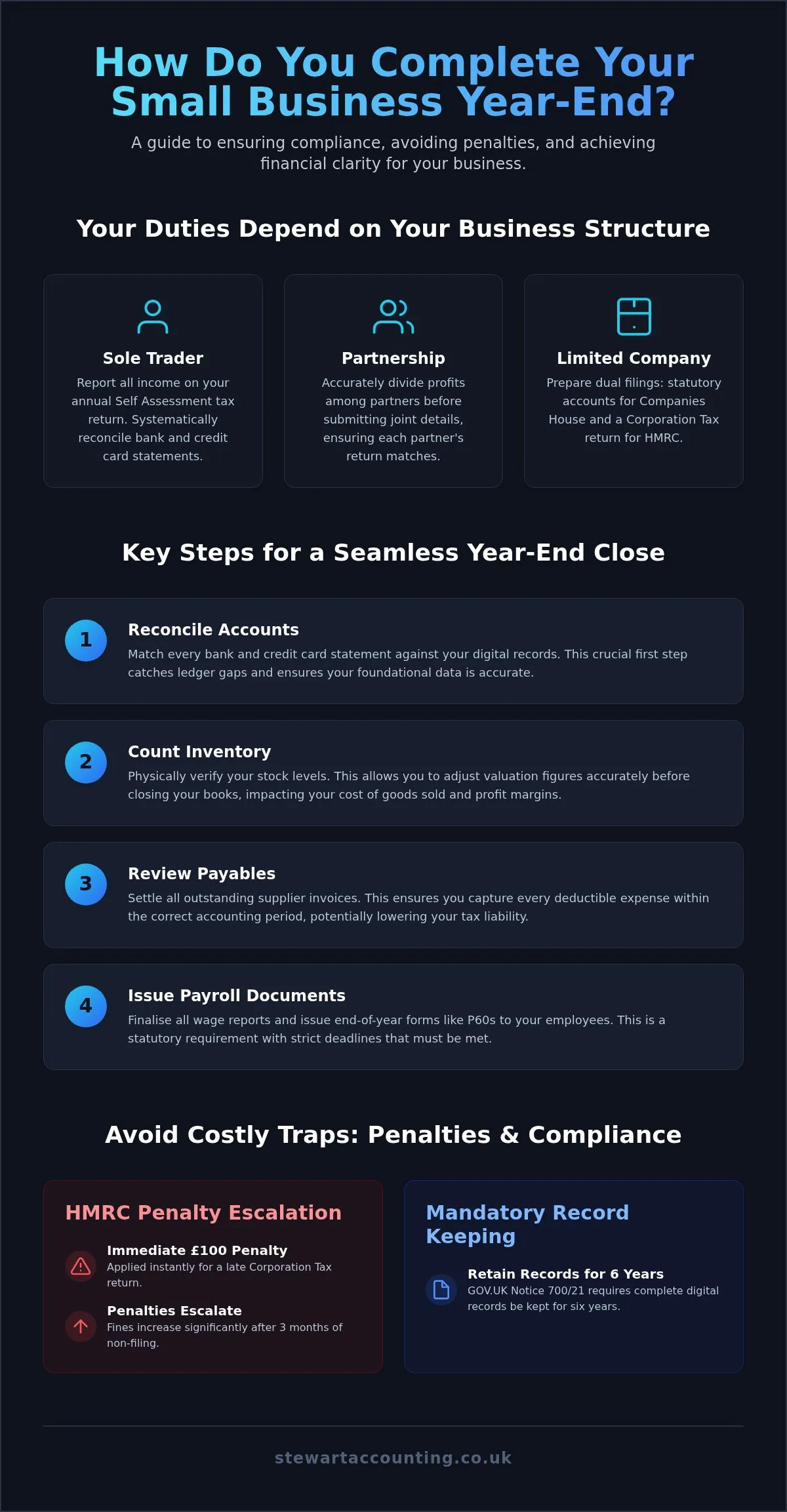
Registered sole traders, partnerships, and limited companies must complete an annual accounting wrap-up to remain legally compliant. Clients often show a clear pattern: new owners mix up self-employment duties with limited company filings, so your legal structure is what sets the tax tasks (VAT requirements) and annual filings that apply.
Typical situations and what to do:
- First-year sole trader unsure about Self Assessment: report income before the financial year-end deadline and gather bank and credit-card statements (account reconciliation) on a fixed monthly rhythm.
- Limited company facing dual filings: prepare formal year accounts (statutory year-end accounts) for Companies House and the Corporation Tax return together, so one data set feeds both.
- Partnership splitting profits: divide profits accurately among partners before submitting joint details, then lock the split in writing so the return matches each partner’s share.
Immediate financial fines apply if you miss the deadlines (late filing penalties), no matter how large or small the business is. Early setup can feel heavy; tailored Business Plans for Small/Medium Business Alloa clarify exact filing dates and financial targets before the pressure builds. Sole traders often manage early setup well, while growing companies need structured business advice (reporting duties) to stay trackable.
A commenter in an online thread on accountants for startups and affordable support from £23.70 a month:
"As a first-year sole trader, I was a little unsure about the accounting side of things, but James has been incredibly helpful throughout the whole process." (source)
Structured guidance at the start helps sole traders stay compliant without the usual first-year fog. If your filing dates are still unclear, request a quote so the calendar matches your structure.
Meeting Companies House and HMRC filing duties keeps you compliant
Filing year accounts with Companies House and submitting a company tax return to HMRC are mandatory legal duties. Meeting those reporting obligations prevents costly financial penalties.
Before financial year-end closing, your company must submit annual balance sheets and profit-and-loss statements to Companies House. At the same time you calculate tax tasks and submit tax returns to HMRC. Seasonal filings create real anxiety without support, and ordinary admin can tip into a chaotic fire drill. You can simplify the ongoing workload once you learn Why Should You Use Xero Bookkeeping Services for Your Small enterprise: organised digital records turn messy piles of bank and credit-card statements into accurate, structured reports.
According to the ASIC 2024 compliance guide, maintaining full financial disclosures remains essential for every registered corporate entity. Failing to submit on time brings swift automatic fees that grow larger the longer they stay unpaid. Stewart Accounting Services handles statutory business advice so filings go in correctly and on time. Ask for a tailored review of your next Companies House and HMRC dates.
Eight ordered steps that close your year-end without errors
A chronological walkthrough prevents costly operational errors as the accounting year closes. One easily overlooked step is matching bank and credit-card records before finalising figures, because omitted entries warp true tax obligations. A clear sequence also protects cash flow.
- Reconcile accounts: Match every statement against your digital records to catch ledger gaps immediately.
- Count inventory: Verify actual stock levels to adjust valuation figures before closing your books.
- Review payables: Settle outstanding supplier invoices to capture all deductible expenses in time.
- Issue payroll documents: Finalise wage reports and hand out end-of-year forms, relying on Payroll Services for Small Businesses in the UK to process payroll P60s without missing the deadlines.
Skipping the sequence creates administrative chaos and pushes tax tasks into last-minute headaches. Tidy the data methodically before financial year-end and preparing year accounts becomes straightforward. Professional business advice then supports growth instead of firefighting. When payroll P60s or ledgers still feel loose, get in touch for a year-end walkthrough.
HMRC penalty traps escalate fast if you miss cutoffs
Passing the due dates for official tax filings prompts instant penalties that escalate swiftly over time. In professional practice, owners routinely underestimate how fast automatic penalties stack up for late submissions, and ignored cutoffs turn manageable tax obligations into heavy business debt.
Situation: a Corporation Tax return slips past the due date. Result: penalties start at £100 immediately, then rise after three months. You must submit the return and calculate tax obligations precisely by deducting allowable expenses from trading profits before financial year-end adjustments. Failing to keep proper financial logs also breaches statutory regulations. As outlined in the GOV.UK Notice 700/21 from 2024, businesses must retain complete digital records for six years to fulfill tax tasks.
Managing complex bank and credit-card statements while rules change adds stress. Professional UK Bookkeeping Services for Small Business prepare year accounts accurately so compliance holds without panic. Solid business advice protects a growing firm from unexpected enforcement. Last-minute panic over filing deadlines needs skilled intervention to bring accounts back on track.
A commenter in an online thread on accountants for startups and affordable support from £23.70 a month:
"Kieran McCann provided outstanding support in helping me file my corporation tax return within an extremely tight timeframe." (source)
That relief is exactly what arrives when urgent Corporation Tax deadlines are taken off your desk before HMRC penalties land. If a cutoff is already close, contact the team to stabilise the return.
The exact records you need before you can file
To file year accounts correctly, gather all sales invoices, purchase receipts, payroll files, and tax documentation. Leaving a previous accountant mid-year often leaves owners without guidance in difficult tax situations; from client work, missing paperwork stalls filings completely, while orderly ledgers prevent severe late fees.
You need bank and credit-card statements to prove all transactions, tax tasks records kept current, and machinery or vehicle details tracked before financial year-end so asset registers stay up to date.
| Record Type | Required Documentation | Purpose |
|---|---|---|
| Sales & Purchases | Invoices, till rolls, and expense receipts | Verifies business income and claims |
| Banking | Bank and credit-card statements | Supports complete account reconciliation |
| Tax & Assets | VAT returns and asset register updates | Meets statutory VAT requirements |
Small businesses struggle when previous advisers leave incomplete files. Working directly with Stewart Accounting Services supplies tailored business advice and helps you avoid missing the deadlines. Proper preparation keeps filings on schedule. Send across your current record list for a gap check before you close the year.
When DIY year-end accounts turn into expensive errors
DIY bookkeeping often creates severe compliance issues once the business grows beyond simple record-keeping. Hand-keying receipts looks easy until critical tax deductions are missed, and small errors snowball.
Situation: self-managed ledgers mix personal expenses with business capital. Solution: separate the streams and reconcile bank and credit-card statements before close. Result: you avoid the unexpected tax adjustments that appear in annual reviews and the late filing penalties that follow unreconciled books. Unfiled balance adjustments often carry over and compound risk each month.
For sole traders with basic transactions, a spreadsheet can work. Growing firms need professional oversight to manage complex tax tasks. Filing year accounts yourself also means constant monitoring of changing legislation before financial year end; DIY mistakes cost far more than professional fees. Handing business advice to Stewart Accounting Services protects working capital. Book a review if your ledgers already blur personal and business spend.
Frequently asked questions
What are year-end accounts?
Year accounts are official financial reports prepared at the end of your company’s reporting period. These records summarize your financial activity for the entire year to help calculate taxes.
What records must be prepared for year‑end accounts?
You must gather sales invoices, purchase receipts, payroll records, and bank statements before financial year-end. Organizing these documents lets your accountant process the return accurately and saves time at filing.
How do I reconcile bank and credit‑card statements?
Compare your accounting software entries directly against your official bank and credit-card statements to match every transaction. Resolve missing entries or discrepancies immediately so the books stay balanced.
What VAT tasks are required at year end?
Complete your final tax tasks by checking all output and input tax calculations for the year, then reconcile your tax account balance against submitted returns to spot errors. Stewart Accounting Services can help review these figures.
What happens if I miss the deadlines?
Missing the deadlines results in automatic financial penalties and potential interest charges from tax authorities. Submit filings early to protect the business from unnecessary costs and from business advice stress.
Complete Your Financial Year End
Completing your small business year-end checklist does not need to feel overwhelming in 2026. The same decisions that opened this guide still apply: know which duties your structure triggers, run the checklist in order, and step away from DIY once the numbers outgrow a spreadsheet.
Orderly bank and credit-card statements keep the books accurate. Preparing year accounts on time helps you avoid missing the deadlines. Proper business advice and careful tax tasks keep tax liabilities on a steady footing. Organising paperwork well before financial year-end keeps the company compliant.
The Stewart Accounting Services team provides clear, tailored guidance for your filings. Get in touch with the advisers today to handle your financial year end on schedule.
Recent Posts
03 Sep, 2026
01 Sep, 2026