

VAT Cash Accounting Scheme: A Practical Guide
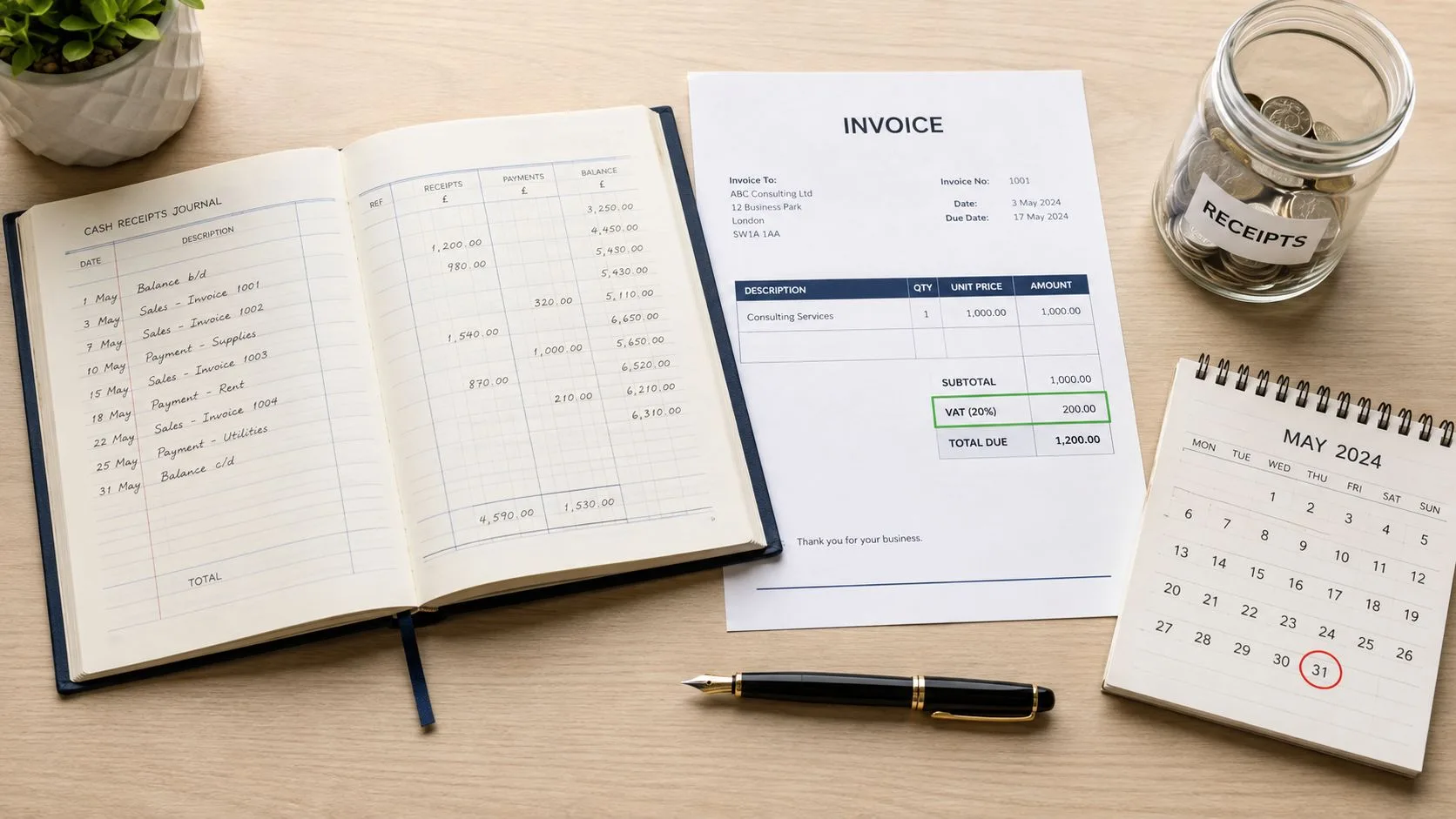
Most guides sell the VAT Cash Accounting Scheme as a free cash-flow upgrade. That advice is incomplete. The scheme can stop you funding VAT on unpaid invoices, but it doesn't remove the liability. It moves the VAT point from invoicing to payment, then can bring the unpaid balance back into focus when your business has to leave.
A tradesperson might invoice £10,000 of work in March, receive payment in May, and welcome the delay in the VAT payment. That relief is real, but temporary. The VAT bill hasn't disappeared. It has moved to May, and any unpaid customer balance remains a deferred VAT liability in the background.
The rules matter most when a growing SME approaches the scheme limits. HMRC allows entry where estimated VAT taxable turnover is £1.35 million or less, while businesses must leave once taxable turnover exceeds £1.6 million. The difference between those thresholds creates room to operate, but it also creates a trap for businesses whose turnover rises quickly. HMRC's VAT Cash Accounting Scheme guidance sets out the core eligibility and payment rules.
Why the Cash Accounting Scheme Is Not Always a Cash Flow Win
Cash accounting can improve working capital, but it is not a free cash-flow gain. Cash accounting is a timing tool, not a tax saving. It delays the VAT payment point until customers pay, while leaving a deferred liability attached to unpaid sales invoices.
The scheme records output VAT when customer money arrives, rather than when the invoice is issued. It records input VAT when the business pays its suppliers. That timing can help a service firm with slow-paying trade debtors, especially when wages and supplier bills fall due before customer receipts.
The unpaid invoice ledger shows the cost of that relief. Each completed sale that remains unpaid contains VAT not yet paid to HMRC. A small debtor balance may be easy to manage. Several large commercial invoices can turn the deferred amount into a serious liability.
Practical rule: Treat unpaid sales invoices under cash accounting as money owed to HMRC later, not as free working capital today.
Growth creates the sharpest risk. HMRC says a business must leave when taxable turnover exceeds £1.6 million, and it must report and pay outstanding VAT on exit. HMRC may allow payment over 6 months, but that period is unavailable if turnover exceeded £1.35 million in the last 3 months. In that case, payment is due immediately. HMRC's eligibility guidance sets out the exit treatment.
The result can be uncomfortable: the business enjoys delayed VAT while invoices remain unpaid, then faces an accelerated VAT obligation during expansion. Model that exposure before joining or staying in the scheme. Review customer payment behaviour, supplier terms, excluded transactions and the likely exit position, rather than relying on the turnover limit alone.
Keep input VAT recovery separate from the scheme decision. The guidance on reclaiming input VAT on business purchases helps clarify how supplier payment timing affects the cash benefit. A business that receives customer cash quickly but pays suppliers slowly may gain less from cash accounting than its debtor ledger initially suggests.
How Cash Accounting Works Against the Standard Method
The standard VAT method follows the invoice or tax point. Cash accounting follows the movement of money.
Under the standard method, output VAT normally enters the return when the supply is invoiced or otherwise becomes due under the relevant VAT rules. Under the VAT Cash Accounting Scheme, output VAT enters the return when the customer pays. Input VAT follows the opposite side of the transaction. Under cash accounting, the business reclaims it when payment leaves the business and reaches the supplier.
Take a business issuing an invoice for £1,200 plus VAT. At the standard VAT rate, the VAT element is £240. If the invoice is issued on 15 March, the standard method brings that £240 into Box 1 for the relevant March return, even if the customer pays later. Under cash accounting, Box 1 remains empty for that invoice until the customer pays on 4 April. The £240 then belongs in the April accounting period.
The same timing principle applies to purchases. If a supplier bill contains recoverable VAT, a cash-accounting business waits until it pays the bill before entering the input VAT in Box 4. A partial payment creates a partial VAT entry, so the bookkeeping must match the amount received or paid.
| Event | Standard accrual method | Cash accounting method |
|---|---|---|
| Sales invoice issued for £1,200 plus VAT | £240 output VAT is due in the relevant return based on the invoice or tax point | No output VAT is due until the customer pays |
| Customer pays on 4 April | Payment date doesn't normally change the original VAT period | £240 output VAT enters the return covering the payment |
| Supplier bill received | Recoverable input VAT is normally claimed in the relevant return | Input VAT is claimed when the supplier is paid |
| Customer or supplier pays partly | The invoice-based treatment generally follows the VAT rules for the supply | Output or input VAT follows the amount actually paid |
The scheme doesn't alter the rate of VAT or the underlying commercial value of the transaction. It changes when the VAT becomes reportable. For a broader explanation of invoice-based and cash-based accounting, see this guide to the difference between cash and accrual accounting.
Eligibility Rules and the Exit Thresholds HMRC Sets
Cash accounting is not an automatic cash-flow win. Entry depends on estimated VAT taxable turnover of £1.35 million or less, and that test must be monitored as sales develop. For Scottish SMEs, the VAT threshold for businesses is a useful reference point, but the scheme has its own entry and exit limits.
Join at the start of a VAT accounting period. Set up the application, bookkeeping rules and opening balances before that period begins. Switching halfway through a return period creates reconciliation work and can leave invoice-based and cash-based transactions mixed together.
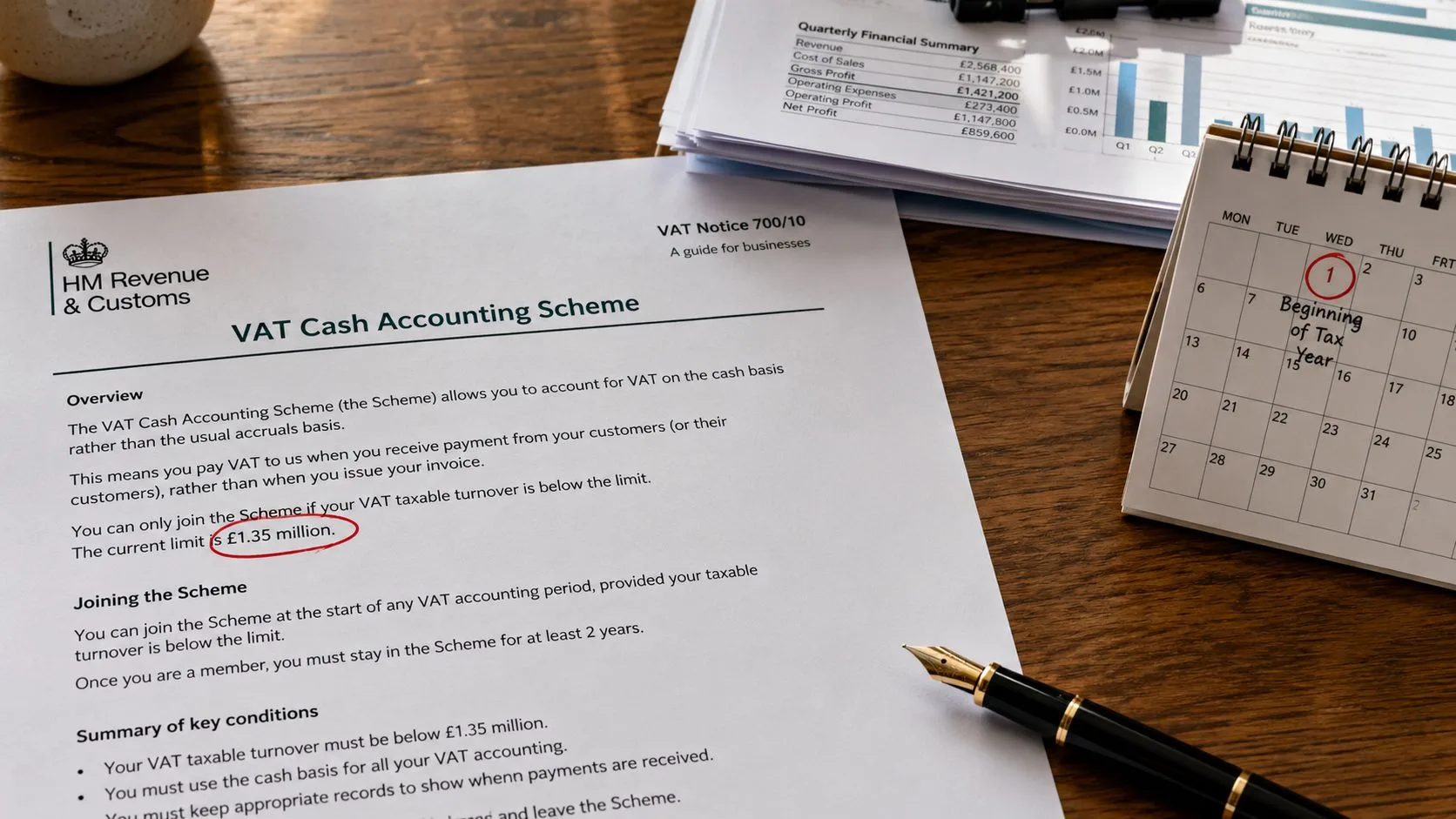
The limits need active monitoring
A business must leave when taxable turnover exceeds £1.6 million. HMRC also lists other exit events, including stopping trade and joining the Flat Rate Scheme. The Flat Rate Scheme changes how VAT is calculated, not just when the receipt date matters. Treat a move between schemes as a controlled VAT project, not an accounting-system switch.
Do not wait for the annual accounts to identify the problem. Review rolling turnover and unpaid invoices throughout the year. The unpaid sales ledger contains deferred output VAT, so the owner needs to model both the final return and the cash required to settle it.
A business that has exceeded £1.35 million in the last 3 months faces a particularly severe exit position. HMRC says outstanding VAT must be reported and paid immediately rather than spread over the available payment window. Rapid growth can therefore produce a funding requirement before the related customer receipts arrive.
Record keeping remains part of the scheme. Businesses must retain VAT records for 6 years, with enough detail to distinguish transactions handled under standard VAT accounting from those handled under cash accounting. The detailed requirements appear in HMRC's VAT Cash Accounting Scheme Notice 731.
Transactions that stay outside the cash treatment
Cash accounting does not cover every transaction. HMRC requires normal VAT treatment for:
- Long payment terms: VAT invoices with payment terms of 6 months or more.
- Advance invoices: VAT invoices issued before the supply takes place in relevant circumstances.
- Finance arrangements: Hire purchase, conditional sale and credit sale transactions.
- Specific movements and imports: Importing goods into Northern Ireland from the EU and movements out of a customs warehouse.
Flag these items before preparing the VAT return. A single bookkeeping setting cannot make every invoice eligible.
Monthly management reporting gives Scottish SMEs better control than an annual check. Monitor turnover, unpaid invoices and the cash needed on exit while there is still time to adjust pricing, collections or spending.
Worked Example of a Monthly VAT Period in Practice
Consider a Scottish graphic designer using cash accounting for a VAT quarter made up of three monthly periods. The designer issues three sales invoices in Month 1. One customer pays in Month 1, another pays in Month 3, and the third invoice remains unpaid at the quarter end.
The sales invoices are:
- Invoice A: £2,000 net, £400 VAT, paid in Month 1.
- Invoice B: £3,000 net, £600 VAT, paid in Month 3.
- Invoice C: £4,000 net, £800 VAT, still unpaid at the quarter end.
The designer also buys business supplies:
- Purchase A: £800 net, £160 VAT, paid in Month 1.
- Purchase B: £400 net, £80 VAT, paid in Month 2.
- Purchase C: £1,200 net, £240 VAT, still unpaid at the quarter end.
This example assumes the supplies are eligible for the chosen method and that the VAT amounts are recoverable. Box 7 records the net value of purchases and expenses, while Box 1 and Box 4 record output and input VAT respectively.
Cash accounting treatment
Under cash accounting, the designer reports Invoice A when the customer pays in Month 1. Invoice B enters the return when it is paid in Month 3. Invoice C produces no output VAT during the quarter because the customer hasn't paid.
The supplier side works in the same way. Purchase A is included when paid in Month 1, Purchase B when paid in Month 2, and Purchase C is excluded from the cash-accounting figures until payment takes place.
Standard accrual treatment
Under the standard method, all three sales invoices are brought into the return based on the relevant invoice or tax point, regardless of customer payment. All three supplier bills are treated based on the applicable standard VAT rules, regardless of whether the designer has paid them.
| VAT return box | Cash accounting (£) | Standard accrual (£) |
|---|---|---|
| Box 1 output VAT | 1,000 | 1,800 |
| Box 2 VAT on relevant acquisitions | 0 | 0 |
| Box 3 total VAT due | 840 | 1,560 |
| Box 4 input VAT reclaimed | 160 | 240 |
| Box 7 total value of purchases and expenses | 1,200 | 2,400 |
The cash-accounting figures show the timing benefit clearly. The designer pays HMRC based on the £400 VAT received in Month 1 and the £600 received in Month 3, less the input VAT available on paid purchases. The £800 VAT on the unpaid customer invoice isn't forgiven. It remains attached to the debtor balance and becomes relevant when the customer pays or when the business leaves the scheme.
The standard figures also require an important accounting qualification. The exact VAT return treatment depends on the applicable tax points and whether any transaction falls within an exclusion. The purpose of the example is to show the timing contrast, not to replace a transaction-level review.
Cash Flow Benefits and the Hidden Exit Liability
Cash accounting is a cash-flow tool, not free money. For a business that invoices customers before receiving payment, it keeps the VAT element in the bank until the customer settles. That can protect working capital when wages, subcontractor costs and overheads fall due before commercial debtors pay.
The same timing helps with unpaid invoices. While an eligible invoice remains unpaid and the business stays in the scheme, output VAT on that receipt has not yet entered the return. The business avoids paying HMRC first and trying to correct the position later.
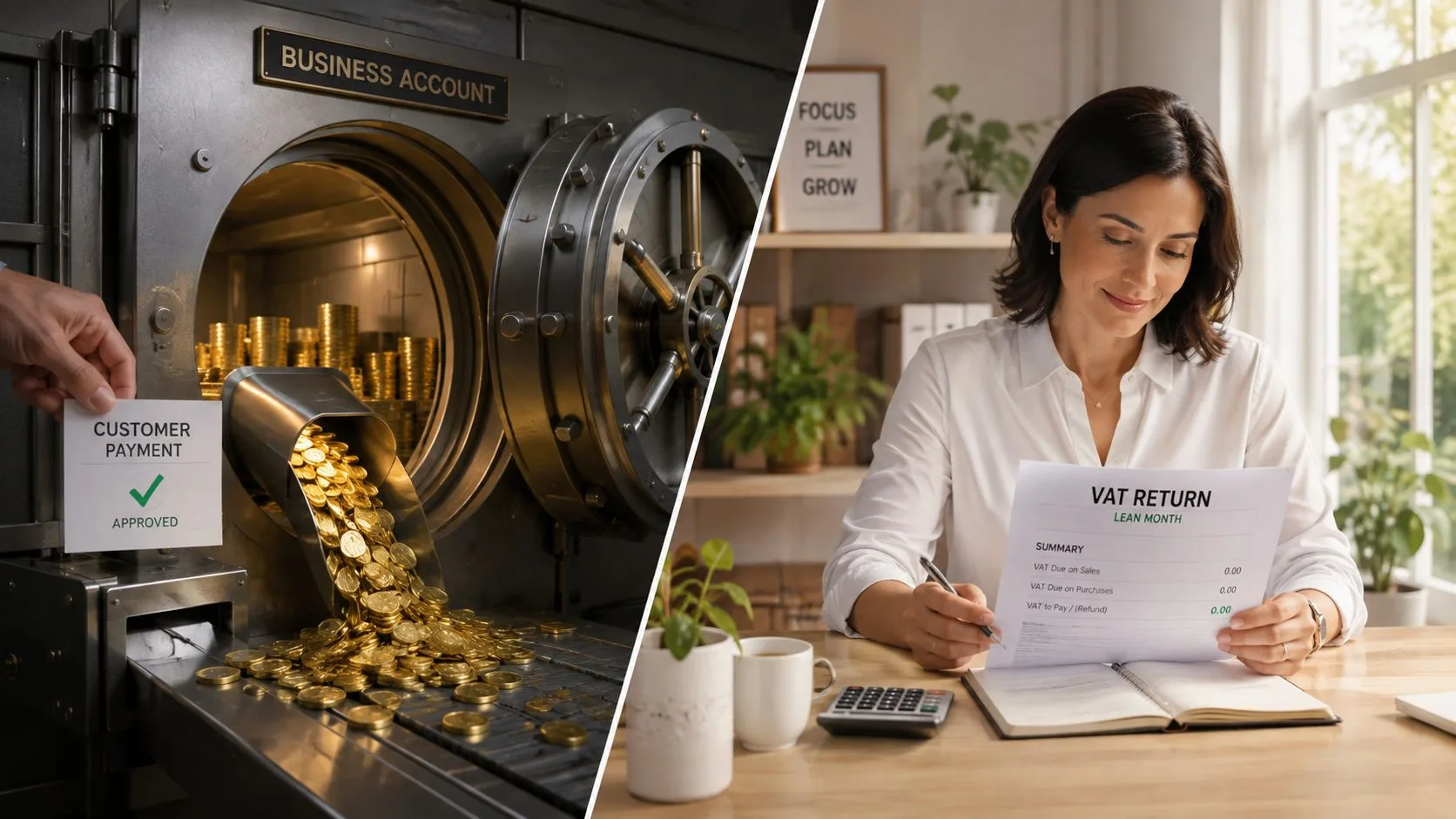
The liability does not disappear. Suppose the business leaves the scheme with £15,000 of unpaid invoices. The VAT included in those debtor balances becomes payable on exit, despite the customers still owing the money. Calculate it from the underlying invoices, taking account of the applicable VAT treatment and rate.
Growth can turn relief into a funding event
The ordinary exit rules allow outstanding VAT to be reported and paid over 6 months. A faster exit route applies if turnover has exceeded the relevant boundary in the recent period, as covered earlier. Check the official scheme notice before preparing the final return.
That creates a funding risk during a sale, retirement or major restructuring. A business can appear profitable and well funded while unpaid invoices carry a VAT liability that crystallises during the handover. A buyer may expect clean working capital, not a tax bill arising from the seller's previous accounting method.
Start planning before growth forces an exit. Maintain a schedule of unpaid eligible sales invoices, separate excluded transactions and estimate the VAT that could become due. A business needs to calculate both outcomes using its sales mix, the cash-flow benefit while enrolled and the liability on departure.
If the exit bill could strain liquidity, contact HMRC early about payment arrangements. Do not wait for the final return deadline and assume terms can be agreed afterwards.
Comparing Cash Accounting with the Flat Rate and Annual Accounting Schemes
These schemes solve different problems. Cash accounting changes the point at which VAT is reported. The Flat Rate Scheme changes how VAT is calculated, while Annual Accounting changes the frequency of returns and payments. Treating them as interchangeable creates poor decisions.
Cash accounting is usually most relevant where customer receipts lag behind invoices. The Flat Rate Scheme can appeal to a low-expense service business, but the outcome depends on its sector rate and the difference between output VAT and recoverable input VAT. Annual Accounting can help an owner plan regular payments, but it doesn't turn invoice-based VAT into receipt-based VAT.
The practical comparison
| Feature | Cash Accounting | Flat Rate Scheme | Annual Accounting Scheme |
|---|---|---|---|
| Main purpose | Align VAT reporting with customer receipts and supplier payments | Calculate VAT using the scheme's prescribed flat-rate approach | Reduce the frequency of VAT return preparation |
| Turnover boundary | Entry at estimated taxable turnover of £1.35 million or less, with exit at £1.6 million | Has its own eligibility rules and sector conditions | Has its own eligibility rules |
| Payment timing | Output VAT follows customer payment and input VAT follows supplier payment, subject to exclusions | The underlying scheme changes the calculation, not simply the receipt date | Changes payment frequency, not the underlying accrual basis |
| Administrative focus | Payment matching, exclusions and separate records | Correct sector classification and scheme calculations | Forecasting instalments and completing the annual return |
| Exit concern | Unpaid invoices can create an accelerated VAT liability | The calculation and eligibility position must be reviewed on exit | Payment timing may differ from the underlying VAT obligation |
Cash accounting and the Flat Rate Scheme may overlap in some circumstances, but that doesn't make the combination automatically attractive. A business needs to calculate both outcomes using its actual sales mix, expense profile and payment patterns. For many service firms, the Flat Rate calculation can undermine the expected benefit if the business has substantial VAT-bearing costs or irregular income.
Annual Accounting is a different proposition. It may suit an owner who values predictable payment planning, but it doesn't solve the central cash-accounting problem of VAT becoming payable before customer cash arrives. Combining payment scheduling with a receipt-based scheme can also create a more complicated forecasting exercise than the owner expects.
My decision matrix is blunt:
- Choose cash accounting when trade customers pay slowly and the business has enough input VAT on paid purchases to make timing worthwhile.
- Consider the Flat Rate Scheme for a low-expense service business only after comparing the actual calculation with standard VAT.
- Consider Annual Accounting when predictable payment planning matters more than matching VAT to individual receipts.
Don't choose by headline simplicity. Calculate the result under each scheme and include the exit cost.
Common Mistakes, Excluded Transactions and HMRC Pitfalls
The most dangerous mistake is assuming that selecting cash accounting changes every VAT transaction in the business. It doesn't. HMRC requires certain supplies to remain under normal VAT rules, so a return can be wrong even when the bank reconciliation looks perfect.
Hire purchase, conditional sale and credit sale arrangements require particular care. The same applies to VAT invoices with payment terms of 6 months or more, advance VAT invoices, and the specific import and customs movements identified by HMRC. Those transactions need separate treatment rather than a blanket “paid equals claimable” rule.
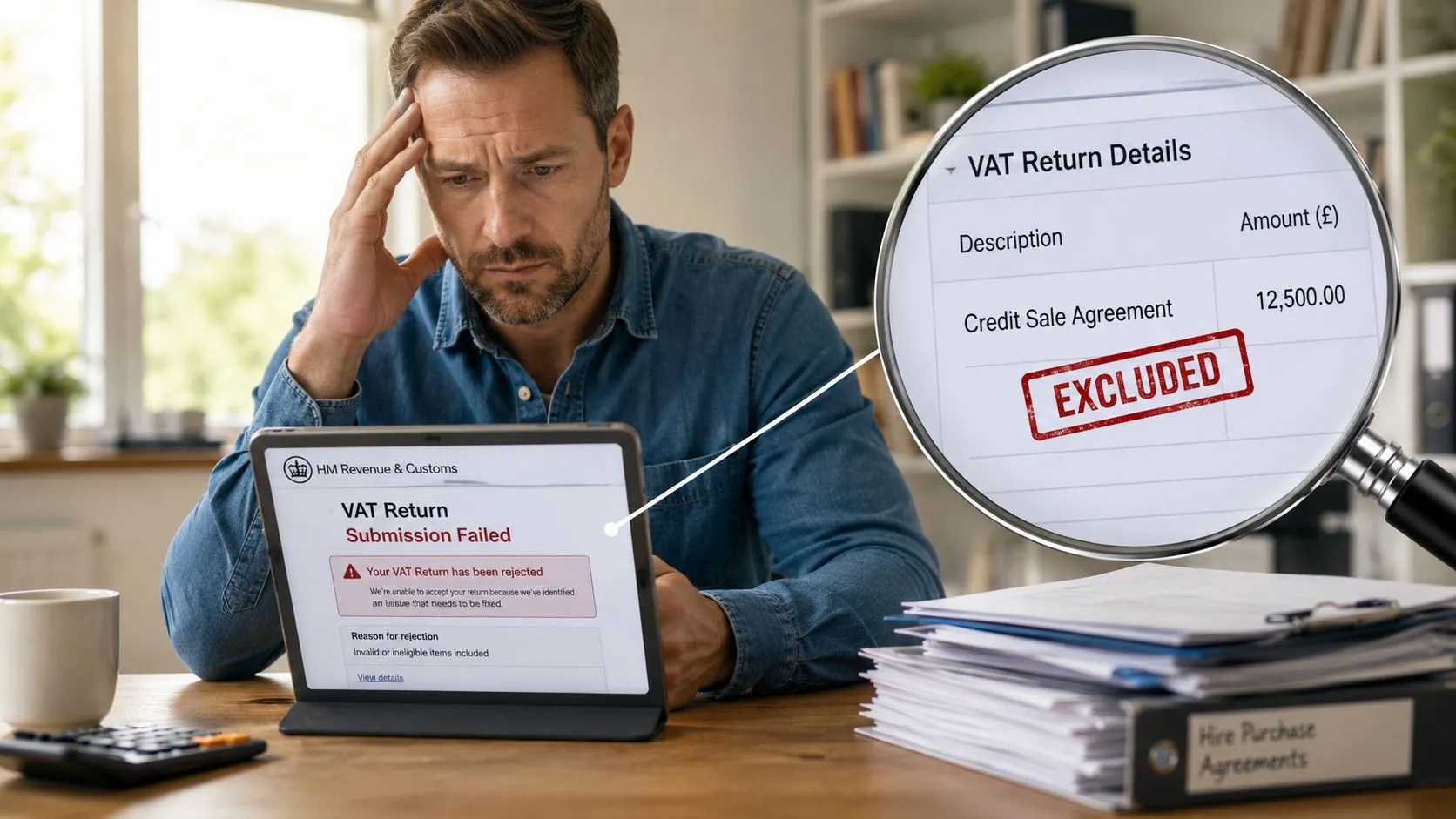
Where bookkeeping fails
Common control failures include:
- Mixed methods in one ledger: Staff apply cash treatment to some invoices and standard treatment to others without recording why.
- Partial payments ignored: The business reports the full VAT when only part of the invoice has been paid.
- Excluded supplies misclassified: Finance arrangements or long credit terms are treated as ordinary cash-accounting sales.
- Weak payment matching: Bank receipts aren't linked to the right invoice, leaving the VAT return unsupported.
- Incomplete records: The business cannot show which transactions were already accounted for under standard VAT accounting.
The bad-debt position also needs precise handling. Cash accounting prevents output VAT from arising on an unpaid eligible invoice while the business remains within the scheme. That is different from a business using standard accounting, which may need to consider formal bad debt relief where VAT has already been accounted for and the debt later becomes irrecoverable.
The invoicing and evidence problem
A VAT invoice can affect the applicable VAT treatment, particularly where it is issued in advance or carries extended payment terms. Dating invoices incorrectly, failing to record payment allocations or changing methods without a cut-off schedule leaves the business exposed during an HMRC review.
Service firms often miss this when they use accounting software configured with a single default VAT setting. Trades businesses face the same issue when deposits, staged payments, retentions and finance arrangements appear in the same customer account. Software such as Xero or QuickBooks can help with matching, but neither platform decides whether a transaction falls within an exclusion. Someone must review the underlying contract and invoice.
Is Switching Right for Your SME? A Decision Checklist
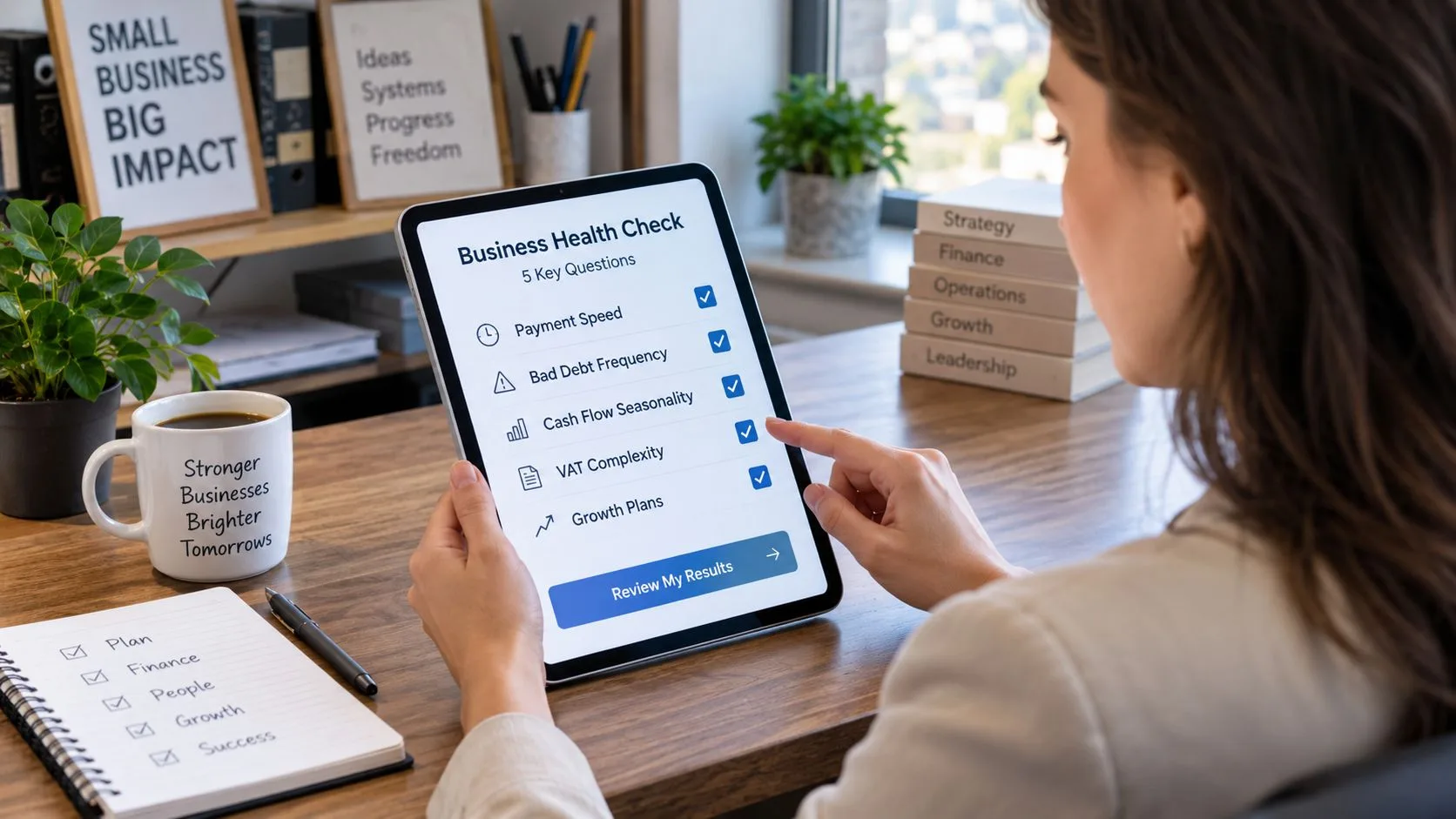
Use five questions before joining. Score each answer as favourable, neutral or unfavourable for cash accounting.
- How quickly do customers pay? Prompt payment weakens the cash-flow case. Slow settlement strengthens it.
- Do invoices regularly remain unpaid beyond normal terms? A substantial debtor book supports the scheme, but it also increases the eventual exit liability.
- When do suppliers expect payment? If suppliers demand payment before the business can reclaim input VAT, cash accounting may delay recoveries.
- Is turnover moving towards £1.35 million? Growth close to the entry and exit boundaries makes the scheme harder to manage.
- Are bad debts common? The scheme can reduce the need to fund output VAT on eligible unpaid invoices, but recurring bad debts may signal a wider credit-control problem.
A £20,000 overdue invoice illustrates why the exit model matters. Under cash accounting, the VAT on that unpaid invoice isn't reported merely because the invoice was issued. If the business later leaves the scheme before collecting it, the associated VAT can become payable without the customer's cash. Calculate that exposure from the actual VAT rate and invoice history before joining.
Match the scheme to the business pattern
| Business profile | Recommendation |
|---|---|
| Recruitment agency with prompt-paying corporates | Standard accounting may be simpler if receipts closely follow invoices |
| Construction subcontractor chasing main contractors | Cash accounting may help, but model retentions, exclusions and the exit liability first |
| Retail shop with high card turnover | Cash accounting may offer limited timing value because sales are collected quickly |
Owners should also decide how much automation they need. A structured bookkeeping workflow, payment matching and exception reporting can support automating UK VAT compliance, provided the software rules are checked against HMRC's transaction exclusions.
My recommendation is firm: prepare a written exit-cost model before joining. Include unpaid customer invoices, unpaid supplier bills, excluded transactions, the likely turnover path and the cash required if HMRC demands immediate payment. A Scottish SME can use cash accounting effectively, but only when its owner understands both sides of the bargain.
If you want an accountant to review the decision, Stewart Accounting Services provides VAT return preparation, bookkeeping and cash-flow support for SMEs across Central Scotland and the wider UK. Compare that support with your existing bookkeeping setup, then choose the arrangement that gives you reliable records and a defensible exit plan.
Before switching to the VAT Cash Accounting Scheme, ask your accountant to model your last VAT period under both methods, reconcile every unpaid invoice and test the consequences of crossing the exit threshold. If you're based in Scotland or operate across the UK, contact Stewart Accounting Services for a transaction-level review and a written recommendation before you submit the application.
Recent Posts
04 Oct, 2026
04 Oct, 2026
04 Oct, 2026