

How to Register for VAT UK: A Practical SME Guide
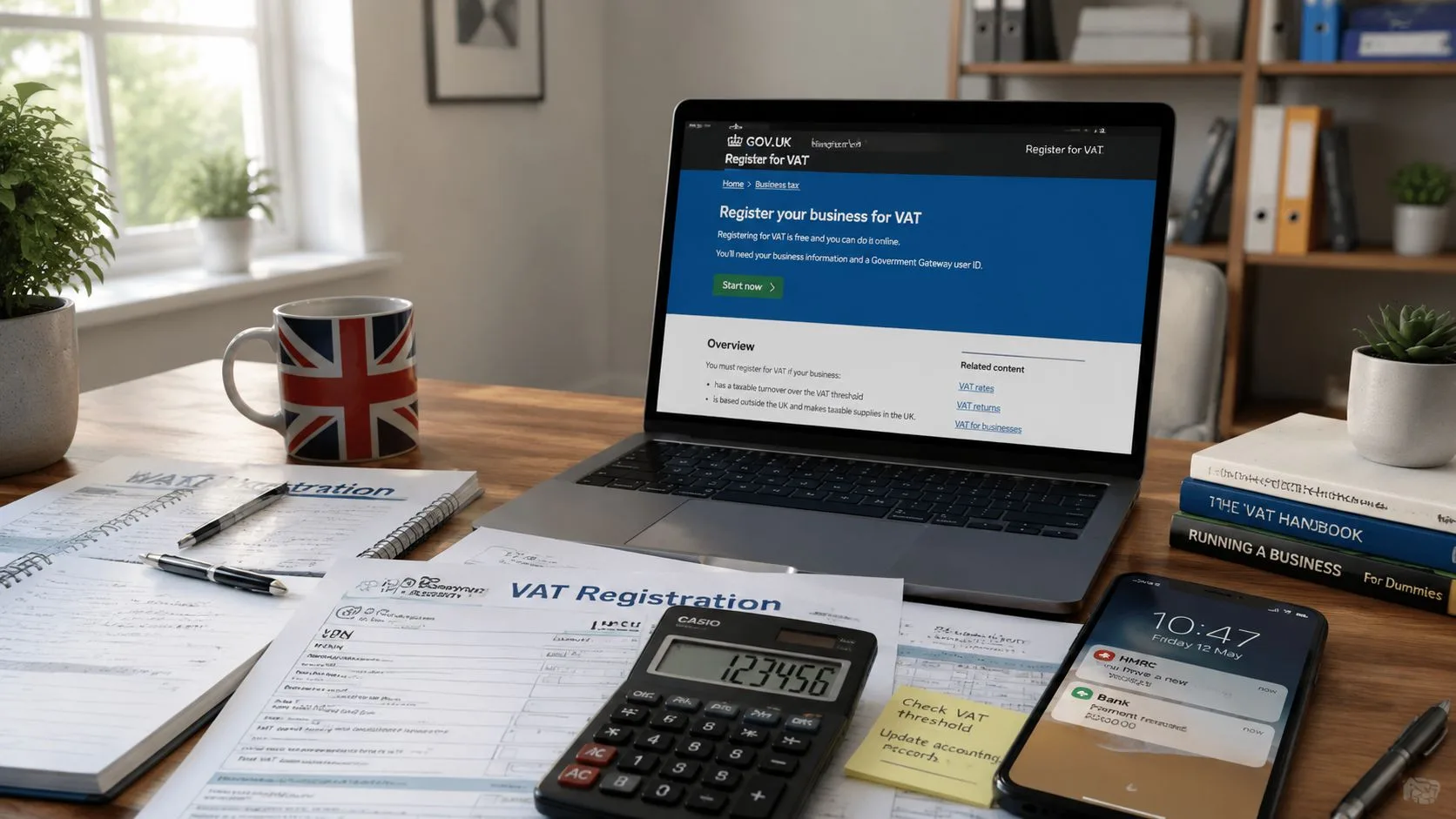
Your online shop has had a strong run. Orders are increasing, a wholesale customer has asked whether you're VAT registered, and your bookkeeping software is showing taxable sales close to the UK threshold. Then one evening, you realise the question isn't theoretical anymore: when must you register for VAT, what date applies, and how do you keep invoicing correctly while HMRC processes the application?
The form itself is rarely the hardest part. The problems usually start earlier, with incomplete turnover checks, missing business information, or confusion between the deadline to notify HMRC and the date from which VAT applies. This practical guide to how to register for VAT UK takes the process in chronological order, with particular attention to the timing gap and the paperwork that catches growing SMEs off guard.
The VAT Registration Reality for Growing UK SMEs
A growing e-commerce business can cross the VAT line without a dramatic moment. The owner may be focused on stock, fulfilment and customer service while taxable turnover accumulates across a rolling period. The first warning often comes from the accounts software, an accountant, or a customer asking for a VAT number.
In the UK, registration becomes mandatory when a business's taxable turnover exceeds £90,000 in the previous 12 months, or when it expects taxable turnover to exceed that amount in the next 30 days, according to HMRC's VAT threshold guidance. That test isn't based solely on the balance-sheet year, company year-end or calendar year. You need a rolling view of taxable supplies.
Once the threshold is crossed, the business has to notify HMRC within the required period. HMRC's VAT registration process sets out a notification deadline of 30 days from the end of the month in which the threshold was exceeded. That deadline runs separately from the effective registration date.
The timing problem owners underestimate
Suppose taxable turnover crosses the threshold during August. The business doesn't wait for a VAT certificate before changing its invoices. The effective date can apply from the point at which the liability arose, while the notification deadline gives the business time to submit the application.
That creates an awkward operational window. Sales may need to be reviewed, pricing may need to be adjusted, invoices may need to show VAT, and the bookkeeping system may need to record transactions from the effective date, even though the VAT number hasn't yet arrived.
Practical rule: Treat the threshold breach as an accounting and invoicing event, not as an administrative task you can leave until the certificate arrives.
The usual anxieties are understandable. Owners worry about submitting the wrong information, selecting a scheme that doesn't suit their cash flow, or issuing invoices without a number. The safest approach is calm and chronological: establish the liability date, prepare the evidence, submit the application, preserve the confirmation, and configure the accounting system from the correct effective date.
When You Must and When You May Want to Register
The core test is straightforward, but the way you monitor it matters. HMRC applies the £90,000 taxable turnover threshold to a rolling 12-month period, and its current guidance also identifies a separate £88,000 deregistration threshold. Businesses near either point should monitor turnover closely rather than relying on an annual review.
Taxable turnover includes taxable supplies, not every amount that appears in the bank account. Your review should distinguish taxable sales from exempt income, non-business receipts and transactions that follow different VAT treatment. If you expect taxable turnover to exceed £90,000 in the next 30 days, the forward-looking rule can require registration before the rolling historical test would otherwise catch you.
Mandatory registration
If the threshold is exceeded, HMRC expects notification within 30 days of the end of the month in which the breach occurred, as explained in its official VAT registration instructions. An overseas business supplying goods or services to the UK may also have to register regardless of turnover, so a non-UK establishment shouldn't assume the UK threshold is the only test.
The threshold rose from £85,000 to £90,000 on 1 April 2024, making the current threshold a recent policy change with a direct effect on registration decisions. You can use HMRC's VAT Registration Estimator as an additional sense check, but it shouldn't replace a properly maintained turnover schedule.
Voluntary registration
A business below the compulsory threshold may still register voluntarily. That decision can make commercial sense where the business:
- Has significant input VAT: Registration may allow recovery of eligible VAT on stock, equipment and other business costs, subject to the normal rules and evidence.
- Sells mainly to VAT-registered customers: Business buyers may focus more on the net price because they can often account for recoverable input VAT.
- Needs to prepare for growth: Registering before a known expansion can avoid a rushed application when a contract or launch pushes turnover upwards.
- Wants clearer tax discipline: A VAT system can encourage more structured invoicing, purchase records and cash planning, although it also adds administration.
Voluntary registration isn't automatically beneficial. It can affect customer pricing, reporting obligations and bookkeeping workload. A consumer-facing business may need to decide whether to increase prices, absorb VAT or adjust margins.
For a fuller explanation of the threshold and how it affects different business structures, see this guide to the VAT threshold for UK businesses.
| Trigger or reason | Type | What to do |
|---|---|---|
| Taxable turnover exceeds £90,000 in a rolling 12-month period | Mandatory | Calculate the liability date and notify HMRC within the required window |
| Expected taxable turnover exceeds £90,000 in the next 30 days | Mandatory | Review the forecast immediately and start the registration process |
| Overseas business supplies the UK | Potentially mandatory | Check the specific place-of-supply and registration rules |
| Input VAT on stock or equipment is commercially significant | Voluntary | Model recoverable VAT against administration and pricing effects |
| Growth or a major contract is approaching | Voluntary or mandatory, depending on forecasts | Plan the effective date and accounting setup before trading changes |
Choosing the Right VAT Scheme for Your Business
Registration and scheme choice are separate decisions. The standard method is often the safest starting point because it follows the ordinary process of charging VAT on taxable sales, reclaiming eligible input VAT and accounting for the difference. That doesn't mean it's optimal for every trading pattern.

Compare the schemes with your cash cycle
Standard Accounting suits businesses that want the clearest link between invoices, VAT returns and input tax recovery. It can work well for both retail and B2B, but businesses with long customer payment periods need to plan for VAT collected on invoices before the cash reaches the bank.
Cash Accounting can be useful where customers pay slowly because VAT is generally aligned more closely with cash received and paid. Eligibility conditions apply, and the method requires disciplined bank reconciliation. The VAT Cash Accounting guidance from Stewart Accounting Services is a useful starting point before making an election.
Flat Rate reduces some calculation work by applying a sector percentage to relevant turnover. It can suit a business with limited input VAT and relatively straightforward costs, but it may produce a poor result where equipment or stock purchases create substantial recoverable VAT. Limited cost trader rules can also change the calculation, so don't choose it because the headline percentage looks convenient.
Annual Accounting may suit a business with stable turnover that prefers regular instalments and one annual reconciliation. It can make cash planning easier, but it demands accurate forecasting. If turnover changes quickly, instalments may no longer reflect the eventual liability.
Margin Scheme is designed for particular trading patterns, including eligible second-hand goods, works of art, antiques and collectibles. It calculates VAT by reference to the margin rather than the full selling price, but detailed purchase and sales records are essential. It isn't a general-purpose scheme for any retailer selling used products.
The right question isn't “Which scheme has the lowest apparent payment?” It's “Which scheme reflects how my customers pay, how I buy stock and where my input VAT arises?”
Before choosing, compare a representative period of sales, purchases, customer payment timing and stock movements. A scheme that saves bookkeeping effort can still harm cash flow or reduce input tax recovery if it doesn't match the business model.
Preparing Your Information Before You Start the Form
A rushed VAT application often starts with one missing date or a turnover figure that does not reconcile. Treat the form as a data-preparation exercise. Assemble the evidence first, then complete the application with consistent information.
HMRC's online process requires a Government Gateway user ID and password, plus details such as the company registration number, business bank account, UTR, annual turnover and estimated taxable turnover for the next 12 months. The HMRC registration checklist identifies further requirements for sole traders, including a National Insurance number and identity document.
Assemble the business file
Keep these details together before opening the form:
- Legal identity: Legal name, trading names, Companies House number where relevant, registered office and business address.
- Tax references: UTR, National Insurance details for relevant individuals, and existing HMRC account information.
- Trading profile: Business activity, start date, customer locations, expected turnover, and the date taxable turnover crossed or is expected to cross the threshold.
- Bank information: Business bank details matching the records used in the application.
- Transaction evidence: Sales and purchase summaries, invoices, receipts, credit notes and bank records.
- Special circumstances: Previous VAT registrations, VAT groups, acquisitions, property transactions, overseas supplies and scheme elections.

Reconcile the figures first
Review the previous 12 months of sales and classify standard-rated, reduced-rated, zero-rated, exempt and overseas transactions. Bank receipts alone do not establish taxable turnover. A receipt could relate to an earlier invoice, deposit, loan or non-business income.
The date matters because the must-notify deadline and effective registration date can differ. Identify the date that created the obligation, preserve the relevant sales records, and flag invoices raised before the VAT number arrives. This prevents a later scramble to reconstruct the period between liability arising and registration confirmation.
Limited companies should compare the application with Companies House and corporation tax records. Sole traders and partnerships should keep personal and business details consistent. Scan incorporation documents, leases, purchase agreements and identity evidence so supporting material is ready if HMRC requests it.
Actual sales and purchase patterns also provide a sound basis for choosing a VAT scheme. Use the reconciled figures to test Cash Accounting, Flat Rate, Annual Accounting or the Margin Scheme against the business's real customer payments, stock purchases and recoverable input VAT, rather than relying on a general impression of typical trading.
Registering Online, Effective Dates and the Agent Route
Start through the relevant GOV.UK VAT registration service, using the business's Government Gateway account. The application asks about the legal structure, business activity, turnover, expected VAT position and the circumstances that created the registration obligation.

Work through the form carefully rather than treating it as a simple identity check. The notification deadline is 30 days from the end of the month in which taxable turnover crossed the threshold, while HMRC sets the effective date according to the liability rules. Those two dates don't necessarily match, which is why the business should identify the effective date before sending invoices.
For example, if taxable turnover crossed the threshold on 12 August, the notification deadline would be 30 September and the effective date would generally be 1 August. The business should preserve records from the effective date and plan how to handle invoices issued during the period before the VAT number arrives.
Using an accountant or tax agent
An agent can submit the registration, but the business still owns the underlying facts and remains responsible for meeting the deadline. The client normally signs in and authorises the agent as its VAT agent, after which the agent uses its own credentials and agent identifier to complete the application.
Give the agent the turnover schedule, legal details and supporting evidence in one organised file. Sending partial information through several emails is a common cause of delay because the application may need clarification before HMRC can process it.
HMRC's application guidance requires accurate turnover estimates, UTR information and bank details. Save the submission confirmation, note the effective date, monitor the Government Gateway account and answer evidence requests promptly.
A registration can take longer than an owner expects. Older professional-body material reports that most registrations took 10 to 14 days, while 20% to 25% took longer because routine information was missing or incomplete, and a small share took up to 10 weeks where more extensive checks applied. Those figures come from the Association of Taxation Technicians' VAT registration material, and they illustrate why preparation matters.
If the application is delayed, don't assume the VAT liability is delayed with it. Keep a clear transaction log from the effective date and obtain advice on correcting invoices or recovering VAT once the registration number is issued.
After Registration, Invoices, Returns and Xero Setup
The first Xero task is to record the effective registration date and configure the bookkeeping from that point. The VAT number may arrive later, so keep dated sales and purchase records while HMRC completes the application.
Enter the nine-digit VAT number once issued, then check the legal name, trading name and address against the registration details. Configure the VAT rates the business uses, including standard-rated, reduced-rated and zero-rated transactions where relevant. If HMRC has accepted Cash Accounting, Flat Rate, Annual Accounting or the Margin Scheme, match those settings in Xero instead of relying on its defaults.

Build the first VAT period properly
From the effective date, VAT invoices should include supplier and customer details, an invoice number, the taxable supply date, the total including VAT and the VAT charged. A simplified invoice can suit qualifying retail or low-value supplies, provided it meets the transaction and customer requirements.
Retain VAT records for at least six years. The file should cover invoices, credit notes, receipts, bank records, import documents and evidence supporting the scheme used. VAT-registered businesses also generally need digital records and compatible software for Making Tax Digital.
A return and payment are normally due one month and seven days after the accounting period ends. Confirm the precise deadline in the VAT account, then keep the VAT due date checklist visible to the owner and bookkeeping team.
Reconcile sales, purchases and bank transactions before approving the return. Review reverse-charge entries separately, since they require different treatment from ordinary deductible VAT. Check unusual credit notes, pre-registration costs and mixed-rate sales before submission.
Keep the control system simple
Set recurring diary dates for the return, reconciliation and payment. Allow time to correct coding errors after the period closes. Keep VAT collected from customers separate from ordinary working cash, so it is available when payment falls due.
Where turnover exceeds the Flat Rate Scheme's £150,000 upper turnover limit, review eligibility before the next return. The HMRC responsibilities for VAT-registered businesses also provides a useful reference for record-keeping, invoicing and filing duties.
Stewart Accounting Services can configure VAT codes, scheme settings, reconciliation controls and first-period Xero processes, alongside registration and return setup.
Common Pitfalls, Timelines and Quick Answers
The dangerous assumption is that VAT registration is just an online form. The form is only one point in a chain that includes turnover monitoring, effective-date analysis, invoice treatment, scheme selection, digital records and return deadlines.
The recurring mistakes are predictable:
- Late notification: The business notices the breach at year-end instead of running a rolling review and misses the HMRC notification window.
- Incomplete information: The Government Gateway application contains inconsistent company details, missing turnover estimates or incorrect bank information.
- Wrong scheme: The business chooses Flat Rate because it appears simple, then discovers that its purchasing pattern makes input VAT recovery more important.
- Late system setup: Xero or another compatible platform remains configured as non-VAT until after the effective date, leaving invoices and reports needing reconstruction.
- Poor evidence: The owner can't support the turnover calculation or explain how the effective date was determined.
Quick answers
What if turnover falls below the threshold after registration?
A later fall doesn't automatically erase the registration. The business should review whether it remains liable and whether deregistration is appropriate, with HMRC's separate £88,000 deregistration point forming part of that assessment.
How quickly will HMRC issue the VAT number?
Processing time varies. HMRC may request evidence, and incomplete applications can take longer. The ATT material cited earlier records ordinary cases taking 10 to 14 days, with longer periods in some cases.
Does voluntary registration remove Making Tax Digital obligations?
Voluntary registration still creates VAT compliance responsibilities. Confirm the applicable digital recordkeeping and filing requirements before the first return, rather than assuming voluntary registration receives lighter treatment.
How long does registration take from start to certificate?
The form may be completed quickly, but the overall timeline depends on application quality and HMRC checks. Build the process around the effective date and notification deadline, not around an assumed certificate arrival date.
If your taxable turnover is approaching the threshold, prepare the rolling calculation and application evidence before the deadline arrives. Contact Stewart Accounting Services to review the liability date, assess voluntary or mandatory registration, choose a suitable scheme and configure your first VAT period in Xero, so your invoices and records are correct from day one.
Recent Posts
04 Oct, 2026
04 Oct, 2026