

CIS Deductions Explained: Rates, Returns and Cash Flow

How much of a builder's invoice reaches the bank? That is the practical question.
CIS works like a holding account, not a fine. One unverified labour payment of £1,000 keeps £300 (30%) with HMRC until Self Assessment or the company tax return reconciles it. The same pattern over a year locks up a much larger sum. The credit appears only when the return is filed.
With CIS deductions explained properly, you can separate tax withheld from money lost, spot verification gaps that hold extra cash, and see reporting mistakes that create penalties for contractors.
CIS Deduction Rates at a Glance
CIS deduction rate by subcontractor status
| Subcontractor status | Deduction rate | What it means |
|---|---|---|
| Registered and verified | 20% | Standard deduction, credited against income tax and National Insurance |
| Not registered or cannot be verified | 30% | Higher deduction applied until status is confirmed |
| HMRC gross payment status | 0% | Paid in full, provided the statutory conditions are met |
These are withholding rates, not your final tax rates. The contractor retains the appropriate amount from the relevant payment and pays it to HMRC on your behalf.
The scale explains why HMRC takes the process seriously. The UK Government's CIS reform assessment estimated in 2024 that the scheme protects approximately £8.6 billion in tax revenue annually.
What the rate means for your payment
Registration and verification aren't interchangeable. A subcontractor might have submitted a registration application, but the contractor still needs a usable HMRC verification result before applying the corresponding payment treatment.
Likewise, gross payment status isn't something a contractor can grant because you've worked together for years. HMRC must approve it, and the subcontractor must continue meeting the statutory conditions.
Practical rule: Agree the payment treatment using HMRC's verification result, not an assumption written on an invoice.
For a hypothetical £1,500 labour-only payment, the standard deduction would be £300, while the higher deduction would be £450. That leaves £150 less cash available when the higher rate applies, even though the work and invoice haven't changed.
Don't mistake a lower bank receipt for a lower invoice value. Your records need to preserve the full income and separately identify the amount withheld.
Gross payment status also doesn't mean tax-free income. It means the contractor doesn't withhold CIS from that payment, leaving you responsible for planning for the eventual tax liability.
Before issuing your next invoice, confirm that the contractor has the correct business details and has established the appropriate payment status. Sorting that out before payment is much easier than questioning a deduction after the money has moved.
Who the Scheme Affects and Why It Exists
CIS works a little like PAYE on a building site: the person paying for work withholds money before the recipient receives it. The important difference is that CIS doesn't turn a self-employed subcontractor into an employee, and registration doesn't prove that someone is self-employed.
The scheme was introduced in 1971 to protect tax revenue in an industry with mobile workers and substantial cash payments; HMRC's CIS history also explains how the modern framework replaced paper registration cards, tax certificates and vouchers with contractor verification and monthly reporting from 6 April 2007.
The payment relationship determines which responsibilities you need to consider.

Follow who pays whom
A contractor pays subcontractors for construction work. This can include a main building contractor or a property developer engaging trades, rather than only a large construction company.
A subcontractor carries out construction work for a contractor. The subcontractor might be a sole trader, a partnership or a limited company, including a freelancer working through their own company.
- Plasterer working for a main contractor: The plasterer invoices for the work and receives the payment after any applicable deduction. The main contractor handles verification, payment records and reporting.
- Groundworks firm engaging a self-employed labourer: The firm takes the contractor role for that payment. It shouldn't assume that paying against an invoice removes its CIS responsibilities.
- Business operating in both roles: A firm can receive payments as a subcontractor while paying other businesses as a contractor. Those incoming and outgoing transactions need separate records.
Employment status comes first
Calling someone a subcontractor doesn't settle their employment status. Before applying CIS, the payer needs to consider whether the actual working arrangement is self-employment or employment.
That distinction matters because CIS isn't an alternative payroll system for employees. A signed subcontract agreement or a tax reference doesn't override how the engagement operates in practice.
The useful starting question is therefore: which side of this payment am I on? If you're receiving payment, check the deduction evidence. If you're making payment, establish your verification and reporting responsibilities before releasing it.
How to Register and Verify Subcontractors Correctly
Registration belongs to the subcontractor; verification belongs to the contractor. Keeping those responsibilities separate prevents the familiar argument where each party assumes the other has completed the necessary checks.
Prepare the identity details before anyone authorises payment.

For subcontractors
- Register the correct business with HMRC. Use the details for the sole trader, partnership or company entering the contract and issuing invoices. Don't mix a director's personal identity with the company receiving payment.
- Prepare your identifiers. Keep your Unique Taxpayer Reference ready, together with your National Insurance number where relevant. Company and partnership details need to match their own HMRC records.
- Give the contractor consistent information. Your registered name, trading name and invoice details should make it clear which business is being paid.
- Consider gross payment status separately. Registration alone doesn't confer it. Apply through HMRC if appropriate and retain the application evidence and approval.
Gross payment approval involves statutory conditions concerning the business, turnover and tax compliance. Prepare supporting records, including business banking information, rather than treating the application as a request for a preferred rate.
For contractors
- Collect details before the first payment. Build this into supplier onboarding, not the final bank-payment approval.
- Use HMRC's verification service when required. Record the result, verification reference and date against the subcontractor's supplier record.
- Apply the instructed payment treatment. Don't substitute the subcontractor's expectation or an old invoice for the verification outcome.
- Act on changes. Follow HMRC's verification requirements and status notifications. A new engagement should prompt a review of your records, not an assumption that an old result remains sufficient.
Our guide to CIS subcontractor verification provides a practical companion for organising those checks.
For a visual explanation to accompany the process, use this walkthrough.
The verification record shows why the contractor used a particular payment treatment. Save it somewhere the person preparing the monthly return can access, rather than leaving it in a site manager's inbox.
If registration is still being processed when work starts, flag that immediately. Complete the registration and resolve mismatched details before the first payment where possible; don't assume a later approval automatically changes an earlier deduction.
How Deductions Are Calculated on Each Payment
Start with the amount subject to CIS, not the invoice total. In a labour-and-materials invoice, the deduction applies to the labour amount after excluding VAT and the qualifying direct cost of materials.
Materials need evidence. A separately labelled invoice line helps, but the contractor should still be satisfied that the amount represents the relevant materials cost, rather than a labour charge or a mark-up relabelled as materials.
Work through the calculation
- Identify the invoice amount before VAT. Deal with the applicable VAT treatment separately from the CIS calculation.
- Remove qualifying materials costs. Check what the subcontractor paid and retain supporting receipts or a suitable breakdown.
- Apply the verified deduction rate to the remaining amount subject to CIS.
- Calculate the payment and record the withholding. Keep the invoice, deduction calculation and payment statement consistent.
For a hypothetical example, assume an invoice totals £2,000 before VAT, comprising £500 of qualifying materials at cost and £1,500 of labour. Assume there's no VAT amount to add to the payments shown below.
Worked example: £2,000 invoice with £500 of materials
| Subcontractor status | Labour base | Deduction | Net payment |
|---|---|---|---|
| Registered and verified (20%) | £1,500 | £300 | £1,700 |
| Not registered or unverified (30%) | £1,500 | £450 | £1,550 |
| HMRC gross payment status (0%) | £1,500 | £0 | £2,000 |
The net payment includes the materials reimbursement. That's why the registered subcontractor receives more than the labour amount remaining after deduction.
Check the base before arguing about the rate
A contractor can use the correct rate and still calculate the wrong deduction. Applying it to an invoice total that includes qualifying materials is a different error from choosing the wrong subcontractor status.
A correct percentage doesn't rescue an incorrect calculation base.
Subcontractors should make the breakdown clear when raising the invoice, with materials supported by purchase records. Contractors should query unclear descriptions before processing the payment, rather than guessing how much is labour.
Don't use an arbitrary materials allowance just to reduce the withholding. The calculation needs to reflect the actual transaction and the CIS rules.
If the statement doesn't match your calculation, raise the discrepancy promptly and identify whether the problem is the payment base, the verification result or the arithmetic. That gives both parties a specific issue to resolve instead of an unexplained year-end difference.
Monthly Returns, Deadlines and Penalties
The contractor's monthly CIS return is due by the 19th of the following month for the preceding CIS tax month, under HMRC's monthly return and penalty guidance. Treat that as a recurring reporting deadline, not a task to remember after paying suppliers.
The return must include all in-scope subcontractor payments, including those paid gross. A month without subcontractor payments generally still requires notification to HMRC, so silence isn't a reliable compliance process.
How late filing becomes expensive
CIS penalties by lateness and error
| Situation | Penalty |
|---|---|
| Return one day late | £100 |
| Return two months late | £200 |
| Return six or twelve months late | £300 or 5% of CIS deductions on the return, whichever is higher |
| Extended non-compliance | Up to £3,000 or 100% of reported deductions |
| Incorrect employment status reported for a subcontractor | Up to £3,000 |
These are the escalating exposures identified in the HMRC guidance above. Don't treat the smallest penalty as a fixed price for filing whenever convenient: continued lateness can trigger further charges.
The employment-status exposure is separate from a simple arithmetic mistake. A business needs a defensible basis for treating the worker as self-employed, not just evidence that it checked their CIS registration.
Reconcile before submitting
The person filing the return should be able to trace every reported payment through the underlying records.
- Invoices and payments: Match the relevant supplier invoices to what was paid during the reporting period.
- Verification results: Check that the payment treatment agrees with the result applicable to that subcontractor.
- Deduction statements: Confirm that the amounts issued to subcontractors agree with the return.
- Gross payments: Include reportable transactions even where nothing was withheld.
Our CIS monthly return deadline guide can help you organise the reporting timetable alongside those checks.
Submitting the return and paying the deductions to HMRC are distinct responsibilities. Don't assume that completing the reporting screen also settles the amount due.
Assign ownership of the monthly process and arrange cover when that person is away. An unreviewed draft or an unanswered query about a supplier shouldn't leave the entire return unattended until the deadline has passed.
Cashflow and Tax Return Impact in Practice
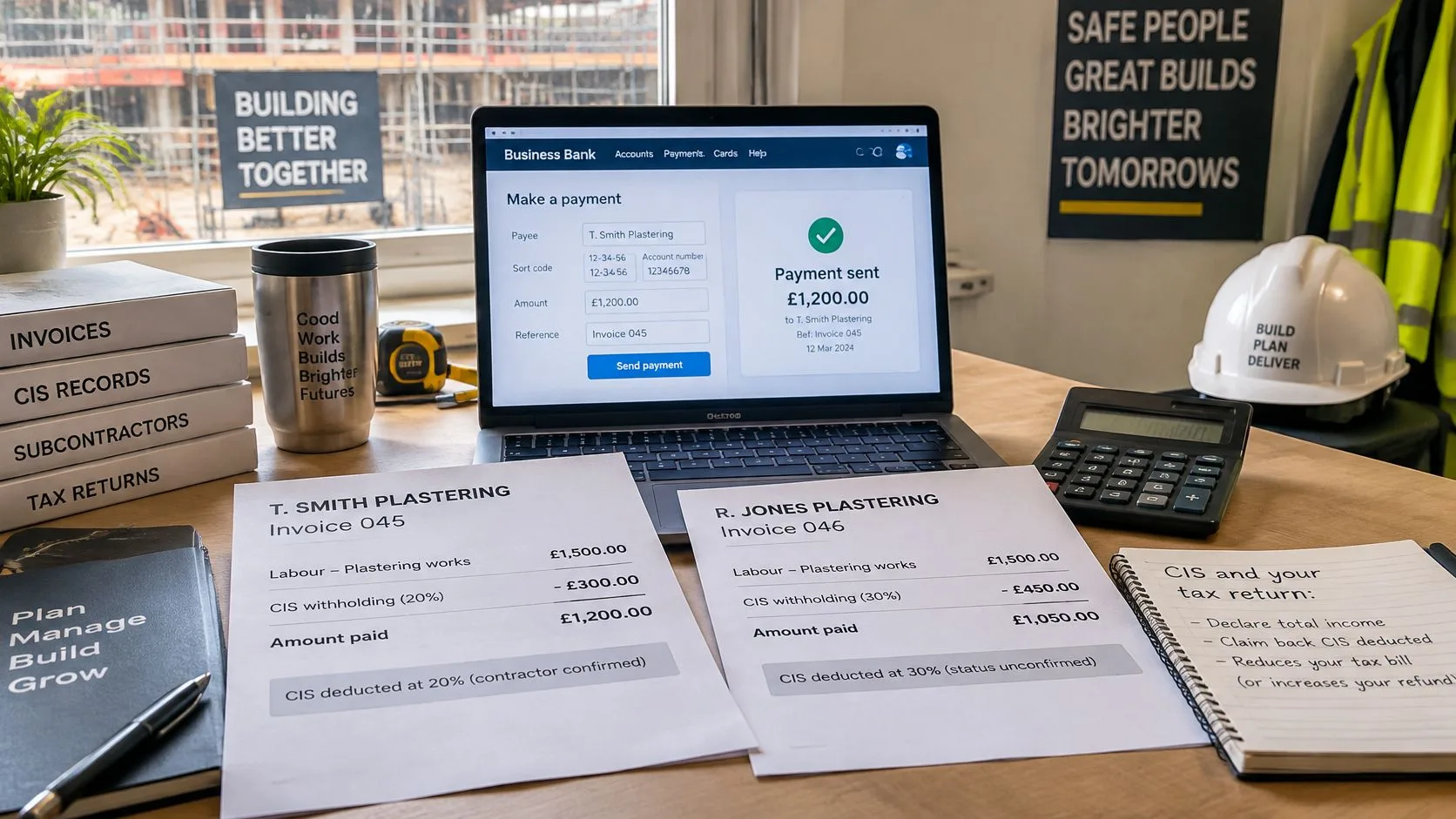
Consider a hypothetical sole-trader plasterer submitting a £1,500 labour invoice. With £300 withheld, the bank receipt is £1,200; if an unresolved verification issue instead produces a £450 deduction, only £1,050 arrives.
The extra £150 hasn't disappeared as an additional tax charge. But the plasterer can't use it to buy supplies, cover travel or pay household bills while HMRC holds it pending the appropriate reconciliation.
Keeping invoices and deduction statements together makes that distinction visible.
Compare a payment with a full year
The following figures are illustrative, not a forecast of anyone's tax bill. Assume annual labour invoices of £60,000 and a final income tax and National Insurance liability of £9,500.
| Hypothetical position | Standard-rate deductions | Higher-rate deductions |
|---|---|---|
| Deduction from the single labour payment | £300 | £450 |
| Cash received from that payment | £1,200 | £1,050 |
| Total deductions across the assumed year | £12,000 | £18,000 |
| Refund after the assumed final liability | £2,500 | £8,500 |
The larger refund isn't a better commercial result. In this scenario, the subcontractor has paid substantially more in advance and had less cash available while completing the work.
A single unverified payment creates a temporary cash shortfall. Repeating that payment treatment throughout the year makes the working-capital effect much larger.
Cashflow lesson: A tax refund can represent money your business needed months earlier, not an unexpected gain.
Reconciliation isn't identical for every business
For a sole trader, Self Assessment brings together income, allowable expenses, other relevant circumstances and CIS deductions. If deductions exceed the final liability, an overpayment can arise; if they fall short, there's a balance to pay.
A limited company needs the company-specific CIS recovery process. Don't assume that entering deductions on a Corporation Tax return is the equivalent of a sole trader claiming them through Self Assessment, or that recovery always has to wait for that return.
Use our CIS tax return guide for UK subcontractors to prepare the reconciliation. Keep a running total by contractor, investigate missing statements promptly and remember that other income, expenses and allowances affect the final outcome.
Records, Pre-Submission Checks and Next Steps
Good CIS records let you answer a practical question: can you explain each payment from invoice to bank receipt to HMRC reporting? A folder full of invoices alone won't establish which deduction was made, why that treatment applied or whether it was reported correctly.
Keep the source documents alongside the accounting entries. Xero or another cloud accounting package can help organise the transactions, but the software still needs the verification evidence and deduction statements attached or stored in an accessible linked filing system.
Contractor records to keep together
- Verification evidence: Retain the subcontractor's identity details, verification result, reference and date, plus relevant status-change notifications.
- Invoice support: Keep the labour-and-materials breakdown and evidence supporting any excluded materials costs.
- Payment trail: Match bank payments to the invoices and CIS calculations they settle.
- Reporting evidence: Save deduction statements issued, submitted monthly returns and the corresponding HMRC payment records.
Make sure someone other than the person who created the records can understand them. File names based on supplier, reporting period and document type are more useful than a collection of downloads labelled with unexplained reference numbers.
Subcontractor records to reconcile
- Statements from every contractor: File them by business and tax year, and follow up missing or inconsistent documents.
- Sales invoices: Preserve the full invoice value and the breakdown of the work and materials.
- Status documents: Keep registration correspondence and any gross payment approval or withdrawal notification.
- Deduction totals: Maintain a running reconciliation between statements, accounting records and bank receipts.
Don't delete documents because you've submitted a return or received a refund. Retention requirements depend on the type of business and records involved, and an unresolved enquiry can affect what you need to retain.
For broader filing-system guidance, Snyp's explanation of small business tax record requirements is a useful companion to your CIS-specific records. Set your retention policy around the requirements that apply to your business rather than treating cloud storage as permission to discard originals indiscriminately.
Checks before the next payment or return
- Confirm the payment status. Can you locate the relevant verification evidence and any subsequent notification?
- Confirm the calculation base. Does the invoice clearly identify labour and supported materials costs, with VAT handled separately?
- Confirm the reporting match. Do the bank payment, deduction statement and monthly return agree?
If something doesn't reconcile, record the discrepancy and assign someone to resolve it. Don't overwrite a figure merely to make the totals match, because that removes the trail you'll need if HMRC or the other party asks questions.
Before your next payment run or tax return, bring your verification records, recent invoices and deduction statements to Stewart Accounting Services for a CIS review. We assist contractors and freelancers, including those trading through limited companies, with their accounting and tax requirements. Our advice continues throughout the year, helping you choose an appropriate business structure, stay on top of tax obligations and manage cashflow before a missing record or incorrect deduction becomes a larger problem.