

How Long to Keep Business Receipts: UK Rules Explained

Keep business receipts for at least six years after the relevant VAT period, accounting period or invoice date, and longer where an asset, open enquiry or late return applies.
The counterintuitive part is that a receipt can reach the end of one retention period while you're still required to keep it under another. The right deletion date comes from identifying every obligation the document supports, not counting forward from the date printed on it.
Retention Periods for Business Receipts at a Glance
Six years is a useful working default for many business records, but it is not a universal destruction date. The applicable period depends on the record, the business structure and the obligation it supports.
A receipt may fall under more than one rule, and each rule can start its clock at a different event. Use the table to identify the relevant categories, then check the starting point before setting a deletion date.
Minimum retention periods for business receipts
| Record or business type | Minimum period | Counted from |
|---|---|---|
| VAT-registered business receipts, invoices and VAT account records | 6 years, under HMRC's VAT record-keeping guidance | The applicable VAT record-keeping starting point; individual invoices generally run from their issue date |
| VAT One Stop Shop records | 10 years under the scheme's separate retention requirement | The scheme-specific starting point for the transaction concerned; confirm it before scheduling deletion |
| Private limited company accounting records | Company-law minimums differ by company type; tax records may need to be kept longer | Depends on the applicable company-law or tax requirement |
| Public limited company accounting records | Company-law minimums differ by company type; tax records may need to be kept longer | Depends on the applicable company-law or tax requirement |
| Limited company tax records supporting Corporation Tax | Generally 6 years, with longer retention where necessary, as described in HMRC's record-retention guidance | End of the relevant financial year or accounting period |
| Sole trader or partnership Self Assessment digital records | Generally 5 years, following the relevant 31 January submission deadline, under HMRC's Making Tax Digital guidance | The relevant submission deadline, rather than the receipt date |
| Bank statements listed in HMRC's retention guidance | 5 years, unless another applicable obligation requires longer | The starting point required by the tax obligation the statement supports |
| Purchase invoices and authenticated receipts listed in HMRC's retention guidance | 4 years, unless another applicable obligation requires longer | The starting point required by the relevant record category and tax obligation |
The periods listed for specific HMRC record categories do not automatically cover a document that also supports VAT or company tax records. Apply the relevant requirements for each purpose the document serves.
Record the starting point as well as the period
An invoice date, the date an accounting record was made and the end of an accounting period are different starting events. A folder labelled by year helps you find a document, but does not establish its disposal date.
Practical rule: Record both the retention period and the event that starts it for each record category. A policy that lists only the number of years is incomplete.
Match each document to its applicable categories and enter the relevant starting event in your retention register. Where more than one requirement applies, use the latest date on which those requirements have all been met.
Why the Three-Year Companies Act Rule Is Not Enough
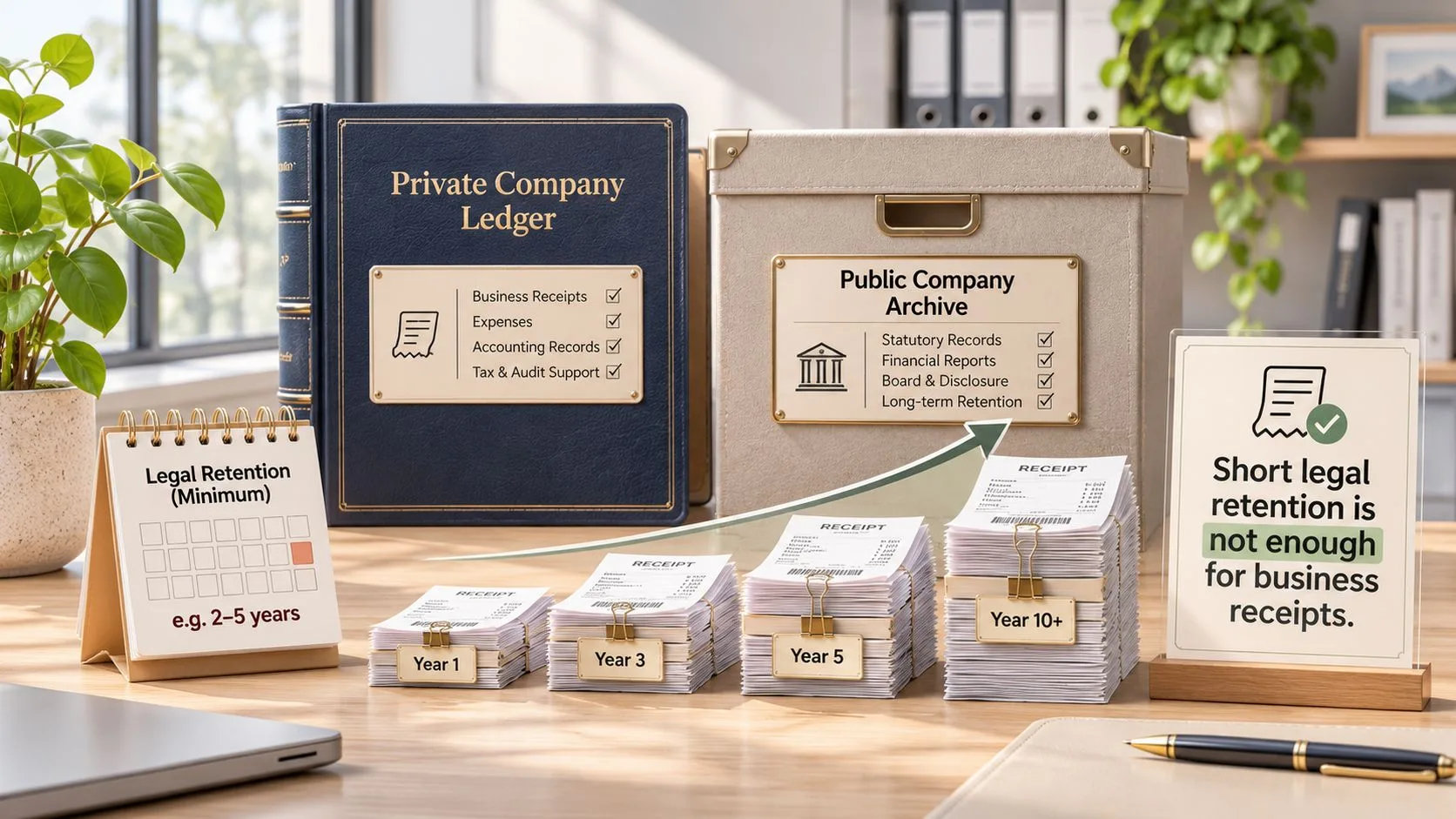
The misconception is that the Companies Act minimum gives a private limited company permission to shred all its receipts once that period has passed. It doesn't: company-law accounting requirements and tax-record obligations answer different questions.
Think of the Companies Act requirement as the minimum period for preserving the company's accounting history. Tax law adds another lock to the archive door, and you can't dispose of the evidence until that requirement has also been met.
A ledger entry isn't the underlying evidence
Accounting records must explain money received and spent and the matters connected with those transactions. A ledger line saying “repairs” records your treatment of the payment; the supplier's invoice helps establish what was repaired, who supplied the work and whether the cost belonged to the business.
The distinction matters when HMRC asks for support rather than a summary. A bank payment may establish that money left the account without establishing whether it bought stock, settled a personal bill or paid a refundable deposit.
The difference between retaining an entry and retaining its evidence is worth making explicit in your filing policy.
Tax obligations can outlast the company-law minimum
HMRC's Compliance Handbook distinguishes the private company's three-year Companies Act minimum from the usual six-year VAT requirement, while recognising that continuing tax positions can require longer retention. That's why using the shorter company-law period as an automatic deletion setting is unsafe.
Say a private company removes the supplier documents behind its expense ledger as soon as its company-law minimum expires. The totals remain in the accounts, but the owner can no longer demonstrate the business purpose or tax treatment of individual purchases when supporting the company's tax return.
- Preserve the explanation: Keep the receipt with any note needed to establish its business purpose.
- Separate record categories: Don't give invoices, company formation documents and employee records a single blanket deletion date.
- Check continuing relevance: An amended return, loss claim or capital-allowance position may still rely on an older document.
An invoice can also relate to a future payment or supply. Don't assume the bank payment starts its retention clock: the document's issue date and the accounting period it supports can produce different endpoints.
For each document type, ask which legal and tax purposes it serves. Use the longer applicable requirement, rather than treating the Companies Act minimum as a shortcut.
Which Period Wins When One Receipt Serves Several Purposes
A laptop bought by a VAT-registered limited company can support Corporation Tax, VAT, capital allowances and an employee expense reimbursement. Filing it only under “staff expenses” doesn't remove its other uses.
The correct test is the latest applicable retention endpoint, not merely the longest duration. A shorter period starting later can finish after a longer period starting on the purchase date.
Compare endpoints rather than labels
An invoice-date clock begins with the document. An accounting-period clock begins at the relevant period end, while a VAT-period-based policy uses the relevant VAT period. Those dates can differ even though the underlying purchase is identical.
For mixed-use evidence, calculate each applicable endpoint before choosing a deletion date. Where an ongoing tax position prevents a reliable endpoint, mark the document as held rather than inventing one.
When a receipt must be kept longer
| Scenario | Keep until | Why the period extends |
|---|---|---|
| Equipment or vehicle bought for the business | The asset's disposal and the resolution of the tax positions and record-retention obligations it supports | Original cost and purchase details may remain relevant to capital allowances and disposal calculations |
| Receipt used in a VAT return | The applicable VAT retention endpoint, or a later endpoint required for another purpose | The document supports VAT accounting as well as the purchase entry |
| Receipt under an open HMRC enquiry | The enquiry has closed and any remaining retention obligations have been satisfied | You must preserve evidence relevant to the unresolved check |
| Late-filed company tax return | The applicable extended retention requirement has been confirmed and met | A late return can change how long supporting evidence is needed |
| Receipt backing a bank-statement expense | The latest endpoint applying to the receipt, statement and associated tax treatment | The statement's record category doesn't replace the receipt's separate obligations |
An asset invoice shouldn't receive an automatic disposal date merely because it sits in an old purchase folder. Equally, a late-filed return shouldn't be treated as routine without checking whether it changes the retention requirement.
Keep unresolved items on hold. An uncertain deletion date is a reason to investigate, not a reason to let the software delete the file.
Tag the obligations at capture
Use practical tags such as VAT, Corporation Tax, asset and employee expense, alongside the ledger reference. If you're unsure whether the document provides appropriate VAT evidence, check what counts as a VAT receipt before relying on it for a claim.
The shortest document-category minimum rarely makes a good operational target for mixed-use records. When deciding how long to keep business receipts, classify the evidence by what it proves, then calculate the last date on which any applicable obligation requires it.
Keeping Digital Copies Without Losing Your Evidence
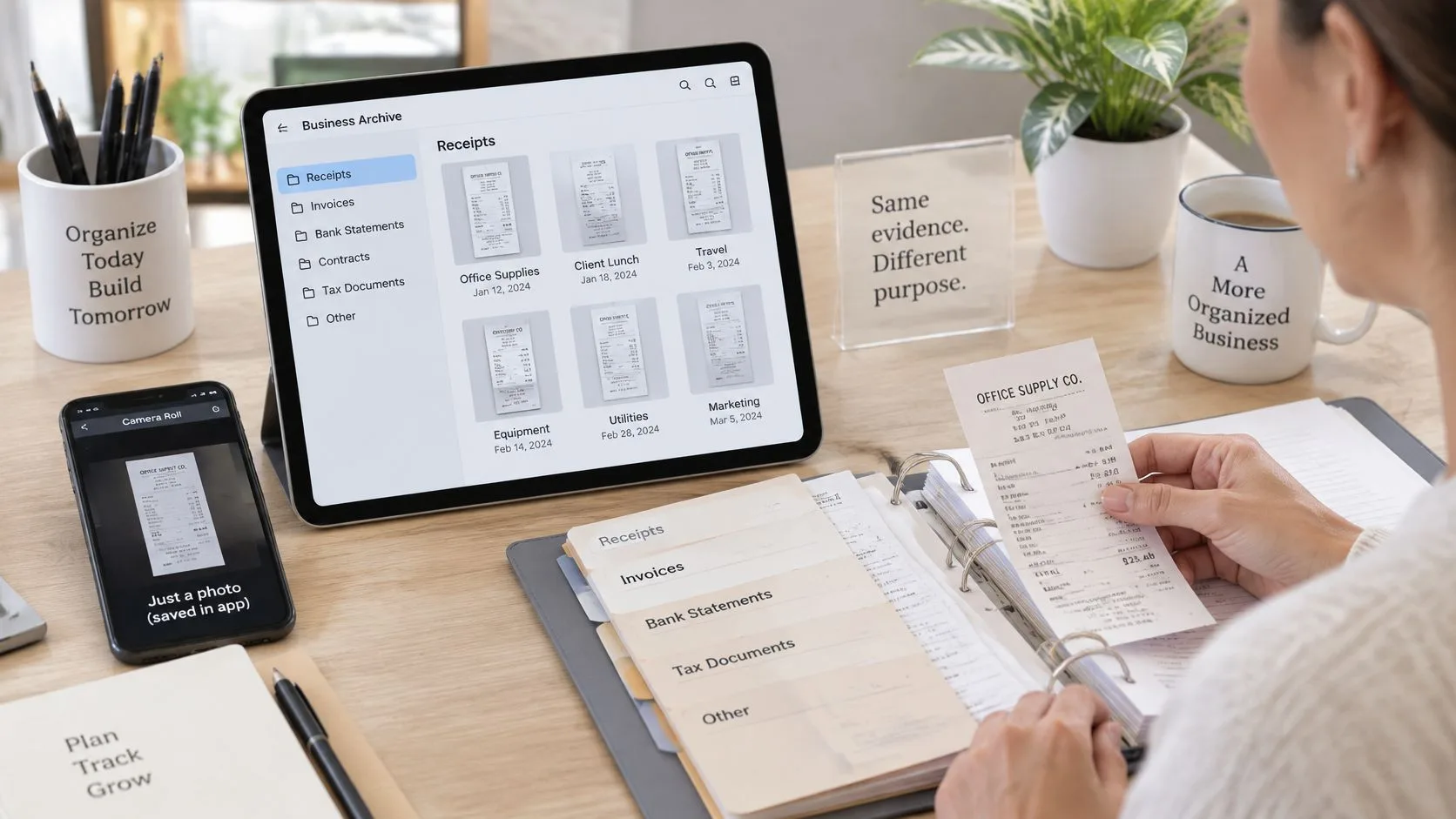
HMRC accepts digital copies where they accurately reproduce the original and remain accessible. That makes scanning useful, but a photograph somewhere inside an app isn't necessarily a dependable archive.
Build the process around retrieval, not just capture.
Check the image and the accounting entry
A usable copy shows the complete document, including any reverse side containing relevant information. It must remain readable when opened outside the capture screen and have a clear connection to the accounting entry.
Optical character recognition saves typing, but it doesn't verify tax treatment. Check the supplier details, VAT number, date and amount against the image, particularly where a faded receipt or folded invoice could confuse the software.
- Complete evidence: Save the actual invoice, not merely the email saying it's available.
- Readable files: Reject cropped photographs, glare and blurred totals.
- Traceable entries: Attach the document to the transaction in Xero or your bookkeeping system.
- Retained support: Keep the invoice or receipt even when the transaction data has imported correctly.
Making Tax Digital changes how records are maintained and returns submitted; it doesn't make supporting documents unnecessary. The Income Tax and VAT retention requirements remain separate, so a shared digital archive must accommodate both where relevant.
This video provides another format for reviewing your receipt-keeping process.
Watch the gaps between systems
Duplicate storage can create false confidence: the capture app may contain the image while the bookkeeping package contains only extracted text. A failed upload can leave neither system with a complete record.
Download supplier-portal invoices while they're available. Before moving software, export attachments as well as transaction data, and test that the exported documents still match their ledger references.
Our guide to VAT digital record keeping explains the bookkeeping side. Before destroying paper, retrieve a small random sample from the archive and confirm that each document opens, matches the recorded amount and connects to its ledger entry.
Worked Examples for Sole Traders, Landlords and Limited Companies
One receipt can support several tax and accounting records, each with its own retention period and start date. These examples show why a business should record the reason it is keeping each document, rather than apply one deletion date to everything.
A sole trader and a residential landlord
Moss Electrical is a VAT-registered sole trader using digital bookkeeping. For each purchase, the owner records the relevant Self Assessment and VAT retention deadlines, then keeps the receipt until the later deadline has passed. The receipt image stays with the VAT treatment and a note of the business purpose. The sole trader record-keeping guide offers a practical starting point for organising those records.
Rowan Lets is a residential landlord who is not VAT registered. Repair invoices, letting-agent charges and mortgage interest statements are filed with the relevant tax records. Property acquisition and improvement documents are kept separately because they may be needed to work out the property's tax position on a future disposal.
The landlord also notes whether expenditure was treated as a repair or an improvement. The invoice description alone may not make that distinction clear later.
A contractor and a company under enquiry
Bridgefield Consulting Ltd keeps purchase receipts, subcontractor evidence and employee expense claims with the company accounting records they support. An expense claim includes the employee's explanation and receipt, so the file shows both the business purpose and the amount reimbursed.
Northbank Design Ltd receives an HMRC enquiry about an older return. The owner pauses deletion of relevant records, including correspondence and explanations, until the enquiry is resolved and other retention periods have been checked.
An enquiry hold should identify the records affected. A general instruction to “keep everything” is harder to apply consistently.
A retailer selling directly to UK customers
Harbour Homeware sells goods directly to UK customers. It keeps sales invoices and supporting VAT records for the applicable VAT retention period, with the sales-ledger reference alongside them.
Payment-platform reports help reconcile receipts against sales, but they do not replace the sales evidence. Record the relevant date for each retention obligation, since the date a customer buys the goods and the date a payment reaches the bank can differ.
For each case, record why the document is retained and which deadline applies. Assets, other taxes or an unresolved enquiry may require the same receipt to be kept for longer.
Archive Receipts for Searching and Check Before Shredding
A useful archive lets someone other than the person who filed the receipt find it and understand why it was kept. Aim for a system your bookkeeper can maintain during a busy week, not a filing convention that depends on the owner's memory.
Build a searchable archive
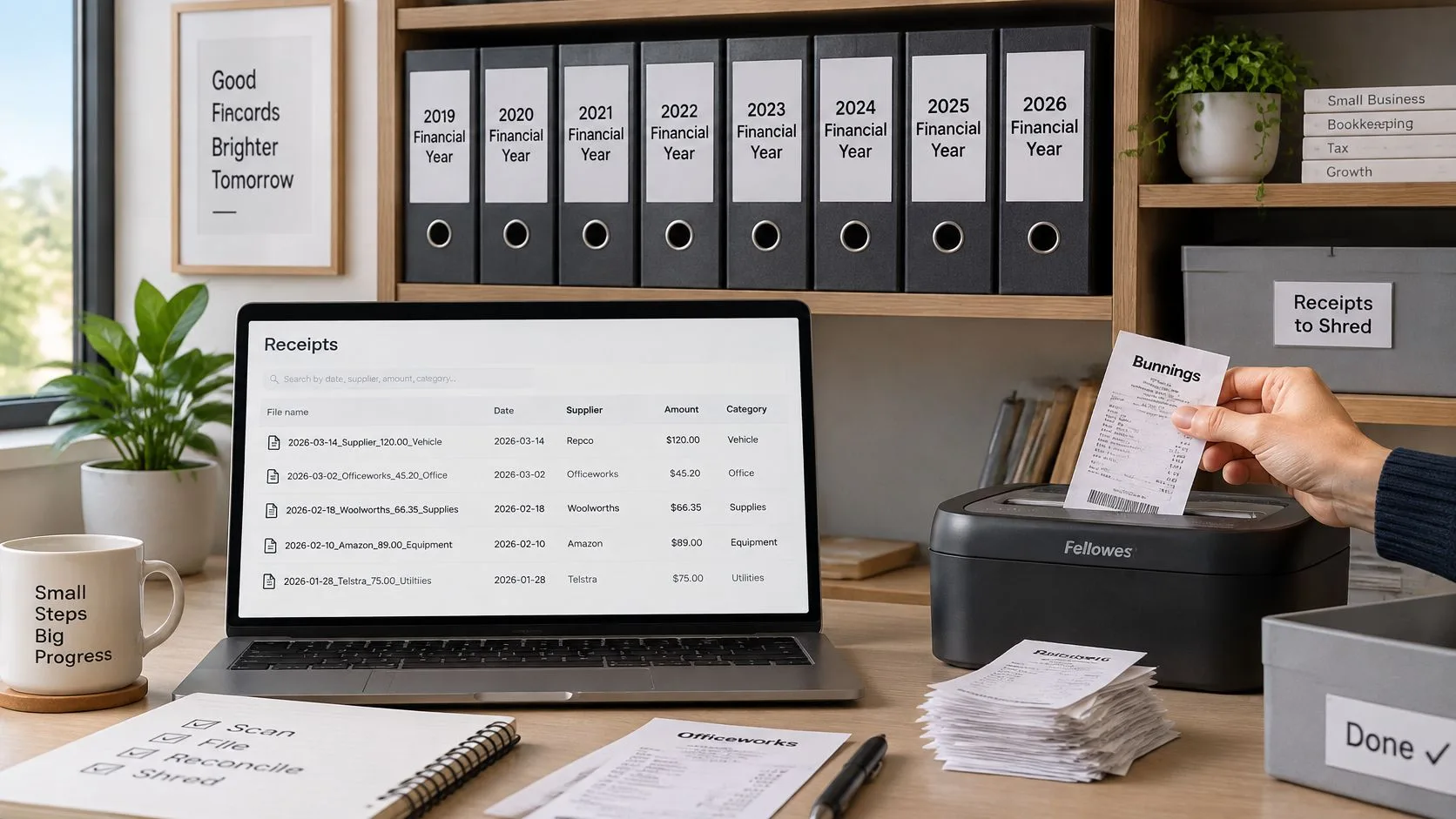
Separate each business. Create an archive for each legal entity, with folders for its financial years. If you move from sole trading to a limited company, keep the predecessor's records identifiable rather than blending everything into the new company's files.
Use meaningful filenames. Include the document date, supplier, amount and a short purpose. Use the date as printed on the document, and make the naming convention consistent across email downloads, scans and mobile captures.
Connect files to transactions. Put the ledger reference in the filename or archive metadata, and attach the receipt within the bookkeeping software where practical. A searchable folder helps locate a supplier; the transaction reference establishes which entry the evidence supports.
Maintain an independent backup. Keep another copy in a separately protected location, with access restricted to appropriate staff. Test restoration periodically: synchronising a folder isn't enough if an accidental deletion removes every accessible copy.
Capture vulnerable paper promptly. Photograph thermal receipts while they're legible, and check the result before putting the paper away. Store paper originals away from heat, damp and direct sunlight when they still need to be retained.
Maintain a retention register. Record the document category, relevant period, applicable obligations, starting events, earliest deletion date and any hold. Give someone responsibility for approving disposal rather than leaving it to whoever needs cupboard space.
Physical storage needs the same discipline as digital storage. Standby Self Storage's guide to archive business documents safely is a useful resource when planning labelled boxes, retrieval and suitable storage conditions.
Make disposal a controlled task, whether you use an office shredder or a document-destruction service.
Run a pre-deletion check
Before removing a batch, check the register against the underlying records. A folder's age isn't sufficient evidence that everything inside it can go.
- Obligations identified: Every tax and accounting purpose has been considered.
- Endpoints passed: The latest applicable retention date has elapsed.
- No unresolved hold: No enquiry, amended return or continuing claim needs the documents.
- Assets reviewed: Purchase evidence is no longer needed for ownership, allowances or disposal calculations.
- Copies tested: Where you're destroying paper but retaining digital evidence, the files are complete and retrievable.
- Disposal recorded: The register records what was removed, when and why.
Review the register during your annual tax preparation, before the filing rush. Avoid blanket deletion settings until you've separated ordinary records from assets, specialist schemes and documents under enquiry.
Keeping everything forever isn't an efficient alternative. It increases storage and access-management work, leaves duplicates to reconcile and makes useful evidence harder to identify.
If a receipt supports several obligations, a return was filed late or your business structure has changed, bring the retention register to a conversation with us before deleting anything. At Stewart Accounting Services, we deal with clients' compliance and deadlines, provide bookkeeping support and give ongoing advice throughout the year, not only when returns are submitted.
Call 01259 721156 with the document categories and any HMRC correspondence to hand. Confirm the applicable period and starting point, clear any hold, then delete securely.
Recent Posts
16 Nov, 2026
16 Nov, 2026