

What is a vat receipt? A Quick Guide to VAT and Reclaiming VAT
Think of a VAT receipt as more than just a flimsy piece of paper from the till. It’s your official proof of purchase that shows you've paid Value Added Tax (VAT) on goods or services, and it’s absolutely essential if you want to claim that tax back from HMRC.
Not every receipt you get will do the job. A standard till slip often just shows the total you paid, but a proper VAT receipt includes specific details that make it a legitimate document for your tax records.
Understanding Your First VAT Receipt
Imagine you've just bought some new tools for your business. The receipt you get isn't just a record of the transaction; it’s the key to getting the VAT you paid back into your business bank account. That’s what a VAT receipt is for—it provides the clear, HMRC-compliant proof you need to reclaim tax on genuine business expenses.
Without this specific piece of evidence, you simply can't reclaim the VAT. It's a non-starter. This is a critical point because many standard receipts from shops just don't have the required level of detail. They might show a total, but they won't break down the VAT element, which is exactly what the tax authorities need to see.
A valid VAT receipt is the legal evidence HMRC requires to back up the numbers on your VAT return. It turns a simple proof of payment into a document with real financial weight.
Knowing the difference is vital for keeping your business on the right side of HMRC. If you try to claim VAT using a receipt that doesn't meet the requirements, your claim will likely be rejected. Worse, it could lead to penalties or even trigger a full-blown tax inspection.
VAT Receipt At a Glance Key Features
This table breaks down the essential purpose and characteristics of a VAT receipt, giving you a quick reference before we dive into the details.
| Feature | Description |
|---|---|
| Primary Purpose | To act as official evidence of VAT paid on a purchase, which allows a business to reclaim that tax. |
| Key Information | Must clearly show the supplier's VAT registration number and the amount or rate of VAT charged. |
| Legal Standing | It's a legal document you need for your VAT returns. You must keep it for compliance, typically for six years. |
| Distinction | It's not the same as a standard till slip, which usually lacks the specific details needed for a valid VAT reclaim. |
Essentially, getting and keeping the right kind of receipt is a fundamental part of managing your VAT properly and protecting your business's cash flow.
VAT Receipt vs Full VAT Invoice Explained
It’s a common mix-up, but for any VAT-registered business, getting a handle on the difference between a receipt and an invoice is non-negotiable. It’s vital for staying on HMRC’s good side and keeping your cash flow healthy.
Here’s a simple way to think about it: a simplified VAT receipt is your everyday proof of purchase for smaller bits and pieces. A full VAT invoice, on the other hand, is the more formal, detailed document you need for significant business spending.
The real tipping point between the two usually comes down to the total cost. A full VAT invoice is the standard, comprehensive document showing a complete breakdown of the sale. A simplified VAT receipt is a less detailed version that HMRC allows for smaller purchases, which honestly makes life much easier for everyone involved.
When a Simplified Receipt Is Enough
For most of your day-to-day business costs, a simplified receipt does the job just fine.
Picture this: you've just bought coffee and some stationery for the office, and the total comes to £45. The till receipt you get is all you need to claim back the VAT, as long as it has the essential VAT details on it.
This common-sense approach is designed to cut down on admin. For any purchase under £250 (including VAT), a simplified receipt is perfectly acceptable. It doesn't need to show a line-by-line breakdown of net amounts, but it absolutely must show key details like the supplier’s VAT number and the total price you paid. It’s a great system for managing those high-volume, low-value retail buys without drowning in paperwork. You can dig into the specifics of what makes a VAT receipt valid in our other guides.
This flowchart gives you a quick visual check to see if the bit of paper in your hand is a proper VAT receipt or just a basic till slip.
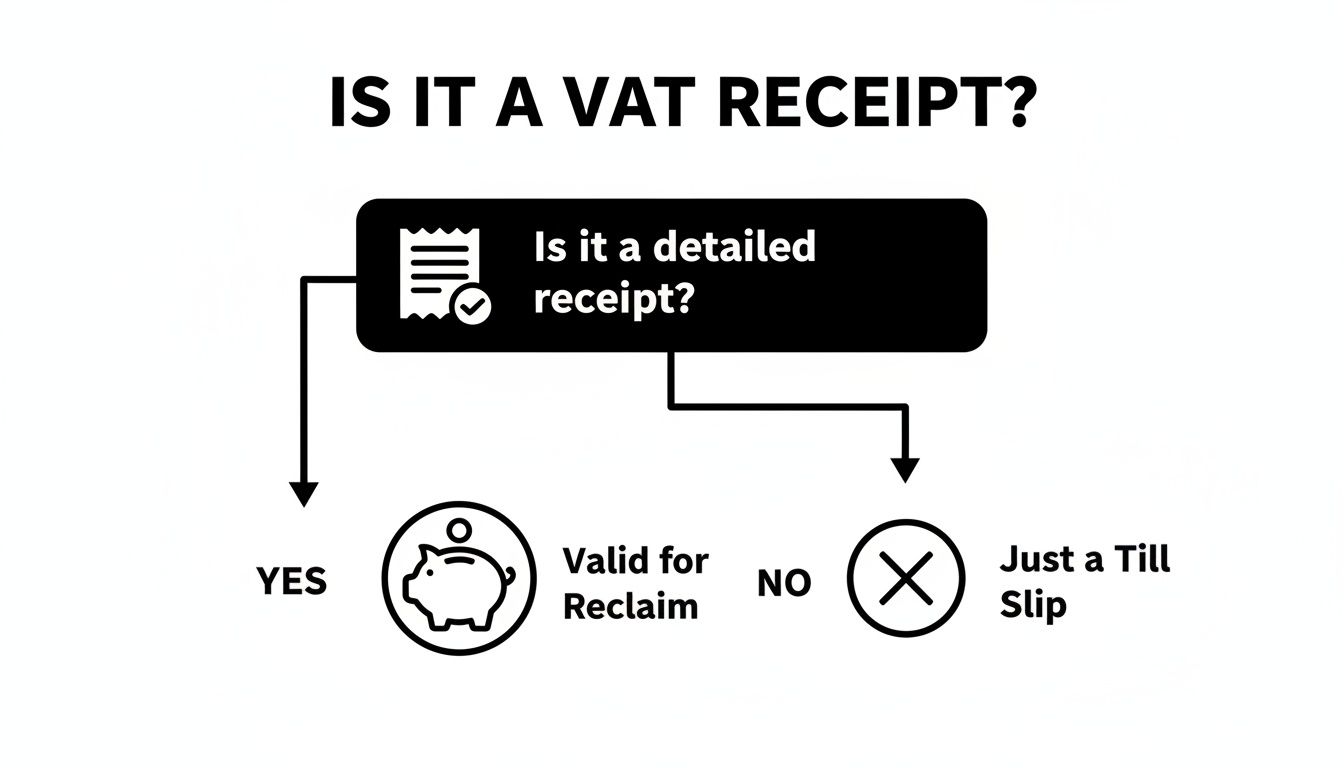
As you can see, it’s the VAT information that transforms a simple slip into a document that’s actually useful for your business accounts.
When You Must Have a Full VAT Invoice
Now, let's talk about bigger purchases. Say your company is buying new laptops for the team, and the bill hits £2,000. That flimsy till slip just won’t do.
For any single purchase over £250, you are legally required to get a full VAT invoice if you want to reclaim the VAT. It’s as simple as that.
A full VAT invoice is your definitive, detailed proof for larger transactions. It must show not just the total VAT paid, but also the net value of the goods or services, the VAT rate for each item, and your business's name and address.
If you don't get a full VAT invoice for these larger expenses, you forfeit your right to reclaim what could be a hefty amount of tax. Make it a rule: for anything over the £250 threshold, always ask your supplier for a full VAT invoice. This one simple habit will save you from compliance headaches and make sure you’re getting back every penny you’re entitled to.
Comparing VAT Receipt and Full VAT Invoice
To make it crystal clear, let's lay out the key differences side-by-side. The main takeaway is that as the value of the purchase increases, so does HMRC's requirement for detail.
| Requirement | Simplified VAT Receipt (Under £250) | Full VAT Invoice (Over £250) |
|---|---|---|
| Supplier's Name & Address | Yes | Yes |
| Supplier's VAT Number | Yes | Yes |
| Date of Supply | Yes | Yes |
| Description of Goods/Services | Yes | Yes |
| Total Amount (Inc. VAT) | Yes | Yes |
| VAT Rate for Each Item | Yes (can be shown by item) | Yes (must be shown by item) |
| Customer's Name & Address | No | Yes |
| Unique Invoice Number | No | Yes |
| Net Amount for Each Item | No | Yes |
| Total Net Amount | No | Yes |
| Total VAT Amount | No (but VAT included total is shown) | Yes |
Ultimately, knowing which document to get is about protecting your business. A simplified receipt is fine for small, everyday costs, but for anything substantial, you absolutely need that full VAT invoice to properly support your claim.
What Every HMRC-Compliant VAT Receipt Needs
When it comes to reclaiming VAT, you need to think of every receipt as a piece of evidence for HMRC. It’s like building a legal case – if you don't have the right proof, your claim won't hold up under inspection. A non-compliant receipt is, for all intents and purposes, useless for your VAT return, so getting this right is a fundamental business skill.
The absolute golden rule? Find the supplier's VAT registration number. This nine-digit number is the only way to prove the business you bought from is legally allowed to charge VAT. If it’s not there, you can’t verify their status, and HMRC will flat-out reject your claim. You must go back to the supplier and ask for a corrected receipt.
Core Details for All VAT Receipts
Whether you have a small till receipt or a full-blown invoice, there are a few details that are simply non-negotiable. These are the first things an auditor will scan for, and they form the backbone of any valid VAT claim.
Make sure every receipt has:
- The supplier’s name and address. This clearly shows who you paid.
- The supplier's VAT registration number. Again, this is the most crucial part.
- The date of supply (tax point). This pinpoints when the transaction actually happened.
- A clear description of what you bought. This proves it was a real business expense.
These are the absolute basics. For any purchase under £250, a simplified receipt with these details will usually do the trick, as long as it also shows the total amount including VAT and the VAT rate applied.
To be considered valid evidence by HMRC, a VAT receipt must contain specific, unalterable details that prove the transaction's legitimacy and the supplier's authority to charge VAT. Missing even one key piece of information can invalidate your entire reclaim for that purchase.
Information Required for Full VAT Invoices
Once you spend over £250 on a single transaction, the goalposts move. HMRC needs a lot more detail, and you must get a full VAT invoice. If you don't get one for these larger purchases, you automatically forfeit your right to reclaim the VAT. Simple as that.
On top of the basics, a full VAT invoice must clearly state:
- A unique invoice number.
- Your business name and address.
- The net amount (before VAT) for each item.
- The VAT rate charged on each item.
- The total amount of VAT charged.
This level of detail creates an undeniable audit trail, leaving no doubt about who was involved, what was sold, and how the tax was calculated. To get a closer look at the proper layout, our guide explains exactly what should be on a VAT invoice to keep you compliant. I always tell my clients to get into the habit of checking their receipts and invoices the moment they get them—it saves a world of trouble later.
How to Calculate and Reclaim Your VAT Correctly
Alright, so you know what a proper VAT receipt looks like and why it’s important. Now for the fun part: turning that piece of paper into cash back into your business. Getting your VAT calculation right is how you make sure you’re reclaiming every penny HMRC owes you.
The most common trip-up is how to figure out the VAT from the total price on a receipt. Your first instinct might be to just knock 20% off the total, but that’s not quite right. The total price you paid already has the VAT baked in, so we need to work backwards.
The VAT Calculation Formula
To pull the VAT amount out of a total (or gross) price, you have to think about what the numbers represent. The standard VAT rate of 20% is added to the original price of the goods (the net price).
Let's break it down:
- Net Price = 100% of the item's cost
- VAT = 20% of the item's cost
- Gross Price (Total You Paid) = 120%
So, the VAT isn't 20% of the total you paid; it's actually one-sixth of it.
VAT Calculation Tip: The simplest way to find the VAT on a standard-rated purchase is to just divide the total price by 6. If you spent £120, the VAT you can reclaim is £120 / 6 = £20. Simple as that. The net price was £100.
Nailing this calculation is absolutely critical for your VAT return. If you get it wrong, you could end up over-claiming (and facing HMRC penalties) or under-claiming, which is like leaving free money on the table.
Handling Mixed-Rate Receipts
Of course, life is rarely that simple. You’ll often get receipts from places like supermarkets or wholesalers that have a jumble of items with different VAT rates on them.
A single shopping trip could easily include:
- Standard-Rated Items (20%): Things like cleaning products, office stationery, or lightbulbs.
- Zero-Rated Items (0%): Most basic foodstuffs, such as bread, milk, and vegetables.
- Reduced-Rate Items (5%): For example, children's car seats or home energy supplies.
Remember, you can only reclaim VAT on the standard and reduced-rate items that are genuine business expenses. This means you need to sift through the receipt, identify the eligible items, and add up the VAT for each one separately. This is precisely why a proper, itemised VAT receipt is a non-negotiable – it gives you the clear breakdown you need to do this accurately.
The standard VAT rate has been 20% in the UK since 4 January 2011, and any compliant receipt should clearly show this. For instance, if you bought £1,200 of standard-rated materials for a job, the VAT element on the invoice should be £200. This is the amount your business can reclaim. For a deeper dive into the specifics, check out our guide on claiming back VAT in the UK.
By using the right formula and carefully separating items on mixed-rate receipts, you keep your VAT records clean and accurate. It not only helps you get the maximum amount back but also builds a rock-solid, audit-proof financial system for your business. That’s what we call peace of mind.
Solving Common VAT Receipt Problems
We’ve all been there. That sinking feeling when you can’t find a receipt for a big purchase, or when the ink has faded into a useless grey smudge. For business owners, these everyday frustrations aren't just annoying—they can cost you real money and cause major headaches with HMRC.
Let's face it, juggling a mountain of paper receipts is a chore. They get lost in coat pockets, crumpled in wallets, or accidentally thrown away. Every missing slip is a missed opportunity to reclaim the VAT you're entitled to, which directly hits your bottom line. Getting on top of this isn't just good housekeeping; it's essential for your business's financial health.
What to Do with Lost or Incorrect Receipts
HMRC is uncompromising on this: you must keep your VAT records for at least six years. So, what happens if one goes missing? Your first port of call should always be the supplier. Get in touch and ask them for a duplicate copy. Most businesses are perfectly happy to help, especially if the transaction was recent.
If you draw a blank and can't get a duplicate, you might be able to use alternative evidence, like a bank statement paired with some correspondence from the supplier confirming the purchase. Be warned, though: this is a last resort and by no means a guaranteed solution. HMRC can be very particular and might reject it during an inspection.
Similarly, if a supplier gives you an invoice with key details missing, don't just file it away. You need to go back to them and ask for a corrected version. Knowingly accepting an invalid document could land you in hot water later on. If you find yourself needing to fix a mistake, our guide on correcting VAT errors has some practical steps to follow.
A quick word of caution: whatever you do, never be tempted to create your own evidence for a lost receipt. Intentionally providing false information to HMRC is a serious offence that comes with hefty penalties. It's simply not worth the risk for the small amount of VAT you might reclaim.
The Digital Solution to Receipt Management
The best way to handle the problem of lost receipts is to stop it from happening in the first place. This is where moving away from paper and embracing digital tools really pays off. Modern accounting software and receipt capture apps are an absolute game-changer.
The process is incredibly simple: the moment you get a receipt, you just snap a photo of it with your phone. That one small action provides a huge number of benefits:
- Instant Backup: You immediately have a secure digital copy. A faded, lost, or damaged original is no longer a catastrophe.
- Automated Data Entry: Many apps can automatically read the key information—supplier, date, VAT amount—saving you from hours of tedious manual bookkeeping.
- Seamless Integration: These digital records can be linked directly to your accounting software, making the whole process of filing your VAT return smoother, faster, and far more accurate.
By taking your receipt management online, you can turn a chaotic administrative headache into a streamlined, almost automatic process. It’s not just about having HMRC-proof records; it's about freeing up your valuable time to focus on what actually matters—running and growing your business.
Got Questions About VAT Receipts? We've Got Answers
Let's finish up by tackling a few of those nagging questions that often pop up for business owners when dealing with VAT. Getting these right can save you a lot of headaches down the line.
Can I Just Use My Bank Statement to Reclaim VAT?
In short, no. It's a common mistake, but you absolutely cannot reclaim VAT with just a bank statement or a credit card slip.
Think of it this way: your bank statement proves you spent the money, but it doesn't prove what you spent it on or how much VAT was involved. HMRC needs to see the supplier's VAT number and a clear breakdown of the tax you paid, which is something only a proper receipt or invoice can provide.
What if a Supplier Refuses to Give Me a VAT Receipt?
If a supplier is registered for VAT, they are legally obligated to provide a proper VAT invoice to another VAT-registered business. There are no two ways about it.
If you find yourself in this tricky situation, a polite reminder of their legal duty is usually all it takes. If they still dig their heels in, it might be a red flag about their own compliance. Make sure you keep a record of your attempts to get the document and, if all else fails, you can report the business directly to HMRC.
HMRC doesn't take this lightly. Issuing a valid VAT invoice is a fundamental part of the system, and a flat-out refusal is seen as a serious breach of their rules.
Do I Need to Keep All the Paper Receipts If I've Scanned Them?
Good news – no, you don't! As long as you have a clear, complete, and readable digital copy, you can happily shred the paper original.
HMRC is fully on board with digital record-keeping, especially with the push for Making Tax Digital (MTD). A good quality scan or photo holds the same weight as the original paper, and it’s a much safer way to protect your records from getting lost, faded, or damaged.
Can I Claim VAT on Things I Bought Before I Registered?
Yes, you can, but you have to play by HMRC's rules, which are quite specific.
- For goods: You can look back up to four years before your registration date. The key condition is that your business must still have those goods on hand (for example, stock or a piece of equipment).
- For services: The window is much smaller. You can only go back six months before your registration date.
For any pre-registration claim, you'll still need the original, valid VAT receipts or invoices to prove the purchase. Without them, you won't be able to reclaim a penny.
Navigating the ins and outs of VAT can feel like a full-time job. The team at Stewart Accounting Services specialises in taking the stress out of VAT returns, bookkeeping, and tax compliance for businesses across the UK. Let us handle the details so you can get back to what you do best.
Recent Posts
21 Oct, 2026
19 Oct, 2026