
Getting your VAT back isn't just a nice-to-have; for any VAT-registered business in the UK, it’s a fundamental part of managing your finances. It’s how you recover the tax you’ve shelled out on genuine business purchases, and it's essential for healthy cash flow. But as with anything involving HMRC, success comes down to a few key things: knowing if you qualify and keeping your paperwork in order.
Are You Eligible to Reclaim VAT?
Before you even think about submitting a claim, you need to be certain you're eligible. The absolute first step is checking your VAT registration status. You must be registered with HMRC to reclaim VAT, no exceptions.
Registration isn't always a choice. It becomes compulsory once your business’s taxable turnover hits the government-set threshold. As of April 2024, that figure was bumped up from £85,000 to £90,000, and it's staying there for 2025. This means if your business earns more than £90,000 in taxable sales over any 12-month period, you have to register. For the most current figures, it's always worth checking a reliable source like The Tax Com for the latest VAT rates.
To quickly see where you stand, run through this simple checklist. It covers the core requirements HMRC will look at.
Key Eligibility Checks for Your VAT Reclaim
| Eligibility Factor | What This Means for Your Business |
|---|---|
| VAT Registration | Your business must be officially registered for VAT with HMRC. This is non-negotiable. |
| Business Purpose | The costs you're claiming for must be for genuine business expenses, not personal use. |
| Taxable Supplies | You must be selling goods or services that are subject to VAT (even if they are zero-rated). |
| Valid VAT Invoice | You need to hold a correct VAT invoice for every expense you claim. No invoice, no reclaim. |
If you can tick all these boxes, you're in a great position to start reclaiming the VAT you've paid out.
How Your Sales Affect Your Claim
What you sell has a direct impact on what you can claim back. HMRC groups your sales (or 'supplies') into different categories, and understanding which one you fall into is crucial.
-
Standard-rated supplies: This covers most goods and services in the UK, taxed at the current 20% rate. If this is what you sell, you can almost always reclaim the VAT you’ve paid on your business costs. Simple.
-
Zero-rated supplies: These are still 'taxable', but the rate is 0%. Think of essentials like most food items, books, and children's clothing. The great news here is that even though you don't charge VAT, you can still reclaim the VAT on your business purchases.
-
Exempt supplies: Some services, like insurance, finance, and certain types of education, are completely exempt from VAT. If your business only sells exempt items, you typically can't register for VAT, which means you can't reclaim it either.
One of the trickiest areas I see businesses struggle with is partial exemption. If you sell a mix of standard-rated and exempt goods, you can generally only reclaim VAT on costs directly related to your taxable sales. This means you’ll need to work out a fair way to split your overheads, which can get complicated.
Building Your System for Flawless VAT Records
Perfect records are the bedrock of any successful process for claiming back VAT in the UK. Without them, even legitimate claims can be denied, so getting your system right from the start is non-negotiable.
The key document you'll need for every claim is a valid VAT invoice. This isn't just any old receipt; HMRC has a strict list of what must be included. A simple credit card slip from a fuel station, for example, won't cut it.
For an invoice to be considered valid, it absolutely must show specific details:
- A unique invoice number
- The supplier's name, address, and VAT number
- The date of the supply (often called the 'tax point')
- A clear description of the goods or services
- The rate of VAT charged on each item
This level of detail is why a robust system is so important. Imagine a busy construction firm trying to track VAT on materials, subcontractor fees, and tools. Without an organised approach, receipts get lost and money is left on the table.
Choosing the Right Tools for the Job
In the age of Making Tax Digital (MTD), paper-based ledgers are a thing of the past. All VAT-registered businesses must keep digital records and use MTD-compatible software to submit returns.
This means choosing a system like Xero or QuickBooks is essential. These platforms allow you to photograph receipts on the go, automatically extracting key data and storing it securely. This turns a complex chore into a simple background task.
A well-organised digital system doesn’t just help with compliance; it becomes a powerful financial tool. By tracking expenses in real time, you get a much clearer picture of your cash flow and profitability, which is invaluable for making smart business decisions.
To build a truly efficient system, it's crucial to minimise human error. Learning how to automate data entry in Excel or using software integrations can save significant time and prevent costly mistakes. The goal is to create a simple yet solid process that ensures no eligible expense is ever overlooked.
A Business Owner's Guide to the HMRC VAT Return
Submitting your VAT return really doesn't need to be the quarterly headache many business owners dread. If you’ve got your digital records in good shape, the actual submission process is fairly simple, thanks largely to the Making Tax Digital (MTD) rules.
Everything is now done through your Government Gateway account, using software that’s compatible with MTD. The return itself has nine boxes, but when you're focused on claiming back VAT, there are only two you really need to worry about:
- Box 1 (VAT due on sales): This is all the VAT you've charged your customers in the accounting period. It's often called your output VAT.
- Box 4 (VAT reclaimed on purchases): This is the VAT you've paid on all your eligible business expenses. This is your input VAT.
The workflow is pretty logical, from getting your documents together to hitting that final submit button.
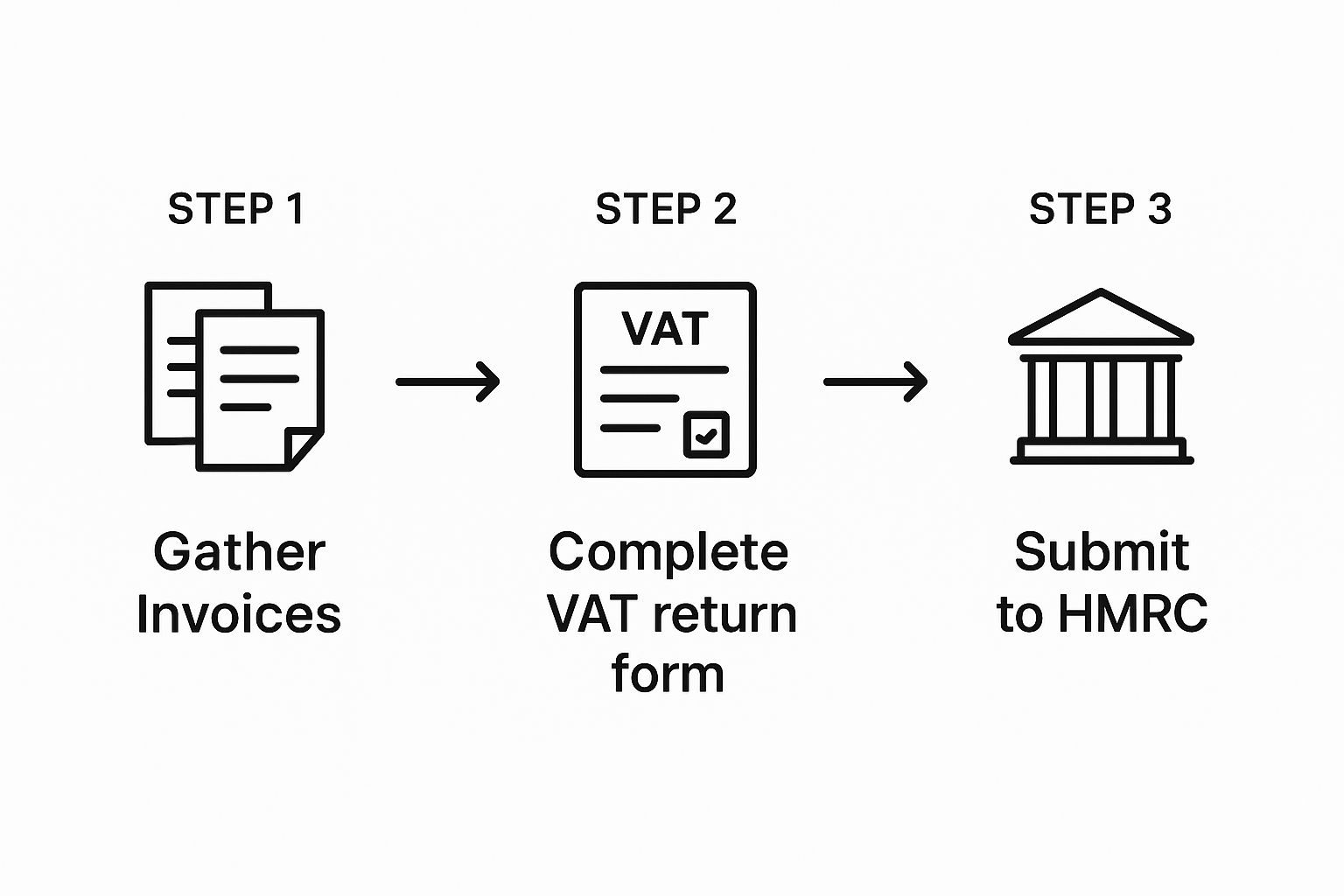
As you can see, the secret to a smooth submission is having everything organised before you even think about logging in to HMRC.
Working Out What You’re Owed
The calculation itself is straightforward arithmetic. If the figure in Box 4 (what you've paid) is bigger than the figure in Box 1 (what you've charged), HMRC owes you a refund. If it’s the other way around, you owe them. Simple as that.
Let’s imagine a small e-commerce business. In one quarter, they charged £4,000 in VAT on their sales (Box 1). During that same time, they paid £5,500 in VAT on stock, marketing agency fees, and shipping costs (Box 4).
The maths is £5,500 minus £4,000, which means they’re due a £1,500 refund from HMRC.
Once you submit your return, you'll get an instant confirmation from HMRC. Here’s a pro tip: always download and save the submission receipt. It’s a tiny step that provides invaluable proof of filing if any questions ever pop up down the line.
After you log in and give your software permission to talk to HMRC, you'll see the nine boxes, which should be pre-filled with your figures. Give them a final check, confirm they’re correct, and submit. Job done.
Of course, if you'd rather have an expert handle it all, using specialised VAT return services can provide real peace of mind, ensuring everything is accurate and compliant.
Navigating the world of VAT can feel like a minefield, and it’s easy to make a wrong turn. Over the years, I've seen businesses make the same few mistakes time and time again, which often leads to a delayed refund or, worse, an unwelcome enquiry from HMRC.
Let's start with the most common slip-up: trying to reclaim VAT on something you can't. The classic example here is client entertainment. That business lunch you expensed? While it's a perfectly legitimate cost for your company accounts, HMRC draws a very firm line here. The VAT on entertaining UK clients is a no-go.
Another major headache stems from shoddy paperwork. You can't just submit a credit card slip or a pro-forma invoice and expect a payout. It just doesn't work that way.
HMRC is incredibly particular about what constitutes a valid VAT invoice. It needs to show the supplier’s VAT number and a clear breakdown of the VAT itself. If it doesn't have that, your claim for that purchase will be dead in the water.
What About Mixed-Use Assets?
This is where things can get a bit murky. Think about assets that serve a dual purpose, like a company car you also use on the weekends or a mobile phone contract that covers personal calls.
You can only reclaim the VAT on the business portion of the expense. The responsibility falls on you to work out a fair and reasonable way to split the cost and, crucially, to keep the records that prove how you calculated it. Simply guessing or forgetting to do this apportionment is a red flag for HMRC.
Here’s a quick rundown of the most frequent errors I see:
- Dodgy Invoices: Relying on documents that don’t meet HMRC’s strict criteria for a proper VAT invoice.
- Forbidden Expenses: Trying to claim for things that are explicitly blocked, like client entertainment.
- Sloppy Apportionment: Failing to properly calculate and document the split between business and private use.
A little bit of diligence goes a long way. Keeping meticulous records and getting to grips with these basic rules will save you a world of trouble and ensure your claim sails through without a hitch.
Navigating Complex VAT Reclaim Scenarios
Standard VAT rules don't always fit neatly with how every business works. Things can get complicated, and certain industries or unique setups add extra layers to the process of claiming back VAT in the UK. Getting these right means diving into some of HMRC's more specific regulations.
One of the most common hurdles I see businesses face is partial exemption. This is a big one for anyone making both taxable sales and exempt sales. Think of a high-street optician: they sell glasses (taxable) but the eye test itself is exempt.
You can't just reclaim all the VAT on your costs in this situation. You have to figure out a fair way to apportion your overheads, only claiming back the portion of VAT that relates directly to your taxable activities. Nailing this calculation is crucial – get it wrong, and you could easily find yourself in a tricky spot with HMRC.
Special VAT Schemes and Timings
Beyond partial exemption, a few other common scenarios can change the game. It's worth knowing if your business falls into any of these categories.
-
The Flat Rate Scheme: This is meant to simplify things by letting you pay a set percentage of your turnover to HMRC. The catch? You generally can’t reclaim VAT on your purchases. The main exception is for single capital assets costing over £2,000.
-
Pre-Registration VAT: Incurred big costs before you even registered for VAT? Don't worry, you haven't necessarily lost out. HMRC lets you reclaim VAT on goods bought up to four years before your registration date, as long as you still have them. For services, the window is a much tighter six months.
-
International Trade: Post-Brexit rules have completely reshaped how VAT works on imports and exports. Getting your head around customs, postponed VAT accounting, and the different rules for goods versus services is no small feat. It really requires specialist knowledge to stay compliant.
HMRC's forecasted VAT receipts for 2025-26 are expected to hit around £180.4 billion. This staggering figure shows just how much is at stake, and it’s why complex claims are scrutinised so carefully. You can explore further UK tax forecasts to see the full picture.
In my experience, these special cases often benefit from a professional eye to make sure you're claiming everything you're entitled to without accidentally crossing any regulatory lines.
Your Top VAT Reclaim Questions Answered
Even with the best system in place for claiming back VAT, there are always a few tricky questions that pop up. Let's tackle some of the most common queries I hear from business owners to clear up any lingering confusion.
How Long Does it Take to Get a VAT Refund?
This is usually the first question on everyone's mind! Under normal circumstances, you can expect HMRC to process your refund and have the money in your account within 30 days of receiving your VAT return.
Of course, things can sometimes take a bit longer. Delays are often down to simple things like incorrect bank details or a small error on your form. HMRC might also decide to run a compliance check, which will naturally slow things down. My best advice? Always give your submission a final once-over before hitting send.
Can I Claim for Costs from Before I Registered?
Absolutely. This is a frequently overlooked area, but the good news is you can often claim VAT on purchases made before your business was officially registered.
HMRC has a couple of key time limits you need to be aware of:
- For goods: You can look back up to four years before you registered, as long as your business still has and uses those goods. Think about that van or computer you bought early on.
- For services: The timeframe is much tighter here. You can only claim for services bought within the six months leading up to your registration date. This could include things like initial accountancy fees or website design.
The golden rule for any claim, pre-registration or not, is that you must have a valid VAT invoice. No invoice, no reclaim – it’s as simple as that.
What if I’ve Made a Mistake on a Past Return?
It happens to the best of us, so don't panic. The important thing is to correct it properly. If you've spotted an error and the net value is under £10,000, you can typically just adjust for it on your next VAT return.
For any larger errors, you'll need to formally notify HMRC. This usually involves filling out form VAT652. From my experience, being transparent and proactive with HMRC is always the right move.
Trying to navigate the ins and outs of VAT can feel like a full-time job in itself. The team at Stewart Accounting Services specialises in taking that pressure off businesses across Central Scotland and the rest of the UK. We handle everything from preparing your records to submitting the final return, making sure your claims are accurate and on time. If you want to make your VAT reclaims completely stress-free, get in touch with us today.