

Companies House Filing Deadline Extension Rules

A Companies House filing deadline extension is discretionary, you must request it before your current deadline, and it cannot push filing beyond 12 months from your accounting reference date. There's no automatic pause because you're busy, your accountant is behind, or cash is tight. Popular advice often treats extra time as something you can ask for near the deadline. That's backwards. Companies House built this route for a specific disruption that stopped a prepared company filing, not for rescuing a timetable that never existed. If you understand that distinction before you apply, you'll know whether to request an extension or spend the remaining days finishing the accounts.
What a Filing Deadline Extension Actually Does
Say your accounts are due on 31 December, your bookkeeping is unfinished, and your accountant says the work will take another six weeks. You want Companies House to pause the clock. For most directors in that position, the answer is no. Unfinished accounts, a busy accountant, or difficulty paying for help don't create extra time. A Companies House filing deadline extension is a discretionary remedy for an unplanned event outside the company's control, such as unexpected serious illness affecting the person who prepares or signs the accounts, or records destroyed by fire.
The Companies House extension service reflects that narrow purpose. It asks for the company number, an explanation of the event, and supporting documents where available. It also sits within strict limits. Under the normal rules, private companies normally have 9 months after their accounting reference date to deliver annual accounts, while public companies have 6 months, and the statutory maximum filing period is 12 months.

The Three Limits That Decide Most Cases
First, your application must reach Companies House before the existing deadline. A request sent after that date generally arrives after late filing consequences have begun. Second, submitting an application doesn't suspend your duty to file. If the accounts become ready, file them by the original date rather than waiting for a decision. Third, approval changes only that one filing date. It doesn't reset later years, move your accounting reference date, or give you a permanent longer timetable.
Think of an approved extension as a one off diversion around a road closure, not a new speed limit for every future journey.
If Companies House refuses your request, the original date still stands. If it approves the request and you miss the revised date, a late filing penalty can still apply. That is why an extension is not insurance against delay. It is a short, defined replacement deadline granted because something exceptional prevented timely filing.
Before you go further, find your company on the Companies House record and write down two dates, your accounting reference date and your current accounts due date. Don't rely on last year's diary entry or a date in an old email. Those two dates tell you whether an application is still possible and how much room, if any, remains inside the twelve month ceiling.
Normal Deadlines and the Twelve Month Ceiling
Use the table as a lookup first. Find your company type, check the normal period, then compare today's date with both the current deadline and the hard limit.
Accounts filing windows and the extension ceiling
| Situation | Normal period | When to apply | Hard limit |
|---|---|---|---|
| Private company annual accounts | 9 months after the accounting reference date | Before the current filing deadline | Cannot exceed 12 months from the accounting reference date |
| Public company annual accounts | 6 months after the accounting reference date | Before the current filing deadline | Cannot exceed 12 months from the accounting reference date |
| Extension approved | Revised date set by Companies House | Already applied before the original deadline | File by the revised date or a penalty can apply |
| Application after the deadline | Extension generally unavailable | Too late to request more time | Late filing consequences already running |
The Companies House guidance on company accounts states that private companies normally have 9 months from their accounting reference date to file annual accounts, while public companies have 6 months. It also describes an extension as a remedy for an event outside the company's control, not a general postponement mechanism. Examples include unexpected illness or destruction of accounting records by fire.
Working Through One Private Company Example
Take a private company with an accounting reference date of 31 March 2026. Its normal nine month filing deadline is 31 December 2026. Twelve months from the accounting reference date is 31 March 2027, so even a successful extension couldn't carry the filing date beyond that point. The company doesn't automatically receive three extra months. It must apply before 31 December 2026, explain the event, state the extra time requested, provide evidence where possible, and wait for Companies House to decide.
That distinction between pending and approved matters. A pending application does not itself suspend the obligation to file, so the company should still submit accounts by 31 December if it can. An approved extension replaces that date with a revised date, and the company must meet the new date. The following year's normal deadline stays where it was. The extension does not reset or move future annual filing deadlines, because it is not a change to the accounting reference date.
Dates You Should Check Rather Than Assume
Check the public record rather than copying last year's timetable. A change to the accounting reference date can alter the period you expect, and shortening that date can reduce the time available. Directors often discover the problem only when an accountant, lender, or Companies House reminder uses a different date from the one in their calendar. Our guide to Companies House filing for annual accounts helps you place the accounts deadline alongside the company's other filings.
Don't copy the pandemic easement either. According to the GOV.UK guidance on applying for more time to file company accounts, companies with relevant deadlines between 27 June 2020 and 5 April 2021 generally received an automatic 3 month extension. Automatic extensions ended for deadlines after 5 April 2021. There is no blanket extra time to apply to a 2026 deadline.
Date check: Identify your row in the table, count the days to your normal due date, then count the days to twelve months after your accounting reference date. If the first date has passed, an extension request is generally too late. If both dates are close, finishing the accounts may matter more than drafting a long application.
How to Ask Companies House for More Time
Treat the form as a factual explanation of one event, not a negotiation about how busy the business has been. Continue preparing the accounts while Companies House considers it. The process below pairs each step with the slip that commonly weakens it.
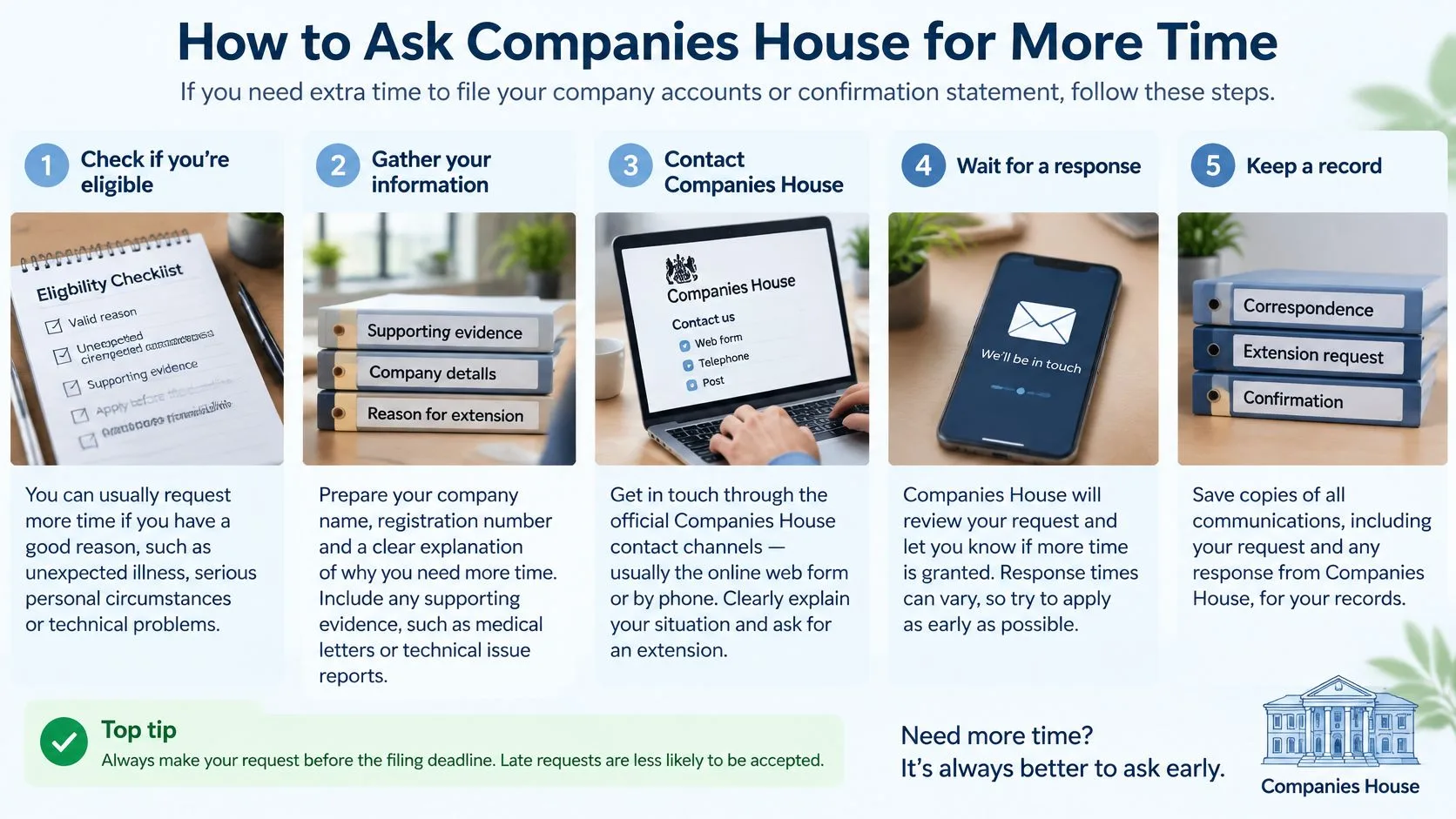
Steps One to Four Build the Application
1. Confirm the company number, accounting reference date, and current filing deadline on the Companies House record. Copy them exactly. The usual slip is using a date from accounting software or an incorporation certificate without checking whether the register has changed. If those details are wrong, every date in your explanation can look careless.
2. Describe the event, the date it began, and why it was outside the company's control. Keep it specific. Write what happened, who or what it affected, and which part of preparing or signing the accounts it stopped. A vague note saying your accountant is behind doesn't show an unplanned event. Neither does a general claim that trading was difficult.
3. State the extra time needed and why that period is enough to file. Tie the request to the remaining work, such as reconstructing destroyed bank records, obtaining replacement invoices, or waiting for the only authorised director to recover enough to sign. Check that your requested date stays inside the twelve month ceiling. Asking for a date beyond that ceiling asks Companies House for something the extension cannot provide.
4. Attach supporting documents where they exist. Useful evidence might include a medical note, an insurer reference, a police reference, photographs of damaged premises, or confirmation that accounting records were destroyed. Don't delay the application indefinitely while collecting perfect paperwork, because the original deadline may pass. Submit what you have, label files clearly, and keep copies with the timestamped application.
Steps Five to Seven Protect You After Submission
The short video below is useful as a visual reminder of the sequence before you complete the remaining actions.
5. Submit the online application before the existing deadline, with the company number, your explanation, and those documents. Read the event description once as an outsider would. It should answer what happened, when, why filing became impossible, and how long recovery will take. If it mostly explains workload, rewrite it before sending.
6. Don't treat a pending application as a suspension. This is the costliest misunderstanding. If the accounts are ready on the original date, file them. Waiting for a decision email before filing can turn an avoidable problem into a penalty if Companies House refuses the request or replies after the due date.
7. Act immediately on the decision. If approved, diary the revised date at once and set working milestones well before it. If refused, file as soon as the accounts can be completed because the original date still stands. Don't spend the remaining time arguing informally by email while the accounts remain unfinished.
A complete application therefore contains the verified company details, a dated account of the event, a realistic requested period, and evidence that connects the event to the delay. On the same day you send it, brief whoever is preparing the accounts, agree what can still be completed now, and diarise both the original and requested dates. The application buys consideration, not permission to stop work.
Events That Qualify and Events That Do Not
Apply one test. Was a reasonable company, already preparing its accounts, stopped by something it could not plan for? If the honest answer is no, a Companies House filing deadline extension is unlikely to be the right route.
Circumstances That Fit the Remedy
Unexpected serious illness can fit when it affects the director who must approve the accounts, the employee who maintains the records, or another person essential to preparation or signing. The evidence should show timing and impact, not private medical detail for its own sake. A fit note or letter covering the relevant period, plus a brief explanation of the tasks only that person could perform, makes the request credible. Ask only for the time needed for recovery, handover, approval, and filing.
Fire, flood, or theft destroying records can also fit because the company may need to reconstruct invoices, bank transactions, payroll information, or stock records before reliable accounts can be prepared. An insurer claim reference, incident report, dated photographs, or correspondence with banks and suppliers helps show both the loss and the reconstruction work. Say which records are missing and how you'll rebuild them. A request for three months with no reconstruction plan is weaker than a shorter request tied to named replacement documents.
Ordinary Delay That Doesn't Meet the Test
Leaving accounts until the final month isn't an external event. Neither is changing accountant close to the deadline, taking a holiday, having a foreseeable dispute with a bookkeeper, or waiting for information you could've requested earlier. A supplier who is slow to answer in December is frustrating, but if you first asked in December for documents needed since April, Companies House may see a planning failure. Assuming a former national easement still applies is another avoidable error.
Compare two companies with the same 31 December deadline. Company A loses paper records and its office computer in a fire in November. The director applies the following week with photographs, an insurer reference, a list of missing records, and a plan to obtain duplicate bank statements and supplier invoices. Company B discovers in December that nobody started the bookkeeping. Its director asks for three months because the accountant cannot begin until January.
Company A describes the kind of disruption the remedy is built for, an unplanned event that removed material needed to finish accounts already in progress. Company B describes work that was never scheduled. Both directors may feel equally pressed, but the cause is different. Companies House is concerned with the cause, the timing, and whether a prudent company could've avoided the delay.
An extension addresses an interruption to preparation. It doesn't replace preparation.
Use this self check before you apply. First, the event was unplanned. Second, it was outside the company's control. Third, your request will arrive before the current deadline. If any answer is no, focus on completing and filing the accounts, because writing a hopeful application won't change the underlying test.
Late Filing Penalties if the Extension Fails
A late accounts penalty is charged to the company for delivering accounts after the deadline. A late application doesn't remove it, and neither does a refused application. If Companies House hasn't approved a later date, work from the date currently on the register.
Late accounts penalties by how late the filing is
| How late | Private company | Public company | Private company if also late last year |
|---|---|---|---|
| Not more than 1 month | £150 | £750 | £300 |
| More than 1 month, up to 3 months | £375 | £1,500 | £750 |
| More than 3 months, up to 6 months | £750 | £3,000 | £1,500 |
| More than 6 months | £1,500 | £7,500 | £3,000 |
Reading Your Band Correctly
For a private company filing late for the first time, the bands are £150 at not more than one month late, £375 at more than one month and up to three months, £750 at more than three months and up to six months, and £1,500 after six months. Public company penalties are higher, at £750, £1,500, £3,000, and £7,500 across the same bands. The jump happens when you cross into the next band, not gradually day by day. Filing just before a band boundary can therefore save a substantial amount.
If the company's accounts were also late for the previous financial year, the current private company penalty is doubled. Say a private company files two months late for the first time. It falls in the more than one month and up to three months band, so the penalty is £375. If the same company is two months late again the following year, the doubled penalty is £750. The arithmetic is simple, but directors often budget for the first column while overlooking last year's filing history.
Why a Pending Application Creates No Free Gap
The penalty clock runs from the original deadline unless Companies House has already approved a later date. Filing while an application is pending protects you if the request is refused. By contrast, waiting for the decision and then filing after the original date leaves you exposed to whichever band your actual filing date reaches. If your extension is approved, the revised date becomes the date that matters, and missing that deadline can also produce a penalty.
That is why the decision sequence matters more than the wording of your application. Apply before the deadline, continue working, and file as soon as the accounts are ready. If approval arrives first, diarise the revised date and still aim to file early. If refusal arrives, you have lost no working time by treating the original date as live.
Persistent non filing can sit alongside consequences beyond the civil penalty, including possible prosecution and strike off. Those wider processes are outside this guide, but they are another reason not to let an overdue set of accounts drift from one band to the next. Our explanation of Companies House late filing penalties and appeals covers the next steps if a penalty notice has already arrived.
An appeal needs a proper basis, such as showing the accounts were not in fact late or that a specified exception applies. Being busy, forgetting the date, or relying on an accountant who was behind is not enough by itself. Don't let an appeal become a reason to delay filing the overdue accounts.
Compare today's date with the due date now. Read across the table, check whether last year's accounts were late, and identify the band you are already in or about to enter. That gives you a concrete filing target: submit before the next boundary, not only when someone finds time.
Keep the Next Accounts Deadline Under Control
The practical goal is to make another extension application unnecessary. Start with dates you can see, records you maintain during the year, and an accountant instructed early enough to solve problems rather than discover them.
- Write down the key dates: Record the accounting reference date, the normal Companies House filing date, and a preparation start at least three months earlier.
- Separate corporation tax: Diary the corporation tax payment and Company Tax Return dates separately, because they aren't the same as the Companies House deadline.
- Keep bookkeeping monthly: Use a cloud ledger, reconcile the bank each month, and file invoices as they arrive so year end becomes a close rather than a reconstruction.
- Engage help before year end: Ask your accountant to check the reference date, identify missing records, and agree approval dates while there's still time to act.
If you're setting up a cloud ledger, these practical cloud accounting basics explain the core habits in plain language. Use our prepare annual accounts checklist to turn that monthly record keeping into a year end timetable. At Stewart Accounting Services, we deal with all compliance and deadlines for clients and can assist with the preparation of year end annual accounts. Businesses can start working with us from the very beginning, not only when year end accounts are due, which helps owners who have just incorporated and don't yet know their first filing date.
Three month rule: If your deadline is less than three months away and the records aren't ready, treat this week as the start date, not the point at which you'll decide whether there's a problem.
Make the dated decision today. If your current deadline is inside three months, finish and file what can be filed, and only ask about a Companies House filing deadline extension if a genuine event outside your control applies. If the deadline is further away, book preparation now, set monthly bookkeeping dates, and leave the extension route unused for the emergency it was designed to cover.
Contact Stewart Accounting Services today to put your accounting reference date, accounts preparation timetable, and Companies House deadline into one managed calendar. Email mark@stewartaccounting.co.uk with your company name and current due date, and we can discuss preparing your year end accounts and handling ongoing compliance before the next deadline becomes urgent.
Recent Posts
01 Nov, 2026