

Construction Industry Scheme (CIS) Tax Advice: A Guide for 2026

Is the stress of CIS taking you away from the building site? For many in the Scottish construction trade, the constant worry over hefty HMRC penalties, the cash flow strain from 20% deductions, and the complex rules for verifying subcontractors can feel overwhelming. It’s a major administrative headache that pulls your focus from the job at hand. This is where getting clear, professional construction industry scheme (CIS) tax advice isn’t just an advantage-it’s essential for protecting your business.
In this guide for 2026, we’ll take the complexity out of CIS. We are here to help you master compliance, explore the steps to apply for Gross Payment Status to boost your cash flow, and ultimately reduce your administrative burden. Our goal is to take the worry off your hands, giving you the peace of mind to focus on what you do best: building.
Key Takeaways
- Learn your legal duties as a contractor or subcontractor, including how to verify payments and maintain HMRC-compliant records to avoid penalties.
- Understand the difference between the 20% and 30% CIS deduction rates and discover the steps to achieve Gross Payment Status, improving your monthly cash flow.
- Navigate the complex interaction between CIS and the VAT Domestic Reverse Charge to ensure your invoices are always correct and compliant.
- Get expert construction industry scheme (CIS) tax advice tailored for Scottish tradespeople to help you reduce stress and focus on growing your business.
What is the Construction Industry Scheme (CIS) in 2026?
The Construction Industry Scheme (CIS) can seem complicated, but at its core, it’s a system created by HMRC to collect income tax in advance from subcontractors working in the UK construction industry. Think of it as a ‘pay-as-you-go’ tax system specifically for construction work, designed to ensure everyone pays their fair share.
HMRC introduced CIS primarily to reduce tax evasion and improve compliance within a sector known for its high levels of self-employment and temporary labour. By requiring contractors to deduct tax directly from a subcontractor’s payments before they are paid, the scheme ensures that tax is collected at the source, making it much harder for payments to go undeclared.
Stewart Advice: The single most expensive mistake you can make is ignoring your CIS obligations. Failing to register, verifying subcontractors incorrectly, or making the wrong deductions can lead to significant penalties from HMRC. Getting professional construction industry scheme (CIS) tax advice from the start saves you time, money, and a great deal of stress.
Who counts as a Contractor?
Under CIS, a ‘contractor’ is a business that pays subcontractors for construction work. You fall under the scheme if:
- Your business is primarily in construction (these are known as ‘mainstream contractors,’ like property developers or building firms).
- Your business is not in construction, but you spend over £3 million on construction within any 12-month period. These are ‘deemed contractors,’ such as a large retail group fitting out new stores or a local authority commissioning building work.
Who counts as a Subcontractor?
A ‘subcontractor’ is any business that carries out construction work for a contractor. This can be a sole trader, a partnership, or a limited company. It’s common for businesses to act as both-for example, a building firm might be a contractor when paying a plasterer but a subcontractor when working for a larger developer. The key is identifying what counts as “construction work,” which includes site preparation, building, and decorating, but excludes purely professional services like architecture or surveying.
Contractor vs Subcontractor: Your CIS Responsibilities
Understanding your specific role within the Construction Industry Scheme is the first step to avoiding costly mistakes. Whether you’re a contractor paying for construction work or a subcontractor getting paid for it, your responsibilities are clearly defined by HMRC. Getting this right is essential, and our expert construction industry scheme (CIS) tax advice is designed to give you complete peace of mind.
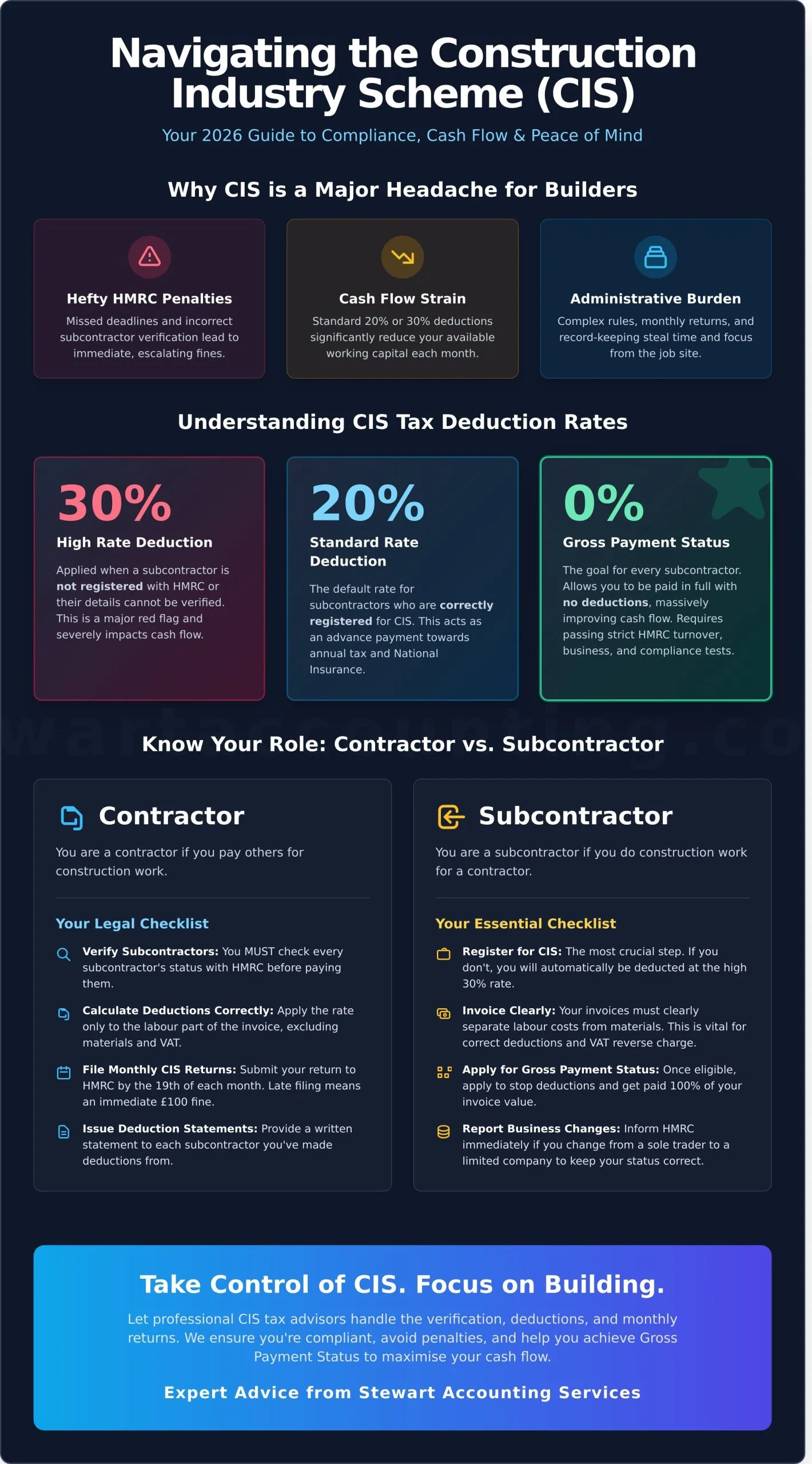
As a contractor, your primary legal duty is to verify every subcontractor with HMRC before you pay them. This determines the correct deduction rate: 0% (gross payment), 20% (standard rate), or 30% (unregistered). You must then keep meticulous records and file a CIS monthly return by the 19th of each month. Missing this deadline, even by a single day, results in an immediate £100 penalty that can quickly escalate.
This administrative burden is a major source of stress for busy contractors. At Stewart Accounting Services, we take this entire verification and filing process off your hands. We handle the HMRC checks, process your monthly returns accurately, and ensure you are fully compliant, freeing up your time and preventing expensive penalties.
The Contractor Checklist
- Verify Subcontractors: Use the HMRC online service to confirm each subcontractor’s registration status and the correct deduction rate to apply.
- Calculate Deductions: Apply the deduction rate only to the labour element of the subcontractor’s invoice, excluding any costs for materials, VAT, or equipment hire.
- Issue Deduction Statements: You are legally required to provide a written payment and deduction statement to your subcontractor within 14 days of the end of each tax month.
The Subcontractor Checklist
- Register for CIS: Register with HMRC as a subcontractor. If you don’t, contractors are legally obliged to deduct tax at the higher 30% “unregistered” rate from your payments.
- Keep Accurate Invoices: Your invoices must clearly separate the costs for your labour and any materials. This is vital for correct CIS deductions and for managing other complex rules like the VAT reverse charge for construction services.
- Report Business Changes: Immediately inform HMRC if your business structure changes (e.g., from sole trader to a limited company) to keep your registration details current and correct.
CIS Tax Rates and the Value of Gross Payment Status
Understanding CIS deduction rates is crucial for managing your business’s cash flow. When a contractor pays you, they are required to deduct tax from your payment. This isn’t a penalty; it’s an advance payment towards your final tax and National Insurance bill. However, the rate of this deduction can dramatically affect the money you have available each month.
HMRC applies three different rates, and your registration status determines which one applies to you. For the most up-to-date details, you can always refer to the government’s Official CIS Guidance. The rates are:
- 30% (Unregistered): If you are not registered with HMRC for CIS, contractors must deduct this high rate, which can place a significant strain on your finances.
- 20% (Net): This is the standard rate for subcontractors who are registered for CIS but do not have Gross Payment Status.
- 0% (Gross): The most desirable status. It allows you to receive 100% of your invoice payment without any deductions, giving you full control over your cash flow.
At Stewart Accounting Services, our expert construction industry scheme (CIS) tax advice always centres on helping you achieve Gross Payment Status. Maximising your monthly income is key to giving you more money and less stress.
Qualifying for Gross Payment Status
To be paid gross, you must prove to HMRC that you meet three specific tests. In summary, you must pass:
- The Business Test: Your construction business must be run primarily through a UK bank account.
- The Turnover Test: Your annual construction turnover must be at least £30,000 (excluding VAT and materials) for a sole trader, or for each partner or director in a company.
- The Compliance Test: You must have a good history of submitting your tax returns and paying your tax on time.
Maintaining Your Status with HMRC
Gaining Gross Payment Status isn’t a one-time task. HMRC automatically reviews your status every year to ensure you still meet the compliance test. You could lose your gross status if you file tax returns late or fail to pay your liabilities on time. If your application is rejected or your status is withdrawn, you have the right to appeal. This is where professional support can be invaluable to help navigate the process and get your application back on track.
CIS Pitfalls: VAT Reverse Charge and MTD 2026
Navigating the Construction Industry Scheme can be complex. For contractors seeking clear construction industry scheme (CIS) tax advice, two significant challenges stand out: the VAT Domestic Reverse Charge and the looming deadline for Making Tax Digital (MTD). Understanding these rules is crucial to avoiding penalties and keeping your cash flow healthy. Let’s break down what you need to know.
Avoiding the VAT Reverse Charge Trap
The VAT reverse charge is a rule designed to combat fraud in the construction sector. It shifts the responsibility for paying VAT from the subcontractor to the contractor. Getting this wrong can lead to serious VAT errors. Here’s when it applies:
- When you supply construction services to another VAT-registered contractor who is not the ‘end user’ (e.g., the property owner).
- When the services you provide fall under the scope of CIS.
Always verify your subcontractor’s VAT status with HMRC before paying an invoice. A common point of confusion is the 5% ‘de minimis’ rule. If the reverse charge element of an invoice is 5% or less of the total value, you can apply normal VAT rules to the whole invoice, simplifying the process. However, this must be applied correctly to remain compliant.
CIS Compliance in the Digital Age
The way you report your income is changing. Making Tax Digital (MTD) for Income Tax Self Assessment (ITSA) begins in April 2026 for self-employed individuals with an income of over £50,000. This means goodbye to the annual tax return scramble and hello to quarterly digital updates.
For contractors, manual spreadsheets are becoming a significant liability. They are prone to errors and simply not built for the demands of MTD. Using accounting software like Xero or Sage can automate CIS deductions and streamline your VAT reporting, ensuring your records are accurate and ready for quarterly submissions. This shift makes robust digital record-keeping a necessity, not just an option.
Stewart Advice: Keeping up with these changes can feel like a full-time job, taking your focus away from your projects. The best way to avoid stress and costly mistakes is with professional construction industry scheme (CIS) tax advice. At Stewart Accounting Services, we help contractors in Central Scotland manage their CIS, VAT, and MTD obligations efficiently. We can take the compliance burden off your hands, giving you peace of mind and more time to focus on what you do best. Get in touch with our team today to see how we can help.
Expert CIS Tax Advice in Alloa, Stirling, and Falkirk
Navigating the Construction Industry Scheme can be a significant drain on your time and resources. For contractors and subcontractors in Central Scotland, choosing a local Chartered Accountant who understands both the scheme and the regional business landscape is crucial. At Stewart Accounting Services, we don’t just process your returns; we partner with you to ensure your business is as tax-efficient and stress-free as possible.
Our entire approach is built on “taking it off your hands.” We handle the complicated paperwork and deadlines so you can focus on what you do best-running your construction business. This commitment is the foundation of our expert construction industry scheme (CIS) tax advice.
Why Local Expertise Matters in Central Scotland
Working with a local accountant means you get support that understands your specific needs. We have a proven track record of helping sole traders and limited companies across the construction sector in our community. Whether you prefer a face-to-face meeting in our Alloa, Stirling, or Falkirk offices or a quick phone call, our team is always accessible and ready to provide clear, practical guidance tailored to the Scottish market.
Get Your Three Freedoms Today
Our goal is to give every tradesperson we work with the “Three Freedoms,” turning a compliance headache into a genuine business advantage.
- More Time: We take charge of verifying subcontractors, preparing and filing your monthly CIS returns, and managing all related administration. This frees you up to concentrate on your projects and clients.
- More Money: Our meticulous approach ensures you claim every single eligible expense and deduction. From tools and materials to vehicle costs and protective clothing, we work to maximise your CIS tax refund and improve your bottom line.
- More Mind: Stop worrying about HMRC deadlines, compliance checks, or the risk of costly fines for late filings. We manage your CIS obligations efficiently, giving you complete peace of mind.
If you’re ready for a smoother, more profitable way to manage your CIS obligations, we’re here to help. Contact Stewart Accounting Services today for a tailored construction tax review and discover how our expert support can benefit your business.
Get Expert CIS Support and Reclaim Your Peace of Mind
Navigating the Construction Industry Scheme in 2026 requires a clear understanding of your responsibilities, whether you’re a contractor or a subcontractor. From managing deductions correctly to staying ahead of the VAT Reverse Charge and MTD, compliance can be a significant burden. But with the right construction industry scheme (CIS) tax advice, it doesn’t have to be a source of worry.
At Stewart Accounting Services, our Fully Qualified Chartered Accountants are here to help. As specialists in Xero and digital construction accounting, we provide tailored support to businesses across Alloa, Stirling, and Falkirk, taking the complexity of CIS completely off your hands.
Ready to achieve more time, more money, and less stress? Book a free consultation to take CIS stress off your hands today and let’s build a stronger financial future for your business.
Frequently Asked Questions About CIS Tax
Do I need to register for CIS if I am a private homeowner hiring a builder?
No, you do not. The Construction Industry Scheme (CIS) applies to contractors and subcontractors within the construction industry, not to their domestic clients. If you are a private individual paying a builder to work on your own home, such as building an extension or a loft conversion, you are not considered a contractor under the scheme. The responsibility for handling CIS compliance rests entirely with the construction businesses involved in the project.
What happens if I miss a CIS monthly return deadline?
Missing a CIS monthly return deadline triggers immediate penalties from HMRC. A late return incurs a £100 penalty, even if it is just one day late. If the return is two months late, another £200 penalty is added. Continued failure to file can lead to further penalties, which can quickly become a significant and unnecessary business expense. Staying organised and filing on time is crucial to avoid these fines and maintain a good compliance record with HMRC.
Can I claim back CIS deductions if I have paid too much tax?
Yes, you can. If the total CIS deductions withheld from your payments throughout the year exceed your final tax and National Insurance liability, you are entitled to a tax refund from HMRC. For sole traders, this is claimed through your annual Self Assessment tax return. For limited companies, the overpayment can be offset against other PAYE liabilities or refunded. We can help ensure your returns are filed correctly so you reclaim every penny you are owed.
Is scaffolding hire covered under the Construction Industry Scheme?
This depends on the specifics of the contract. If your business simply hires out scaffolding with no labour involved in its erection or dismantling, this is not covered by CIS. However, if the contract includes the labour to put up and take down the scaffolding, the payment for that service does fall under the scheme. The deciding factor is whether the work includes construction operations, which erecting scaffolding is considered to be.
How does CIS affect my Self Assessment tax return at the end of the year?
As a subcontractor, the CIS deductions taken from your income act as advance payments towards your annual tax and National Insurance bill. When completing your Self Assessment, you must declare your full gross income before deductions. You then enter the total amount of CIS tax that has been withheld. This amount is then subtracted from your final tax liability, often leading to a tax refund if you have overpaid throughout the year.
Can a limited company apply for Gross Payment Status?
Yes, a limited company is eligible to apply for Gross Payment Status (GPS). This status allows the company to receive payments from contractors in full, without any CIS deductions being made. To qualify, your company must pass three tests set by HMRC: the business test, the turnover test (at least £30,000 per director or for the company itself), and the compliance test, which involves having a good history of filing and paying taxes on time.
What records do I need to keep as a CIS contractor for 2026?
As a contractor, you must maintain meticulous records for HMRC. These include the gross amount paid to each subcontractor (excluding VAT), a detailed breakdown of any deductions made for materials, and the amount of CIS tax you have deducted. You must also keep records of the subcontractor’s details, including their name and Unique Taxpayer Reference (UTR). These records must be kept for at least three years after the end of the tax year they relate to.
Does CIS apply to work done on commercial properties in Scotland?
Yes, absolutely. The Construction Industry Scheme is a UK-wide tax system, and its rules apply equally in Scotland, England, Wales, and Northern Ireland. If you are carrying out construction work on a commercial property in Glasgow, Edinburgh, or anywhere else in Scotland, you are required to follow the same CIS regulations. Our expert construction industry scheme (CIS) tax advice ensures you remain fully compliant, no matter where in the UK your projects are based.
Recent Posts
25 Oct, 2026