

HMRC MTD for Income Tax: A Simple Guide to the 2026 Changes

The way sole traders and landlords report their earnings to HMRC is about to undergo its biggest change in a generation. Making Tax Digital (MTD) is being extended to Income Tax Self Assessment, and it’s essential to be prepared. This guide will help you understand exactly how the new digital tax rules will affect you and what you need to do to get ready for the switch.
What is Making Tax Digital for Income Tax (MTD for ITSA)?
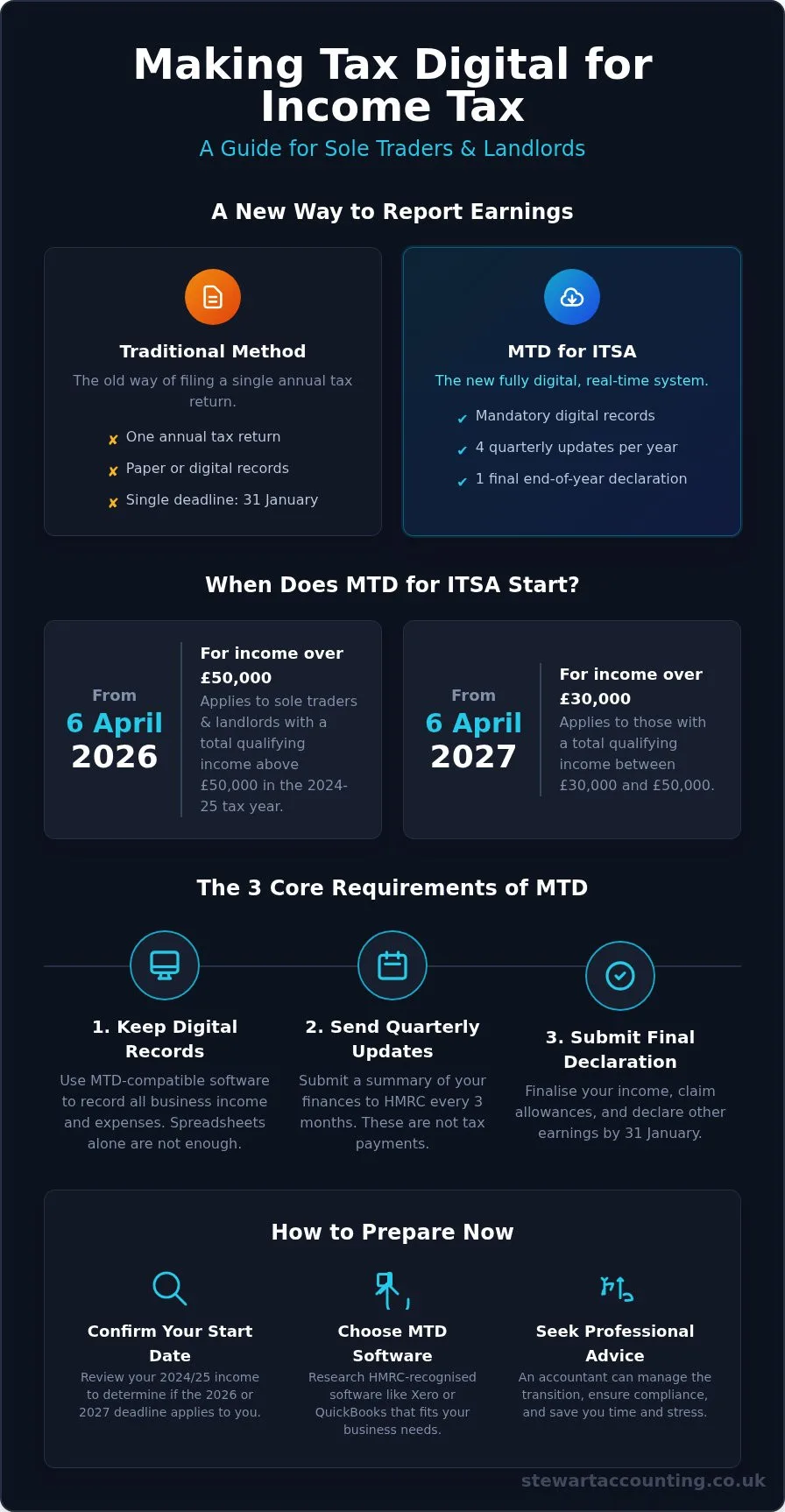
Making Tax Digital for Income Tax Self Assessment (MTD for ITSA) is HMRC’s new system for reporting income. It moves away from the traditional single annual Self Assessment tax return and introduces a fully digital process. Under the new rules, businesses and landlords will be required to keep digital records of their income and expenses and send regular updates to HMRC throughout the year using compatible software.
Who Needs to Follow the New MTD Rules from April 2026?
The new rules will be phased in, starting from 6 April 2026. You will be required to follow MTD for ITSA from this date if your total qualifying income from self-employment or property in a tax year is more than £50,000. To determine if this applies to you for the 2026 start, you will need to look at your total income from the 2024-2025 tax year.
Key MTD for Income Tax Dates and Deadlines
It’s crucial to know which start date applies to you. The rollout is staggered based on your annual income:
- From 6 April 2026: For sole traders and landlords with a qualifying income of over £50,000.
- From 6 April 2027: For sole traders and landlords with a qualifying income of over £30,000.
HMRC has also confirmed that general partnerships will be required to join MTD for ITSA at a later, unconfirmed date.
Who is Exempt from MTD for Income Tax?
Not everyone will be required to join MTD. Certain entities, such as trusts, estates, and non-resident companies, are exempt. Individuals can also apply to HMRC for an exemption if they are unable to follow the digital rules for reasons such as age, disability, or location (e.g., no internet access). If you are granted an exemption, you will continue to file your Self Assessment tax return as you do now.
How MTD Will Change Your Tax Reporting Process
The introduction of MTD for ITSA marks a significant shift from the familiar routine of filing one large tax return by 31 January. The new process is built around three core requirements that focus on maintaining real-time, digital records and providing regular updates to HMRC.
Requirement 1: Keep Digital Records
Under MTD, you must use compatible software to keep track of your business finances. This means recording all your business income and expenses in a digital format. While spreadsheets can be used to collate your figures, they are not sufficient on their own and must be linked to MTD-compatible software that can send the required updates directly to HMRC.
Requirement 2: Send Quarterly Updates to HMRC
Instead of one annual submission, you will need to send a summary of your business income and expenses to HMRC every three months. It’s important to note that these quarterly updates are not a final tax return, and you won’t be expected to make a tax payment at these points. They are designed to help you and HMRC get a clearer, more up-to-date picture of your estimated tax liability throughout the year.
Requirement 3: Submit a Final Declaration
After the tax year ends, you will need to finalise your business income by making any necessary accounting adjustments and submitting a final declaration to HMRC. This is the stage where you confirm your figures for the entire year, declare any other income (such as savings interest or employment income), and establish your final tax liability. The deadline for this final submission remains 31 January following the end of the tax year.
How to Prepare for the MTD for ITSA Changes
The deadline may seem far away, but preparing early will make the transition to MTD much smoother and less stressful. By taking a few simple steps now, you can ensure your business is ready for the new digital requirements. Getting expert advice can help you avoid common pitfalls and find the most efficient solution for your circumstances.
Step 1: Confirm Your MTD Start Date
The first step is to be certain about when you need to start. Review your total gross income from self-employment and property for the 2024/25 tax year. If this figure is over £50,000, you will need to be ready for the April 2026 start date. If you are unsure about what counts as qualifying income or which threshold you fall into, a qualified accountant can provide clarity.
Step 2: Choose MTD-Compatible Software
You will need to choose a software package that is recognised by HMRC for MTD for ITSA. There are many options available, including popular platforms like Xero, QuickBooks, and FreeAgent. Take the time to research which software has the features that best suit your business needs and budget. We can help you assess the options and get you set up on the right platform.
Step 3: Consider Professional Support
Navigating these changes can be a challenge, but you don’t have to do it alone. An accountant can manage the entire MTD process on your behalf, from setting up software to submitting all the required updates and declarations. We can ensure your records are accurate, your deadlines are always met, and your business remains fully compliant, freeing up your valuable time to focus on what you do best. Let us take the stress of MTD off your hands. Get in touch today.
Frequently Asked Questions
Do I still need to file a Self Assessment tax return under MTD?
Yes, but in a different way. The quarterly updates and the end-of-period statement (EOPS) for your business, followed by a final declaration for all your income, collectively replace the traditional Self Assessment tax return.
What exactly is ‘qualifying income’ for MTD for ITSA?
Qualifying income is the total gross income or turnover from your self-employment and/or property rental business during a tax year, before deducting any expenses.
Can I use a spreadsheet for MTD for Income Tax?
You cannot use a spreadsheet on its own. While you can use one to keep records, it must be digitally linked to MTD-compatible software that can send the required information directly to HMRC. This is known as using ‘bridging software’.
What happens if I miss a quarterly update deadline?
HMRC is introducing a new points-based penalty system for late submissions under MTD. If you accumulate a certain number of points for missing deadlines, you will receive a financial penalty. It is therefore crucial to submit all updates on time.
Will my tax payments be due every quarter?
No. The quarterly updates are for reporting your income and expenses only. The deadlines for paying your tax bill remain the same: 31 January and 31 July for Payments on Account.
How much does MTD-compatible software cost?
The cost varies widely depending on the provider and the features included. Some companies offer free, basic versions, while more comprehensive packages come with a monthly subscription fee. We can advise on the most cost-effective solution for your business.
The move to Making Tax Digital is a significant change, and it’s natural to have questions or feel concerned about the new requirements. As Fully Qualified Chartered Accountants and experts in Self Assessment for sole traders and landlords, we are here to provide clear, practical guidance. We offer local, approachable support for businesses across Alloa, Stirling, and Falkirk to ensure you are fully prepared and confident about the transition. Worried about the MTD changes? Book a free, no-obligation chat with our experts.
Recent Posts
25 Oct, 2026