

8-Step VAT Compliance Checklist for UK SMEs
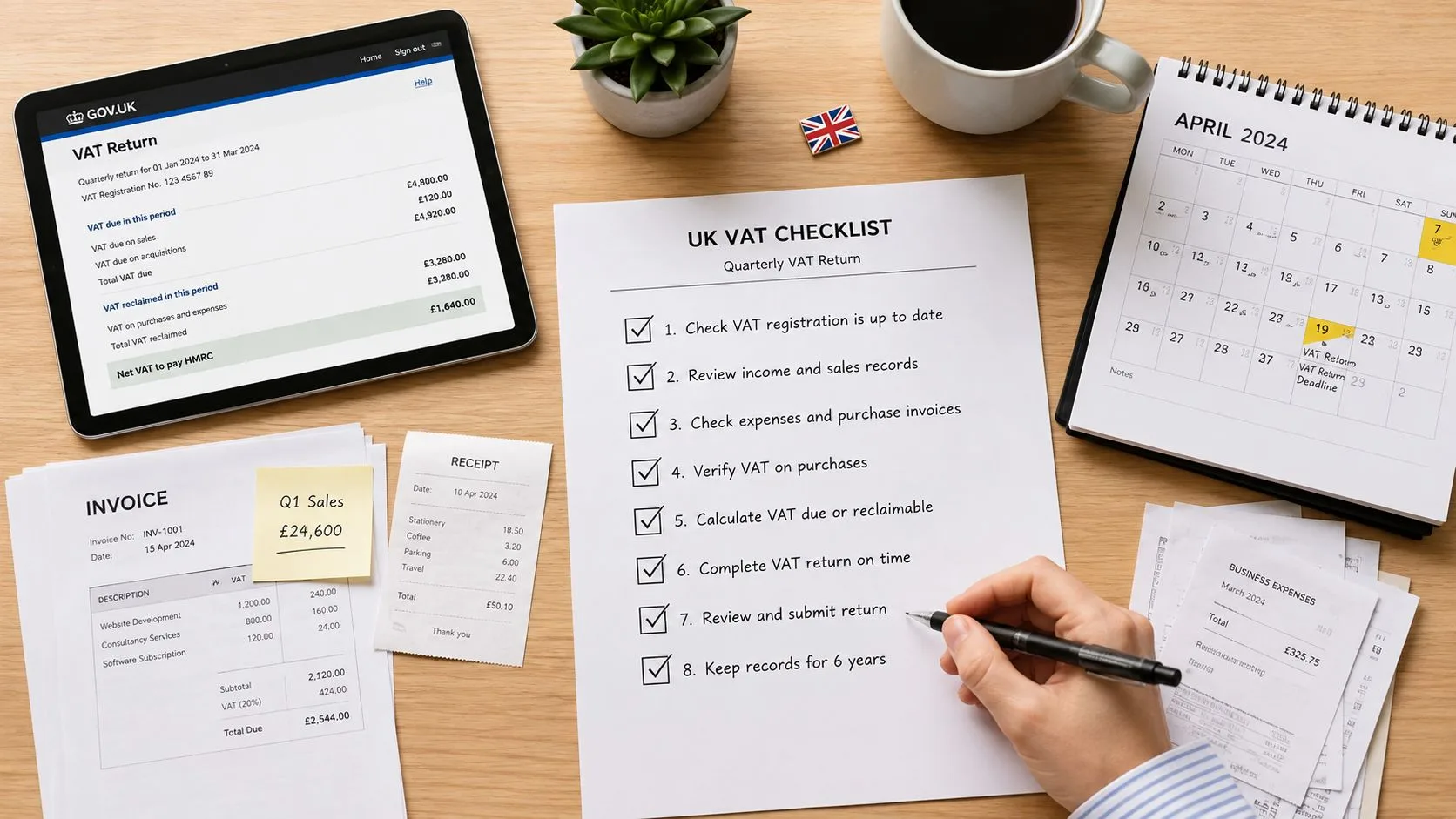
Your turnover is climbing towards VAT registration, invoices are landing in Xero, and the next return is due before you've reconciled the books. Sales may be split between online orders, recurring services and one-off projects, while supplier bills contain different VAT treatments. The risk isn't only submitting a return late. It's applying the wrong treatment, claiming unsupported input tax, paying after the deadline or being unable to explain how an automated figure was produced.
This VAT compliance checklist turns VAT into an operating routine that follows the SME lifecycle, from registration and scheme choice through records, returns, recovery, cash flow, specialist transactions and HMRC readiness. Use it with cloud accounting, but don't assume software removes the need for review. HMRC's current guidance should always take priority, particularly where thresholds, deadlines, penalty rules or sector treatments may change.
1. VAT Registration Threshold Management
Registration starts with a reliable view of taxable turnover, not a last-minute conversation with your accountant. Review rolling turnover regularly and separate taxable supplies from income that may have a different VAT treatment. A Central Scotland consultancy approaching the registration point should monitor its position before the business reaches the relevant limit, then plan pricing, contracts and customer communications rather than reacting after the event.
The registration decision can affect customers differently. A business selling mainly to VAT-registered companies may be able to show VAT separately with less commercial friction. A consumer-facing business may need to absorb some of the cost, change prices or explain why invoices now look different. Voluntary registration can also be appropriate in some circumstances, particularly where a business makes mainly zero-rated supplies or has significant VAT-bearing costs, but the decision should be modelled rather than treated as automatically beneficial.
Build registration into monthly management accounts
Add a VAT review to the monthly close. The person responsible should record current taxable turnover, investigate unusual income and flag a likely registration requirement to the owner or accountant. If the business changes from sole trader to limited company, transfers activities, adds a partner or acquires another trade, reassess the VAT position. A new legal structure doesn't automatically make the old analysis safe.
Use this action list:
- Track the right turnover: Reconcile sales reports to the accounting ledger and investigate differences between invoicing, cash receipts and platform reports.
- Plan customer pricing: Decide whether contracts, proposals and online prices need updating before registration takes effect.
- Prepare the application: Keep business details, trading information and expected activity ready for the HMRC process.
- Escalate uncertainty: Ask a VAT adviser to review connected activities, transfers, property income or unusual supplies before you rely on a registration conclusion.
Don't promise customers that VAT can be added later without checking the contract. A registration mistake can become a pricing problem as well as a tax problem.
2. VAT Scheme Selection and Optimisation
Scheme choice should follow the way the business sells, buys and collects payment. Standard VAT accounting offers a familiar process, while Cash Accounting may suit a contractor waiting months for payment. Flat Rate, Annual Accounting and Margin Schemes can change the calculation or administration, but each has eligibility rules and trade-offs. Headline simplicity is not enough.
Use a short decision paper rather than relying on the software's default settings. Compare representative sales, typical purchases, capital expenditure, margins and customer payment patterns. A service business with few recoverable costs may reach a different result from a manufacturer with substantial input VAT. Record the assumptions, expected VAT result and any costs or restrictions that influenced the decision.
A scheme can affect cash flow as well as the return calculation. Cash Accounting may align VAT payments more closely with customer receipts, subject to its rules and eligibility. Another scheme may suit predictable administration but create a payment obligation before customers have paid. Specialist arrangements, including Margin Schemes, need particular care because the taxable calculation does not follow ordinary sales and purchase coding.
Use change events as review triggers
Review the choice after incorporation, a new business division, rapid turnover growth, changed payment terms or a significant shift in product mix. A limited company cannot inherit the previous analysis from a sole trader. Cloud accounting can calculate the selected method, but it cannot test whether the commercial assumptions remain appropriate.
Keep the scheme decision, eligibility check and supporting calculations with the VAT records. That gives the accountant a clear starting point when circumstances change.
Apply these controls:
- Compare actual patterns: Use representative periods and include unusual purchases, capital items and slow-paying customers.
- Confirm eligibility: Check current turnover limits, sector conditions and scheme restrictions against HMRC's VAT scheme guidance before applying or changing a scheme.
- Test cash impact: Estimate when VAT becomes payable and when input VAT can be recovered under the proposed method.
- Set ownership: Assign the review to the person responsible for the monthly close, with the owner or accountant approving the conclusion.
- Escalate specialist cases: Obtain VAT advice for Margin Schemes, connected businesses, mixed activities or transactions that do not fit standard coding.

Reassess a scheme before growth or restructuring makes the old assumptions unreliable. The practical comparison is between payment behaviour, margins, purchase patterns and the control effort required, not between labels that appear interchangeable.
3. VAT Documentation and Record-Keeping Standards
A supplier invoice arrives without a clear business purpose, while a bank-feed match suggests the transaction is complete. That combination can leave a VAT return difficult to defend. Each figure should be traceable from the submitted return to the accounting entry, source document, payment and any adjustment.
Set the record system around the business, not individual locations. A company with offices in Alloa, Stirling and Falkirk should use one filing convention and shared access rules. A landlord with several properties should code contractor invoices to the correct property and separate activities that may receive different VAT treatment.
Build an audit trail at entry
Use consistent folders or tags for sales invoices, purchase invoices, credit notes, bank records and VAT adjustments. Scan paper documents when received, retain originals where appropriate and limit editing rights to trained users. Under Making Tax Digital, VAT-registered businesses must keep digital records and use compatible software. The Making Tax Digital for VAT guidance explains that compatible software preserves digital records, prepares returns from them and communicates with HMRC through an API.
For cloud accounting such as Xero, require staff to attach bills and receipts to transactions, then review the coding rather than treating the attachment as proof of correct VAT treatment. Apply these controls:
- Invoice validation: Check supplier identity, invoice number, date, VAT amount, VAT treatment and business purpose before approval.
- Attachment discipline: Require an invoice or receipt, with a documented exception route where evidence is missing.
- Change tracking: Record who corrected an entry, why, and which VAT return could be affected.
- Backup protection: Test user permissions, data exports and recovery arrangements with the cloud provider.
Review records monthly, not only before year-end. Set an owner for missing documents and escalate unusual VAT treatment, property allocations or corrections to the accountant or a VAT adviser before submission.

4. VAT Return Preparation and Submission
A return can fail even when the bookkeeping appears complete. Before drafting it, reconcile sales, purchases, bank feeds, credit notes, journals and suspense accounts across the period. A business combining product sales, consulting income and property activity should use separate VAT codes and reports, so the result does not rest on one broad assumption.
Set the review around exceptions rather than checking every transaction twice. In cloud accounting, Xero may apply VAT rates as entries are created, but a matched bank transaction does not confirm the treatment. Review new suppliers, unusual expenses, refunds and manual journals. Compare the VAT report with bank and sales records, then investigate material changes from earlier periods.
Record three dates for each return: preparation, review and submission. The preparer confirms completeness and reconciliations. A second reviewer, the owner or accountant, examines exceptions, adjustments and unusual balances. The authorised user submits only after that review is documented.
Use this control sequence:
- Sales completeness: Compare invoices with till reports, ecommerce settlements and other sales channels.
- Purchase accuracy: Check VAT codes, duplicate bills, missing invoices and personal expenditure.
- Adjustment evidence: Retain calculations for bad debt relief, partial exemption, corrections and other manual entries.
- Submission confirmation: Save HMRC's acknowledgement and record any payment or repayment action separately.
Set a calendar reminder before the filing deadline and assign a named owner for unresolved items. Escalate partial exemption calculations, property-related adjustments, large corrections or unusual VAT balances to the accountant or a VAT adviser before submission.
Late filing creates a points risk. For accounting periods starting on or after 1 January 2023, HMRC awards one point for each late VAT Return. The threshold is 2 points for annual returns, 4 for quarterly returns and 5 for monthly returns. Reaching the applicable threshold leads to a £200 penalty, with another £200 for each further late submission while the business remains at that threshold, as set out in HMRC's late VAT Return penalty guidance. Points generally expire after 24 months, subject to HMRC's conditions.
5. Input VAT Recovery and Claim Management
A new supplier invoice arrives, the bill is paid, and the software assigns a VAT code automatically. That workflow is efficient only when someone checks whether the tax is recoverable. Input VAT must be supported by valid evidence and linked to taxable business activity.
Set the rule at invoice entry. Train the person recording bills to identify restricted or non-recoverable costs, including entertainment, mixed-use expenditure, vehicles, property costs and expenses linked to exempt activities. A property landlord may face different recovery treatment from a fully taxable trading business, so do not accept the accounting software's default code without review.
Use the cloud system to route exceptions rather than inspect every transaction manually:
- Check the invoice: Request a proper VAT invoice and confirm the supplier, transaction, VAT treatment and amount are clear. Keep capital purchase invoices with the asset record, including any private or exempt use.
- Review higher-risk costs: Flag new suppliers, overseas vendors, directors' expenses and large one-off purchases for approval.
- Separate restricted expenditure: Apply dedicated nominal and VAT codes to entertainment, private use and mixed activities.
- Reconcile the claim: Compare the input VAT report with purchase ledgers, bank payments and supporting documents before the return is finalised.
- Document apportionment: Store the method and calculation for partial exemption or mixed use with the relevant VAT period.
A missing invoice can remove the evidence for a claim. Pause recovery until the record is complete, or obtain specialist advice where the treatment is uncertain.
For capital purchases, property costs and mixed-use expenditure, record the business rationale as well as the amount. This gives the accountant a clear basis for review and makes an HMRC query easier to answer.
Escalate repeated uncertainty instead of allowing inconsistent coding. If staff disagree about a category, write a short policy with examples and ask the accountant to confirm it. Routine business costs can follow the documented policy. Partial exemption, property-related recovery and unusual claims should reach the accountant or a VAT adviser before submission.
6. VAT Cash Flow Management and Refund Optimisation
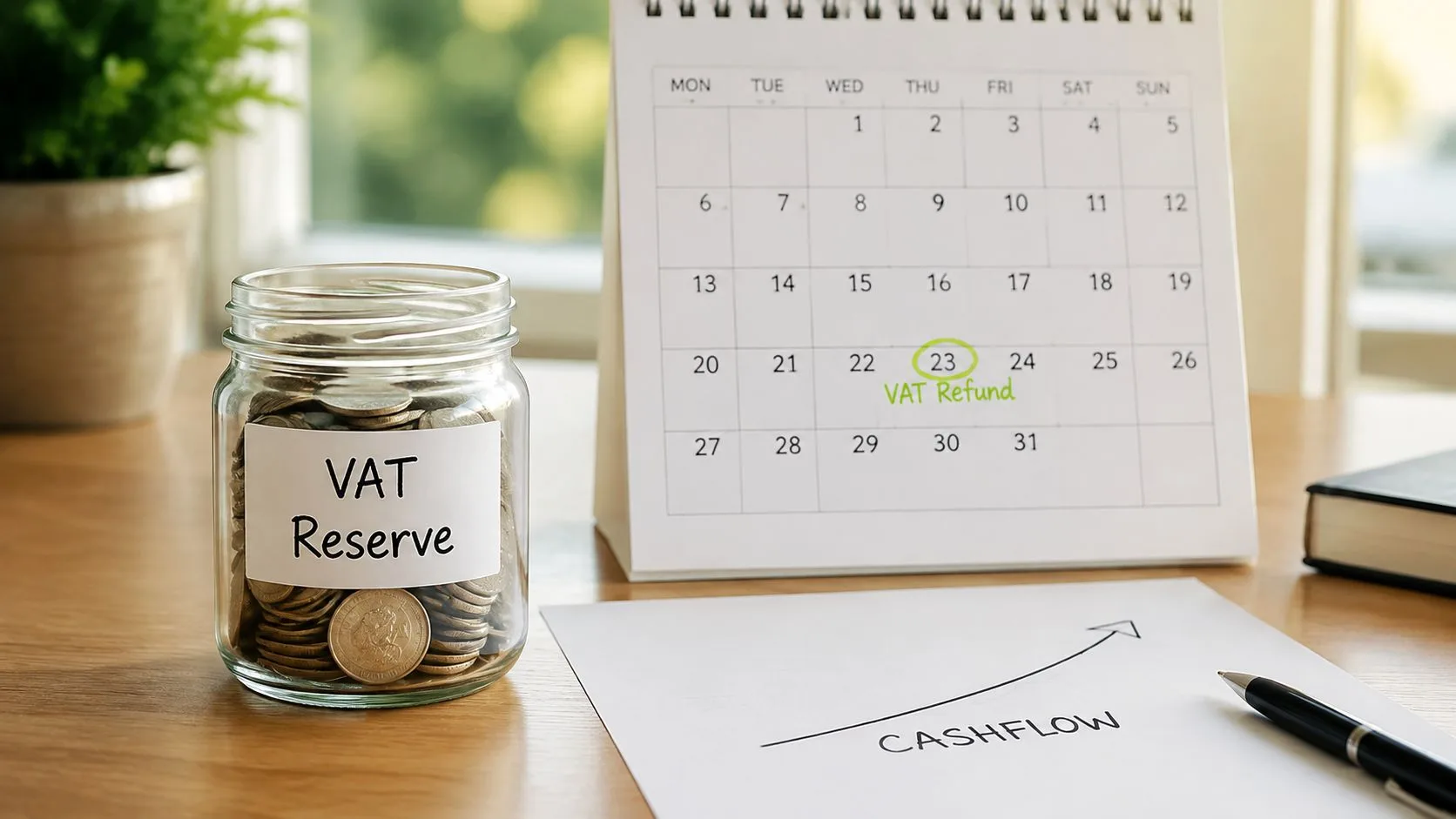
A profitable SME can still face a cash shortage when a VAT payment falls due before customers settle their invoices. Treat VAT collected from customers as money reserved for HMRC. Keep it visible in the cloud accounting system, forecast the balance separately, and include expected repayments, major purchases and delayed receipts in the cash plan.
The payment deadline needs an owner. For VAT due on or after 31 May 2025, HMRC's late-payment regime applies 3% at day 15, another 3% at day 30 and a daily penalty equivalent to 10% per year from day 31, according to the HMRC Compliance Handbook. Filing on time does not remove the risk of interest or penalties when payment arrives late.
Turn the VAT calendar into a cash control
Record the return deadline, payment instruction date and bank approval date together. Assign responsibility for checking the payment reference, account details and bank processing time. After submission, confirm that the payment has cleared rather than assuming the return itself transferred funds.
A seasonal business should forecast VAT against its sales and purchasing cycle. A manufacturer with substantial input VAT may consider more frequent returns to improve cash timing, but the potential benefit must justify extra preparation and review work. A contractor planning an equipment purchase should model the VAT payment date, supplier terms and expected output VAT. Tax timing alone should not drive the purchase.
Use these operating controls:
- Protect the reserve: Transfer expected VAT into a separate account or identify it clearly in the cash report.
- Check HMRC balances: Review outstanding liabilities before allocating funds to other commitments.
- Test refund trends: Investigate repeated repayments and confirm that they match genuine trading activity and available records.
- Escalate payment pressure: Contact the accountant and HMRC promptly if the forecast shows a shortfall.
HMRC treats nil returns as late when they miss the deadline. The guidance on late VAT returns and payment explains how payment history and turnover can affect surcharge treatment. Put every VAT period on the calendar, including periods with no liability.
7. VAT Compliance for Specialised Business Activities
A new service, property deal or overseas customer can change the VAT treatment before the accounting team notices. Property, construction, imports, exports, digital services and ecommerce each raise different questions about place of supply, exemptions, reverse charges, evidence and input VAT recovery. Review the treatment whenever the business adds a materially different activity.
Start with the transaction, not the software code. A landlord with residential and commercial property should separate both streams and retain the reasoning for each treatment. A construction contractor should match subcontractor invoices, CIS information and VAT treatment with the main contractor's records. A digital services business selling across borders needs customer-location evidence and a place-of-supply review before coding the invoice.
Set up separate tracking categories, products or ledgers for each activity. Configure cloud accounting invoices to capture the evidence required for the VAT decision, including customer details and transaction type. Keep customs declarations and import VAT records with the related purchase. Use a customs broker or VAT specialist when the process exceeds the team's experience.
Use this review at month-end:
- Property activity: Check exemption, option-to-tax decisions, tenant status and costs assigned to each property.
- Construction activity: Reconcile subcontractor invoices, CIS deductions and VAT treatment with the main contractor's records.
- Digital services: Confirm customer location, billing address and supporting evidence before the return is prepared.
- International trade: Match customs documents, import VAT records and any reverse-charge analysis to the ledger.
- Mixed supplies: Keep taxable, zero-rated and exempt activities separate. Do not average their treatment.
Escalate before the first transaction in a new sector or country. Correcting several months of invoices takes longer and may require amended returns, customer contact or specialist advice.
Partial exemption, property transactions, cross-border sales and construction arrangements warrant specialist review. The result depends on the contracts, commercial facts and available evidence, not just the business label. Record the decision, reviewer and date in the accounting system so the next return preparer can apply the same treatment.
8. VAT Audit Preparation and HMRC Dispute Resolution
An HMRC letter can arrive while a return, refund claim or technical decision is still being explained internally. Audit readiness comes from preserving the reasoning, calculations and approvals when transactions are fresh. For a large claim, specialised scheme or partial exemption method, create a concise file covering the commercial facts, calculation method and supporting evidence.
For example, a manufacturing company should link purchase invoices, production activity, sales and input VAT calculations. A property business should retain leases, invoices, property classifications and relevant correspondence. If a partnership receives an HMRC question, appoint one coordinator so replies remain consistent.
Build an HMRC response file
Keep submitted returns, acknowledgements, reconciliations, adjustment schedules, correspondence and review notes in a restricted location that authorised staff can access. Maintain a dated request log. Store the final response with the evidence supplied, rather than relying on email folders or an individual employee's mailbox.
Use this sequence when a request arrives:
- Confirm the scope: Check the periods, records and questions covered.
- Gather evidence: Export the relevant ledger data and match it to invoices, bank records, contracts and calculations.
- Test the explanation: Have an accountant review technical treatment, disputed figures and the link between evidence and the return.
- Control the deadline: Respond within the stated period. If more time is needed, request an extension early and explain why.
- Close the issue: Save HMRC's response, record any agreed adjustment and update the control that failed or caused confusion.
Send only material that answers the questions. Unrelated documents can obscure the explanation and create further queries.
Routine enquiries can often be managed through a clear evidence file and a checked response. Specialist representation is appropriate where the dispute concerns partial exemption, property transactions, recovery restrictions, cross-border treatment or penalty mitigation. Keep evidence of reasonable care, including staff training, reconciliations and management review. If HMRC challenges the process, these records show how the business made and checked its VAT decisions.
8-Point VAT Compliance Comparison
| Item | Implementation complexity | Resource requirements | Expected outcomes | Ideal use cases | Key advantages |
|---|---|---|---|---|---|
| VAT Registration Threshold Management | Low–Moderate: monitoring turnover and filing registration | Basic bookkeeping, occasional accountant input, HMRC portal access | Legal compliance; timely registration; pricing and cashflow impacts | Growing SMEs near £85,000 threshold; businesses changing structure | Clear compliance trigger; access to input VAT recovery; professional credibility |
| VAT Scheme Selection and Optimization | Moderate–High: modelling and eligibility assessment | Accountant analysis, modelling tools, management time | Reduced VAT cost or simplified compliance when optimised | Businesses near scheme limits, variable margins, high input or bad-debt risk | Potential VAT savings; simplified admin (Flat Rate); cashflow improvements (Cash Accounting) |
| VAT Documentation and Record-Keeping Standards | Moderate: system setup and ongoing discipline | Document management system, staff training, storage/backups | Audit-ready records; fewer errors; faster accounting turnaround | Multi-site SMEs, high transaction volumes, MTD-qualifying businesses | Strong audit defence; lower accounting costs; reliable retrieval for HMRC inquiries |
| VAT Return Preparation and Submission | Moderate: reconciliation, categorisation, MTD integration | Cloud accounting software, regular bookkeeping, trained staff | Timely, accurate VAT returns; predictable VAT positions and deadlines | Businesses with quarterly/monthly returns or multiple revenue streams | Regular cashflow visibility; automated submission; reduced penalty risk |
| Input VAT Recovery and Claim Management | Moderate–High: eligibility rules and partial exemption handling | Detailed invoice control, tracking spreadsheets, accounting support | Lower net VAT liability; possible refunds; improved working capital | Capital-intensive firms, landlords, businesses with high supplier VAT | Cashflow benefit from reclaiming eligible VAT; enforces better invoicing practices |
| VAT Cash Flow Management and Refund Optimization | Moderate: forecasting and timing strategies | Cashflow forecasting tools, accounting advice, disciplined planning | Improved liquidity; optimized refund timing; reduced short-term borrowing | Seasonal businesses, firms with large refunds or major capital spend | Predictable cash injections; reduced financing needs; timing-based savings |
| VAT Compliance for Specialized Business Activities | High: sector-specific rules and exceptions | Sector expertise, specialist advisors, tailored accounting processes | Correct sector treatment; minimized compliance errors; targeted recovery | Property, construction, import/export, digital services, mixed-activity businesses | Avoids costly sector mistakes; enables optional treatments where beneficial |
| VAT Audit Preparation and HMRC Dispute Resolution | High: audit readiness and legal/appeal procedures | Comprehensive records, professional representation, time resources | Resolved disputes; reduced penalties; validated positions under review | Businesses with high input claims, previous issues, or HMRC inquiries | Strong defence in audits; penalty mitigation via reasonable care; formal appeal routes |
Turn the Checklist into a Year-Round Control
A VAT compliance checklist works when it becomes part of the operating rhythm, not when someone opens it the night before submission. Assign ownership for each task, set review dates in the accounting calendar and keep evidence of completion. The owner should know which items the bookkeeper handles, which items require accountant input and which decisions cannot be delegated to software.
Use three review points.
Monthly, check taxable turnover, new products, customer locations, transaction coding, missing documents and the VAT cash reserve. Review the rolling cash forecast and look for liabilities that could fall due before customer receipts arrive. Investigate unusual VAT balances rather than allowing them to roll forward without explanation.
Quarterly, reconcile the sales ledger, purchase ledger, bank records, credit notes and VAT report. Confirm that every return has been prepared, independently reviewed where practical and submitted on time. Record the acknowledgement, arrange payment separately and check that the bank has released the funds. If the business files nil returns, keep them in the same calendar because HMRC includes late nil returns within its late-return rules.
At year end, revisit registration status, scheme suitability, partial exemption methods, sector-specific treatments, asset records and outstanding corrections. Check that the digital audit trail remains complete across ecommerce, point-of-sale, invoicing and bookkeeping systems. HMRC's digital direction makes data integrity increasingly important, and HMRC-compatible software must preserve digital records, prepare returns from them and communicate through an API, as set out in its Making Tax Digital collection.
When HMRC contacts you, verify the request, gather only the relevant records, preserve all correspondence and meet the stated deadline. If you need more time, request an extension early. For disputed or technically complex matters, involve a VAT professional before sending a substantive response.
Stewart Accounting Services is one option for SMEs that need support with VAT registration, scheme reviews, bookkeeping, cloud accounting, VAT return preparation and deadline management. The firm is headquartered in Alloa, with offices in Stirling and Falkirk, and supports businesses across Central Scotland and the wider UK. It can be relevant for limited companies, sole traders, partnerships, contractors and property landlords, but the appropriate scheme and treatment still depend on each business's facts.
Use this checklist at your next monthly close, then book a VAT health check with Stewart Accounting Services if your records, software or sector rules need a second review. Bring your latest VAT return, accounting reports, scheme details and any unresolved transaction questions so the review can produce specific actions rather than general reassurance.
Recent Posts
07 Oct, 2026
06 Oct, 2026