

Your Guide to 12 Pay Payroll in the UK

At its core, a 12 pay payroll system is beautifully simple: you pay your employees once a month, which adds up to 12 paydays over the course of a year. It’s the go-to payment schedule for the vast majority of UK businesses for a good reason – it mirrors the monthly cycle of life’s biggest expenses, like rent, mortgages, and utility bills.
What Does 12 Pay Payroll Actually Mean?
Instead of thinking of it as some complex financial mechanism, picture it more like a straightforward subscription for salaries. Your team receives a predictable, consistent payment on the same date every month. This creates a reliable financial rhythm that benefits everyone, from the business owner managing cash flow to the employee planning their budget.
It's no surprise that this monthly schedule has become the standard here in the UK. A staggering 97% of businesses in the country run on a monthly pay system. This isn't just a trend; it's a reflection of its efficiency and cost-effectiveness, two things every business owner values. If you're interested in the wider trends, the Chartered Institute of Payroll Professionals offers a wealth of payroll statistics that paint a clear picture of the industry.

Breaking Down the Basics
For a small or medium-sized enterprise (SME), choosing a monthly payroll isn’t about just following the crowd. It’s a practical decision that builds a stable foundation for your operations. By simplifying one of your most critical business functions, you cut down on the hours spent processing payments and significantly reduce the risk of costly errors.
From an employee's perspective, this structure brings welcome predictability. Knowing exactly when their salary will land in their bank account—and for how much—empowers them to manage their personal finances effectively. It removes the stress and guesswork that can often come with more frequent or variable pay schedules.
To pull it all together, let’s quickly look at the key characteristics of a 12-pay system.
Key Characteristics of a 12 Pay (Monthly) Payroll System
This table breaks down the core elements of a monthly payroll schedule for easy reference.
| Attribute | Description |
|---|---|
| Payment Frequency | Employees are paid once per calendar month. |
| Annual Paydays | There are exactly 12 pay dates in a year. |
| Administrative Load | The processing workload is minimal compared to other schedules. |
| Cash Flow Impact | Creates a single, predictable, major monthly expense. |
| Employee Budgeting | Aligns perfectly with standard monthly bills and financial commitments. |
| HMRC Reporting | Requires 12 Real Time Information (RTI) submissions per year. |
As you can see, the real advantage of a 12 pay payroll is its straightforward nature. It’s a system built for clarity and consistency, making it an excellent choice for businesses that want to focus on growth and stability. It strips away unnecessary admin, freeing you up to concentrate on what you do best: running your business.
The Real Benefits of Monthly Payroll for UK SMEs
Switching to a 12 pay payroll schedule is more than just falling in line with the UK standard. For a small or medium-sized business, it’s a smart move that brings real, practical advantages in efficiency, cost, and financial management. Moving your payroll to a monthly cycle helps create a much more stable and predictable rhythm for your entire operation.

For many UK business owners I've worked with, making the change to a monthly payroll system brings a welcome sense of order to what can often feel like a chaotic and demanding task.
Streamlined Administration and Fewer Errors
Let's be honest, one of the biggest immediate wins you'll notice with monthly payroll is just how much it lightens the administrative load. Think about the hours your team sinks into preparing, checking, and running payroll. If you’re paying weekly, you’re doing that whole dance 52 times a year. A monthly system slashes that down to just 12.
That reduction has a brilliant knock-on effect. Fewer payroll runs mean:
- Less paperwork and digital admin, which frees up your people to focus on work that actually grows the business.
- A lower risk of mistakes in calculations, tax deductions, and payments. It’s simple probability.
- Easier compliance with HMRC's Real Time Information (RTI) reporting, as you only have 12 submissions to worry about each year.
When you handle something less frequently, you naturally create a more reliable and accurate process, reducing the chances of those frustrating, costly errors that take time and money to fix.
Significant Cost Savings
Running payroll costs money. Every time you process it, you're hit with costs, whether that's bank transaction fees, your payroll software subscription, or the hours you’re paying your accountant for. By pulling all of this into a single monthly run, you directly cut down on these recurring expenses.
A monthly schedule can lead to genuine savings over the course of a year. For any SME, trimming these regular operational costs feeds straight back into a healthier bottom line.
This cost-effectiveness is a major reason why the 12 pay payroll model is the go-to for most UK businesses. It’s a simple, effective way to make your financial operations leaner.
Superior Cash Flow Management
For any small business, this is perhaps the most important benefit: better control over your cash flow. A monthly payroll means you have one, predictable salary payment leaving your account each month. That consistency makes financial forecasting far more accurate and a whole lot less stressful.
One of the significant real benefits of monthly payroll is its positive impact on a business's cash flow, helping to keep your business thriving by managing cash flow effectively. When you know exactly when your biggest expense is going out, you can budget with much more confidence. It turns financial planning from a bit of a guessing game into a structured, reliable activity, allowing you to make smarter decisions about investment, growth, and day-to-day spending.
Choosing Your Payroll Schedule
Picking the right payroll schedule is one of those foundational decisions that can make your life as a business owner a whole lot easier—or more complicated.## Choosing Your Payroll Schedule
Picking the right payroll schedule is one of those foundational decisions that can make your life as a business owner a whole lot easier—or more complicated. While a 12 pay payroll—paying your team once a month—is the standard here in the UK, it’s worth taking a moment to see how it stacks up against other common frequencies like weekly or fortnightly. Each has its own rhythm and a unique set of trade-offs for both you and your staff.
This image neatly illustrates how a 12 pay system works, taking an annual salary and dividing it into even, predictable monthly payments.
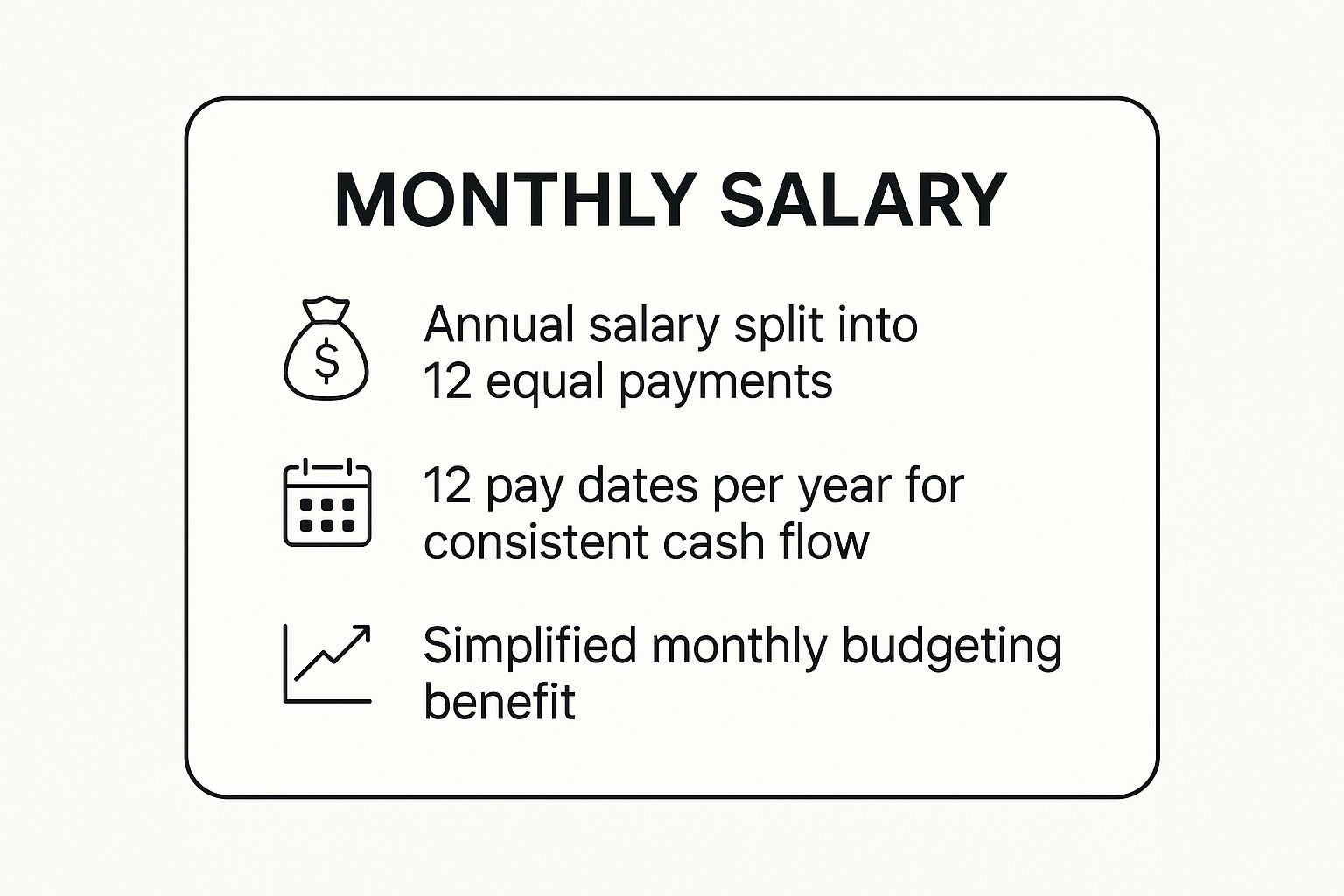
As you can see, the whole structure is built for consistency. This straightforward approach is a massive help for budgeting, not just for your business but for your employees too. That clarity is really the heart of the monthly model’s appeal.
Weighing Your Options: Monthly, Fortnightly, or Weekly?
So, how do the different payroll frequencies really compare? Let's break down the pros and cons of the most common options to figure out which one aligns best with your business operations and company culture.
The table below gives you a side-by-side look at how the different pay schedules impact your business and your team.
Payroll Schedule Comparison: Monthly vs Fortnightly vs Weekly
| Pay Schedule | Pros for Employer | Cons for Employer | Pros for Employee |
|---|---|---|---|
| Monthly (12 pay runs) | Simplest admin, lower processing costs. Aligns perfectly with monthly accounting & reporting. | Less attractive to employees who prefer more frequent pay. | Predictable, consistent income makes budgeting for big expenses (rent, mortgage) easier. |
| Fortnightly (26 pay runs) | A good middle-ground. More frequent than monthly, less admin than weekly. | Creates accounting complexities with "three-pay months" that misalign with monthly budgets. | Pay arrives more often, which helps with managing weekly bills and cash flow. |
| Weekly (52 pay runs) | Ideal for hourly workers or industries with high turnover. | High administrative burden with 52 pay runs a year. Increased chance of errors and higher processing fees. | Fastest access to earnings, which is a major perk for short-term financial management. |
Ultimately, choosing the right schedule comes down to balancing administrative simplicity and cost against what works best for your employees' financial well-being.
Unravelling the Accounting Complexities
The biggest headache with fortnightly (26 pay runs) or 4-weekly (13 pay runs) schedules comes down to one thing: they don't fit neatly into calendar months. This misalignment might seem small, but it can create a ripple effect of accounting issues.
Here’s what you run into:
- Inconsistent Monthly Costs: Your salary expenses will suddenly jump in certain months, making it tough to get a true reading of your overheads.
- Budgeting Nightmares: Trying to forecast your finances is much harder when your single largest cost isn't a fixed monthly figure.
- Skewed Reports: Your monthly management reports can look misleading, showing artificially high labour costs in months with an extra payday.
This is where a 12 pay payroll system really shines. By processing payroll just once per calendar month, you keep your salary outflow perfectly consistent and predictable.
Think about it: your rent, software subscriptions, and other major bills are almost always monthly. Aligning your payroll with that cycle just makes sense. It simplifies your bookkeeping, sharpens your budget accuracy, and gives you a much clearer, more reliable picture of your company's financial health.
The decision boils down to a simple trade-off: administrative ease and financial clarity versus employees' preference for getting paid more often.
How to Set Up a 12-Pay Payroll System
So, you're ready to make the switch to a monthly payroll? Let's walk through how to get it done. This is your action plan, broken down into clear, manageable steps to make the transition feel less like a mountain to climb and more like a straightforward process for your UK business.

Putting a 12-pay payroll system in place is more than just picking a date to send out payments. It’s really about building a solid, reliable process. One that makes sure your team gets paid correctly and on time, every single month, while keeping you on the right side of HMRC.
Your Initial Setup Checklist
Before you can even think about running that first monthly payroll, you need to lay the groundwork. Think of it like preparing the foundations before putting up a house – getting these early steps right will save you a world of headaches later on.
Here’s where to start:
- Register as an Employer: This is non-negotiable. You have to register with HMRC before your first payday. They'll give you your PAYE reference numbers, which you’ll need for all your reporting and payments.
- Gather Employee Information: You'll need the essentials for every team member. That means their full name, address, date of birth, and, crucially, their National Insurance (NI) number and the correct tax code (usually found on a P45 form or a starter checklist).
- Choose Your Payroll Software: Unless you live and breathe payroll, doing this manually is asking for trouble. Modern cloud-based software is a lifesaver. Tools like Xero, QuickBooks, or Sage handle all the complex calculations, create payslips, and even manage your HMRC submissions for you. It's a massive help in reducing errors.
Getting these fundamentals sorted from day one makes the whole thing run so much more smoothly. As you build your system, looking into workflow automation strategies for small businesses can offer some fantastic ideas for making the process even more efficient.
Running Your First Monthly Payroll
Once your setup is solid, you're ready for the main event: your first monthly pay run. This involves a bit more than just moving money around; it’s all about getting the numbers right and reporting them on time.
A well-run payroll system is the backbone of employee trust. When staff are paid accurately and on schedule every month, it fosters a stable and professional work environment.
Here’s the step-by-step for each pay cycle:
- Establish a Clear Payroll Calendar: Pick a consistent pay date and stick to it—for example, the last working day of the month. You also need a cut-off date for things like overtime or expenses. This keeps everyone on the same page and ensures you have all the information you need in good time.
- Calculate Pay and Deductions: For each employee, you'll start with their gross pay for the month. Your software will then take over and automatically work out all the deductions: Income Tax (PAYE), National Insurance, student loan repayments, and pension contributions.
- Generate and Distribute Payslips: It's a legal requirement to give every employee a payslip on or before their payday. This document needs to clearly show their gross pay, a full breakdown of deductions, and their final net pay.
- Report to HMRC: You must send a Full Payment Submission (FPS) to HMRC on or before each payday. This is part of the Real Time Information (RTI) system and tells HMRC exactly what you’ve paid your staff and the deductions you've made.
The reliance on digital systems to get this right is huge. To give you an idea, Bacs Payment System data showed that in 2023, it processed over 410,000 payroll-related payments. This really highlights just how central automated systems have become in modern UK payroll. You can discover more insights about these payment statistics on wearepay.uk.
Of course. Here is the rewritten section, crafted to sound like it was written by an experienced human expert.
Navigating the Tricky Bits of Monthly Payroll
Even the most straightforward payroll system has its quirks. While a 12 pay payroll brings a welcome dose of predictability, you’re bound to run into situations that need a bit of careful handling. People start mid-month, others leave, and things like overtime and commission can throw a spanner in the works.
The trick isn’t to avoid these things—they’re a normal part of running a business. It’s about having a clear, fair plan in place before they happen. That way, your payroll stays a source of stability, not a last-minute headache for you or your team.
Let's walk through the most common hurdles and how to clear them with confidence.
Handling Pro-Rata Pay for Starters and Leavers
One of the first things you'll encounter is figuring out pay for someone who joins or leaves part-way through a month. This is where pro-rata pay comes into play. You need a consistent and transparent way to calculate what they’re owed for the time they were actually with you.
A simple and fair method that many businesses rely on is based on calendar days:
- First, calculate a daily rate by dividing the employee's annual salary by 365.
- Then, multiply that daily rate by the number of calendar days they were officially employed that month.
So, if someone on a £30,000 salary starts on the 15th of a 30-day month, they’ve been on the books for 16 days (from the 15th to the 30th inclusive). You'd simply pay them for those 16 days. The most important thing is to have this policy written down and applied consistently. It avoids any confusion and makes sure everyone feels they've been treated fairly.
Managing Variable Pay Elements
Life would be simple if every payslip was identical, but that's rarely the case. Overtime, commissions, and bonuses often need to be factored in, and these amounts can change every single month.
The secret to keeping this manageable is setting a firm cut-off date. For example, you might decide that any overtime or commission earned up to the 20th of the month gets paid in that month's salary. Anything after the 20th simply rolls into the next month's pay run.
This gives everyone a clear deadline. Your team knows when their timesheets are due, and managers know when approvals need to be sorted. It puts a stop to the frantic, last-minute chase for numbers and ensures you have everything you need to run payroll accurately and on time. Just make sure you communicate this cut-off date clearly to everyone.
Supporting Your Team Through a Transition
If you're thinking of switching from a weekly or fortnightly schedule to a monthly one, be prepared for some adjustment pains. For an employee used to getting paid every Friday, waiting a full month can be a genuine shock to their personal budget.
Helping your team navigate this change requires empathy and great communication.
- Give Plenty of Notice: Don’t spring this on people. Announce the change several months in advance to give everyone time to prepare.
- Explain the 'Why': Be open about the reasons for moving to a 12 pay payroll. When people understand the benefits to the business's stability, they're more likely to be on board.
- Offer Real Support: Think about providing resources on monthly budgeting. Some companies even offer a one-off salary advance to help employees bridge that first long gap between paydays.
When you manage the transition with care, you show your team that you've got their back. It builds trust and helps everyone adapt without the financial stress.
The Future of Payroll Management in the UK
Looking ahead, it’s clear that the world of UK payroll is changing. It's being shaped by technology and a growing realisation that people are the true heart of any business. The old-school, manual slog of calculating wages and deductions is thankfully giving way to smarter, automated systems. These tools don't just promise more accuracy and efficiency; they genuinely deliver it, freeing up precious time for business owners like you.
But the future isn't just about processing paycheques faster. It’s about creating a better, more transparent experience for your employees. Features that once felt like a nice-to-have, such as employee self-service portals, are quickly becoming a standard expectation. Giving your team the power to instantly check their payslips, see their remaining holiday, or update their own details is a game-changer. It empowers them and cuts down the admin headaches for you.
Embracing Payroll Automation and Technology
The shift to digital payroll is undeniable. Automation is no longer some complex tool reserved for massive corporations; it's accessible, affordable, and frankly, essential for small and medium-sized businesses that want to thrive. These systems handle the fiddly calculations for tax and National Insurance with pinpoint accuracy, dramatically reducing the risk of human error that can lead to costly fixes and compliance tangles with HMRC.
Adopting modern payroll tools isn't just about getting things done quicker. It’s about building a resilient, future-ready system that can flex with new regulations and employee needs. A stable 12 pay payroll system is the perfect foundation for this.
This move towards digital is happening as the UK workforce itself grows and changes. For example, between December 2023 and December 2024, the total number of payrolled employments saw a small but steady increase of 0.2%, rising from 32.1 million to 32.2 million. It's also interesting to see how pay varies—the median monthly pay for EU nationals, for instance, was the highest at £2,588. You can dive into the specifics by exploring the full UK government employment data on GOV.UK.
The Growing Importance of Employee Experience
People today expect more transparency and control over their work life, and that includes their pay. A simple monthly payroll, when backed by the right software, can deliver exactly that.
So, what does a better payroll experience actually look like for your team?
- Instant Access: Employees can pull up their payslips and payment history whenever they want, no need to chase anyone down.
- Self-Service Updates: Your team can update their own bank details or contact information, which means your records are always spot on.
- Integrated Leave Management: Holiday requests can be submitted and approved right inside the payroll system, making planning a breeze for everyone.
Once you understand these shifts, you can see why a predictable monthly pay schedule is the perfect launchpad for embracing what’s next. It gives you the stability you need to integrate new tools that will not only simplify your processes but also keep your team happy and engaged.
Are you ready to modernise your payroll and get your time back? At Stewart Accounting Services, we specialise in taking the complexity out of payroll, CIS, and auto-enrolment for SMEs across the UK. Let us manage the details so you can focus on growing your business. Discover how we can help you today.