

The 31st January deadline for Self Assessment tax returns can feel like a looming storm cloud for SMEs, sole traders, partnerships, and landlords across the UK. The fear of missing a crucial document, miscalculating figures, or facing an unexpected penalty from HMRC is a common source of stress. But what if you could approach this annual task with confidence and clarity? This comprehensive self assessment checklist is designed to do just that. We'll break down the entire process into eight manageable, actionable steps, transforming a daunting obligation into a streamlined financial exercise.
Getting organised isn't just about ticking boxes; it's a fundamental business process. Just as clear guidelines simplify complex tasks, exploring effective business process documentation templates can further enhance your approach to financial management and operational efficiency beyond tax season.
This guide provides the specific details and practical examples you need to ensure a smooth, accurate, and timely tax return for the 2024/2025 tax year. From gathering your initial records to making the final submission, you will gain the structure needed to take control of your tax affairs with precision. Let's get started.
1. Getting Registered and Gathering Your Core Information
The very first step in any successful self assessment checklist is foundational: ensuring you are correctly registered with HMRC and have all your core information ready. Neglecting this administrative groundwork is a common source of stress, leading to last-minute panics when filing deadlines loom. This initial stage is about establishing your official status as a taxpayer and securely organising the identifiers you'll need to access and complete your return.
Why is this the first step?
You cannot file a tax return without being registered for Self Assessment. The process involves receiving a Unique Taxpayer Reference (UTR), a 10-digit number that is your primary identifier with HMRC for tax purposes. This number is essential for filing online or by paper. Similarly, accessing the online portal requires a Government Gateway user ID and password. Both of these can take time to be issued and arrive by post, so early action is critical.
Key Insight: The registration deadline is the 5th of October after the end of the tax year in which you started needing to file. For example, if you began as a sole trader in July 2023 (within the 2023-24 tax year), you must register by 5th October 2024.
Actionable Steps and Examples:
- Confirm Your Need to Register: You must register if you earned more than £1,000 from self-employment, are a partner in a business partnership, or have untaxed income from renting out a property.
- Example 1: A freelance graphic designer who started trading in August 2023 must register for Self Assessment by 5th October 2024.
- Example 2: A landlord who began renting out their second property in January 2024 must also register to declare this new income stream.
- Gather Core Information: Before you start the registration process, collect these details:
- National Insurance (NI) number
- Full name and address
- Date of birth
- Contact information (email and phone number)
- The date your self-employment or business activity started
- Store Your Credentials Securely: Once you receive your UTR and set up your Government Gateway account, store these details safely. Use a reputable password manager to keep your login information secure but accessible, preventing a frantic search every time you need to log in. This small organisational step will save you significant time and frustration.
2. Collating All Your Income Sources
Once registered, the next critical task in your self assessment checklist is to meticulously collate every source of income earned during the tax year. This step is about creating a complete and accurate financial picture. Overlooking or misreporting income, even accidentally, can lead to penalties from HMRC and a much more complicated tax situation down the line. A systematic approach to gathering this information is essential for a smooth and compliant filing process.
Why is this the next step?
Your total income is the foundation upon which your tax liability is calculated. Without a comprehensive record of everything you have earned, you cannot accurately complete your tax return or calculate the tax you owe. Different types of income are treated differently for tax purposes, so simply having a single total figure is insufficient. You need a detailed breakdown to fill in the correct sections of the Self Assessment form.
Key Insight: The tax year in the UK runs from 6th April to 5th April the following year. It is vital that all income you declare was received between these two dates. Forgetting this and using a calendar year or your business’s financial year by mistake is a common error.
Actionable Steps and Examples:
- Identify All Income Streams: List every way you earned money during the tax year. This isn't just about your main self-employment or business income. Consider all possibilities.
- Example 1: A sole trader plumber must include income from all private jobs, any subcontracting work (CIS deductions apply here), and also declare interest earned on their business bank account savings.
- Example 2: A landlord renting out a property must declare the rental income received. If they also have a full-time job (PAYE), a freelance side hustle, and received dividends from shares, all of these must be included in their return.
- Gather Supporting Documents: For each income source, collect the corresponding paperwork. This provides the evidence for the figures you enter and is crucial if HMRC ever investigates your return.
- Self-Employment: Sales invoices, bank statements showing payments received, and records from payment platforms like Stripe or PayPal.
- Employment (if applicable): Your P60 form from your employer, which summarises your pay and tax for the year.
- Rental Income: Tenancy agreements and bank statements showing rent payments.
- Other Income: Dividend vouchers or certificates, and bank statements detailing interest received.
- Organise by Category: Create separate folders (digital or physical) for each income type. This not only helps when filling out the form but also makes it far easier to cross-reference your figures and ensure nothing has been missed. Using accounting software can automate this categorisation for you.
3. Evidence Collection and Documentation Process
A systematic approach to gathering and organising your financial evidence is the backbone of an accurate Self Assessment return. This process involves creating a reliable, easy-to-navigate system for all your invoices, receipts, and bank statements. Moving beyond a shoebox of crumpled papers, this methodical approach ensures your tax return is based on factual data, minimising errors and providing a solid foundation should HMRC ever have questions.

Why is this the third step?
After registering and understanding your core obligations, the next logical step is to collect the proof that substantiates your income and expenses. This evidence is what you will use to calculate your final tax liability. A disorganised or incomplete set of records can lead to overpaying tax by missing allowable expenses or underpaying and facing potential penalties. Establishing a robust documentation process early on makes the final calculation stage significantly smoother.
Key Insight: HMRC requires you to keep records for at least 5 years after the 31st January submission deadline of the relevant tax year. For example, for the 2023-24 tax year (submitted by 31 Jan 2025), you must keep records until at least 31st January 2030.
Actionable Steps and Examples:
- Categorise Your Evidence: From day one, sort your documents into logical categories. The most common are 'Income' (invoices you've issued) and 'Expenses' (receipts for purchases). You can further subdivide expenses into types like office supplies, travel, software subscriptions, and marketing costs.
- Example 1: A sole trader uses digital folders for each month, with sub-folders for "Sales Invoices" and "Purchase Receipts." They scan or save all documents into the correct folder immediately.
- Example 2: A landlord maintains a spreadsheet with tabs for each property, logging all rental income received and every expense, from letting agent fees to repair costs, linking each entry to a scanned receipt.
- Leverage Technology: Use modern tools to streamline this part of your self assessment checklist. Accounting software like Xero or QuickBooks can automate much of the data entry by connecting to your business bank account. Even simple receipt scanning apps on your phone can digitise and categorise expenses on the go.
- Document Complex Expenses: For items that aren't straightforward, keep detailed notes. This includes car mileage logs (date, purpose, start/end mileage) and 'use of home as office' calculations. Similarly, for self-employed individuals, understanding the tax implications of specific costs is crucial for maximising deductions. For instance, guidance on Self Employment Health Insurance Made Simple can clarify what is considered an allowable business expense.
4. Identifying and Collating All Your Income Sources
Once registered, the next critical task in your self assessment checklist is to create a comprehensive record of all your income for the tax year. This step involves more than just your primary self-employment or business earnings; it requires meticulously tracking every single stream of income, as HMRC needs a complete picture of your financial situation to calculate your tax liability correctly. Overlooking a source of income is a common error that can lead to enquiries and penalties.
Why is this a crucial step?
Your total income from all sources determines your overall tax and National Insurance contributions. Different types of income are treated differently for tax purposes, and some may have already been taxed at source. A complete and accurate income list is essential for filling out the correct supplementary pages of your tax return and ensuring you don't overpay or underpay. It’s the core data upon which your entire calculation is built.
Key Insight: The tax year runs from 6th April to 5th April. You must report all income received within this period. Forgetting smaller or one-off income sources, like interest from savings or freelance side-jobs, is a frequent mistake that can complicate your self assessment.
Actionable Steps and Examples:
- Categorise Your Income Streams: Systematically list every way you earned money during the tax year. This includes, but is not limited to:
- Income from self-employment (all sales and takings for your business)
- Salary or wages from any employment (found on your P60 or P45)
- Dividends from company shares
- Interest from bank accounts or savings (unless it falls within your Personal Savings Allowance)
- Rental income from property
- Income from overseas, including pensions
- Capital gains from selling assets like shares or a second property
- Gather Supporting Documents: For each income stream, collect the relevant evidence. This makes filling in the return straightforward and provides proof should HMRC ever ask for it.
- Example 1: A sole trader must collate all their business invoices, bank statements showing payments received, and records of cash takings.
- Example 2: A landlord needs to gather their rental agreements and bank statements showing rent payments received throughout the year.
- Example 3: Someone who is employed and also has a freelance side-hustle must have their P60 from their employer as well as the invoices and bank records for their freelance work.
- Use a Simple Tracking System: Whether it's a dedicated spreadsheet or accounting software, maintain a running log of your income throughout the year. This prevents the stressful task of trying to reconstruct a year's worth of financial activity just before the filing deadline.
5. Gap Analysis and Root Cause Investigation
Beyond simply gathering figures, a powerful self assessment checklist includes a strategic review of your financial performance. Gap analysis is a systematic process for identifying discrepancies between your current performance (e.g., actual profit) and your desired standards or goals. This is followed by a root cause investigation to understand the deep-seated reasons behind these gaps, transforming simple data entry into actionable business intelligence.
Why is this a crucial step?
Simply knowing your tax liability isn't enough for ambitious business owners. Understanding why your profits, expenses, or income streams look the way they do is what drives growth. This analytical step moves you from being a passive reporter of historical data to an active strategist. By identifying the root cause of a financial shortfall or an unexpected cost increase, you can implement targeted changes to improve performance in the next tax year, rather than repeating the same financial patterns.
Key Insight: This process borrows principles from quality management systems, like those pioneered by Toyota, to apply rigorous problem-solving to your business finances. It's about asking "why" multiple times to get past surface-level symptoms and uncover the core issue.
This infographic outlines the core workflow for turning financial data into strategic action.
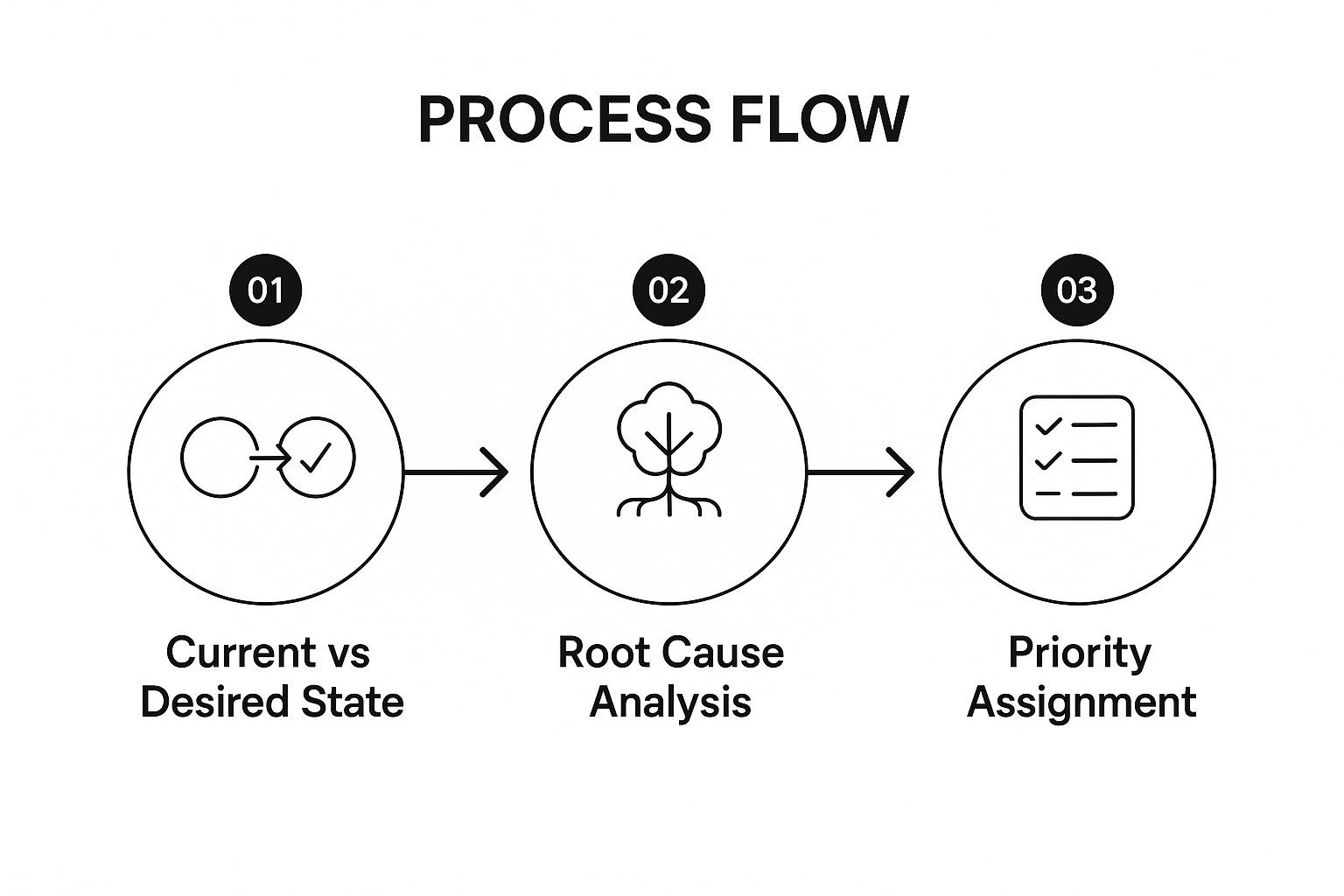
The flow demonstrates how identifying the performance gap is only the starting point; the real value comes from investigating its cause and then prioritising a corrective action plan.
Actionable Steps and Examples:
- Identify the Gap: Compare your finalised self assessment figures against your initial business plan or goals for the year.
- Example 1: A sole trader projected a £50,000 profit but their self assessment reveals only £38,000. The gap is £12,000.
- Example 2: A landlord notices their property maintenance costs were 40% higher than the previous year, significantly reducing their rental profit.
- Investigate the Root Cause: Use tools like a "Fishbone Diagram" (Ishikawa diagram) or the "5 Whys" technique to dig deeper. Don't stop at the first answer.
- Scenario: The landlord's higher maintenance costs. Why? A major boiler replacement. Why was it needed? The old system was inefficient and poorly serviced. Why? No preventative maintenance schedule was in place. The root cause is a lack of proactive maintenance, not just a single broken boiler.
- Develop an Action Plan: Based on the root cause, create specific, measurable actions to prevent the issue from recurring. This turns your self assessment from a compliance task into a powerful annual business review. For those operating under different frameworks, such as in France, a simplified auto-entrepreneur tax declaration still provides the foundational data needed for this type of analysis.
6. Action Planning and Priority Setting
Once you have gathered all your financial documents and identified potential issues or opportunities, the next critical stage is to transform these findings into a concrete action plan. This step bridges the gap between evaluation and implementation, ensuring that the insights gained from your self assessment preparation lead to tangible improvements in your financial management and tax efficiency. It is about creating a structured, prioritised roadmap to address any problems, capitalise on savings, and streamline your process for future years.

Why is this the next step?
Simply identifying missing receipts or unclaimed expenses is not enough; you need a systematic approach to resolve these issues before the filing deadline. Without a clear plan, important tasks can be forgotten, leading to inaccuracies in your tax return, potential penalties from HMRC, or missed opportunities to reduce your tax bill. By setting priorities, you ensure that the most urgent and impactful actions are handled first, preventing last-minute chaos and making the entire self assessment checklist process more manageable.
Key Insight: Adopting a priority matrix, popularised by Stephen Covey, can be highly effective. Categorise tasks by urgency and importance to distinguish between what must be done now (e.g., finding a missing P60) and what can be planned for the future (e.g., switching to a new accounting software).
Actionable Steps and Examples:
- Identify and List All Actions: Review your gathered information and list every action needed. This could range from chasing a client for an overdue invoice to calculating the exact business use percentage of your mobile phone.
- Example 1: A sole trader realises they have not recorded any of their business mileage for the year. The action is to reconstruct their travel log using their calendar and estimate mileage for tax relief.
- Example 2: A landlord finds they are missing the final statement from their letting agent. The action is to contact the agent immediately to get a copy before calculating their rental profit.
- Prioritise Your List: Not all tasks are created equal. Use a simple system to prioritise:
- High Priority: Tasks that directly impact your tax calculation and are time-sensitive (e.g., finding proof of a large allowable expense).
- Medium Priority: Important but less urgent tasks (e.g., organising digital receipts into folders for next year).
- Low Priority: "Nice-to-have" optimisations (e.g., researching new expense-tracking apps).
- Assign Deadlines and Owners: For each action, set a realistic completion date well before the 31st January filing deadline. If you work in a partnership, assign a specific owner to each task to ensure clear accountability and prevent anything from being overlooked. This structured approach turns a vague to-do list into a powerful project plan.
7. Calculating and Claiming Capital Allowances
Understanding Capital Allowances is a crucial part of any comprehensive self assessment checklist, yet it is often overlooked by sole traders and small businesses. This involves claiming tax relief on ‘plant and machinery’ you buy and own for your business. These are assets with a lasting business use, such as equipment, machinery, and business vehicles, and claiming for them correctly can significantly reduce your taxable profit.
Why is this an important step?
Capital allowances allow you to deduct some or all of the value of an item from your profits before you pay tax. Instead of claiming the full cost as a business expense in the year of purchase, you spread the tax relief over several years. However, powerful schemes like the Annual Investment Allowance (AIA) often allow you to deduct the full value in the first year, providing a substantial and immediate tax benefit. Getting this right is essential for accurate profit calculation and tax efficiency.
Key Insight: For the 2023-24 tax year, the Annual Investment Allowance (AIA) lets you claim 100% tax relief on qualifying plant and machinery purchases up to £1 million. This is a significant allowance that can cover the asset costs for most small and medium-sized businesses.
Actionable Steps and Examples:
- Identify Qualifying Assets: First, create a list of all major assets you've purchased for your business during the tax year. This doesn't include day-to-day running costs but rather long-term items.
- Example 1: A self-employed plumber buys a new van for £20,000 and power tools costing £1,500. Both are qualifying assets for capital allowances.
- Example 2: A freelance photographer purchases a new professional camera and lenses for £4,000. This equipment is considered plant and machinery.
- Calculate the Allowance: For most items, you can claim them under the AIA. If you’ve already exceeded the £1 million limit or the asset doesn't qualify (e.g., cars with certain CO2 emissions), you will use 'writing down allowances' at different rates (typically 18% or 6%).
- For the plumber: They can claim the full £21,500 (£20,000 + £1,500) under the AIA, reducing their taxable profit by that amount.
- Complete the Self Assessment Form: You will enter these calculations in the capital allowances section of your tax return (SA103S or SA103F for sole traders). Ensure you keep accurate records, including receipts and the date of purchase, as HMRC may ask for evidence. This part of the self assessment checklist ensures you don't overpay tax.
8. Continuous Improvement and Learning Integration
The final, and perhaps most strategic, part of any robust self assessment checklist is looking beyond the immediate submission. This step involves systematically reviewing the entire process you just completed to capture lessons and create a cycle of improvement. It’s a meta-level component that ensures each future tax return becomes easier, more accurate, and less stressful than the last.
Why is this a crucial step?
Simply getting through the tax return process is a win, but learning from it is how you achieve long-term efficiency. Without a formal review, you are likely to repeat the same mistakes, face the same bottlenecks, and experience the same anxieties year after year. By integrating learning, you transform a reactive, annual chore into a proactive, evolving system that saves you time and potentially money.
Key Insight: This practice, often called a 'post-mortem' or 'retrospective', is borrowed from highly efficient sectors like software development and project management. Its goal is to refine processes, not to assign blame, making future self assessments smoother.
Actionable Steps and Examples:
- Schedule a Post-Submission Review: Once your return is filed, block out an hour in your calendar for a review session. Ask yourself: What went well? What was a bottleneck? What information was difficult to find?
- Example 1: A sole trader realises they spent hours hunting for receipts for small tool purchases. They decide to implement a system where they immediately photograph and log every business receipt using an app.
- Example 2: A landlord finds that calculating the split between personal and rental use of their home office was complicated. They create a simple spreadsheet template to track this monthly for the next tax year.
- Create or Update Your Checklist: Based on your review, update your personal self assessment checklist. Add new steps, refine existing ones, and note down reminders for next year.
- Add a reminder for January to check if you need to make a 'payment on account'.
- Note which specific bank statements you needed to find your interest income.
- Standardise Your Knowledge Capture: Create a simple document or folder dedicated to "Self Assessment Lessons". This ensures that the insights you gain are not forgotten by the time the next tax year rolls around. This file can hold notes, updated checklists, and links to useful HMRC guidance pages you discovered.
Self-Assessment Checklist Comparison
| Item | Implementation Complexity 🔄 | Resource Requirements ⚡ | Expected Outcomes 📊 | Ideal Use Cases 💡 | Key Advantages ⭐ |
|---|---|---|---|---|---|
| Clear Objectives and Scope Definition | Medium – Needs upfront planning and alignment | Moderate – Stakeholder involvement needed | Focused, measurable assessments; baseline set | Performance reviews, quality management, personal goals | Prevents scope creep; accountability through SMART goals |
| Comprehensive Criteria and Standards Framework | High – Requires developing detailed rubrics | High – Benchmark data and expertise needed | Consistent, objective evaluations; benchmarking | Organizational performance, software maturity, healthcare | Ensures evaluation consistency; identifies improvement areas |
| Evidence Collection and Documentation Process | Medium to High – Systematic data gathering | High – Training and tools for documentation | Reliable, data-driven findings with audit trails | Six Sigma, accreditation, audits, project management | Increases credibility; supports continuous improvement |
| Stakeholder Engagement and Input Mechanisms | High – Coordination and facilitation intensive | Moderate to High – Multiple communication channels | Multi-perspective insights and buy-in | 360-feedback, community planning, healthcare, education | Builds transparency; identifies blind spots |
| Gap Analysis and Root Cause Investigation | Medium to High – Analytical tools required | Moderate – Requires skilled personnel | Identifies root causes; prioritized improvements | Quality issues, IT security, HR skill gaps, financial planning | Addresses underlying problems; guides resource allocation |
| Action Planning and Priority Setting | Medium – Translating insights into plans | Moderate – Time for planning and follow-up | Clear, prioritized actions with accountability | CAPA systems, personal and strategic plans, healthcare | Converts insights into steps; optimizes resource use |
| Progress Monitoring and Review Cycles | Medium – Requires regular tracking and reporting | Moderate – Tools and meeting time needed | Continuous advancement with course correction | Balanced scorecards, agile retrospectives, audits, personal tracking | Maintains momentum; early issue detection |
| Continuous Improvement and Learning Integration | Medium to High – Knowledge capture and sharing | Moderate to High – Requires dedicated resources | Enhanced future assessments; organizational learning | Military AARs, retrospectives, consulting reviews, healthcare | Builds improvement culture; reduces future effort |
Achieving Financial Clarity and Peace of Mind
Navigating the annual ritual of Self Assessment doesn’t have to be a source of stress and confusion. As this comprehensive guide has demonstrated, transforming this complex task into a manageable process is entirely achievable. The key lies in shifting your mindset from a last-minute scramble to a structured, year-round approach to financial organisation. By diligently working through each stage of this self assessment checklist, you are not just preparing a tax return; you are building a robust system for financial health and clarity.
From defining your objectives and meticulously collecting evidence to engaging stakeholders and setting priorities, each step builds upon the last. The power of this checklist is its systematic nature. It ensures no crucial detail is overlooked, from tracking every allowable expense for a landlord to correctly documenting partnership profit shares or a sole trader's diverse income streams. The true value emerges when you move beyond simple compliance and into a cycle of continuous improvement, where insights from one tax year inform smarter financial decisions for the next.
Key Takeaways for a Stress-Free Tax Season
The ultimate goal is to replace uncertainty with confidence. Mastering this process brings several profound benefits that extend well beyond simply meeting the 31st January deadline:
- Empowerment Through Organisation: A well-organised system gives you a real-time, accurate picture of your financial standing. This empowers you to make informed business and personal finance decisions, identify growth opportunities, and spot potential issues before they escalate.
- Maximised Financial Efficiency: A thorough self assessment checklist is your roadmap to tax efficiency. By systematically identifying and documenting every allowable expense and relief, you ensure you are not paying a penny more in tax than is legally required.
- Reduced Risk and Enhanced Compliance: Meticulous record-keeping and a clear understanding of your obligations significantly reduce the risk of errors, late submission penalties, or a dreaded HMRC enquiry. This structured approach provides a clear, defensible audit trail.
- Reclaimed Time and Mental Energy: Perhaps the most significant benefit is the peace of mind that comes from being in control. By replacing frantic searching with a methodical process, you free up valuable time and mental energy to focus on what you do best: running your business, managing your properties, or advancing your career.
Ultimately, this checklist is more than a set of instructions; it is a framework for achieving financial mastery. The principles of evidence collection, gap analysis, and continuous review are the cornerstones of sound financial management for any small business, landlord, or independent professional. By adopting these practices, you turn a mandatory obligation into a powerful tool for strategic planning and sustainable growth, ensuring you are always prepared, compliant, and positioned for success.
Ready to trade tax season stress for year-round financial clarity? The team at Stewart Accounting Services specialises in transforming the Self Assessment process for businesses and individuals across the UK, leveraging expert knowledge and powerful tools like Xero. Contact Stewart Accounting Services today to see how we can help you reclaim your time, optimise your finances, and achieve complete peace of mind.