
When you run a limited company in the UK, one of the best ways to keep your Corporation Tax bill down is by claiming for all your allowable business expenses. The core idea is simple: any money you spend purely for the sake of your business can usually be deducted from your profits, meaning you pay tax on a smaller amount.
This covers everything from the obvious stuff, like paying your staff and renting an office, to smaller costs you might not immediately think of, such as specific travel costs or advertising campaigns.
What Counts As A Business Expense For A Limited Company?

The single most important rule to get your head around comes directly from HMRC: an expense must be “wholly and exclusively” for business purposes. Get this right, and you're well on your way. If there’s a personal element to the cost, things get a bit more complicated.
Think of it this way: if you drive your own car for a client meeting, the cost of the fuel for that specific journey is a business expense. But the fuel for your weekend shopping trip? That’s personal, and you can’t claim for it. This principle applies to every single cost you want to put through your company accounts, from day-to-day spending to bigger investments.
Getting a good grasp of this is fundamental. If you're new to this, it's worth brushing up on the basics of understanding the accounts of limited companies to build your confidence.
The "wholly and exclusively" rule isn't just a guideline; it's the legal test. If an expense has a dual business and personal purpose, you can only claim for the business part. And crucially, you need to be able to show HMRC exactly how you worked that out.
Major Categories of Allowable Expenses
So, what kind of things can you actually claim for? The categories are pretty broad and touch on almost every part of running a business. We're talking about things like:
- Office costs (rent, business rates, utilities)
- Staff salaries, pensions, and other benefits
- Business travel and accommodation
- Marketing, advertising, and website costs
- Professional fees (like your accountant or solicitor)
For instance, staff costs aren't just about their monthly wage. You can also include employer National Insurance contributions, pension payments, and even reasonable health insurance benefits.
When it comes to travel, if an employee uses their personal car for work, your company can reimburse them for mileage. The approved HMRC rate is currently 45p per mile for the first 10,000 miles in a tax year, and 25p per mile after that.
Knowing these categories inside and out is the first step to making sure your company is tax-efficient and not handing over more cash to HMRC than it needs to.
Claiming Office Premises and Home Working Costs
Whether you’re running your limited company from a leased commercial unit or a corner of your spare room, the costs associated with that workspace are a major source of tax relief. Getting these claims right is fundamental to lowering your Corporation Tax bill, but it's crucial to understand that the rules for a dedicated office and a home office are worlds apart.
The Straightforward Route: Commercial Premises
If your company operates from a commercial property, like an office, workshop, or shop, things are refreshingly simple. Because the space is used 100% for business, the costs align perfectly with HMRC's "wholly and exclusively" rule.
This means you can typically claim the full amount for:
- Rent: The entire monthly or annual rent you pay for the property.
- Business Rates: The non-domestic rates charged by your local council.
- Utilities: All the gas, electricity, and water bills for the premises.
- Repairs and Maintenance: The cost of keeping the place in good shape, from fixing a dripping tap to a full repaint.
There’s no need to divvy up personal and business use here, making it a much clearer process.
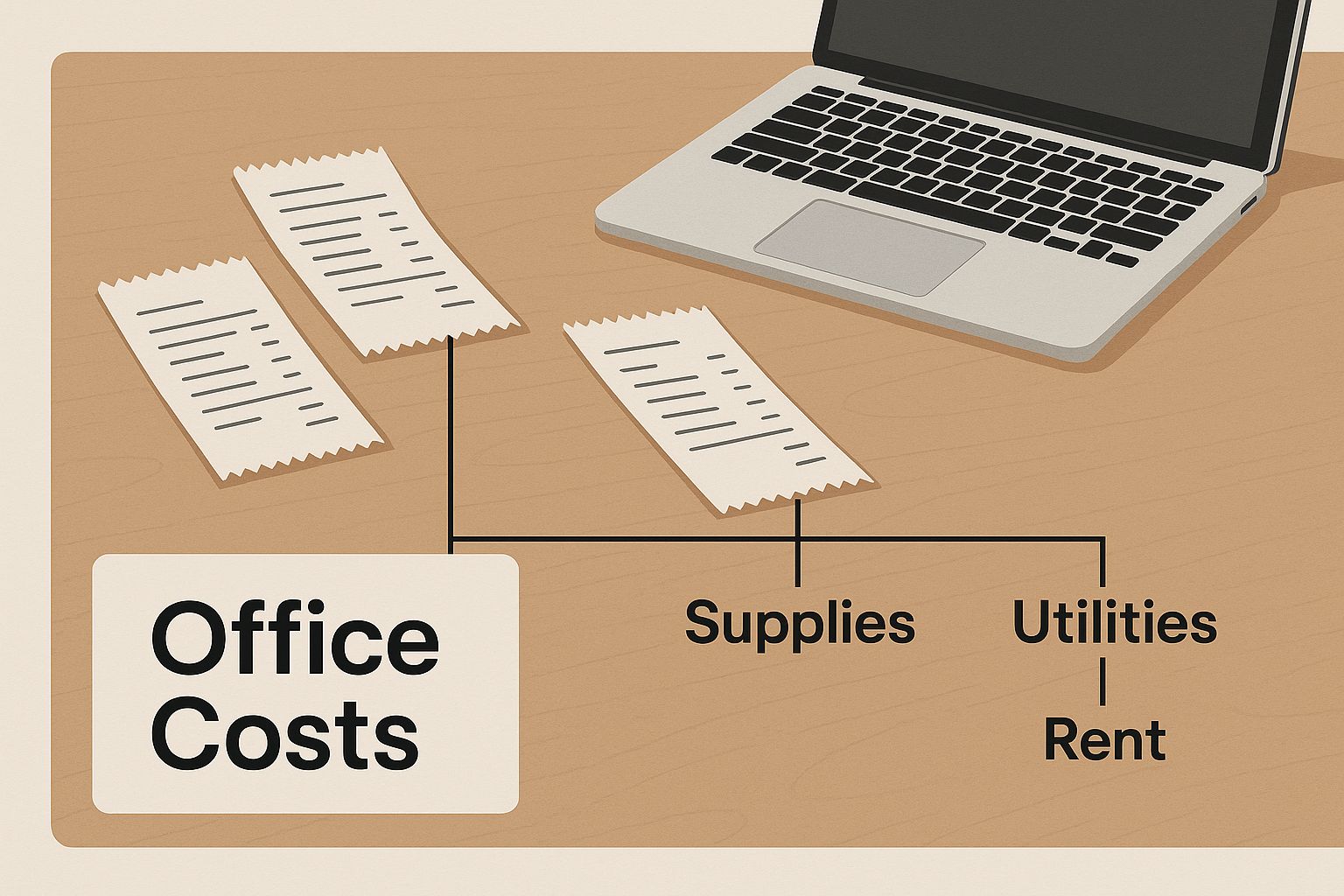
As you can see, understanding which category your expenses fall into is the first step towards making an accurate and compliant claim.
The Home Office Calculation: A Bit More Involved
When you work from home, the lines between business and personal spending blur. You can’t just claim your entire mortgage payment or council tax bill. Instead, you need to claim a fair and reasonable proportion of your household running costs.
This is where you need a solid, logical method to separate the two. A common and HMRC-accepted approach is to figure out what percentage of your home is used for work and how much time you spend working there.
For instance, say you live in a five-room house and use one of those rooms purely as an office. That room makes up 20% of your home's total space. If your monthly electricity bill is £100, a reasonable starting point for your claim would be £20 (£100 x 20%). You would then apply this same thinking across all relevant household expenses.
A key piece of advice: Always be prepared to justify your maths to HMRC. Keep your household bills and a clear note of how you arrived at your figures, whether it was based on the number of rooms, the square footage, or the hours you work. Good records are your best friend.
What Household Costs Can You Apportion?
Once you've settled on a fair calculation method, you can apply it to a range of running costs. The goal is to identify the business-use portion of bills such as:
- Heating and Electricity: The cost of keeping your workspace warm, lit, and powered up.
- Council Tax: A portion of your annual bill can be attributed to your business.
- Mortgage Interest: You can claim a percentage of the interest part of your mortgage payments, but crucially, not the capital repayment part.
- Broadband: If it's a standard home package, you can only claim the business-use portion. However, if you've installed a separate line just for the business, you can claim 100% of that cost.
To help clarify what's typically claimable in either scenario, here’s a quick-glance table.
Common Office Expense Claims At A Glance
| Expense Category | Commercial Premises Claim | Working From Home Claim | Key Consideration |
|---|---|---|---|
| Rent | 100% of commercial rent | Portion of rent based on usage | Must have a formal rental agreement with your company. |
| Mortgage | N/A | Portion of interest only | Capital repayment is not an allowable expense. |
| Utilities | 100% (Gas, Electric, Water) | Portion based on business usage | Keep bills and your calculation method well-documented. |
| Council Tax | Business Rates (100%) | Portion of Council Tax bill | Business rates apply to non-domestic properties only. |
| Broadband | 100% for a business line | Portion of a home package | Claim 100% only if the contract is in the company's name. |
| Repairs | 100% for business property | Portion for general repairs | Repairs solely for the business part of the home are 100% claimable. |
This table provides a useful summary, but remember that individual circumstances can vary. Careful calculation ensures you maximise your tax relief while staying firmly within HMRC guidelines.
2. Handling Staff Salaries, Benefits And Entertainment

It’s an old saying, but it's true: your team is your company’s greatest asset. So when you’re thinking, “What expenses can my limited company claim?”, the costs of employing your people should be right at the top of your list.
Thankfully, almost everything you spend on your team is an allowable business expense. This goes well beyond the simple net pay that hits their bank accounts each month.
The most obvious claim is the gross salary you pay to all staff, and that includes directors. On top of this, you can deduct the employer's National Insurance Contributions (NICs) that your company pays. Any performance-based bonuses or commissions you pay out are also fully deductible in the accounting year you award them.
But these direct payroll costs are really just the starting point. Your company can also claim for a whole host of employee benefits that make up their total compensation package.
Claiming Pensions And Other Benefits
A good benefits package is key to attracting and keeping the best people, and the great news is that these costs are generally 100% deductible against your company's profits. This directly lowers your Corporation Tax bill.
Here are some of the main allowable benefits you can claim for:
- Pension Contributions: Your company's contributions into your employees' workplace pensions are a fully deductible expense.
- Life Insurance: Premiums for what are often called 'death in service' policies are allowable.
- Private Medical Insurance: If you provide private health cover for your team, the cost is a claimable expense for the business.
- Training and Development: Any courses that help an employee get better at their current job are deductible.
- Childcare Vouchers: The cost of providing eligible childcare support can also be claimed.
Put simply, if a benefit is part of an employee's overall remuneration package, you can almost certainly put it through the company's books as a legitimate expense. It’s a classic win-win: you get to reward your team and make your company more tax-efficient at the same time.
Crucial Tip: Just remember that many of these perks are considered a 'benefit in kind' for the employee. While your company gets the tax relief, the employee might have to pay personal tax on the value of that benefit. This must all be reported correctly to HMRC on a P11D form.
The Rules Around Staff Entertainment
Staff entertainment is one of those areas that trips a lot of directors up. Many miss out on valuable tax relief simply because they're not sure where they stand with the rules. The good news is that HMRC provides a specific exemption for annual events, like a Christmas party or a summer barbecue.
To claim the cost of these events, you have to meet all of the following conditions:
- The event has to be an annual thing (like the yearly summer do).
- It must be open to all of your employees.
- The total cost per head must not be more than £150 (including VAT).
This £150 isn't a per-event allowance; it’s for the whole year. So, you could hold a summer event costing £75 a head and a Christmas party costing another £75 a head, and you'd still be within the limit.
Be careful, though. If the total cost per head goes over the £150 limit by even a single penny, the entire amount becomes a taxable benefit. The official guidance on claiming for annual staff events makes it clear that these conditions are strict. You can find more practical examples of deductible expenses on 123financials.com.
Getting to Grips with Business Travel and Subsistence
For many company directors, business travel is just part of the job. You might be zipping across the country to woo a new client, or maybe you're attending a vital industry conference. Whatever the reason, travel is a major category of allowable expenses, but it’s also one where the rules can be a bit tricky. Get it right, and you can significantly reduce your company’s tax bill. Get it wrong, and you could find yourself in a spot of bother with HMRC.
The first thing to nail down is what HMRC actually considers 'business travel'. It's not just any old trip. It specifically refers to journeys you make to a workplace that isn't your permanent one. Think of it as any travel to a ‘temporary’ location for a clear business purpose. This is a crucial point, because it means your everyday commute from home to your usual office is never a claimable business expense. That's a personal cost.
What Travel Costs Can You Actually Claim?
So, you've established the trip is genuine business travel. What can you claim for? Thankfully, HMRC is quite practical here and allows for most common forms of transport.
You can typically claim for:
- Public Transport: This covers the full cost of train tickets, flights, bus fares, and even taxi rides. Simple and straightforward.
- Using Your Own Car: If you take your personal vehicle, you can claim a specific mileage allowance. The approved rate is currently 45p per mile for the first 10,000 business miles you do in a tax year, dropping to 25p per mile after that.
- Parking and Tolls: Don't forget those extra costs! Any charges you rack up on your journey, like motorway tolls or car park fees at your destination, are also fair game.
The golden rule here is to keep meticulous records. For mileage, that means a detailed logbook: date, destination, why you went, and the number of miles. For everything else, hang on to every ticket, receipt, and invoice. Proof is everything.
Clearing Up the Confusion Around Subsistence
When a business trip keeps you away from home overnight, you can also claim for what’s known as ‘subsistence’. This is just a fancy word for the necessary costs of accommodation and meals while you're away. The key word HMRC focuses on is ‘reasonable’. They expect you to be sensible, so claiming for a penthouse suite when a perfectly good business hotel was available probably won’t fly.
What HMRC Says About Subsistence: The costs must be a direct consequence of you being away from your normal place of work. The underlying principle is that the expenses shouldn't be excessive; they should cover what’s genuinely needed to look after yourself while you're working away.
Let's say you travel from London to Manchester for a two-day project. You can absolutely claim for your hotel room and the cost of your dinner and breakfast. But a round of drinks at the bar with friends after you've wrapped up for the day? That’s personal entertainment, not a business necessity. The expense must always be "wholly and exclusively" for business purposes.
Claiming Marketing and Professional Development Costs
Investing in your company's growth is just good business sense, and thankfully, HMRC recognises this. Most of the money you spend to market your services and sharpen your team's skills can be claimed as allowable expenses, which is a huge relief for any limited company director.
Think of marketing costs as anything you spend to get your name out there and win new business. It’s a pretty broad umbrella, covering everything from old-school print ads to the latest digital campaigns.
For example, the costs of keeping your company website live, like hosting fees and domain name renewals, are perfectly legitimate expenses. The same goes for what you spend on online advertising, whether that's through Google Ads, LinkedIn, or social media platforms.
As your online footprint grows, you might also find yourself paying for specialised services. Taking the time to get your head around things like understanding the cost of online reputation management is crucial, as these services are often claimable too.
A Quick Word of Warning: The golden rule of "wholly and exclusively" for business purposes is key here. Sponsoring your local grassroots football team? That's a solid marketing expense. But taking a client to a Premier League match? That falls under client entertainment, which unfortunately isn't deductible for Corporation Tax. The distinction is subtle but important.
Growing Your Skills with Professional Development
Beyond just promoting your business, you can also claim for investments that build it from the inside out. Professional development is a fantastic allowable expense, but it comes with one very important string attached.
The training must relate to improving skills and knowledge within your company's existing line of business.
For instance, if you run a web design agency and send one of your developers on an advanced JavaScript course, that's a textbook allowable expense. It directly helps them do their current job better, which benefits the company.
So, what can you typically claim?
- Training Courses: Any course designed to upgrade or maintain existing professional skills.
- Professional Subscriptions: Your annual fees for trade bodies or subscriptions to industry-specific journals.
- Books and Manuals: Any literature you buy that's directly relevant to your field.
What you can't claim for is training that equips you with a completely new skill set, essentially preparing you to start a different business. An accountant taking a course to become a certified plumber, for example, wouldn't be able to claim that. The training has to be about getting better at what your business already does.
Deducting Startup And Pre-Trading Expenses
Every new venture has a story that starts long before the first invoice is sent. Thankfully, HMRC recognises this reality. They allow you to claim for many of the crucial costs you rack up before your company officially opens its doors for business. These are what we call pre-trading expenses.
Think of it as setting the stage for a play. You have to book the theatre, build the set, and print the flyers well before the curtain rises. In the business world, this translates to expenses like company formation fees, designing your first logo, building a website, or carrying out essential market research.
The good news? None of that initial spending is wasted. UK tax rules are designed to let you treat these pre-trading costs as if you incurred them on your very first day of trading. This means you can subtract them from your early profits, which helps lower your Corporation Tax bill right out of the gate.
What Startup Costs Can You Claim?
The range of claimable pre-trading expenses is quite generous. Essentially, if a cost would be allowable after you start trading, you can usually claim it if it was incurred before.
Here are some of the most common examples:
- Legal and Professional Fees: This covers things like the fee for registering your company at Companies House.
- Marketing and Branding: Money spent on creating your logo, running initial ads, or printing those first business cards.
- Office Setup: Costs for essential software subscriptions or basic office furniture you bought in preparation.
- Market Research: Expenses from surveys or analysis you ran to validate your business idea.
This is a huge help for new companies where cash flow is king. Under the right guidelines, these startup costs are tax-deductible, which can include legal advice, initial marketing pushes, and even wages for staff you hired before trading began. By accounting for these costs properly, a new limited company can significantly reduce its first Corporation Tax bill and kick things off on a much stronger financial footing. For a deeper dive, you can find more guidance on how UK tax law treats startup costs at taxd.co.uk.
Important Distinction: A quick heads-up – large equipment purchases fall into a different category called 'capital expenditure'. You can't deduct the full cost of these items upfront, but you can claim tax relief on them over several years through a system called capital allowances.
Keeping meticulous records of these early expenses is non-negotiable. It's the only way to ensure you're claiming every penny you're entitled to and starting your business journey in the most tax-efficient way possible.
Got Questions About Business Expenses? We’ve Got Answers.
When you're running a limited company, figuring out what you can and can't claim as an expense can feel like a bit of a minefield. It’s completely normal to have questions, and getting them answered is key to keeping your business compliant and tax-efficient. Let's tackle some of the most common queries we hear from company directors.
Can I Claim for Entertaining Clients?
This is a big one, and a frequent source of confusion. The short answer is almost always no.
While taking a client out for lunch or to a sporting event certainly feels like a valid business activity, HMRC is very clear on this. You cannot deduct the cost of client entertainment from your company's profits to reduce your Corporation Tax bill.
It's a really important distinction to grasp. You can absolutely still pay for client entertainment through the business account. However, unlike staff entertainment (which has its own set of rules and allowances), you won’t get any tax relief for it. It’s best to think of it as a cost of building relationships that, unfortunately, you can’t write off for tax purposes.
What Records Do I Need to Keep for My Expense Claims?
Meticulous record-keeping isn't just a "nice-to-have"—it's a legal must. If HMRC decides to take a closer look at your accounts, the responsibility is entirely on you to prove every single expense claim is legitimate. No proof, no claim. It's as simple as that.
For every expense, you need a clear paper trail. This should include:
- Receipts: Keep every single receipt, whether it's a paper copy or a digital version.
- Invoices: For any services or larger purchases, hold onto the official invoice.
- Bank Statements: Your company bank and credit card statements are vital for cross-referencing all transactions.
- Mileage Logs: If you use your personal car for business trips, you must maintain a detailed log. It needs to show the date, the reason for the journey, and the exact distance travelled.
In the UK, you are legally required to keep all financial and accounting records for at least six years from the end of the last company financial year they relate to. This is a hard-and-fast rule with no exceptions.
What Happens If I Claim for Something I Shouldn't Have?
Mistakes happen, especially when you're juggling the demands of running a business. If you spot that you've claimed for an expense that isn't actually allowable, the most important thing is to correct it as soon as you can.
You'll need to amend your Company Tax Return to remove the disallowed expense. This will almost certainly mean your Corporation Tax bill will go up, and you'll need to pay the difference, plus any interest that has built up.
If HMRC finds the mistake during an inspection, you could also be facing penalties. These are typically calculated as a percentage of the unpaid tax, and the amount can vary depending on whether they view the error as a genuine mistake or something more deliberate. It really just highlights how crucial it is to get your claims right from the start to avoid any extra cost and stress later on.
Managing your limited company's finances can be complex, but you don't have to do it alone. The team at Stewart Accounting Services specialises in helping businesses across Central Scotland and the UK navigate their accounting and tax obligations with confidence. Whether you need help with year-end accounts, tax returns, or strategic business planning, we provide the expert support you need to achieve more time, more money, and a clearer mind. Get in touch with us today to see how we can help your business thrive.