The formula for gross profit is refreshingly simple: just take your total Revenue and subtract the Cost of Goods Sold (COGS). This one figure cuts through the noise to give you the most direct measure of your core business efficiency.
Why Gross Profit Is Your Most Important Metric
Before we get into the nuts and bolts of the calculation, it’s worth taking a moment to appreciate what gross profit really tells you about your business. I like to think of it as the first, most honest indicator of your company's financial health. It’s the money left over after you’ve paid for the direct costs of making your products or delivering your services.
What you're left with is a pure, unfiltered look at how effective your production and pricing strategies really are.

This number is the bedrock of your entire financial picture. If your gross profit isn't healthy, you'll find it nearly impossible to turn a healthy net profit down the line.
Distinguishing Between Profit Types
It's easy to get tangled up in financial jargon, but the main types of profit are actually quite distinct. Getting your head around them helps you build a complete picture of how your business is performing.
- Gross Profit: This zeroes in on your production efficiency. It answers one key question: "How much are we making on the actual goods or services we sell, before any other business costs?"
- Operating Profit: This takes things a step further. It subtracts your day-to-day operating expenses (think marketing, rent, and admin salaries) from your gross profit, showing you how profitable your core operations are.
- Net Profit: This is the famous "bottom line." It’s what’s left after every single expense—including taxes and interest—has been paid. This figure shows the total profitability of the company as a whole.
The Strategic Value of This Metric
Knowing your gross profit isn’t just an accounting exercise; it's a powerful strategic tool. A strong gross profit signals a solid business model where the price your customers pay comfortably covers the cost of what you’re selling. It's that simple.
Even on a national scale, this concept is central to economic health. A key metric used in government surveys is the gross operating surplus (GOS). In 2023, the UK’s GOS for the whole economy was estimated at around £420 billion, which shows just how significant this measure is.
For a small business owner, tracking gross profit month-on-month is like having a compass. It tells you if your pricing, production costs, and supplier relationships are heading in the right direction.
Ultimately, gross profit is one of the most powerful Key Performance Indicators (KPIs) you can have on your dashboard. Keeping a close eye on it helps you assess the health of your revenue streams and the real-world efficiency of your operations. To dig deeper into this, have a look at our guide on four critically important KPIs for your business.
The Gross Profit Formula Explained
At its core, calculating gross profit is surprisingly simple. It hinges on a powerful little formula that cuts through the noise to show you how much money you're really making on the things you sell.
The formula looks like this: Gross Profit = Revenue – Cost of Goods Sold (COGS)
In short, this tells you what's left over from your sales once you've paid for the direct costs of producing your goods or delivering your services. Let's get into what each of these terms actually means for your business, so you can calculate it with confidence.
Getting a True Picture of Your Revenue
Revenue—you might also call it sales or turnover—is all the money your business brings in from its main operations. But here’s the crucial bit: it’s the total before any other costs are deducted. Getting this figure spot-on is the foundation of an accurate gross profit calculation.
For instance, let's say you run a boutique and sell a dress for £120. That entire £120 isn't your revenue. You first have to account for Value Added Tax (VAT). If VAT is 20%, you’d subtract the £20 you owe to HMRC, leaving you with an actual revenue of £100 for that sale.
So, what should you count and what should you ignore?
- Include: The total value of all the goods and services you've sold.
- Exclude: VAT, any money you've handed back for customer returns or refunds, and any discounts you offered at the point of sale.
By stripping these out, you arrive at your net sales. This is the real, uninflated number you need to start with.
Think of revenue as the pure income from what you’ve sold. Anything that artificially bloats that number, like tax you're just collecting for the government or cash you had to refund, needs to be cleared out first.
Pinning Down Your Cost of Goods Sold (COGS)
Now for the second piece of the puzzle: Cost of Goods Sold (COGS). This covers all the direct costs that are tied to making your products or providing your services. This is where it's easy to go wrong, because you have to be disciplined about separating direct costs from indirect ones.
Direct costs are expenses you can point to and say, "That went directly into making this product." If you own a bakery, the flour, sugar, and the wages for the baker who mixed and baked the cakes are all part of your COGS.
Indirect costs, on the other hand, are things like your marketing spend or the rent for your shop. While they're absolutely essential business expenses, they aren't included here. They get factored in later when you're working out your net profit.
Getting your COGS right is non-negotiable if you want a true picture of your profitability. Here’s a quick summary to help you keep things straight.
Key Components of the Gross Profit Calculation
This table breaks down what you should and shouldn't include when tallying up your revenue and COGS. Getting this right is fundamental to a calculation you can trust.
| Component | What to Include | Common Exclusions |
|---|---|---|
| Revenue | Total income from the sale of your goods or services. | VAT, returns, allowances, and any discounts. |
| COGS | Raw materials, direct labour costs, and any manufacturing overheads. | Marketing, sales staff salaries, rent, and other administrative costs. |
By being precise about both your revenue and your COGS, you're not just doing an accounting exercise. You're gaining genuine insight into how financially efficient your core business really is.
How to Calculate Your Cost of Goods Sold Accurately
Getting your Cost of Goods Sold (COGS) right is easily the most challenging part of calculating gross profit, but it's where the real accuracy comes from. A miscalculation here doesn't just skew one number; it can throw off your entire financial picture. This is your best tool for getting a true measure of how efficiently you're producing what you sell.
At its core, the formula for COGS is pretty simple: Beginning Inventory + Purchases – Ending Inventory.
Let's unpack that. You take the value of the stock you had on hand at the start of a period (say, a quarter). Add in the cost of any new stock you bought during that time. Then, subtract the value of whatever stock was left unsold at the end. What remains is the direct cost of the products you actually sold.
This infographic lays out the whole process, showing you exactly where COGS fits into the puzzle.
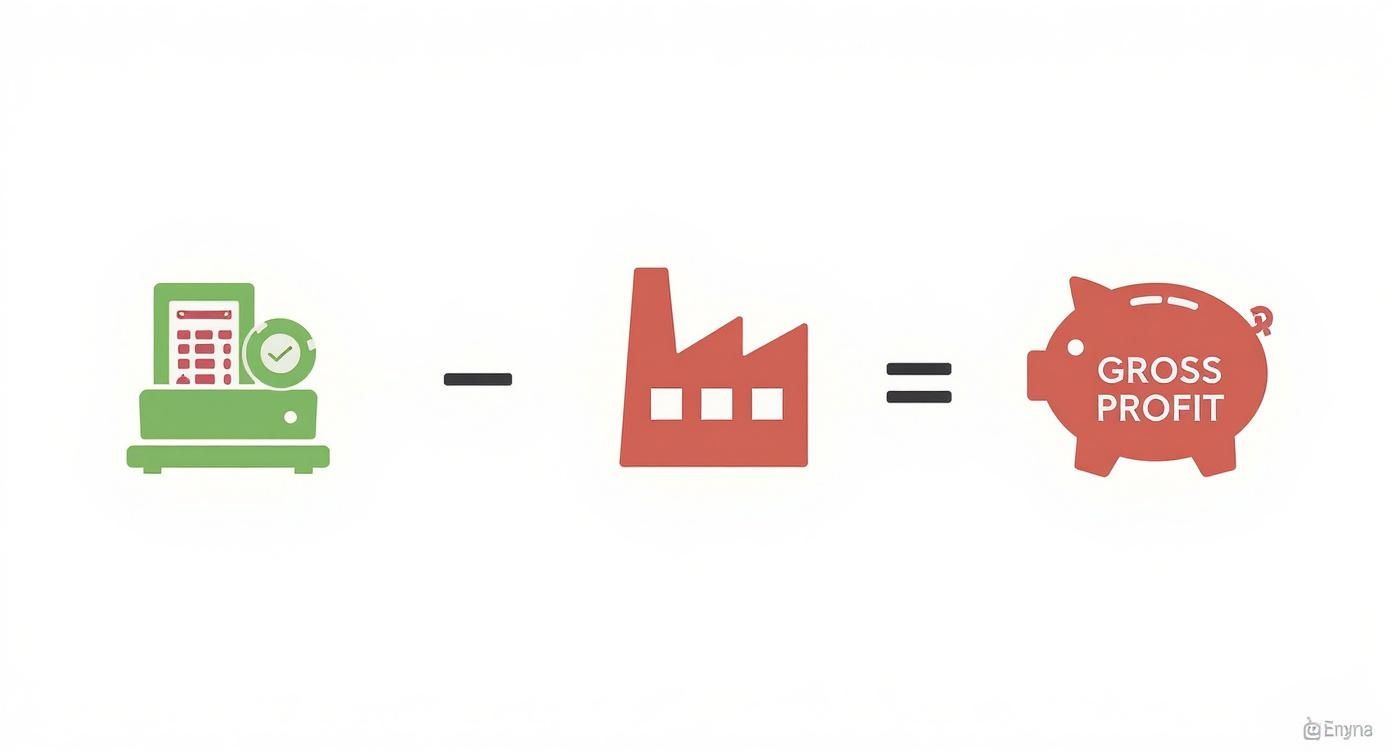
As you can see, COGS is the big number you subtract from your revenue. Its size has a massive impact on your final gross profit figure, which is why we need to get it spot on.
COGS in Different Business Contexts
How you apply that formula can look very different depending on what your business actually does. A product-based business and a service provider will have completely different things to track.
- A local bakery: COGS is quite tangible here. It’s the cost of your flour, sugar, and other key ingredients, plus the direct labour costs of the bakers who turn those ingredients into sellable goods.
- An e-commerce retailer: For an online shop, this includes the wholesale price of the items you sell. It also covers crucial extras like shipping costs to get the products to your warehouse and any import duties you had to pay. If you sell on a platform like Amazon, it's vital to factor in all the associated fees. You can find a to see just how many costs there are to consider.
- A SaaS company: In the software world, COGS is often called the 'Cost of Revenue'. It includes things like server hosting fees, licences for third-party software that your service relies on, and the salaries of the support team who directly help your customers.
How Inventory Valuation Changes Everything
Here's where things get more detailed—and it's a point many business owners miss. How you value your inventory can significantly alter your COGS figure, which in turn changes your gross profit.
In the UK, the most widely used method is FIFO, which stands for First-In, First-Out.
The FIFO method works on the assumption that the first items you purchased are the first ones you sell. Think of that bakery again. Let's say they buy flour weekly and the price keeps rising. Under FIFO, their COGS is calculated using the cost of the older, cheaper flour first. This can lead to a temporarily higher gross profit, but it's a standard accounting practice because it mirrors how stock usually moves.
Getting COGS right means going beyond just adding up invoices. You must have a consistent inventory valuation method and a clear system for tracking stock levels from the start to the end of your accounting period.
Without that level of precision, you're really just making an educated guess about your profitability. If you want to get into the nitty-gritty, you can learn more about how to calculate Cost of Goods Sold to make sure your numbers are completely watertight. Ultimately, this accuracy is non-negotiable if you want to make smart business decisions based on how your company is truly performing.
Putting Gross Profit Calculations to Work: Real-World Scenarios
Theory is one thing, but seeing how the gross profit formula works in a real, living business is where the lightbulb moments happen. The numbers really start to make sense when you apply them to tangible situations. Let's walk through three different UK business examples to see these calculations in action and highlight the unique curveballs each one throws.

These examples are designed to be practical, showing you exactly how to handle everything from physical stock and spoilage to the slightly fuzzier costs of a service-based business.
Example 1: The Manchester Coffee Shop
Picture a popular independent coffee shop in Manchester, buzzing with customers. Last month, this was their financial snapshot:
- Total Revenue (after VAT): £18,000
- Direct Costs (COGS):
- Coffee beans, milk, and syrups: £3,500
- Pastries, sandwiches, and cakes: £2,000
- Takeaway cups, lids, and sleeves: £800
- Wages for baristas (direct labour): £5,000
- Spoilage (wasted food and drink): £400
First things first, we need to add up all those direct costs to get the total Cost of Goods Sold (COGS).
That’s £3,500 + £2,000 + £800 + £5,000 + £400, which comes to £11,700.
Now, we can plug that into the gross profit formula:
Gross Profit = Revenue – COGS
£18,000 – £11,700 = £6,300
So, the shop’s gross profit for the month was £6,300. The biggest challenge for a business like this? Accurately tracking spoilage. Every unsold pastry or jug of expired milk is a direct cost. If you forget to account for it, you'll think you're more profitable than you really are.
Example 2: The Freelance Digital Marketer
Let's switch gears to a freelance digital marketer based in Glasgow. For service businesses, there's no physical stock, so "COGS" is usually called the 'Cost of Revenue' or 'Cost of Sales'. It's simply the costs directly linked to delivering your service to a client.
Here's a look at a typical month:
- Total Revenue: £8,500
- Direct Costs (Cost of Revenue):
- Specific software subscriptions (e.g., SEO tools used only for client work): £300
- Freelance writer hired for a specific client project: £1,000
- Stock image licences for client campaigns: £150
Tallying up the Cost of Revenue gives us: £300 + £1,000 + £150 = £1,450.
Let's run the numbers:
- Gross Profit: £8,500 – £1,450 = £7,050
The main hurdle for any freelancer or consultant is learning to separate direct costs from general overheads. Your accounting software subscription is an overhead. But that specialist analytics tool you pay for only to generate client reports? That's a direct cost. Getting this distinction right is absolutely vital for an accurate gross profit figure.
Example 3: The Bristol Online Boutique
Finally, let’s check in on a small e-commerce boutique in Bristol selling handmade jewellery. This is a classic example of where managing inventory becomes a key part of the COGS calculation.
Here's their data for the last quarter:
- Total Revenue (Net Sales): £25,000
- Beginning Inventory (value of stock at the start): £7,000
- Purchases (new materials and stock bought during the quarter): £8,000
- Ending Inventory (value of stock left at the end): £6,000
Before we can find the gross profit, we have to calculate the Cost of Goods Sold using the inventory formula.
- COGS = Beginning Inventory + Purchases – Ending Inventory
- COGS = £7,000 + £8,000 – £6,000 = £9,000
With our COGS figure sorted, the final step is easy:
- Gross Profit: £25,000 – £9,000 = £16,000
For any online retailer, the make-or-break factor here is rigorous stocktaking. If your count of the ending inventory is off, it can throw your COGS and gross profit figures out dramatically. For businesses that hold stock, precise and regular inventory management is completely non-negotiable.
Taking Your Analysis Further: How to Improve Your Gross Profit Margin
Once you’ve got the hang of calculating gross profit, you’ve taken the first step toward understanding your business’s financial engine. But the raw number itself is just the beginning. The real magic happens when you convert that figure into your gross profit margin—a percentage that shows you, in no uncertain terms, how profitable your core operations are.
The formula is pretty simple: (Gross Profit / Revenue) x 100. This calculation reveals how many pence of profit you’re making for every pound that comes through the door. Knowing your margin is critical, but knowing what to do with it is what separates struggling businesses from successful ones.
What’s a Good Gross Profit Margin, Anyway?
This is a question I get all the time, and the honest answer is: it depends. There’s no single "good" number because margins vary massively across UK industries. A software business with minimal direct costs might happily see margins over 70%. In contrast, a local grocer relying on high sales volume would see 15-20% as a huge win.
Don't get fixated on a universal benchmark. Instead, focus on two things: how you stack up against others in your specific sector, and—more importantly—your own margin trends over time. If you see it dipping, that’s your early warning signal. It could mean your supplier costs are getting out of hand or that your pricing no longer holds up. To really get a grip on your financial health, it’s worth learning how to calculate various profit margins including gross, operating, and net.
Your gross profit margin is a vital diagnostic tool. Think of it less as a dry accounting metric and more as a direct reflection of your pricing strategy, supplier relationships, and production efficiency all rolled into one. When you track it consistently, it stops being a static number and becomes a dynamic guide for growth.
Practical Ways to Boost Your Margin
If your margin isn’t quite what you'd hoped for, there’s no need to panic. You have several powerful levers at your disposal. The trick is to be strategic and avoid knee-jerk reactions like slashing costs across the board. For a more detailed look at this metric, our guide on what is gross profit margin is a great resource.
Here are three focused strategies you can put into action right away:
-
Fine-Tune Your Pricing Strategy
A big, sudden price hike can scare customers off. A much smarter approach is to introduce small, incremental increases on your most popular products. A modest 2-3% bump might not seem like much, but it can have an outsized impact on your margin without causing a stir. Test different price points and see what the market will bear. -
Talk to Your Suppliers
Your Cost of Goods Sold is one of the most direct ways to improve your margin. It's time to have a conversation with your main suppliers. Can you get a better rate? What about a discount for buying in bulk? It’s also worth exploring alternative vendors to see if you can get a better deal elsewhere. Shaving just a few percentage points off your COGS goes straight to your bottom line. -
Optimise Your Product and Service Mix
Take a close look at what you sell. Which products or services actually bring in the highest margins? It’s common to find that 20% of your offerings generate 80% of your gross profit. Once you identify these high-performers, you can shift your sales and marketing focus to push them. It's one of the fastest routes to lifting your overall profitability.
Getting to Grips with Gross Profit: Your Questions Answered
Once you’ve got the hang of the gross profit formula, a few practical questions almost always crop up. Let's dig into some of the most common ones I hear from UK business owners, so you can start applying this knowledge with real confidence.
Can a Service Business Have a Cost of Goods Sold?
Yes, it absolutely can—though you'll often see it called Cost of Services or Cost of Revenue. It's a common stumbling block. You might not have physical stock, but you definitely have direct costs tied to delivering your service.
Think about a UK-based marketing consultant. Their direct costs could include things like:
- A subscription to a specific analytics tool used only for one client's campaign.
- The invoice from a freelance designer hired for a particular project.
- Train tickets to travel to a client’s office for a project kick-off meeting.
The principle is exactly the same: if a cost is directly tied to earning a specific bit of revenue, you need to account for it.
How Often Should I Calculate Gross Profit?
For most small businesses in the UK, a monthly calculation is the sweet spot. It’s frequent enough to give you a clear view of your performance, letting you spot any worrying trends before they become serious problems. This gives you the chance to make quick adjustments to your pricing or chat with your suppliers.
As a bare minimum, you'll need to do it quarterly and annually for your formal accounts. But honestly, if your sales or costs fluctuate, sticking to a monthly review gives you far more control over your business's health.
Gross Profit vs. Net Profit
It's easy to mix these two up. Gross profit is purely about your production efficiency—it's your revenue minus the direct costs of making what you sell (COGS). Net profit, on the other hand, is your bottom line. It's what’s left after all your expenses (rent, marketing, salaries, etc.) have been paid.
Does VAT Affect My Gross Profit Calculation?
This is a big one: no, it shouldn't. You must always exclude VAT when calculating your revenue. Your revenue figure should only reflect the price of what you sold, not the tax you're collecting for HMRC. If you include VAT, you’ll artificially inflate your revenue and get a completely misleading gross profit figure.
At Stewart Accounting Services, we help businesses across the UK move beyond calculations to achieve real financial clarity. If you need help turning your numbers into a strategy for growth, book a consultation with our team. Learn more at https://stewartaccounting.co.uk.