

8 Practical Business Continuity Plan Example Frameworks for 2025

In an era of unpredictable disruptions, from digital threats to supply chain shocks, simply hoping for the best is a strategy for failure. A robust Business Continuity Plan (BCP) is no longer a luxury for large corporations; it's an essential operational tool for every small and medium-sized enterprise (SME) in the UK. But where do you start? The theory is one thing, but practical application is everything. This is where a clear business continuity plan example becomes invaluable.
This guide moves beyond abstract concepts to provide tangible, actionable frameworks tailored for businesses like yours. We will break down several industry-specific examples, showing you not just what to include, but why each component matters strategically. You will see how a plan comes together in a real-world context, helping you visualise the steps needed to protect your own operations.
Crucially, we’ll highlight where key financial management tasks fit into your recovery strategy. We will demonstrate how to integrate critical accounting functions like managing cash flow, processing payroll, meeting VAT and tax deadlines, and generating timely financial reports to ensure your business remains financially viable even when disaster strikes. For a detailed guide on creating your own resilient strategy, review these 8 essential steps for a business continuity plan.
By examining these detailed examples, you will learn how to build a BCP that safeguards your assets, protects your people, and maintains customer trust. Let's explore the practical templates that can fortify your business against the unexpected.
1. Healthcare Facility Business Continuity Plan
A healthcare facility business continuity plan (BCP) is a specialised framework designed to ensure that patient care and critical medical services continue without interruption during a disruptive event. Unlike a standard corporate plan, its primary objectives are patient safety, continuity of care, and compliance with stringent regulatory bodies like the Care Quality Commission (CQC) in the UK. This plan must be incredibly robust, covering everything from power outages and IT system failures to public health crises and natural disasters.

The core of this business continuity plan example involves identifying critical functions and setting aggressive recovery time objectives (RTOs). For instance, life-support systems may have an RTO of zero, meaning no downtime is acceptable, requiring immediate failover to backup power. Similarly, access to Electronic Health Records (EHR) needs a very low recovery point objective (RPO) to prevent loss of critical patient data.
Strategic Analysis and Key Components
A healthcare BCP is unique because its failure has life-or-death consequences. Its success hinges on integrating clinical and operational planning. For example, during the COVID-19 pandemic, hospitals that had pre-established pandemic response protocols were able to rapidly reconfigure wards, manage supply chains for PPE, and implement telehealth services far more effectively than those without.
Key components that must be meticulously planned include:
- Patient Care Continuity: Protocols for transferring patients, maintaining critical care, and managing patient records if primary systems fail.
- Supply Chain Management: Alternate suppliers for pharmaceuticals, medical equipment, and essential supplies. This includes maintaining a clear view of cashflow to secure emergency stock.
- Staffing Plans: Procedures for staff recall, cross-training employees for critical roles, and managing staff welfare during an extended crisis. Payroll systems must be resilient to ensure staff are paid on time.
- Infrastructure & IT Resilience: Backup power generators, redundant IT networks, and secure, accessible cloud-based EHR systems.
Actionable Takeaways for Your Business
Even if you don't operate in healthcare, this BCP model offers valuable lessons in prioritisation and resilience. Small businesses can adapt these principles by identifying their own "life-support" functions, whether it's a customer database, an e-commerce platform, or a key piece of machinery.
Key Takeaway: Establish clear, tiered response levels for different types of disruptions. A minor IT issue shouldn't trigger the same response as a building-wide power failure. This prevents overreaction and conserves resources.
By categorising threats and defining pre-approved actions for each level, you can empower your team to act decisively without waiting for senior management. This approach ensures a proportionate and efficient response every time.
2. Financial Services Business continuity Plan
A financial services business continuity plan (BCP) is a highly specialised framework essential for banks, investment firms, and insurance companies to maintain operations, protect assets, and uphold market integrity during a crisis. Unlike other sectors, a disruption here can trigger systemic economic consequences. Therefore, this plan is rigorously governed by bodies like the Financial Conduct Authority (FCA) in the UK, focusing on data security, transaction continuity, and regulatory compliance.
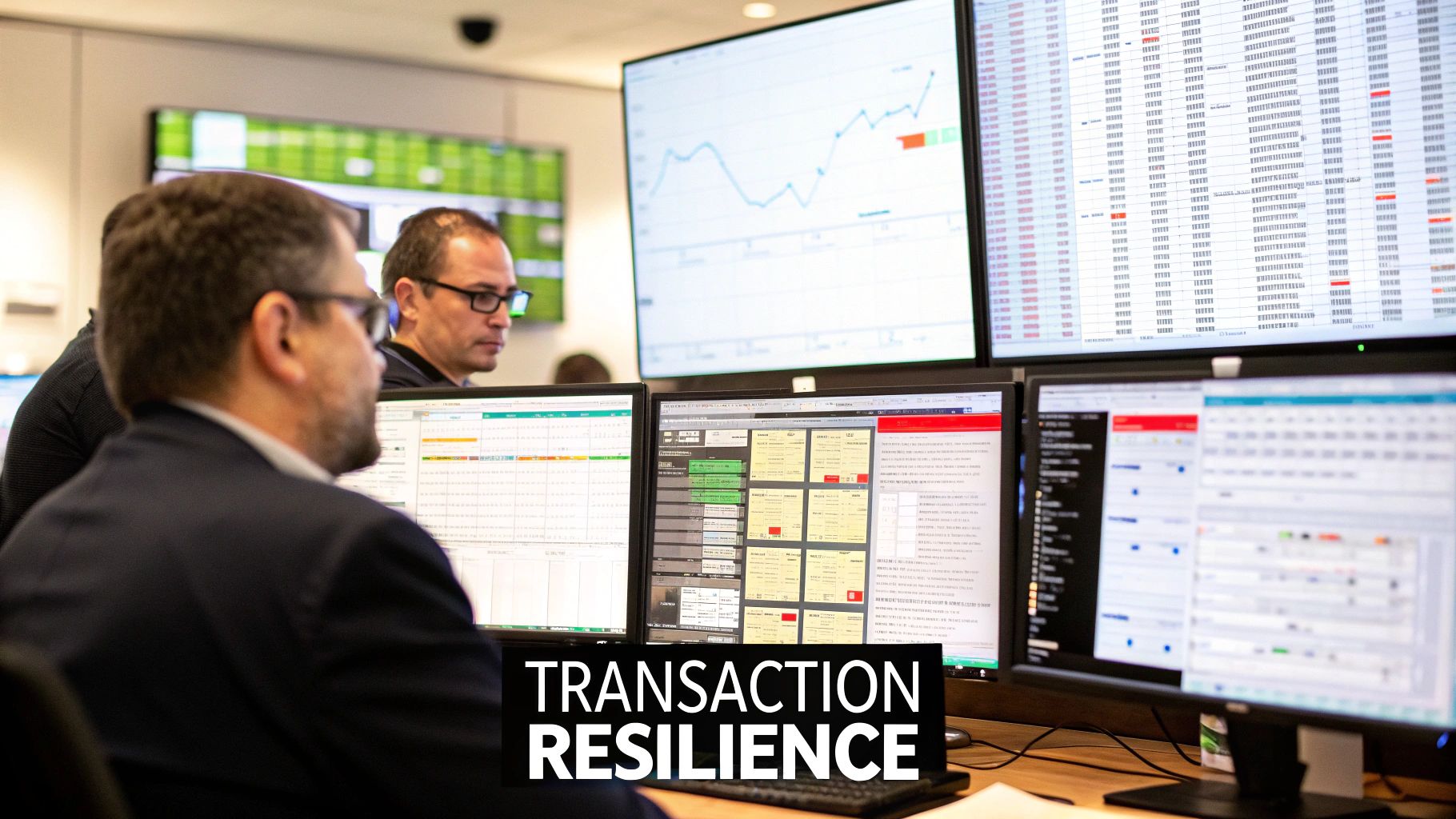
The foundation of this business continuity plan example is the near-instantaneous recovery of critical operations. Recovery Time Objectives (RTOs) for trading platforms or payment processing systems are often measured in seconds, not hours, necessitating automated failover systems. Similarly, the Recovery Point Objective (RPO) must be close to zero to prevent the loss of any transaction data, which could lead to massive financial and reputational damage.
Strategic Analysis and Key Components
The financial sector's BCP is unique due to its interconnectedness and the high stakes of maintaining public trust. A failure doesn't just impact one company; it can erode confidence in the entire financial system. For instance, following major events like the 9/11 attacks, financial institutions invested heavily in geographically diverse data centres and real-time data mirroring to ensure trading could continue uninterrupted even if a primary site was lost.
Key components demanding precise planning include:
- Transaction and Data Continuity: Automated failover systems and real-time mirroring to backup sites for trading and payment platforms.
- Cybersecurity Response: Protocols for identifying, containing, and recovering from cyber-attacks, including ransomware and data breaches.
- Regulatory Compliance and Reporting: Procedures to ensure that regulatory reporting obligations to bodies like the FCA and HMRC are met, even during a disruption. This includes maintaining payroll and VAT records securely.
- Client Communication: A multi-channel strategy to keep clients and stakeholders informed during volatile market conditions to prevent panic and maintain trust.
Actionable Takeaways for Your Business
While most SMEs don't handle billions in transactions, the financial sector's focus on data integrity offers a crucial lesson. Your customer database, financial records, and payroll information are core assets. For guidance on protecting your financial core, explore these tips on building financial resilience in uncertain times.
Key Takeaway: Implement the principle of "geographical diversity" for your critical data and operations. Don't rely on a single physical location for your servers or key staff. Using secure, cloud-based services for accounting and data storage provides inherent resilience.
By ensuring your critical business information isn't tied to one office, you protect it from localised threats like fire, flood, or theft. This simple strategy significantly enhances your ability to recover quickly and maintain operations from anywhere.
3. Manufacturing Plant Business Continuity Plan
A manufacturing plant business continuity plan (BCP) is a detailed strategy focused on maintaining production output and meeting customer commitments during disruptions. Unlike an office-based plan, its core priorities are equipment uptime, supply chain integrity, and workforce safety on the factory floor. The plan must account for physical threats like equipment failure and raw material shortages, as well as logistical and economic threats that can halt production.

This business continuity plan example is built around minimising downtime and protecting revenue streams. Recovery time objectives (RTOs) for critical machinery might be measured in hours, not days, requiring readily available spare parts and on-call engineers. Similarly, the recovery point objective (RPO) for production data, like order processing and inventory levels, must be extremely low to prevent costly errors in fulfilment and procurement.
Strategic Analysis and Key Components
A manufacturing BCP is distinct because its success is directly tied to tangible outputs and complex, interdependent supply chains. Its strength lies in anticipating points of failure before they occur. For instance, Toyota’s legendary resilience after the 2011 Japan earthquake was due to its deep, pre-existing knowledge of its multi-tiered supply chain, allowing it to quickly identify and support affected suppliers.
Key components that require detailed planning include:
- Production Line Resilience: Protocols for emergency equipment maintenance, alternative production scheduling, and failover to secondary machinery or locations.
- Supply Chain Continuity: Mapping the entire supply chain to identify single points of failure, diversifying suppliers for critical components, and maintaining a clear cashflow strategy to secure alternative materials.
- Workforce Management: Cross-training staff to operate critical machinery, establishing clear shift patterns during a crisis, and ensuring payroll systems are robust enough to handle disruptions.
- Logistics and Distribution: Pre-arranged agreements with alternative logistics providers and backup warehousing options to ensure finished goods can still reach customers.
Actionable Takeaways for Your Business
Even service-based businesses can learn from the manufacturing BCP’s focus on process flow and dependency mapping. Identify the critical "production line" in your own operations, whether it's a software development pipeline or a client onboarding process, and map its dependencies.
Key Takeaway: Implement a "just-in-case" strategy for your most critical resources, rather than relying solely on "just-in-time". This could mean holding a small buffer of key inventory, maintaining a cash reserve for emergencies, or having backup freelance talent on standby.
This proactive approach mitigates the risk of a single point of failure bringing your entire operation to a standstill. By understanding the various economic threats your business needs to plan for, you can build a more resilient financial and operational foundation.
4. Information Technology/Data Center Business Continuity Plan
An information technology (IT) and data centre business continuity plan is a highly technical framework designed to guarantee the availability, integrity, and security of digital infrastructure. It is the bedrock upon which most modern businesses operate, focusing on mitigating disruptions from hardware failures, cyberattacks, software bugs, and power outages. Its primary goal is to ensure that all dependent business functions continue with minimal data loss and downtime.
The core of this business continuity plan example revolves around defining strict recovery time objectives (RTOs) and recovery point objectives (RPOs) for critical systems. For instance, a transactional database might have an RPO of mere seconds to prevent financial loss, while an internal development server could have a higher RTO. These objectives dictate the choice of technology, from real-time data replication to nightly backups.
Strategic Analysis and Key Components
An IT BCP is the engine room of nearly every other continuity plan, as finance, operations, and communications all rely on technology. Its success lies in proactive design and rigorous testing. For example, Netflix’s "Chaos Monkey" tool intentionally causes failures in its production environment to continuously test and harden its resilience, a strategy that ensures its streaming service remains available despite underlying component failures.
Key components that demand precise planning include:
- Infrastructure Redundancy: Implementing failover systems for servers, networks, and power supplies. This includes geo-redundant data centres to protect against regional disasters.
- Data Backup and Recovery: Establishing a robust backup schedule, validating backup integrity, and having clearly documented procedures for data restoration.
- Cybersecurity Incident Response: A detailed plan to detect, contain, and eradicate cyber threats like ransomware, including protocols for communication and system recovery.
- Supplier Management: Ensuring third-party vendors, like cloud service providers or software suppliers, have their own adequate BCPs and meet your RTO/RPO requirements.
Actionable Takeaways for Your Business
Even a small business heavily relies on its IT, from its accounting software to its customer relationship management (CRM) system. The principles of redundancy and proactive testing are universally applicable. Consider the impact on your cashflow if your invoicing system goes down or if payroll data is lost before a payment run.
Key Takeaway: Implement automated and frequent backups for all critical data, and most importantly, regularly test your ability to restore from them. A backup you can't restore from is worthless.
By scheduling quarterly restoration drills, you can validate your processes and ensure your team is prepared. This approach transforms business continuity from a theoretical document into a practical, reliable capability that supports everything, including the ability to transition to effective remote working during a disruption.
5. Retail and E–Commerce Business Continuity Plan
A retail and e-commerce business continuity plan (BCP) is a dual-focused strategy designed to ensure both physical and digital operations remain functional during a disruption. Unlike plans for single-channel businesses, this BCP must address the unique challenges of an omnichannel environment, where a failure in one area, like a website crash or a warehouse closure, can have a cascading impact on the entire sales ecosystem. The primary goals are to protect revenue streams, maintain customer trust, and ensure supply chain integrity.
The core of this business continuity plan example is the integration of physical and online systems. It involves mapping out critical dependencies, such as point-of-sale (POS) systems linking to central inventory databases or online payment gateways connecting to financial accounts. Recovery Time Objectives (RTOs) are crucial; an e-commerce website might have an RTO of under an hour, while a physical store's POS system might require an immediate failover to a mobile alternative to prevent sales loss.
Strategic Analysis and Key Components
A modern retail BCP succeeds by creating resilience across its entire sales funnel, from customer acquisition to fulfilment. For example, during the COVID-19 pandemic, retailers like Best Buy thrived by rapidly scaling their "click-and-collect" services, turning physical stores into local fulfilment hubs. This was only possible because their BCP had already integrated online and in-store inventory management, allowing for seamless operational pivots.
Key components that demand careful planning include:
- Omnichannel Sales Continuity: Procedures for website outages (e.g., redirecting to social media sales channels), POS system failures (e.g., manual processing or mobile POS backups), and payment gateway disruptions.
- Supply Chain and Inventory Management: Identifying alternate suppliers and logistics partners, and maintaining real-time, unified inventory visibility to reroute stock as needed. Strong cashflow management is vital to secure alternative stock quickly.
- Customer Communication: A clear, multi-channel communication plan to inform customers about order delays, store closures, or website issues, preserving trust and managing expectations.
- Financial Resilience: Ensuring payroll systems can operate to pay staff and that financial reporting continues, providing a clear picture of cashflow and profitability during the disruption.
Actionable Takeaways for Your Business
Any business with both online and offline customer touchpoints can learn from this model. The key is to eliminate single points of failure between your digital and physical worlds. Map out your customer journey and identify the technology or processes that, if they failed, would halt progress.
Key Takeaway: Implement system redundancy and operational flexibility. Don't rely on one payment processor, one shipping provider, or one sales channel. A diversified operational stack is your best defence against targeted disruptions.
For instance, by using a Content Delivery Network (CDN), you can protect your website from traffic surges or regional outages. Similarly, training staff on manual transaction processing provides a low-tech, high-reliability backup if your digital POS system fails. This builds a resilient business that can absorb shocks and continue trading.
6. Telecommunications Provider Business Continuity Plan
A telecommunications provider business continuity plan (BCP) is a high-stakes framework focused on maintaining network availability and service continuity, which are now considered essential utilities. Unlike plans for other sectors, a telecom BCP's failure can have a cascading effect, disrupting everything from emergency services and financial transactions to remote work and government operations. Its core objective is to ensure maximum uptime during infrastructure failures, natural disasters, or cyber-attacks.
The foundation of this business continuity plan example is aggressive network resilience, aiming for near-zero Recovery Time Objectives (RTOs) for core services. This is achieved through immense investment in redundant infrastructure, such as diverse fibre-optic routing and geographically separate switching centres. The Recovery Point Objective (RPO) is also effectively zero, as real-time data replication is standard practice to prevent the loss of call data records or customer information.
Strategic Analysis and Key Components
A telecommunications BCP is unique because it underpins the continuity plans of nearly every other industry. Its success relies on a combination of physical hardening and operational agility. For instance, following Hurricane Katrina, telecom providers activated emergency response systems, deploying mobile cell sites (Cells on Wheels) to restore basic communication for first responders and the public, demonstrating a plan that was both robust and adaptable.
Key components that must be meticulously planned include:
- Network Redundancy: Implementing multiple, independent paths for data traffic to automatically reroute around failures. This includes physical diversity (different cable routes) and technology diversity (fibre, microwave, satellite).
- Infrastructure Hardening: Building key facilities like data centres and switching hubs to withstand physical threats like floods, earthquakes, and attacks. This includes backup power and cooling systems.
- Emergency Communication Protocols: Coordinating with government agencies and other critical services to prioritise network traffic during a large-scale emergency, ensuring first responders can communicate.
- Supply Chain & Financials: Maintaining relationships with multiple equipment vendors and having clear cashflow plans to fund rapid, large-scale repairs or equipment replacement without delay. Resilient payroll systems are critical to manage field engineering teams during a crisis.
Actionable Takeaways for Your Business
Even for an SME, the telecom model provides crucial lessons in eliminating single points of failure. Analyse your business operations and identify dependencies, whether it's a single internet provider, a key supplier, or a critical software application. The goal is to build in redundancy wherever possible.
Key Takeaway: Establish mutual aid agreements or pre-vetted alternative suppliers for your most critical functions. A telecom provider may have an agreement with a competitor; a small business could have one with a friendly rival or a secondary supplier.
Don't wait for a disaster to find an alternative. By having a backup plan and a relationship already in place, you can activate your recovery strategy immediately, dramatically reducing downtime and financial impact.
7. Government and Critical Infrastructure Business Continuity Plan
A government and critical infrastructure business continuity plan (BCP) is a high-stakes framework ensuring the uninterrupted delivery of essential public services and utilities. Unlike a commercial plan focused on profit, its core objective is national security, public safety, and societal stability. This plan must account for large-scale threats such as natural disasters, cyber-attacks on national infrastructure, or acts of terrorism, demanding unparalleled coordination between multiple agencies.
The foundation of this business continuity plan example is the concept of Continuity of Operations (COOP) and Continuity of Government (COG). Recovery Time Objectives (RTOs) for services like power grids, water supply, and emergency communications are often near-zero. This requires immense investment in redundant systems, secure communication channels, and clearly defined chains of command, often formalised in frameworks like the UK's Civil Contingencies Act 2004.
Strategic Analysis and Key Components
The uniqueness of a government BCP lies in its scale and interdependency. A failure in one sector, like energy, can trigger a cascading failure across transport, communications, and healthcare. Its success depends on a multi-layered, multi-agency approach, exemplified by the coordination required during national emergencies like widespread flooding, which tests everything from emergency response to financial support distribution.
Key components that demand rigorous planning include:
- Essential Service Continuity: Detailed procedures to maintain law enforcement, emergency services, and utility operations. This includes securing fuel, equipment, and personnel.
- Chain of Command & Succession: Clear, legally sound plans for leadership succession to ensure decisive governance can continue under any circumstance.
- Inter-agency Coordination: Protocols for communication and resource sharing between local councils, national government bodies (like the Cabinet Office Briefing Rooms – COBR), and private sector partners.
- Public Communication Strategy: A robust plan for delivering timely, accurate, and reassuring information to the public to prevent panic and ensure cooperation.
Actionable Takeaways for Your Business
While most SMEs don't manage national infrastructure, the principles of interdependency and clear communication are highly relevant. Map out your own critical dependencies, not just internally, but with key suppliers and service providers. What happens if your cloud provider, logistics partner, or primary raw material supplier goes offline?
Key Takeaway: Implement a clear succession plan for key roles within your business. If you or another critical team member is unavailable, who is empowered to make financial decisions, process payroll, and communicate with clients?
Document this chain of command and ensure the designated individuals have the necessary access and authority to act. This simple step prevents operational paralysis when a key person is unexpectedly absent, ensuring business continuity at a leadership level.
8. Higher Education Institution Business Continuity Plan
A higher education institution business continuity plan is a complex framework designed to ensure the continuation of academic operations, research activities, and student services during a disruption. Unlike a typical corporate plan, it must address a unique ecosystem of stakeholders, including students, faculty, researchers, and administrative staff, while protecting valuable intellectual property and ensuring student welfare. The plan must cover scenarios ranging from campus-wide IT outages and infrastructure failures to public health crises and severe weather events.
At its heart, this business continuity plan example is about maintaining the core mission of education and research. This involves setting clear recovery time objectives (RTOs) for critical systems like online learning platforms and student information databases. The recovery point objective (RPO) for research data must be near-zero to prevent the catastrophic loss of years of work, requiring sophisticated and resilient backup solutions.
Strategic Analysis and Key Components
The BCP for a university is distinguished by its multifaceted operational scope, from student housing and campus safety to multi-million-pound research projects. The COVID-19 pandemic highlighted this complexity, as institutions like Stanford University had to rapidly pivot to remote learning, demonstrating the importance of pre-existing and scalable digital infrastructure. Their success depended on a plan that integrated academic, technological, and student support functions.
Key components that demand careful planning include:
- Academic & Research Continuity: Protocols for shifting to online or hybrid learning models, securing research data, and managing laboratory-dependent projects.
- Student Welfare & Housing: Plans for emergency student accommodation, remote mental health support, and clear communication channels with students and their families.
- Financial Resilience: Managing cashflow to cover unexpected expenses, such as technology upgrades or refunds, and ensuring payroll systems for staff and faculty remain operational.
- Campus Infrastructure: Securing campus buildings, managing utilities, and ensuring IT networks can handle surges in remote access.
Actionable Takeaways for Your Business
The higher education model provides powerful lessons on managing diverse operations under one BCP. Businesses can learn from how universities segment their plans to address vastly different functions, such as customer-facing services versus back-office operations, each with its own specific recovery needs.
Key Takeaway: Create sub-plans for distinct business units or functions. Your sales team's continuity needs are different from your product development team's. Tailoring the response ensures that each part of the business gets the precise support it needs to recover efficiently.
By developing modular continuity plans for each department, you can avoid a one-size-fits-all approach that fails to address critical nuances. This strategy empowers departmental leaders and ensures a more organised, effective, and rapid recovery across the entire organisation.
8-Sector Business Continuity Plan Comparison
| Business Continuity Plan (Industry) | Implementation Complexity 🔄 | Resource Requirements ⚡ | Expected Outcomes 📊 | Ideal Use Cases 💡 | Key Advantages ⭐ |
|---|---|---|---|---|---|
| Healthcare Facility (Healthcare) | 🔄 Very high — multi‑department coordination, clinical protocols, regulatory constraints | ⚡ Very high — backup power, EHR redundancy, trained clinical staff | 📊 Preserve patient care continuity; meet HIPAA/CMS requirements | 💡 Hospitals, emergency departments, pandemic response | ⭐ Life‑saving continuity; regulatory compliance; protects trust |
| Financial Services (Financial Services) | 🔄 Very high — strict regulatory testing and secure failovers | ⚡ Very high — geo‑redundant sites, cybersecurity talent, real‑time mirroring | 📊 Maintain transactions, protect assets, prevent regulatory fines | 💡 Banks, trading platforms, payment processors | ⭐ Protects customer assets; preserves market confidence |
| Manufacturing Plant (Manufacturing) | 🔄 High — equipment redundancy, supplier coordination, cross‑training | ⚡ High — spare parts, alternative suppliers, inventory buffers | 📊 Reduce production stoppages; meet customer commitments | 💡 Assembly lines, just‑in‑time supply chains, critical suppliers | ⭐ Keeps production running; protects contracts and revenue |
| IT / Data Center (Information Technology) | 🔄 High — complex architectures, RTO/RPO alignment, testing impact | ⚡ High — redundant servers, replication, cloud/hybrid setups | 📊 Rapid system recovery; minimal downtime; data integrity | 💡 SaaS providers, enterprise IT, critical online services | ⭐ Fast recovery; prevents cascading failures; preserves data |
| Retail & E‑Commerce (Retail and E‑Commerce) | 🔄 Medium‑high — integration of POS, e‑commerce, inventory systems | ⚡ Medium — CDN, payment gateway redundancy, POS backups | 📊 Maintain sales and customer experience during outages | 💡 Omnichannel retailers, online storefronts, seasonal peaks | ⭐ Sustains revenue; reduces customer churn; omnichannel resilience |
| Telecommunications Provider (Telecommunications) | 🔄 Very high — network topology, regulatory priorities, wide geography | ⚡ Very high — network diversity, switching centers, hardened facilities | 📊 Keep connectivity for public safety and dependent services | 💡 Carriers, emergency comms, public networks | ⭐ Maintains critical communications; supports first responders |
| Government & Critical Infrastructure (Government) | 🔄 Extremely high — multi‑agency coordination, classified operations | ⚡ Very high — alternate facilities, secure communications, policy support | 📊 Ensure essential services, national security, public safety | 💡 Emergency management, utilities, national continuity plans | ⭐ Preserves public services and governance during crises |
| Higher Education Institution (Higher Education) | 🔄 High — diverse stakeholders, academic and research needs | ⚡ Medium‑high — remote learning, research backups, housing plans | 📊 Continue education and research; protect reputation and funding | 💡 Universities, research labs, campuses with residential housing | ⭐ Preserves degrees/research continuity; protects students and staff |
Turning Your Plan into Action with Financial Foresight
Having journeyed through diverse examples, from the high-stakes environment of a healthcare facility to the complex logistics of a manufacturing plant, one principle stands out: a business continuity plan is far more than a document. It is a living strategy, a roadmap designed not just to survive a crisis but to emerge stronger. The examples we have analysed demonstrate that resilience is not a generic template; it is a bespoke framework built on a deep understanding of your specific operational vulnerabilities and strategic priorities.
The common thread woven through every effective business continuity plan example is the undeniable importance of financial foresight. A plan without a solid financial foundation is merely a theoretical exercise. When a disruption hits, your ability to pay staff, manage suppliers, and fund recovery efforts hinges entirely on your financial preparedness. This is where the theoretical meets the practical, and where many well-intentioned plans falter.
From Blueprint to Reality: Key Takeaways
Reflecting on the various plans, several core actions rise to the surface. These are the critical steps that transform a static document into an actionable resilience strategy.
- Financial Integration is Non-Negotiable: As seen in the retail and financial services examples, BCPs must explicitly detail financial procedures. This includes authorising emergency spending, processing payroll under adverse conditions, and managing VAT and tax obligations when normal operations are suspended. Your accountant should be a key stakeholder in this process.
- Define RTOs and RPOs with Precision: The IT and telecommunications plans highlight the necessity of precise Recovery Time Objectives (RTOs) and Recovery Point Objectives (RPOs). These metrics are not just technical jargon; they have direct financial implications, influencing insurance costs, backup solution investments, and potential revenue loss.
- Supplier and Third-Party Due Diligence: The manufacturing and critical infrastructure examples underscore the risk posed by supply chain dependencies. Your plan must account for the financial viability of key partners and have pre-vetted alternatives, ensuring a disruption in their business doesn't automatically become a catastrophe for yours.
Your Actionable Next Steps
Moving from understanding these examples to implementing your own plan requires a structured approach. Don't let the scope of the task lead to inaction. Begin with small, manageable steps that build momentum and create a culture of preparedness within your organisation.
- Conduct a Financial Stress Test: Don't wait for a crisis to discover your financial breaking points. A crucial aspect of financial foresight within a business continuity plan involves thorough cash flow analysis to ensure adequate liquidity for recovery and sustained operations during and after a crisis. Model scenarios like a 30-day revenue loss or a sudden major capital expenditure.
- Map Your Critical Financial Functions: Identify every process essential for financial survival. This includes payroll, invoicing, supplier payments, and tax submissions. For each, document the required personnel, technology (like Xero or QuickBooks), and data needed to execute it.
- Assemble Your Recovery Team: Formally designate a team responsible for activating and managing the BCP. This team should include financial leadership alongside operational heads. Ensure everyone understands their roles and has the authority to act decisively.
- Review and Rehearse: A plan on a shelf is useless. Schedule regular tabletop exercises to walk through different scenarios. This practice will reveal gaps, clarify roles, and build the muscle memory needed to respond effectively under real pressure.
Ultimately, mastering the concepts within each business continuity plan example is about securing the future you are working so hard to build. It provides the stability to weather storms, the confidence to pursue growth, and the peace of mind that comes from knowing you are prepared. Resilience is not an expense; it is the most critical investment you can make in the long-term health and success of your business.
A robust business continuity plan is anchored by sound financial management. At Stewart Accounting Services, we help SMEs across the UK integrate financial resilience into their strategic planning, from cash flow forecasting to managing tax obligations during a crisis. Let us help you build a financial foundation strong enough to withstand any challenge by visiting Stewart Accounting Services today.