
Let's get straight to it. Revenue is the total amount of money your business brings in from sales, before a single penny in costs is taken out. Profit, on the other hand, is what you're left with after you've paid for everything – from stock and materials to rent and salaries.
Understanding the Top Line vs the Bottom Line
It’s a classic trap for many UK small and medium-sized enterprises (SMEs). They chase sky-high revenue figures, thinking it's the ultimate sign of success, only to be baffled when their bank account doesn't match up. This misunderstanding is more than just a minor mix-up; it can lead to serious cash flow headaches if left unchecked. Getting to grips with the difference between revenue and profit is absolutely fundamental for building a sustainable business.
Think of it this way: Revenue is your 'top line'. It sits right at the top of your Profit and Loss (P&L) statement and shows how effective your sales and marketing are. It's a raw measure of the demand for your products or services.
Profit is the 'bottom line'. It tells the real story about your business's financial health and how efficiently you're running things. Ultimately, profit is the true test of whether your business model actually works.
The infographic below paints a clear picture of this distinction, showing revenue as the total pot of money coming in, and profit as the slice you actually get to keep.
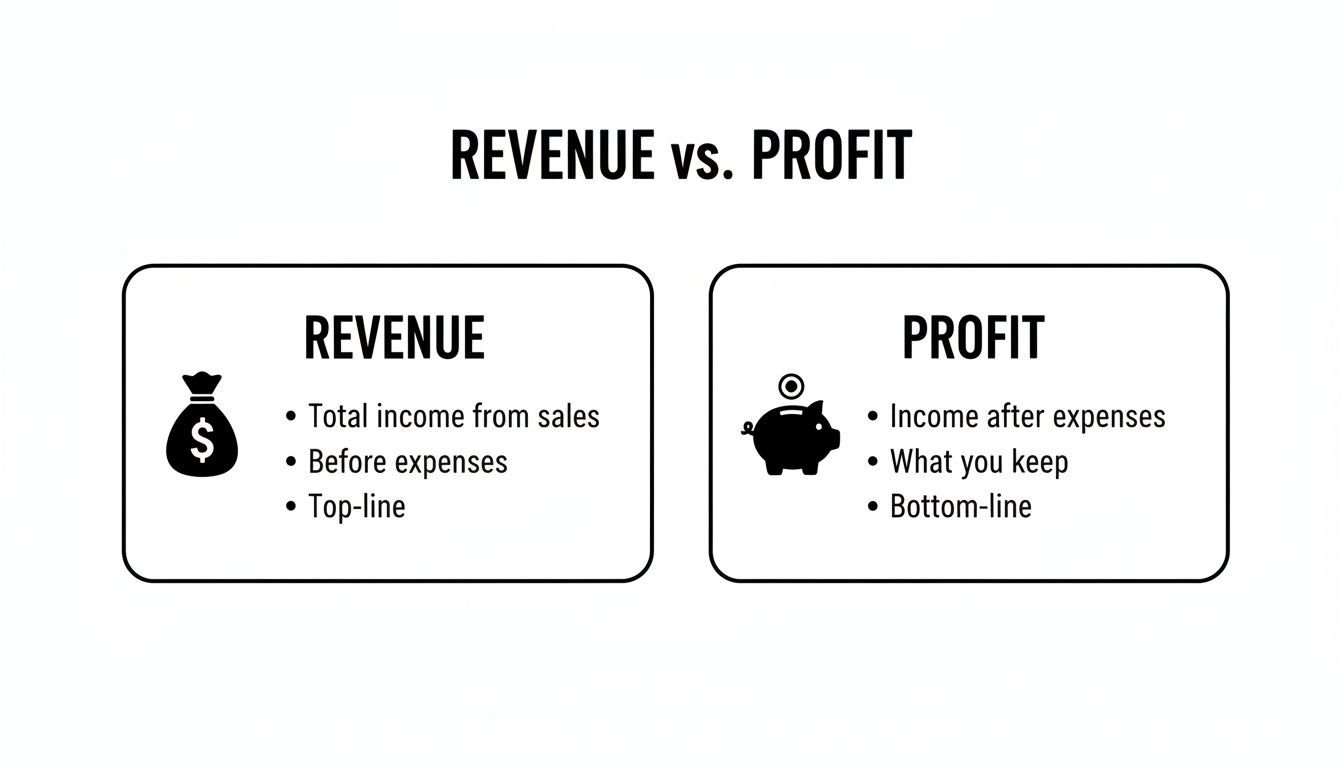
As you can see, revenue is the starting block, but profit is the finish line. It's the end result once every single business cost has been paid. To really nail down these differences in a practical sense, let's break them down side-by-side.
Core Differences Revenue vs Profit
Here’s a foundational comparison highlighting how revenue and profit differ across essential business functions and financial reporting.
| Aspect | Revenue (The 'Top Line') | Profit (The 'Bottom Line') |
|---|---|---|
| What It Measures | The total income generated from all sales activities before any costs are deducted. | The amount of money remaining after all expenses have been subtracted from revenue. |
| Where It Appears | At the very top of a Profit and Loss (P&L) statement. | At the very bottom of a Profit and Loss (P&L) statement. |
| Strategic Focus | Indicates market demand, sales volume, and business scale. Growth strategies focus on sales and marketing. | Indicates operational efficiency, financial health, and long-term sustainability. Improvement strategies focus on cost control. |
| Can It Be Negative? | No, revenue cannot be a negative figure. It represents total incoming sales. | Yes, if expenses exceed revenue, the result is a net loss (negative profit). |
This table neatly summarises why you can’t look at one figure without the other. High revenue shows potential, but healthy profit proves performance.
Calculating Your Key Financial Metrics
Knowing the difference between revenue and profit is a great start, but the real power comes from being able to calculate these figures yourself. These formulas are the backbone of any solid financial report, helping you translate raw sales numbers into a clear story about your business's health.
Let's begin at the top with your total revenue. Often called 'turnover' here in the UK, this is the total amount of money your business brings in before a single penny in costs is taken out.
Calculating Total Revenue
The simplest way to work out your revenue is with a basic formula that adds up all your sales.
- Formula: Total Revenue = Sales Price per Unit x Quantity of Units Sold
Let's use a practical example. Imagine you run a coffee shop in Stirling. If you sell 2,000 cups of coffee in a month at £3.50 each, the calculation is £3.50 x 2,000 = £7,000. This £7,000 is your top-line revenue, but it doesn't mean your business is profitable.
Calculating Gross Profit
To get a clearer picture of your actual earnings, the first step is to calculate your gross profit. This figure tells you how much money is left over after you've paid for the direct costs of what you sell.
- Formula: Gross Profit = Total Revenue – Cost of Goods Sold (COGS)
The Cost of Goods Sold (COGS) covers all your direct costs. For our coffee shop, this would be things like the coffee beans, milk, and paper cups. If you're a service-based business, like a consultant, your COGS might be subcontractor fees or a specific software licence you need for a client's project.
Let's say the direct cost for each cup of coffee is £1.00. Your total COGS would be £1.00 x 2,000 = £2,000. So, your gross profit is £7,000 (Revenue) – £2,000 (COGS) = £5,000.
Gross profit is a brilliant indicator of how efficient your production is and whether your pricing strategy is working. A healthy gross profit means you've got enough cash in the pot to cover all your other running costs.
Calculating Operating Profit
Operating profit digs a little deeper by subtracting the indirect costs—the general overheads needed to keep the lights on and the doors open every day.
- Formula: Operating Profit = Gross Profit – Operating Expenses
Operating expenses are costs not directly linked to producing a single product or service. Think of things like:
- Rent for your shop
- Staff wages and salaries
- Marketing budgets
- Utility bills like electricity and internet
- Business insurance
Back to our coffee shop. Let's say the monthly rent, staff wages, and other overheads come to £3,500. Your operating profit would be £5,000 (Gross Profit) – £3,500 (Operating Expenses) = £1,500. This number shows you how profitable your core business activities really are.
Calculating Net Profit
Finally, we get to the famous 'bottom line': your net profit. This is the ultimate measure of your business's success, as it accounts for absolutely every remaining expense, including things like interest on loans and tax.
- Formula: Net Profit = Operating Profit – Interest and Taxes
If the coffee shop has a small business loan with monthly interest payments of £100 and a corporation tax bill for the period that works out to £250, the final calculation is: £1,500 (Operating Profit) – £100 (Interest) – £250 (Taxes) = £1,150.
This £1,150 is the actual profit your business has made. It's the money you can either reinvest or take home.
These calculations are the building blocks of what you'll find when you learn how to read a Profit and Loss statement. To take your analysis even further, many business owners also explore how to calculate profit margins, which turns these raw numbers into powerful performance indicators.
Why This Distinction Shapes Your Business Strategy

Knowing the formulas is one thing, but truly getting to grips with how revenue and profit shape your decisions is what separates a struggling business from a successful one. These two figures tell completely different stories about your company’s health. High revenue looks great on paper—it shows there's strong demand for what you do. But it's profit that tells you if your business model actually works.
Think of your Profit & Loss (P&L) statement as the story of your trading period. Revenue is the headline right at the top, shouting about the total sales you've made. Profit is the bottom line, the final chapter that reveals what's actually left after all the costs and expenses have had their say. The P&L is designed this way for a reason: to show you exactly how every single cost chips away at your initial sales figure.
Revenue Focus vs. Profit Focus: Which Strategy is Right for You?
A business strategy geared towards boosting revenue looks very different from one designed to maximise profit. Neither is necessarily "better," but they're suited to different goals and different stages of a business's journey.
A revenue-focused strategy is often the go-to for startups or businesses trying to break into a new market. The main objective is rapid growth and grabbing as much market share as possible. Tactics often include:
- Launching with aggressive discounts to get new customers through the door.
- Pouring money into marketing to build brand awareness quickly.
- Rapidly expanding product lines or services to scale up operations.
On the other hand, a profit-focused strategy is all about efficiency and long-term health. It’s a common approach for more established businesses that want to get the best possible return. This usually involves:
- Drilling down into costs to find and cut unnecessary spending.
- Optimising pricing to improve margins, even if it means selling a bit less.
- Going back to suppliers to renegotiate better deals.
The real skill is knowing which approach to take, and when. Pushing for revenue at all costs can lead to a situation where you "grow broke"—sales are booming, but there's no cash in the bank to pay the bills.
A business can turn over millions and still go bust. Profit is what keeps the lights on; it’s the cash that funds new projects, pays off loans, and ultimately rewards you for all the risk you’ve taken. Without it, high revenue is just a vanity metric.
The Real-World Impact on UK SMEs
This isn't just theory; it has a direct impact on your tax bill, your ability to get funding, and how you run your business day-to-day.
Picture this: you're running your limited company in Alloa or Stirling. The invoices are flying out and the revenue figures look fantastic, but you’re left wondering why the bank balance doesn't reflect that success. This is the classic revenue vs. profit puzzle that so many business owners face. As official data on UK corporate profit on Trading Economics shows, profits can be surprisingly volatile because costs like wages, materials, and overheads eat into that top-line figure.
Crucially, HMRC calculates your Corporation Tax bill based on your profit, not your revenue. A high-turnover, low-profit company will pay far less tax than a leaner business with lower revenue but much healthier profit margins. In the same way, when you're looking for a loan or trying to attract investors, they'll look straight past the sales figures. They want to see your net profit to judge the real, underlying health of your business before putting any money in.
Real-World Scenarios for UK Businesses
Theory is great, but seeing how revenue and profit play out in the real world is where the lesson truly sticks. Let's look at a few practical examples for UK business owners, starting with a limited company that, on the surface, seems to be flying.
Imagine a design agency in Stirling. They've had a fantastic year, bringing in £500,000 in revenue from client projects. This is their turnover, a number that certainly suggests healthy demand for their services. But after the initial celebrations, a closer look at the accounts tells a different, more worrying story: their net profit is dangerously low.
What happened? The agency had let several overheads creep up without anyone really noticing. We're talking about rising software subscription costs, marketing campaigns that didn't deliver a decent return, and some unbudgeted administrative salaries. Their high revenue created a false sense of security, masking an inefficient cost structure that was quietly eating away at their bottom line.
A Falkirk Landlord's Financials
Now, let's switch gears and look at a property landlord in Falkirk with a small portfolio. Their total rental income for the year comes to £40,000. This figure is their total revenue. Critically, though, this isn't the amount they’ll be paying tax on when they file their self-assessment return.
From that top-line revenue, they need to deduct a whole host of expenses:
- Mortgage interest payments on the buy-to-let loans.
- Letting agent fees for managing the properties.
- The cost of any essential maintenance and repairs.
- Landlord insurance and other compliance-related expenses.
After subtracting all these legitimate costs, their final taxable profit might only be £15,000. And that's the figure HMRC actually cares about. Confusing the £40,000 revenue with their actual profit could lead to a nasty shock when the tax bill lands, which is why getting this right is so crucial for proper financial planning. For any business owner, understanding how to calculate gross profit and other profit levels is a vital first step.
The most common mistake is living off revenue. A business owner sees money coming into the bank and spends it, forgetting that a large portion is already claimed by suppliers, staff, and the taxman. Profit is what you've earned; revenue is just money passing through.
The Sole Trader's Take-Home Pay
Finally, let's consider a sole trader, maybe a freelance consultant. Their turnover for the year is a solid £70,000. While all of that money might land in their bank account, it is absolutely not their personal income. For a sole trader, the line between business and personal finances can get a bit blurry, but the distinction between revenue and profit remains crystal clear for tax purposes.
They have to meticulously track every allowable business expense. For UK businesses, this is non-negotiable, especially when it comes to your tax bill, as detailed in guides on UK sole trader tax deductions. Once they deduct costs like professional insurance, travel, and software, their taxable profit might actually be closer to £45,000. This is the number that will determine their Income Tax and National Insurance contributions.
Balancing Revenue Growth with Profitability

Knowing your numbers is one thing, but using them to steer your business is the real skill. Every successful business owner learns how to pull the right financial levers at the right time. Chasing more revenue and boosting your profit aren't the same thing—they require completely different strategies. Finding a healthy balance between them is crucial for long-term survival.
It’s easy to get fixated on revenue growth, especially when you’re just starting out and trying to make a name for yourself. But this can quickly become a trap. Throwing money at aggressive marketing campaigns or deep discounts might get the phone ringing, but if your costs are spiralling, you could be selling your way into a loss.
On the flip side, focusing only on profitability by cutting costs to the bone can be just as harmful. Of course, you need to be efficient. But slashing the marketing budget or putting off essential upgrades can stifle growth and leave you wide open to competitors who are willing to invest. The goal isn't just a profitable month; it's a sustainable, successful business.
Strategies to Boost Your Top Line Revenue
If your main goal right now is to grab a bigger slice of the market or simply increase sales, you’ll need tactics that focus on bringing more money through the door. Think of these as ways to turn up the volume on your income.
- Strategic Pricing Adjustments: This isn't just about hiking up your prices. You could introduce tiered packages, bundle products together, or create a premium version of your service to increase how much each customer spends.
- Entering New Markets: Look beyond your current horizons. Could you expand into a new town, or maybe target a completely different type of customer? This can open up whole new income streams.
- Targeted Marketing Campaigns: A well-thought-out marketing push can directly drive sales by attracting new customers and, just as importantly, encouraging your existing ones to come back for more.
Strategies to Improve Your Bottom Line Profitability
When it's time to focus on making your business more financially sound, the strategies become more about what’s happening inside your own walls. The aim here is simple: make sure more of the money you earn actually stays in your pocket as profit.
A classic mistake is thinking that the only way to make more profit is to make more sales. Often, the fastest route to a healthier bottom line is to optimise what you’re already doing—plugging leaks and getting more efficient.
Here are some key ways to improve your profitability:
- Rigorous Cost Analysis: Go through every single expense with a fine-tooth comb, from what you pay your suppliers to those software subscriptions you forgot about. A deep dive into your cost of goods sold is a brilliant place to start.
- Enhancing Operational Efficiency: Where are the bottlenecks in your business? Look for ways to streamline how you work, reduce waste, or use technology to automate repetitive tasks. All of these will lower your operating costs.
- Renegotiating Supplier Contracts: Don't be afraid to pick up the phone and ask for a better deal. Loyalty is valuable, and your suppliers know it. Even a small discount can make a big difference to your gross profit over the year.
How We Help You Master Your Financials
Knowing the difference between revenue and profit is one thing, but using that insight to build a stronger business is what truly counts. At Stewart Accounting Services, that’s where we come in. We help you move beyond the theory and turn your financial data into a practical roadmap for growth.
It all starts with getting a crystal-clear, real-time picture of your finances. Our expert bookkeeping services, often using powerful tools like Xero, give you an up-to-the-minute view of your income and expenses. This means you can spot opportunities to trim costs or double down on what’s working now, not three months down the line.
From Raw Data to Smart Decisions
Of course, just having the numbers isn't enough. We help you translate that raw data into reports that actually mean something for your day-to-day decisions.
- Management Accounts: We produce regular, easy-to-understand management accounts that show you the trends and performance patterns hiding in your numbers. This isn't just for compliance; it's for strategy.
- KPI Reporting: Together, we’ll pinpoint the Key Performance Indicators (KPIs) that are most critical for your business. This helps you see a direct line between your daily efforts and your bottom-line profit.
This clarity is vital. It shows you which sales are genuinely profitable and which ones might be costing you more than they’re worth.
Our goal is simple: we handle the financial complexity so you can focus on what you do best—running and growing your business. We take care of the numbers so you can build your success story.
Finally, we make sure you keep as much of your hard-earned profit as possible. With our expertise in tax planning, VAT returns, and payroll management, we ensure your business runs efficiently. This keeps you fully compliant while minimising unnecessary costs, creating a solid foundation for sustainable growth.
Your Top Questions Answered
It’s one thing to understand the theory, but another to see how it works in the real world. Let's tackle a few common questions we hear from business owners trying to get to grips with their finances.
Is it possible to be profitable but have no cash in the bank?
Yes, and it’s a trap that catches many businesses out. Imagine you sell £10,000 worth of services on 30-day payment terms. Your profit and loss statement immediately shows a healthy profit from that sale.
However, the cash won’t actually hit your bank account for another month. This is a classic case of positive profit but negative cash flow. It’s precisely why you need to keep a close eye on both your P&L and your cash flow forecast.
For a new business, what should I focus on: revenue or profit?
In the very beginning, the focus is often squarely on generating revenue. You need to prove your concept, win those first customers, and establish a foothold in the market. It's all about growth and gaining traction.
But this can't last forever. That initial push for revenue must be backed by a clear and credible plan to become profitable. Sooner or later, investors, lenders, and you yourself will need to see that the business can stand on its own two feet and actually make money.
How does depreciation impact my profit figure?
Depreciation is a bit of an accounting quirk, but an important one. It's a non-cash expense that reflects the gradual loss in value of your assets, like a company van or a piece of machinery.
Because it's classed as an operating expense, it reduces your operating and net profit. The upside? This lowers your profit on paper, which in turn reduces your corporation tax bill. So, while no cash leaves your bank for depreciation itself, it has a very real impact on the tax you pay.
Ready to move beyond the numbers and start making strategic decisions that drive real growth? The team at Stewart Accounting Services can help you translate your financial data into a clear plan for the future. Book a consultation with us today and let's build a more profitable business together.