
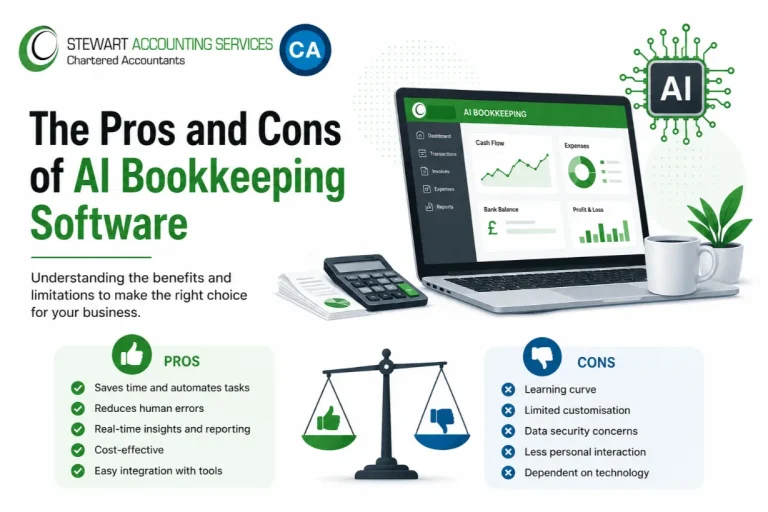
Artificial intelligence is no longer a futuristic concept reserved for large corporations. Today, AI-powered bookkeeping software is becoming a practical tool for small businesses, freelancers, and growing companies across the UK. From automatically categorising expenses to generating financial reports in seconds, AI is changing the way businesses manage their finances.
However, while the benefits are compelling, AI bookkeeping software is not a perfect solution for every business. Understanding both the advantages and limitations can help you decide whether it’s the right fit for your organisation.
What Is AI Bookkeeping Software?
AI bookkeeping software uses machine learning and automation to perform tasks traditionally completed by bookkeepers or accountants. These platforms can analyse financial transactions, categorise expenses, reconcile bank accounts, process invoices, identify anomalies, and even provide cash flow insights.
Popular bookkeeping platforms are increasingly incorporating AI features to reduce manual data entry and improve financial accuracy.
The Advantages of AI Bookkeeping Software
1. Significant Time Savings
One of the biggest benefits of AI bookkeeping software is its ability to automate repetitive financial tasks.
Instead of manually entering receipts, invoices, and transactions, the software can import data directly from bank feeds and accounting systems. This allows business owners to spend less time on administration and more time focusing on growth, sales, and customer service.
For many small businesses, hours of bookkeeping each month can be reduced to minutes.
2. Improved Accuracy
Human error is one of the most common causes of bookkeeping issues. A misplaced decimal point or incorrectly categorised expense can create reporting problems and compliance risks.
AI systems are designed to learn from previous transactions and apply consistent categorisation rules. While mistakes can still occur, automated processes often reduce the frequency of common bookkeeping errors.
3. Real-Time Financial Visibility
Traditional bookkeeping often provides a view of finances weeks or months after transactions occur. AI-powered systems work continuously, updating financial records in real time.
This gives business owners access to current profit figures, cash flow data, and expense trends whenever they need them. Faster access to financial information can lead to quicker and more informed business decisions.
4. Faster Invoice and Expense Processing
AI can extract information from invoices, receipts, and financial documents without manual input.
Rather than entering supplier details and amounts line by line, users can simply upload documents and allow the software to process the information automatically. This speeds up workflow and reduces administrative workload.
5. Better Financial Insights
Modern AI tools do more than record transactions. Many platforms analyse spending patterns, forecast cash flow, and identify unusual financial activity.
These insights can help businesses spot potential issues before they become serious problems and uncover opportunities to improve profitability.
6. Scalability for Growing Businesses
As businesses grow, bookkeeping requirements become more complex. AI software can often handle increasing transaction volumes without requiring significant additional resources.
This scalability makes AI particularly attractive for businesses experiencing rapid growth or seasonal fluctuations.
The Disadvantages of AI Bookkeeping Software
1. Limited Human Judgement
While AI excels at processing data, it cannot fully replicate professional judgement.
Complex tax situations, unusual transactions, business restructuring, and strategic financial planning often require the expertise of a qualified accountant. AI can assist with data processing, but it cannot replace professional financial advice.
2. Potential Classification Errors
AI systems learn from patterns, but they are not infallible.
Unusual expenses, new suppliers, or unique transactions may be categorised incorrectly. If these errors go unnoticed, they can affect reporting accuracy and tax calculations.
Regular review of automated bookkeeping entries remains essential.
3. Data Security Concerns
Financial data is among the most sensitive information a business holds.
Although reputable software providers invest heavily in cybersecurity, any cloud-based platform carries some level of risk. Businesses should carefully evaluate security features, data storage policies, and compliance standards before selecting a provider.
4. Ongoing Subscription Costs
AI bookkeeping software is usually sold through monthly or annual subscription plans.
While the cost may be lower than hiring additional administrative staff, businesses should still assess whether the software delivers sufficient value relative to its ongoing expense.
For very small businesses with minimal transactions, the investment may not always be justified.
5. Dependence on Technology
Automated bookkeeping relies on stable internet connections, software integrations, and accurate data feeds.
System outages, integration failures, or software glitches can temporarily disrupt financial processes. Businesses that rely entirely on automation may face challenges when technical issues arise.
6. Learning Curve and Setup Time
Although AI software is designed to simplify bookkeeping, implementation still requires effort.
Business owners need to connect bank accounts, configure settings, review automation rules, and understand how the platform works. Without proper setup, businesses may not achieve the full benefits of automation.
Is AI Bookkeeping Software Right for Your Business?
The answer depends largely on your business size, complexity, and financial requirements.
For many small and medium-sized businesses, AI bookkeeping software can dramatically reduce administrative tasks, improve efficiency, and provide valuable financial insights. However, it works best when combined with human oversight rather than replacing it entirely.
The most successful approach is often a hybrid model where AI handles routine bookkeeping while experienced accountants provide strategic guidance, compliance support, and financial expertise.
Final Thoughts
AI bookkeeping software is transforming business finance by making bookkeeping faster, more accurate, and more accessible. The technology can save significant time and provide valuable real-time insights that help businesses make smarter decisions.
However, automation should not be viewed as a complete substitute for professional financial expertise. AI is a powerful tool, but it remains most effective when paired with knowledgeable human oversight.
Businesses that strike the right balance between automation and professional support are likely to gain the greatest long-term benefit from AI-driven bookkeeping solutions.