
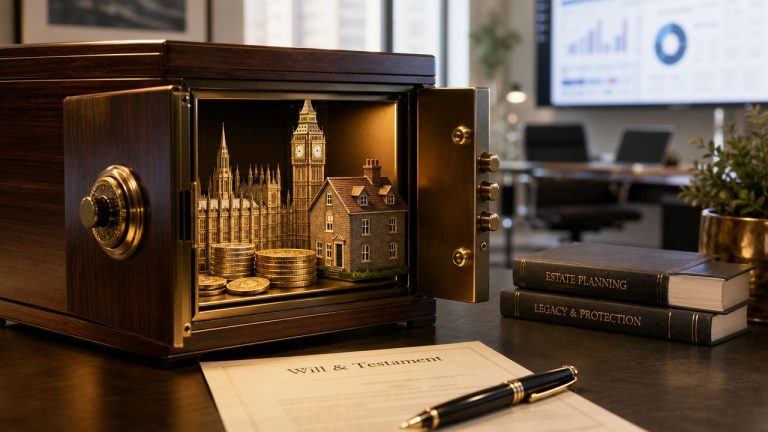
A trust is best thought of as a financial safety deposit box with a rulebook. It isn't a company and it isn't the same as owning assets personally. In UK law, a trust is a legal arrangement where one person holds assets for someone else's benefit, and the modern framework was shaped by the Statute of Uses (1535) and the Trustee Act 2000.
If you're a business owner or landlord, you've probably had the same moment many clients describe to me. The company is doing well, the property portfolio has grown, and what started as “I'll sort that later” has become a real question about control. Who gets what if something happens to you? How do you help family without handing over assets outright? Can you keep things organised without creating a tax mess?
That's where trusts enter the conversation.
The word sounds legalistic because it is. But the idea is surprisingly practical. Think of a trust as a locked box for shares, cash, investments, or property, with written rules on who manages it, who can benefit, and under what conditions. The box doesn't own itself. A person or people act as trustees and follow the rulebook.
That distinction matters. A trust isn't just a clever bit of paperwork. It can affect who controls assets, how income is dealt with, and what ongoing reporting lands on someone's desk. For UK families, landlords, and owner-managed businesses, that practical side is often more important than the textbook definition.
I'll keep this in plain English. No legal theatre. Just what a trust is, how it works, where people get confused, and why the Trust Registration Service has made trusts an ongoing compliance job rather than a one-off planning exercise. If you want a useful cross-border perspective on how families think about these structures, the Law Office of Bryan Fagan trust insights are a helpful companion read.
Introduction A Financial Safety Box for Your Assets
A client once put it neatly over coffee. “I don't want my son to inherit a problem. I want him to inherit something useful.”
He owned shares in his trading company and a couple of rental properties. His children were sensible, but still young. He didn't want assets drifting into the wrong hands, being sold too early, or creating arguments later. He also didn't want to give everything away now and lose control. That's the exact type of situation where people start asking, what is a trust, really?
The shortest useful answer is this. A trust is a legal arrangement. In UK law, it is not a separate legal person. The trustee holds legal title to the trust property, while the beneficiaries hold rights to benefit from it. That split is why trusts are used for asset protection, succession planning, and controlled distributions of income or capital, as noted in the Merriam-Webster explanation of trust ownership.
Why the safety box analogy works
A normal bank safety deposit box holds valuables. A trust does something similar in legal form. It can hold family wealth or business assets behind a set of instructions.
Those instructions answer practical questions:
- Who manages the assets: The trustees take charge.
- Who benefits: The beneficiaries receive income, capital, or both, depending on the terms.
- When money is released: The rules can delay access, stagger payments, or leave decisions to trustee judgement.
A trust is often less about hiding assets and more about controlling timing, responsibility, and decision-making.
Why business owners pay attention
If you own a company, a buy-to-let portfolio, or both, trusts become relevant when your wealth has outgrown the simplicity of “it's all in my own name”. At that point, the issue isn't just ownership. It's continuity.
You may want to protect younger family members from receiving too much too soon. You may want a surviving spouse to have income but not full control of capital. You may want someone independent involved because family and money don't always mix well.
That's why a trust sits somewhere between outright personal ownership and a company. It gives structure without becoming its own person in law.
The Core Concept What a Trust Really Is
A trust has three moving parts. Once you understand those, the jargon loses its bite.

The three key players
The settlor is the person who creates the trust and puts assets into it.
The trustee is the person, or group of people, who manages those assets.
The beneficiary is the person or class of people who can benefit under the trust.
A simple example helps. A parent wants money set aside for a child's future. The parent creates the trust. Two trusted adults act as trustees. The child is the beneficiary. The trustees follow the trust deed, which is the written rulebook.
If you've come across the tax term “settlement” before, it often overlaps with trust planning. Stewart Accounting has a useful primer on settlement legislation and why it matters.
The split that confuses most people
The hardest concept for most readers is this: the trustee can hold the asset without enjoying it.
That sounds odd until you compare it with a keyholder. If I give you the keys to a storage unit and tell you to manage what's inside for my children, you control access. But you don't own the contents for your own benefit.
That's how trust ownership works. In UK law, trustees hold and manage assets for beneficiaries, and the Trustee Act 2000 modernised trustee duties by requiring trustees to exercise care and skill when investing and managing trust property, as outlined in the background note on UK trust law and trustee duties.
What a trust is not
People often confuse trusts with other structures. They are not the same.
- Not a company: A company is a separate legal person. A trust isn't.
- Not a bank account: The account may be one asset held within the trust, but the trust itself is the arrangement.
- Not a will: A will says where assets go after death. A trust can operate during life, on death, or both.
Practical rule: If your first question is “Who owns it?”, a trust usually needs a second question. “Owned in what sense?”
Why the rulebook matters so much
The trust deed does the heavy lifting. It sets out trustee powers, beneficiary classes, and decision rules. Two trusts holding similar assets can operate very differently because their deeds say different things.
That's why “what is a trust” can't be answered properly with one dictionary sentence. The structure is simple. The consequences depend on the drafting.
Common UK Trust Types A Comparison
Choosing a trust is a bit like choosing the rules for a safe. The asset may be the same, shares, rental property, cash, but the access rules change everything. For a UK business owner or landlord, that choice affects who can benefit, how much freedom trustees have, and how much admin and tax reporting may follow.
That last point gets missed. A trust is not only a planning idea on paper. It can bring ongoing record-keeping, trustee decisions, tax returns, and in many cases registration under the Trust Registration Service.
Bare trusts
A bare trust is the simplest form. The beneficiary is absolutely entitled to the asset and any income from it, even if the legal title sits with the trustee for the time being.
In practical terms, the trustee is holding the asset rather than making judgment calls about it. There is very little room for discretion. If you picture a nominee arrangement with clear instructions, you are close to how a bare trust works.
That simplicity can be useful. It can also be limiting. If your aim is long-term control over when a child or family member receives value, a bare trust often does not give you much room to manoeuvre.
Usually suits: straightforward cases where certainty matters more than flexibility.
Interest in possession trusts
An interest in possession trust splits the benefit in two. One person has a current right to the income, while someone else may receive the capital later.
A common example is a second-marriage family. A surviving spouse receives income from investments or rent from a property during their lifetime, but the capital is preserved for children from an earlier relationship. That arrangement can reduce family tension because it answers two different needs at once. One person gets support now. Another group keeps a longer-term claim on the asset.
For landlords, this type can make sense where rental income needs to support one family member, but the property itself is meant for the next generation.
Usually suits: families who want to separate present income from future ownership.
Discretionary trusts
A discretionary trust gives trustees the widest decision-making power. The beneficiaries are usually named as a group or class, but no individual has an automatic right to a specific payment unless the trustees choose to make one.
This works well when life is unlikely to stay tidy. Children may mature at different speeds. One family member may need help with school fees, another with a house deposit, and another may need nothing for years. A discretionary trust lets trustees respond to those changes instead of being locked into a fixed formula.
That flexibility has a cost. Trustees need good judgment, proper records, and a clear process for decisions. For UK business owners, that matters if the trust holds company shares. For landlords, it matters if the trust receives rental income and trustees must decide how and when to distribute it.
Usually suits: families who need flexibility and are prepared for more trustee involvement and administration.
Settlor-interested trusts
A settlor-interested trust is a trust where the person who created it can still benefit, directly or indirectly. This is the point where many tidy planning ideas start to get messy.
Why? Because if you put assets into a trust but can still enjoy the benefit, HMRC may still look at those assets or the income as closely connected to you for tax purposes. In plain English, you may have given away legal ownership without getting the clean tax result you expected.
For that reason, these trusts need careful drafting and careful tax advice. They are less about choosing a trust "type" for convenience and more about understanding the consequences if the settlor stays in the picture.
Usually suits: narrower situations where the tax position has been reviewed properly before anything is signed.
UK Trust Types at a Glance
| Trust Type | Beneficiary's Rights | Trustee's Control | Common Use Case |
|---|---|---|---|
| Bare Trust | Clear and immediate entitlement | Low discretion | Holding assets in a simple, straightforward arrangement |
| Interest in Possession Trust | Current right to income, with capital often passing later | Control mainly over managing the capital | Supporting one person now while preserving value for others later |
| Discretionary Trust | No automatic right to each payment | High discretion | Family wealth planning where circumstances may change |
| Settlor-Interested Trust | Depends on the deed and the settlor's retained benefit | Varies, often with added tax sensitivity | Cases where the settlor remains connected to the benefit |
Which one tends to suit which situation
If you want a trust that is easy to understand and leaves little room for debate, a bare trust is often the clearest fit.
If you need to support one person from income while keeping the underlying asset for someone else, an interest in possession trust often matches that goal more neatly.
If your real concern is uncertainty, family change, uneven financial maturity, changing business roles, or unequal need, a discretionary trust is usually the trust that earns a serious discussion.
The practical question is not only, "Which trust sounds right?" It is also, "Who will run it, how will decisions be recorded, what tax filings will arise, and does TRS registration apply?" For many UK business owners and landlords, those day-to-day responsibilities are what separate a workable trust from an expensive headache.
Practical Uses for Business Owners and Landlords
For business owners and landlords, a trust isn't an abstract legal device. It changes the way assets are held, how income is taxed, and how beneficiaries become entitled to distributions. HMRC's Trust Registration Service has also pushed trusts into a more formal reporting structure, so legal form and tax treatment have to be considered together, as explained in this overview of trusts and reporting considerations.

Succession without giving everything away
Take a company director who wants children involved eventually, but not immediately. A trust can sit between “I own all the shares” and “the children own them outright”.
That can help where the next generation is still learning the trade, where family members have different levels of financial judgement, or where the founder wants a framework for staged control rather than a cliff-edge handover.
For a landlord, the same logic applies to property wealth. You may want future family benefit without immediate unrestricted access.
Why this matters emotionally as well as financially
Succession planning is rarely just a tax conversation. It's about confidence. Many owners don't mind passing value on. They mind passing control on too early.
A trust can provide a middle ground. Not because it removes all risk, but because it lets you decide the rules in advance.
A way to ring-fence decision-making
People often use the phrase asset protection too casually. A trust isn't a magic shield, and it won't rescue poor planning after a problem has already arrived.
Still, in the right circumstances, a trust can help separate who controls an asset from who benefits from it. That distinction can matter in family protection planning, vulnerability planning, and situations where you want assets managed under clear fiduciary duties rather than left to personal impulse.
If the real goal is “I want this asset looked after properly for specific people”, a trust may fit better than outright gifting.
A short explainer can help visual learners, especially if you're comparing trusts with simpler ownership routes.
Tax changes with the structure
At this stage, clients often expect a neat answer and get an annoying accountant's answer instead. It depends.
Trusts can affect Inheritance Tax, Capital Gains Tax, and Income Tax. The result turns on the type of trust, the assets involved, who benefits, how income is distributed, and whether the settlor still has an interest.
That's why “put it in trust and save tax” is dangerous pub advice. Sometimes a trust is tax-efficient. Sometimes it isn't. Sometimes the trust is worthwhile for control reasons even when the tax answer is neutral or less attractive.
Two quick examples
- Business shares: A founder wants to earmark value for children but keep distributions controlled and professionally managed.
- Rental property: A parent wants family benefit from property income but doesn't want a young adult beneficiary making immediate sale decisions.
In both cases, the trust is doing more than shifting ownership. It is setting governance around family wealth.
How to Set Up a Trust The Key Steps
A trust setup usually starts with a practical problem, not a legal document.

A landlord wants rental income used for children, but does not want the property sold at the wrong time. A business owner wants shares ring-fenced for family, while keeping decisions orderly and documented. In both cases, the trust is only part of the job. The other part is getting the paperwork, asset transfer, registration, and tax process right from day one.
Start with the real objective
Start with one clear sentence: what is this trust meant to do?
That sentence might be, "hold company shares for my children until they are mature enough to benefit sensibly," or "keep a rental property under trustee control so income can support family members without giving anyone immediate sale rights." If the goal is fuzzy, the deed usually ends up fuzzy too. That is when families later discover the trust allows something they never intended, or blocks something they assumed would be allowed.
A trust works like a rulebook attached to an asset. If the rulebook is vague, trustees and beneficiaries are left guessing.
Choose trustees with staying power
Trustees hold the legal title and make the decisions, so this choice deserves the same care you would give to appointing company directors.
You want people who can read financial information, ask awkward questions when needed, and keep going years after the initial signing meeting. They also need to stay even-handed. That matters more in family trusts than people expect, especially where one beneficiary needs money now and another may benefit later.
A simple checklist helps:
- Capable: comfortable dealing with accountants, solicitors, banks, and HMRC
- Fair-minded: able to act for all beneficiaries, not just the loudest one
- Available: willing to sign documents, review decisions, and respond on time
- Practical: able to deal with assets such as shares, property, or investment accounts
Family trustees can work well. An independent trustee can also be sensible where there is tension in the family, a valuable property portfolio, or a trading business involved.
Draft the trust deed properly
The deed is the instruction manual. It sets out who the beneficiaries are, what powers the trustees have, how income and capital can be used, and what decision-making rules apply.
Loose drafting causes expensive trouble later. For example, if the settlor might still benefit in some way, the tax treatment can change sharply. Earlier in the article, we touched on that risk. Stewart Accounting's guide to when a settlor retains an interest in settled property explains why that detail needs careful handling.
A well-drafted deed should answer the questions your family is likely to ask in five years, not just the questions raised on signing day.
Transfer the assets into the trust correctly
Signing the deed does not, by itself, move the asset.
Cash must be paid in. Shares usually need stock transfer paperwork and updated records. Property may need a formal transfer, Land Registry steps, lender consent, and tax review before anything is signed. If that transfer process is incomplete, you can end up with a valid trust document but the wrong person still owning the asset.
That gap causes confusion fast. It can also undermine the tax treatment everyone thought they were creating.
Register the trust and set up the admin from the start
For UK business owners and landlords, this is often the part that gets missed. A trust is not just a legal arrangement that merely sits in a drawer. It can bring ongoing reporting duties, record-keeping, and updates through HMRC's Trust Registration Service.
Treat that as part of the setup, not as an afterthought. Decide who will keep the trust records, who will monitor deadlines, and who will deal with tax returns or changes in trustee or beneficiary details. If nobody owns that process, the trust can create avoidable compliance problems even when the original planning was sensible.
A good setup gives you more than a signed deed. It gives you a structure that can be run.
Managing a Trust Trustee Duties and Governance
A trust only works well if the trustees do the job properly. That sounds obvious, but many families treat the trustee role as honorary. It isn't.
The modern framework matters here. UK trust law developed through equity and the Court of Chancery, and later legislation such as the Trustee Act 2000 modernised trustee duties by requiring care and skill in investment and management decisions. In practical terms, trustees are stewards with obligations, not placeholders.
What trustees actually do
The day-to-day work often includes:
- Managing assets: Looking after property, investments, cash, or shares sensibly.
- Keeping records: Minutes, decisions, valuations, and supporting documents need to be retained.
- Handling tax administration: Trustees may need to file trust tax returns and maintain accurate reporting. Stewart Accounting's guide to trusts and income tax responsibilities is a solid starting point.
- Making distribution decisions: Where the trust gives discretion, trustees must exercise it properly and fairly.
Governance matters more than people expect
Trustee decisions should be documented. If one beneficiary later asks, “Why was that payment made?” there should be a paper trail showing the reasoning.
That's especially important where the trust owns multiple assets or where distributions are uneven over time. Good governance doesn't remove conflict, but it does give trustees a defensible process.
If you're dealing with large volumes of paperwork, a document tool such as a Financial document AI agent can help trustees review records and tax documents faster, though it shouldn't replace legal or accounting judgement.
Trustees should behave like careful managers of someone else's wealth, because that's exactly what they are.
The quiet risk in family trusts
The biggest operational risk is often not tax. It's drift.
Nobody updates records. Nobody checks reporting deadlines. The original trustee loses interest. Family assumptions replace written decisions. That's when simple trusts become messy.
A well-run trust needs periodic attention, clear files, and trustees who understand that acting informally is still acting.
FAQs and When to Seek Professional Advice
The questions that matter most usually show up once the theory meets real life. You understand what a trust is, then you ask the practical questions. Who controls it? What does it cost to run? What will HMRC expect from me next year?
For UK business owners and landlords, that last question often decides whether a trust is useful or a burden. A trust can protect assets and help with succession planning, but it also creates an ongoing job. Someone has to keep records, review decisions, deal with tax filings, and check whether Trust Registration Service obligations apply.
Can I be a trustee of my own trust
Sometimes, yes. The trust deed and the type of trust matter.
But business owners often get caught out in this situation. Keeping a hand on the steering wheel may feel sensible, especially if the trust holds company shares or a property you built up over years. Yet too much control, or too much personal benefit, can change the tax outcome and weaken the planning you were trying to achieve in the first place.
A simple way to look at it is this. If you give assets away with one hand but keep effective control with the other, HMRC may not view that arrangement in the way you hoped.
Are trusts expensive to run
They can be, even where the original setup looked straightforward.
The cost is often less about one-off legal drafting and more about the steady drip of administration. Trustees may need to keep accounts, file tax returns, hold meetings, record decisions, review beneficiary positions, and update HMRC where required. If the trust owns rental property or business assets, the paperwork and judgement calls usually increase.
That is why a trust should be treated less like a document in a drawer and more like a small financial operation with its own rules.
Do all family trusts need to think about registration
Yes, they should at least check.
Registration is one of the most misunderstood parts of trust planning in the UK. Some families assume a private arrangement stays private. In practice, many trusts need a review to see whether the Trust Registration Service applies, what details must be reported, and when changes need to be updated.
The exact position depends on the type of trust and what it holds, so this is not an area for guesswork. If a trust is meant to hold assets for years, the better question is not just "can we set this up?" but "can we keep it compliant without creating an admin problem every year?"
When advice is worth paying for
Professional advice is usually money well spent if any of these apply:
- Business assets are involved: Shares, partnership interests, and trading structures need careful drafting and tax review.
- Property sits in the trust: Rental income, capital gains, mortgage issues, and occupation by family members can all affect the outcome.
- You want to keep influence after gifting: That can create tax problems if the arrangement gives you ongoing benefit or control.
- TRS or HMRC reporting may apply: Registration mistakes are often cheaper to prevent than to untangle later.
- There is family sensitivity: Uneven benefit, second families, or unclear expectations can turn a sensible plan into a dispute.
A trust works like a locked box with several keyholders. The box may protect what is inside, but only if the people holding the keys understand the rules for opening it, recording what they did, and reporting the right details to HMRC.
Used well, a trust can be a smart long-term tool. Used casually, it can become an expensive misunderstanding, with the wrong tax treatment, poor records, and trustees who did not realise they had taken on an active compliance role.
If you're weighing up whether a trust fits your business, property portfolio, or family plans, Stewart Accounting Services can help you assess the tax, compliance, and practical management side before you commit.