

What Records Do I Need for My Year-End Accounts? A Simple Checklist

Does the thought of your year-end accounts bring on a familiar feeling of stress? The frantic search for receipts, the worry about missing something crucial, and the fear of an HMRC penalty-it’s enough to overwhelm any business owner. It’s no wonder so many people ask, ‘Do blogs answering a question on an accounting topic actually provide clear guidance?’ We believe they absolutely should, and that’s precisely why we’ve created this guide.
We’re here to help take that burden off your hands. Forget the confusion and last-minute panic. In this article, we provide a straightforward, simple checklist of every record you need for a smooth and efficient year-end. Following our advice will not only ensure you are fully compliant with HMRC but will also save you valuable time, reduce stress, and give you the confidence that comes from being in complete control of your business finances.
Why Good Record-Keeping is a Game-Changer (Not Just a Chore)
For many business owners, the thought of ‘bookkeeping’ brings on a headache. It feels like a chore-a compliance task to be put off until the last minute. But what if you viewed it as the key to unlocking the three freedoms you went into business for in the first place? More time, more money, and more peace of mind.
It’s a common query we see: do blogs answering a question on an accounting topic really help business owners? We believe they do, especially when they reframe essential tasks. Good record-keeping isn’t just about satisfying the tax man; it’s the bedrock of a healthy, growing business. It’s how you claim every allowable expense to lower your tax bill, make smarter decisions, and secure funding when you need it most. It transforms your finances from a source of stress into a tool for freedom.
Meeting Your Legal Obligations
Let’s get the legal bit out of the way first. Both HMRC and Companies House require you to keep accurate financial records, often for up to six years. Failing to do so can lead to stressful investigations and costly penalties. But there’s no need to worry. With a simple, organised system in place-something we can help you set up-meeting your obligations becomes a smooth and straightforward part of your routine, taking the stress completely off your hands.
Unlocking Business Insights
This is where your records transform from a compliance task into your most powerful business tool. Your fundamental accounting records are more than just historical documents; they are your roadmap for growth. They provide clear, actionable insights by helping you:
- Identify Your Most Profitable Areas: See exactly which products or services are driving your success, so you can focus your efforts there.
- Control Your Spending: Easily track where your money is going, spot unnecessary costs, and find opportunities to make significant savings.
- Plan for the Future: Use accurate historical data to create realistic cash flow forecasts and make confident decisions about expansion or investment.
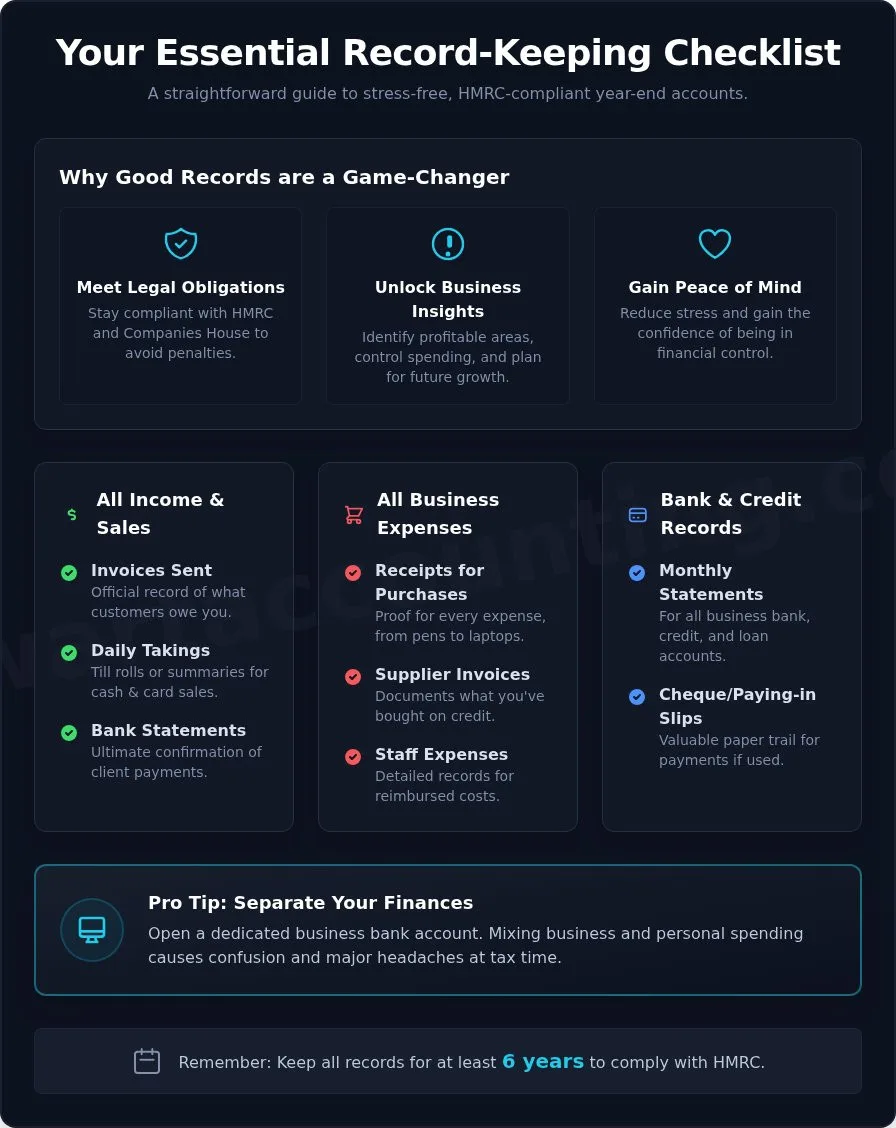
The Core Records Every Business Must Keep: Your Essential Checklist
Keeping accurate business records can feel like a chore, but it’s the bedrock of a healthy, stress-free business. It’s how you track performance, manage cash flow, and ensure you’re prepared for tax season. This is a common area of concern for our clients, and it’s a perfect example of why do blogs answering a question on an accounting topic like this one are so valuable. Think of this checklist as your simple guide to what you absolutely must hold on to.
All Income and Sales Records
This is the proof of every pound your business has earned. Keeping these records organised means you’ll always have a clear picture of your financial health and can easily verify your income for tax purposes.
- Copies of invoices sent: This is your official record of what customers owe you. It’s essential for chasing payments and calculating your total revenue.
- Records of daily takings: If you run a retail shop or café, your till rolls or daily sales summaries are crucial for tracking cash and card transactions accurately.
- Bank statements showing payments: Your bank statement is the ultimate confirmation that a client has paid. It provides a clear, dated trail of all money coming into the business.
All Business Expenses and Purchases
Every legitimate business expense can potentially reduce your tax bill, but only if you have the proof. Without a receipt, you can’t claim the cost. It’s as simple as that. We can help you take the stress out of this by managing it for you.
- Receipts for all purchases: From a pack of pens to a new laptop, keep the receipt for every single item you buy for your business. Digital copies are perfectly fine!
- Supplier invoices and statements: These documents show what you’ve bought on credit and what you owe, helping you manage your liabilities.
- Records of staff expenses: If you reimburse staff for travel, meals, or other costs, you must keep detailed records and receipts for those claims.
Business Bank and Credit Card Statements
One of the best things you can do for your business is to open a separate business bank account. Mixing business and personal spending is a recipe for confusion and can cause major headaches when it comes to preparing your accounts. Keeping them separate is a fundamental principle of good financial management, and tax authorities worldwide agree. For instance, the detailed IRS recordkeeping guidelines from the US highlight how clear separation of funds is crucial for accurate reporting.
- Monthly statements: Keep the statements for all business bank accounts, credit cards, and loan accounts. They provide a complete overview of your financial activity.
- Cheque book stubs and paying-in slips: While less common now, if you still use them, these slips provide a valuable paper trail for payments made and received.
Specific Records for Your Business Structure
One of the most common sources of stress for business owners is knowing exactly which records to keep. The requirements aren’t one-size-fits-all; they change depending on your company’s legal structure. This is where blogs answering a question on an accounting topic can be so helpful-they provide tailored advice that cuts through the confusion. While the specifics vary by business type and location, the fundamental principles of what to keep are universal. Even major tax authorities like the US Internal Revenue Service offer detailed guidance on what kind of records to keep, highlighting the importance of thorough documentation for any business.
Here in the UK, the records you must maintain are directly linked to your business type. Let’s break down the key differences to help you stay compliant and stress-free.
For Limited Companies
As a director of a limited company, you have specific legal responsibilities. Your company is a separate legal entity, and your records must clearly reflect this distinction. Keeping these documents in order is crucial for filing accurate accounts and tax returns. We can help you manage:
- Directors’ loan account: A detailed record of any money you have personally loaned to the company or borrowed from it.
- Dividend records: Copies of dividend vouchers and the board meeting minutes that officially approve the payments to shareholders.
- Share capital details: A register of shareholders and any changes to the company’s share structure throughout the year.
For Sole Traders and Partnerships
If you are a sole trader or in a partnership, there is no legal distinction between you and your business. This means your personal and business finances can easily get mixed up. Meticulous records are essential to accurately calculate your profits for your Self Assessment tax return. Key records include:
- Personal funds invested: A clear log of any money from your personal accounts that you’ve put into the business.
- Drawings: A detailed account of all money or goods you have taken from the business for your own personal use.
If You Are VAT Registered
Regardless of your business structure, if you are registered for VAT, you have additional record-keeping duties for HMRC. Staying on top of your VAT obligations is non-negotiable and something we can easily take off your hands. You must keep:
- Your VAT account: A summary of your VAT inputs (what you’ve paid on purchases) and outputs (what you’ve charged on sales).
- Copies of VAT returns: Keep a copy of every VAT return you submit to HMRC.
- Special scheme records: If you use a specific scheme, like the Flat Rate Scheme, you must keep the records required to prove you are eligible.
Other Important Records You Might Need
Beyond the daily invoices and bank statements, there are a few other key records that can make or break your year-end accounts preparation. Forgetting these can lead to a stressful scramble for information when deadlines are looming. Many business owners ask us, ‘Do blogs answering a question on an accounting topic really make a difference?’ We believe they do, especially when they highlight the details that save you time and worry down the line.
Covering these less common but equally vital records demonstrates thorough expertise and helps you stay organised, preventing any last-minute panic.
Fixed Asset Register
A fixed asset is a significant item your business owns and uses for more than a year, such as a company vehicle, office computers, or machinery. Your register should be a simple list of each asset, its purchase date, and its original cost. This isn’t just for tidy record-keeping; it’s absolutely essential for correctly calculating depreciation, which is a key part of your year-end accounts and can help reduce your tax bill.
Payroll Records (If You Have Employees)
If you have a team, maintaining organised payroll records is a legal requirement and crucial for HMRC. Keeping these documents in order ensures everything runs smoothly. You’ll need:
- Payslips, annual P60s for current staff, and P45s for any leavers.
- Details of any employee benefits or expenses provided (recorded on a P11D form).
- Proof of payments made to HMRC for PAYE and National Insurance.
- Records of all contributions made to your workplace pension scheme.
Stock and Work in Progress
For businesses that sell physical products, your stock is a major asset. You need a detailed record of your stock-take at the financial year-end, including how it was valued (typically at its cost price). This figure is critical because it directly impacts the calculation of your ‘cost of sales’ and, ultimately, your business’s reported profit for the year.
Keeping these records organised provides a complete financial picture and prevents unnecessary delays. We find that good blogs answering a question on an accounting topic can empower business owners, but if managing the details feels overwhelming, we are here to help. Let us take it off your hands for a smoother, stress-free process.
How to Organise Your Records and Make Year-End Stress-Free
Keeping accurate and organised financial records is the foundation of a healthy business. It’s not just a legal requirement; it’s essential for making smart decisions and achieving stress-free year-end accounts. A simple, consistent system can save you countless hours of worry. Many business owners wonder, do blogs answering a question on an accounting topic provide real help? When it comes to setting up your systems, the right advice is invaluable.
Choosing Your System: Digital vs. Paper
While a shoebox of receipts is a classic cliché, it’s far from efficient. A paper-based system can feel simple initially but quickly becomes cumbersome and prone to error. We strongly recommend a digital approach. Cloud accounting software like Xero streamlines the entire process, linking directly to your bank accounts and providing a real-time view of your finances. Paired with apps for receipt scanning, it almost entirely eliminates manual data entry, saving you time and improving accuracy.
How Long Must You Keep Records?
Understanding HMRC’s rules on record retention is crucial to staying compliant. The requirements differ slightly depending on your business structure:
- Limited Companies: You must keep records for 6 years from the end of the last company financial year they relate to.
- Sole Traders & Partnerships: You need to keep your records for at least 5 years after the 31st January submission deadline of the relevant tax year.
Whether your records are paper or digital, ensure they are stored securely to protect against loss, damage, or cyber threats.
Let Us Take It Off Your Hands
The most effective way to guarantee peace of mind is to let a professional handle it for you. At Stewart Accounting Services, we do more than just process your numbers. We help you set up efficient, modern systems like Xero and can manage your bookkeeping throughout the year. This ensures everything is accurate, compliant, and always up to date.
Think of it not as a cost, but as an investment in your own time and mental clarity. By letting us take the bookkeeping burden off your hands, you’re free to focus on what you do best: running and growing your business.
Get in touch for a free, no-obligation chat about your business.
From Checklist to Clarity: Making Your Year-End Accounts Simple
Keeping accurate records isn’t just about ticking a compliance box; it’s the foundation for a stress-free year-end and smarter business decisions. By using this checklist to organise your core documents-from bank statements and receipts to sales invoices-you transform a daunting task into a manageable process. We find that many business owners search for terms like “Do blogs answering a question on an accounting topic” because they are looking for clear, straightforward advice, which we aim to provide.
But you don’t have to manage it all alone. If you’re ready to take the final step towards complete peace of mind, our team of Fully Qualified Chartered Accountants is here to help. As local experts specialising in helping small and medium-sized businesses grow across Central Scotland, we can take the complexity of year-end accounts completely off your hands.
Ready to make your year-end simple? Contact our friendly team in Alloa, Stirling, or Falkirk today.
Let us help you achieve the freedom of more time, more money, and a lot less worry.
Frequently Asked Questions
What happens if I’ve lost a receipt for a business expense?
Don’t panic, it’s a common problem. While an original receipt is always best, HMRC can accept alternative proof of an expense. You should find the transaction on your business bank or credit card statement and make a note of what the purchase was for. Having a clear, corresponding entry in your records will help support your claim. Consistent, good record-keeping makes these small issues much less stressful to deal with when they happen.
Can I use my personal bank account for my business as a sole trader?
While you legally can as a sole trader, we strongly advise against it. Mixing personal and business transactions makes bookkeeping incredibly complicated and time-consuming. It’s difficult to track your business performance and can cause major headaches when preparing your Self Assessment tax return. Opening a separate business bank account provides clarity, simplifies your accounting, and makes your financial life much easier to manage.
Do I need to keep records if my business is making a loss?
Yes, absolutely. You are still required by HMRC to keep accurate financial records and file a tax return, even if you don’t have any tax to pay. More importantly, you can carry forward business losses to offset against profits in future years. This can significantly reduce your tax bill when your business becomes profitable. Without proper records, you cannot prove these losses and will miss out on this valuable tax relief.
What is the difference between bookkeeping and year-end accounts?
Bookkeeping is the day-to-day process of recording all your financial transactions, such as sales invoices, supplier bills, and bank payments. It’s the foundation of your financial records. Year-end accounts are the formal reports prepared from your bookkeeping records after your business’s financial year has finished. These accounts summarise your performance, calculate your profit or loss, and form the basis for your tax return to HMRC.
How can accounting software like Xero make record-keeping easier?
Software like Xero transforms record-keeping from a manual chore into a streamlined process. It connects directly to your business bank account, automatically importing transactions. You can snap photos of receipts with your phone and upload them instantly, eliminating lost paperwork. This is why many blogs answering a question on an accounting topic recommend these tools; they save you significant time, reduce errors, and give you a real-time view of your finances.
Is an email confirmation a valid record for an expense?
Yes, in most cases an email confirmation or digital invoice is a perfectly valid record for an expense. To be acceptable for HMRC, it must contain all the key information: the supplier’s name, the date of purchase, a clear description of the goods or services, and the total amount paid, including any VAT. It is good practice to save a digital copy of these emails, for example as a PDF, along with your other business records.