
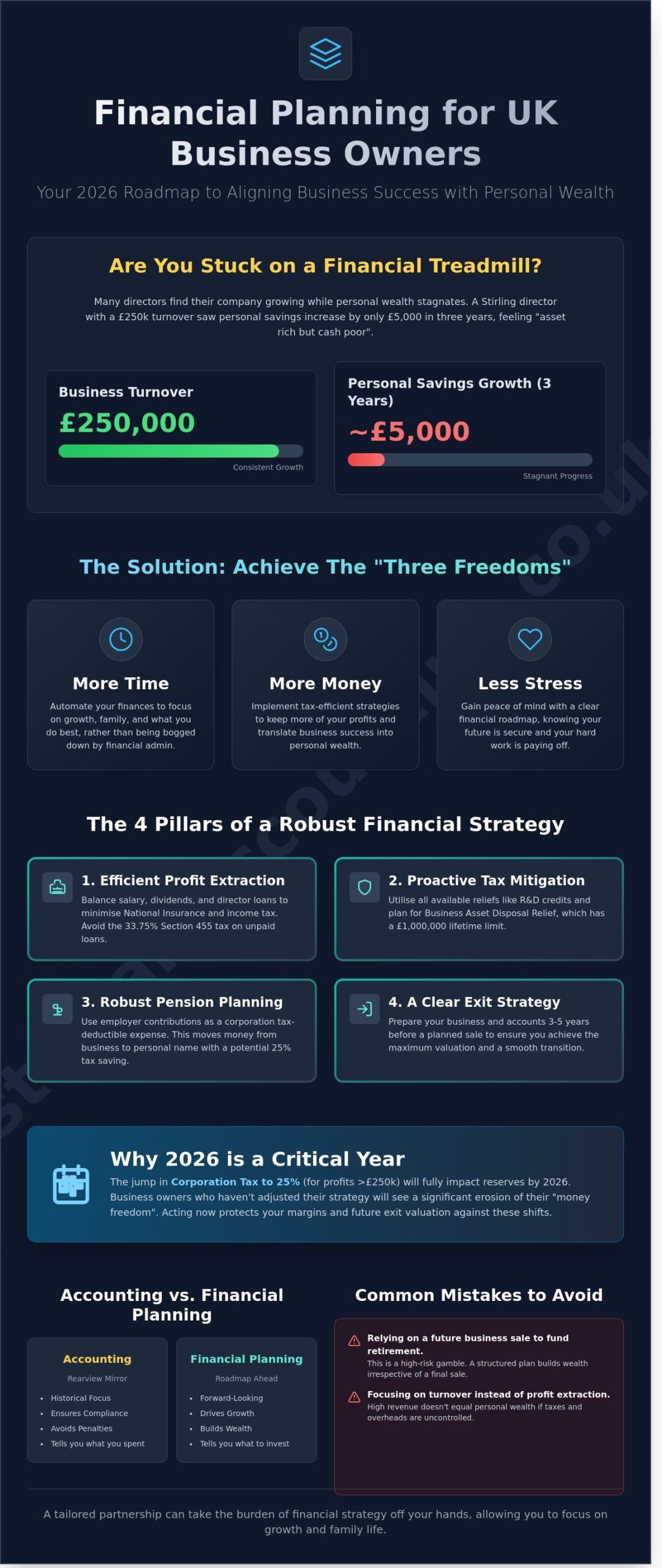
Last Tuesday, a director in Stirling with a £250,000 annual turnover realised that despite their company’s consistent growth, their personal savings hadn’t increased by more than £5,000 in three years. You probably agree that it’s exhausting to run a profitable firm while feeling like you’re stuck on a financial treadmill. You’ve put in the long hours, but the high tax burden on profit extraction and the lack of a clear exit strategy often leave you feeling more drained than rewarded. Mastering financial planning for business owners UK is the only way to ensure your hard work actually translates into personal wealth rather than just higher overheads.
We’ll show you how to align your business success with your personal goals to achieve the “three freedoms”: more time, more money, and significantly less stress. This 2026 guide provides a clear roadmap for tax-efficient cash extraction and a structured path toward a comfortable retirement. We’ll explore how to take the complex financial weight off your hands so you can focus on what you do best while your wealth grows in the background.
Key Takeaways
- Understand how strategic financial planning for business owners UK aligns your company’s performance with your personal wealth goals for a more secure future.
- Learn to build a robust financial foundation using tax-efficient strategies that help you keep more of your profits and grow your long-term assets.
- Discover the roadmap to achieving the “Three Freedoms”-more time, more money, and less stress-by automating your business finances.
- Identify high-risk mistakes to avoid, such as relying entirely on a future business sale to fund your retirement.
- See how a tailored partnership can take the burden of financial strategy off your hands, allowing you to focus on growth and family life.
What is financial planning for business owners in the UK?
Financial planning for business owners UK is the strategic process of aligning your company’s performance with your personal wealth goals. It isn’t just about ensuring your business is profitable; it’s about making sure that profit translates into a secure future for you and your family. Many directors find themselves “asset rich but cash poor” because they focus entirely on turnover without a clear plan to extract value efficiently. True financial planning bridges this gap by treating your business as a vehicle to achieve your desired lifestyle.
This process requires a deep understanding of corporate finance and how it intersects with personal taxation. It involves more than just picking a pension fund. You need to coordinate four critical pillars: efficient profit extraction, proactive tax mitigation, robust pension contributions, and a clear exit strategy. When these elements work together, you stop reacting to bank balances and start driving toward a specific financial destination. We focus on giving you more time, more money, and less stress, which we call the “Three Freedoms.”
- Profit Extraction: Finding the right balance between a small salary, dividends, and director loans to keep your tax bill low.
- Tax Mitigation: Using current UK legislation to claim every available relief, such as Research and Development (R&D) credits or the £1,000,000 Business Asset Disposal Relief limit.
- Pension Planning: Using employer pension contributions as a corporation tax-deductible expense, which effectively moves money from your business to your personal name with a 25% tax saving for many companies.
- Exit Strategies: Preparing your accounts three to five years before a sale to ensure you achieve the maximum valuation multiple.
The difference between accounting and financial planning
Standard accounting is often a look in the rearview mirror. It focuses on historical accuracy, ensuring your Limited Company meets HMRC deadlines and stays compliant with the Companies Act 2006. While this is vital for avoiding penalties, it doesn’t grow your wealth. Financial planning is the forward-looking counterpart. It uses your historical data to forecast future cash flows and build a roadmap for your “Three Freedoms.” You need a Chartered Accountant who doesn’t just tell you what you spent last year but tells you what you can afford to invest next year. We take the burden of compliance off your hands so you can focus on these strategic decisions.
Why 2026 is a critical year for UK business owners
The financial landscape is shifting rapidly, making 2026 a pivotal year for your strategy. The jump in Corporation Tax to 25% for profits over £250,000, which began in April 2023, will have a cumulative impact on business reserves by 2026. Business owners who haven’t adjusted their dividend policies or capital expenditure plans will see a significant erosion of their “money freedom.”
Current ONS data shows that inflation trends are still volatile, directly affecting business valuations. If you plan to retire or exit by 2030, the steps you take in 2026 to protect your margins will dictate your final payout. We use this timeline to help you recalibrate your retirement pots against the rising cost of living. Success isn’t just a high turnover; it’s having the peace of mind that your business can withstand these external pressures while still funding your personal dreams.
The pillars of a robust business financial strategy
Building a secure future for yourself and your family requires a strategy that goes beyond basic bookkeeping. Effective financial planning for business owners UK involves a multi-layered defence system designed to shield your hard-earned assets while fueling future growth. You need to build a structure where tax efficiency, risk management, and succession planning work in harmony. If one pillar is weak, the whole building risks a tilt during economic shifts. We often see that succession planning is overlooked; however, you should start this process at least five years before you intend to step away to ensure the business remains a viable asset rather than a job you can’t leave.
Tax-efficient profit extraction
Extracting money from your Limited Company shouldn’t feel like a penalty. By the 2026 tax landscape, the gap between dividend rates and salary levels will require even tighter management to avoid overpaying the Treasury. Currently, the first £500 of dividends is tax-free, but most directors benefit from a low salary and high dividend model to minimise National Insurance. Using your business to fund your personal life requires precision. You can utilise Director’s Loans for short-term cash flow, but these must be repaid within nine months of your year-end to avoid a 33.75% Section 455 tax charge. Managing expenses correctly ensures you aren’t paying for business-related costs with post-tax personal income.
- Salary vs. Dividends: Balancing these to stay below the higher rate tax thresholds.
- Expense Management: Ensuring every allowable cost is claimed to reduce Corporation Tax.
- Director’s Loans: Using them as a temporary tool without triggering HMRC penalties.
Business protection and risk mitigation
Protecting the business from the unexpected is a core component of financial planning for business owners UK. According to data from The Business Finance Guide, many SMEs lack a contingency plan for the loss of a founder. Key Person Insurance provides a lump sum to the business to cover recruitment costs or lost revenue if a vital member of the team falls ill. Relevant Life Insurance is another win for directors. The company pays the premiums, it’s a deductible business expense, and it doesn’t count as a benefit in kind. We also recommend building a cash buffer equal to 3 to 6 months of operating costs to weather UK inflation spikes and economic volatility.
- Key Person Cover: Protecting the company’s financial stability in your absence.
- Relevant Life: A tax-efficient way for the business to provide your personal life cover.
- Cash Reserves: Maintaining liquidity to handle sudden market shifts or late payments.
Pensions as a corporate tool
Smart directors use pensions as more than just a retirement pot. Employer pension contributions are usually treated as an allowable business expense, which can reduce your Corporation Tax bill by up to 25% for profits over £250,000. A Self-Invested Personal Pension (SIPP) gives you control over your investment choices. If you want more flexibility, a Small Self-Administered Scheme (SSAS) allows the pension fund to buy your business premises and lease them back to the company. This moves money from the business into a protected environment while still supporting your operational needs. It’s an efficient way to achieve our “three freedoms” by growing your wealth while reducing your tax burden.
- Corporation Tax Savings: Turning tax liabilities into long-term personal wealth.
- SSAS Property Investment: Using pension funds to own your office or warehouse.
- SIPP Flexibility: Tailoring your investment strategy to match your risk profile.
If you want to explore how these strategies fit your specific goals, we can help take the complexity off your hands and ensure your strategy is watertight.
Achieving the Three Freedoms: Time, Money, and Mind
Stewart Accounting Services focuses on three specific outcomes for every client we partner with. We believe that professional financial planning for business owners UK should deliver more than just a tax return at the end of the year. Our goal is to help you achieve the “Three Freedoms”: more time, more money, and more mind. By structuring your finances correctly, you stop being a slave to your spreadsheets and start acting as the visionary leader your company needs.
Organising for “More Time”
Time is the only resource you can’t buy back, yet many directors in Central Scotland spend over 12 hours a month on manual bookkeeping. We change this by implementing cloud accounting platforms like Xero to provide real-time financial clarity. When your bank feeds are automated and your receipts are scanned via mobile apps, the manual data entry disappears. This allows us to produce monthly management accounts that show exactly where you stand. You’ll stop working “in” the business on low-value admin tasks and start “planning for” the business. Our role is to take the heavy lifting off your hands so you can spend your weekends with family in Stirling or focusing on high-level growth strategies.
Strategies for “More Money”
Increasing your wealth isn’t just about selling more; it’s about keeping more of what you earn. We look for tax leakage and identify “hidden” costs that drain your personal wealth, such as duplicate software subscriptions or inefficient director loan structures. By benchmarking your business against industry standards in Alloa and Falkirk, we often find ways to improve net margins by 5% to 7%. Many owners forget the basics they learned when researching how to start a business, particularly the importance of lean operations. We revisit these foundations to ensure your bottom line is optimised. Reliable cash flow forecasting prevents missed opportunities by highlighting exactly when you have the surplus capital to invest in new equipment or staff.
Achieving “More Mind” (Less Stress)
The “night-time worry” is a common burden for entrepreneurs, usually involving fears of HMRC audits or unexpected VAT bills. We remove this anxiety by taking full responsibility for your compliance. Knowing that your accounts are handled by fully qualified Chartered Accountants provides a level of peace of mind that software alone cannot offer. We ensure you’re 100% compliant with the latest 2024 UK tax regulations, so there are no nasty surprises. Part of this mental freedom comes from knowing your “exit number.” When you have a clear financial plan that calculates exactly how much you need for a comfortable retirement or sale, daily operational hiccups feel less significant. It’s about turning “what if” into “what’s next.”
- Automation: We use Xero and integrated apps to cut your admin time by up to 60%.
- Tax Efficiency: Our proactive reviews ensure you never pay a penny more in Corporation Tax or National Insurance than necessary.
- Clarity: Regular meetings mean you always know your profit, your tax bill, and your cash position.
Effective financial planning for business owners UK is about creating a bridge between your current reality and your future goals. Whether you’re based in Alloa, Stirling, or Falkirk, our team provides the local expertise and professional support needed to make your business work for you, rather than the other way around. It’s time to take the stress off your hands and focus on what really matters.
Common financial planning mistakes to avoid
Many business owners delay their financial freedom by falling into predictable traps. It’s easy to focus on the daily grind while ignoring the structural flaws that undermine long-term security. Effective financial planning for business owners UK requires more than just a profitable year; it demands a clear separation between your company’s health and your personal wealth. Relying on gut instinct rather than data often leads to missed opportunities for growth and unnecessary tax burdens.
A frequent error is the failure to update plans as UK legislation shifts. For example, the 2024 reduction of the Dividend Allowance to just £500 caught many directors off guard. If you haven’t reviewed your withdrawal strategy since 2022, you’re likely overpaying. We see many clients who mix personal and business expenses, which complicates HMRC compliance and clouds your true profitability. Avoiding these common traps is a vital part of financial planning for business owners UK who want to protect their hard-earned wealth and achieve the “three freedoms” of more time, more money, and less stress.
The “Business is my Pension” myth
Relying solely on a future sale to fund your retirement is a high-risk gamble. Market conditions projected for 2026 suggest a tighter acquisitions environment where buyers will prioritise “turnkey” operations with minimal owner dependency. If your business can’t run without you, its value could drop by as much as 30% during negotiations. You should build external wealth through SIPPs or ISAs to ensure you aren’t stranded if a sale falls through. Accurate valuation isn’t about what you think it’s worth; it’s about EBITDA multiples and documented recurring revenue. Diversification ensures that even if the market dips, your lifestyle remains secure.
Inconsistent tax planning
Year-end panicking is the enemy of efficiency. Waiting until March to look at your numbers means you’ve already missed the chance to utilise key incentives. Many UK firms fail to claim Full Expensing, which allows a 100% tax deduction on qualifying plant and machinery investments. This isn’t just for heavy industry; it applies to various capital assets that drive growth. “Cheap” accounting often results in expensive mistakes because it lacks the proactive strategy needed to spot R&D tax credit eligibility or capital allowance opportunities. A year-round approach identifies these savings early, keeping more cash in your business bank account. We help you stay ahead of the curve so you don’t have to worry about surprise bills or missed deadlines.
- Ignoring the 2024 Basis Period Reform: This change affects how unincorporated businesses report profits and can lead to a significant one-off tax spike if not managed.
- Underfunding Protection: 40% of small business owners lack Key Person Insurance, leaving the company vulnerable if a founder becomes unable to work.
- Neglecting CGT Changes: With Capital Gains Tax annual exempt amounts reduced to £3,000 in April 2024, your exit strategy needs a modern perspective.
Don’t let avoidable errors stall your progress toward financial independence. Our team can take the stress off your hands by building a robust, compliant strategy that works for you every day of the year.
How Stewart Accounting Services takes it off your hands
We act as your dedicated strategic partner across Alloa, Stirling, Falkirk, and the surrounding areas. Our mission is simple: we want to enable you to achieve your personal and business ambitions without the weight of financial admin holding you back. We provide a tailored roadmap that bridges the gap between your Limited Company’s performance and your long-term personal goals. Since the tax changes in April 2024, including the reduction in the Dividend Allowance to £500, the need for precise financial planning for business owners UK has never been more critical for protecting your wealth.
From the daily grind of bookkeeping to the complexities of high-level tax planning, we handle every detail. This allows you to step away from the spreadsheets and focus on growth. We don’t just file forms; we look at the bigger picture. If your business is one of the 5.5 million small enterprises in the UK, you know that time is your most precious resource. Our job is to give it back to you. We take the stress out of compliance so you can enjoy the rewards of your hard work.
Our integrated approach
We believe that looking at the past is only half the job. While we produce precise Year End Accounts, we combine this with forward-looking advisory services. This integrated method ensures that every decision you make today supports your position twelve months from now. You won’t have to jump between different advisors or explain your history repeatedly. You get a single point of contact who understands your entire financial health. This continuity prevents vital details from slipping through the cracks, especially when you’re balancing business growth with personal pension planning.
Security is a major concern for any director. This is why our status as Fully Qualified Chartered Accountants is so important. It means we operate under strict professional standards and ethical codes. You aren’t just getting a bookkeeper; you’re getting a regulated professional who provides a safety net for your assets. This expertise is vital when navigating the 25% main rate of Corporation Tax or complex VAT regulations. We provide the peace of mind that comes from knowing your affairs are in expert hands.
Start your journey to the Three Freedoms
Our philosophy centres on the “Three Freedoms”: more time, more money, and more mind – leading to reduced stress. During your initial consultation, we’ll dive deep into your current setup. We don’t use a one-size-fits-all template. Instead, we look at your specific circumstances. Whether you’re a contractor concerned about IR35, a landlord managing a property portfolio, or a sole trader looking to incorporate, we’ll build a plan for you. We’ve helped over 200 local clients move from feeling overwhelmed to feeling in control of their future.
We’ll show you how to structure your withdrawals, optimise your pension contributions, and ensure your business is as tax-efficient as possible. This is proactive financial planning for business owners UK designed for the real world. Stop worrying about deadlines and start looking forward to your retirement. We make the process smooth, easy, and entirely transparent. It’s time to reclaim your schedule and focus on what you do best.
Contact Stewart Accounting Services today for a free consultation and let us take the burden off your hands.
Secure Your Three Freedoms Before 2026
Effective financial planning for business owners UK transforms your company from a source of daily stress into a vehicle for genuine freedom. By implementing a robust strategy today, you’ll gain back the time, money, and peace of mind you need to thrive. Our Fully Qualified Chartered Accountants specialise in removing the administrative burden, allowing you to focus on high-level growth while we handle the complexities of tax, VAT, and compliance.
With physical offices in Alloa, Stirling, and Falkirk, we provide local expertise that’s grounded in the Scottish business landscape. We’ve developed our proven “Three Freedoms” framework specifically to help ambitious owners scale their operations without burning out. We take the heavy lifting off your hands so you’re never left guessing about your cash flow or tax liabilities. Don’t let another year slip by with unorganised finances or missed opportunities. Take the first step toward a more profitable and balanced life by speaking with our dedicated team.
Book your free consultation with Stewart Accounting Services today. We’re ready to take the weight off your shoulders and help you build the business you’ve always envisioned.
Frequently Asked Questions
What is the most tax-efficient way to take money out of my business in 2026?
In 2026, the most tax-efficient strategy remains a combination of a low salary and dividends. You’ll set your salary at the secondary National Insurance threshold, which is currently £9,100 per year, to maintain your state pension record without paying extra tax. The remaining drawings should come from dividends, utilising your £500 tax-free allowance. This approach balances personal income needs while minimising your overall Corporation Tax and Income Tax liabilities for the year.
Can my Limited Company pay for my personal financial planning?
Your Limited Company can pay for up to £500 of pension-related financial planning advice per year for each employee as a tax-free benefit. Any costs above this £500 limit or advice unrelated to pensions are treated as a Benefit in Kind (BIK). This means you’d pay personal Income Tax on the value, and the company would pay Class 1A National Insurance at 13.8%. We’ll help you structure these payments to ensure you stay compliant.
How much should a UK business owner have in their pension?
A UK business owner should aim for a pension pot of at least £645,000 to achieve a comfortable retirement lifestyle according to the Pensions and Lifetime Savings Association 2024 standards. This figure provides an annual income of roughly £43,100. Effective financial planning for business owners UK involves using employer pension contributions to reduce your Corporation Tax bill by up to 25% while building this essential safety net for your future.
Is financial planning different for Scottish business owners?
Yes, financial planning is different for Scottish business owners because of the devolved Income Tax powers. In the 2024/25 tax year, Scotland has six tax bands compared to three in the rest of the UK, with the Advanced rate of 45% starting at £62,431. If your business is based in Stirling or Falkirk, we’ll tailor your extraction strategy to account for these specific Scottish rates and ensure you don’t overpay.
What is the “Three Freedoms” framework in accounting?
The “Three Freedoms” framework is our promise to help you achieve more time, more money, and more mind. We focus on freeing up your schedule by handling the heavy lifting of accounts, increasing your wealth through tax-efficient strategies, and reducing your stress by taking the burden of compliance off your hands. This holistic approach ensures your business serves your life rather than the other way around. It’s about achieving your goals without the worry.
How often should I review my business financial plan?
You should review your business financial plan at least once every 12 months or whenever a major life event occurs. Regular reviews allow us to adjust for changes in UK tax legislation, such as the Autumn Statement updates, and ensure your strategy still aligns with your goals. We recommend a quarterly health check to track your progress toward the Three Freedoms and keep your tax planning on track throughout the year.
Can an accountant help with my personal mortgage and investment advice?
Accountants provide the essential financial data and certifications, like your SA302 forms, that lenders require for mortgage applications. While we don’t provide regulated investment advice ourselves, we work closely with trusted Independent Financial Advisers (IFAs) to ensure your personal and business goals are joined up. This collaborative approach means your financial planning for business owners UK is handled by experts in every field, making the process smooth and easy.
What happens to my business finances if I am unable to work?
If you’re unable to work due to illness or injury, your business finances could suffer without specific protections like Income Protection or Key Person Insurance. These policies can replace up to 65% of your gross income or provide the business with a lump sum to cover operational costs. We help you identify these gaps so that a health setback doesn’t lead to financial stress or business failure. We’ll take the worry off your hands.