
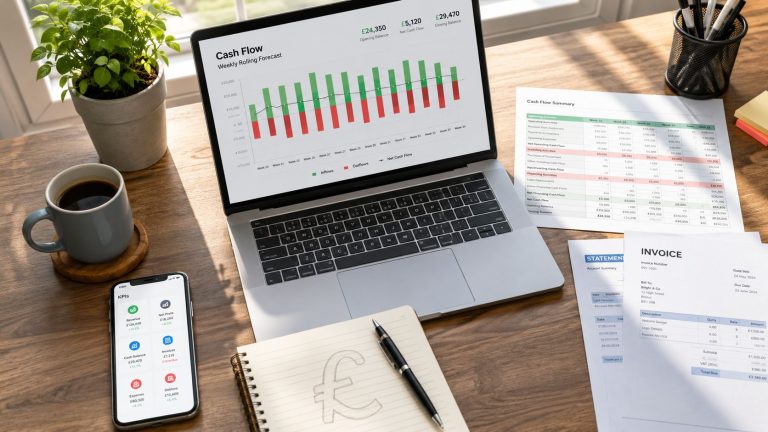
A familiar pattern shows up in growing SMEs. Sales look healthy, the profit and loss account says the month was good, but the bank balance is tight and payroll is approaching fast.
That gap unsettles owners because profit and cash aren't the same thing. Revenue can sit in unpaid invoices. Costs can land before customer money arrives. VAT, payroll, loan repayments and supplier terms rarely line up neatly with when you book a sale.
That's why learning how to forecast cash flow matters so much once a business starts moving from steady trading into real growth. A forecast gives you advance warning. What's more, it gives you options while there's still time to use them.
Why Your Business Needs More Than a Guess
Many owners start with a rough mental model. They know what should come in, what usually goes out, and whether next month feels manageable. That can work when the business is small, simple and stable.
It breaks down when cash becomes more volatile.
Most UK guidance still centres on static annual forecasting, but that misses the rhythm of real trading. Recent data shows 68% of UK SMEs experienced cash flow shocks in 2025 due to delayed client payments or rising input costs, and many guides still underplay the need for a dynamic weekly process, as noted by the British Business Bank guidance on creating a cash flow forecast.
Profit tells you performance. Cash tells you timing
A profitable business can still run into trouble if receipts arrive after wages, VAT or supplier payments fall due. That's the practical distinction many owners only feel when the bank account gets uncomfortable.
A static 12 month model often looks tidy because it smooths everything into monthly averages. Real life doesn't behave like an average month. One late customer, one large stock order or one tax payment can change the picture quickly.
Practical rule: If your forecast can't tell you what your bank position is likely to look like over the next few weeks, it isn't helping you manage liquidity.
Why rolling forecasts work better
For day to day control, a rolling forecast is far more useful than a once-a-year spreadsheet. It keeps moving forward. You compare last week's expectation with what happened, correct your assumptions, and extend the view ahead.
That does two things static forecasting doesn't do well:
- It forces realism by using actual cash movement instead of old assumptions.
- It improves response time so you can act before a squeeze becomes a crisis.
If you want a wider operational view alongside forecasting, this guide to managing small business cash flow is a sensible companion read because it connects forecasting with invoicing discipline, spending control and working capital habits.
What usually works and what usually doesn't
A few patterns show up repeatedly in practice:
| Approach | What happens in real businesses |
|---|---|
| Annual forecast built once | Useful for budgeting, weak for near term cash decisions |
| Monthly cash projection | Better, but often too slow when customer payment behaviour shifts |
| Weekly rolling forecast | Strong visibility, faster course correction, fewer surprises |
If you're running an SME with uneven receipts, supplier pressure or growth plans, guessing isn't prudent management. It's delayed decision-making. The businesses that stay calmer under pressure usually aren't luckier. They know what their cash is likely to do next.
Gathering Your Essential Forecasting Data
A reliable forecast starts before the spreadsheet does. Most weak cash forecasts aren't really forecasting problems. They're input problems.
If the opening bank figure is wrong, if debtor timing is guessed, or if future payments are based on hope instead of evidence, the output won't mean much. Good forecasting begins with a disciplined data pull.

Start with what the bank says
Your first figure is always the current cash position across all business bank accounts. That sounds obvious, but many owners still begin with the nominal ledger, an old report, or a balance that hasn't been reconciled properly.
Use current bank data, not memory.
Build from there with this checklist:
- Bank balances. Pull live or recently reconciled balances from each account the business uses.
- Accounts receivable. Review who owes you money, how old each invoice is, and how those customers pay.
- Accounts payable. List what you owe, the due date, and what you will pay on time versus what might move.
- Payroll and recurring overheads. Wages, rent, software subscriptions, loan repayments, utilities and insurance need to be scheduled by payment date.
- Tax commitments. VAT, PAYE and corporation tax planning shouldn't sit outside the model.
- Sales pipeline. Include only the cash you have a reasonable basis to expect, not every quote you've sent.
Use payment behaviour, not invoice dates
A common mistake is to forecast receipts on invoice date plus stated terms, even when customers rarely pay that way. Forecasting should reflect behaviour.
If a customer is on 30 day terms but tends to pay later, model that reality. The same goes for your own supplier pattern. If you routinely pay key suppliers early and stretch others, your forecast should show the pattern you follow.
The most useful forecast isn't the most optimistic one. It's the one that best matches how cash really moves through your business.
Pull reports from the right systems
For many SMEs, cloud accounting software makes this easier. Xero, Dext and connected banking feeds reduce manual handling and help you work from current information rather than stale exports.
Management reports also matter here. If you already review margins, overhead trends and balance sheet movements monthly, your forecasting assumptions become more grounded. Stewart's guide to reading management accounts effectively is worth using if you want to connect reporting with day to day cash decisions.
A practical pre-flight check
Before you build anything, confirm these points:
- All bank accounts are reconciled to a recent date.
- Old debtor balances are reviewed so you're not counting doubtful cash twice.
- Upcoming one-off payments are listed separately from normal monthly spend.
- Sales assumptions are filtered so only likely receipts remain.
- Owners' drawings or dividend plans are considered where relevant.
A forecast built from clean, current data gives you something to trust. A forecast built from rough guesses gives you false comfort.
Building Your Short-Term and Rolling Forecasts
Most owners don't need a complex model on day one. They need a working view of what cash is likely to do next.
The easiest place to start is a short direct forecast covering the next few weeks. After that, move to the more useful professional model, the 13 week rolling forecast.

Stage one with a simple short-term cash view
For the next few weeks, keep it direct and practical. Use a spreadsheet with columns for each week and rows for opening cash, receipts, payments, net movement and closing cash.
Your starting layout can be as simple as this:
| Line item | Week 1 | Week 2 | Week 3 | Week 4 |
|---|---|---|---|---|
| Opening cash | ||||
| Customer receipts | ||||
| Other inflows | ||||
| Payroll | ||||
| Suppliers | ||||
| VAT and tax | ||||
| Other payments | ||||
| Net cash movement | ||||
| Closing cash |
That gives you immediate visibility. It answers practical questions such as whether you can make payroll, whether a VAT payment creates a pinch point, or whether a major receipt needs chasing sooner.
A spreadsheet is fine at this stage if it's maintained properly. For businesses with more moving parts, Xero exports, bank feed data and forecasting apps can save time and reduce error.
Stage two with a 13 week rolling forecast
This is the model I'd recommend for most established SMEs.
An effective method uses a 13 week rolling horizon with weekly time buckets, refreshed weekly by replacing forecasts with actuals. According to the British Business Bank data referenced in this cash flow forecasting guide, 85% of SMEs in Central Scotland using this approach achieved forecast variance within a 5% tolerance, which makes it markedly more reliable than slower monthly updating.
That weekly refresh is the key part. The forecast doesn't sit still. Each week, you do three things:
- Replace forecast with actuals for the week just finished.
- Review the variance and ask why the difference happened.
- Add a new week at the end so you always keep a full 13 week view.
A rolling forecast isn't valuable because it predicts the future perfectly. It's valuable because it forces you to correct your assumptions every single week.
What to include in the 13 week model
Use weekly buckets and focus on actual cash timing. Typical lines include:
- Receipts from customers based on likely payment date
- VAT refunds or finance inflows if applicable
- Wages and salaries
- Supplier payments
- Rent, utilities and software subscriptions
- Loan repayments and interest
- Tax payments
- Capital spending
- Owner withdrawals or dividends, where relevant
Keep operating items separate from one-off or strategic items. That makes it easier to see whether pressure comes from core trading or a specific decision.
A helpful way to sharpen your method is to compare your structure with other reliable financial forecasting models and then adapt the model to your own trading pattern rather than copying a generic template blindly.
Review variances properly
Variance review is where forecasting becomes management, not administration.
If a receipt expected in Week 2 lands in Week 4, don't just move the line and carry on. Ask why. Was the client slower than usual? Was an invoice disputed? Did your assumptions overstate conversion from pipeline to cash?
Later in the process, it can help to see a worked example in action:
Spreadsheet versus supported tools
There's no shame in starting with Excel or Google Sheets. In fact, many good forecasts begin there because the logic is transparent.
The trade-off is maintenance. Spreadsheets depend on discipline, version control and someone who understands the model. Software can automate data pulls, but poor assumptions still produce poor forecasts. The better route is usually a simple model, fed by clean accounting data, reviewed on a set weekly rhythm.
For clients who want a broader planning view, Stewart Accounting Services can support a three-way forecast that links cash flow, profit and loss, and the balance sheet. That's useful once the business needs more than a short-term liquidity tool.
Using Scenario Analysis for Strategic Decisions
A single forecast shows what you think will happen. Scenario analysis shows what you'll do if it doesn't.
That shift matters. Forecasting isn't only about avoiding short-term stress. It's also how you decide whether growth plans are affordable, and whether the timing of those plans is sensible.
Three versions of the same future
For most SMEs, scenario planning works best with three views:
- Base case. Your realistic trading expectation.
- Best case. Things go better than expected. A customer pays early, a new contract starts smoothly, margins hold.
- Worst case. Receipts slip, costs rise, or a key customer pauses orders.
The exercise is straightforward. You don't rebuild the whole model from scratch. You change the assumptions that matter most and watch the effect on weekly cash balances.

Decisions owners often test
Here are the questions that come up most often in practice:
| Decision | What to test in the forecast |
|---|---|
| Hiring a new employee | Salary timing, NI, pension, onboarding costs, and the lag before extra revenue arrives |
| Buying equipment | Deposit, finance payments, maintenance, and whether the purchase reduces or increases short-term pressure |
| Taking on a large client | Delivery costs, staffing, stock, and how long that client usually takes to pay |
| Preparing for a slow season | Reduced inflows, fixed overhead cover, and the minimum cash buffer required |
A forecast becomes strategic when it helps you say, “Yes, but not this month,” or “Yes, if debtor collections improve first,” or “No, unless funding is arranged in advance.”
Why scenarios matter in practice
This isn't theoretical. Data cited in these cash flow forecasting best practices shows 78% of firms that use scenario planning avoid crisis liquidity gaps.
That makes sense from an accountant's perspective. Owners rarely get into difficulty because one forecast line was slightly wrong. They get into difficulty because they made a decision without testing what would happen if timing moved against them.
If one late payer can derail your month, the answer usually isn't “hope they pay”. The answer is to model the delay and decide your response before it happens.
Set trigger points, not just scenarios
A useful scenario plan also defines action points. For example:
- If closing cash falls below your comfort level, pause non-essential spend.
- If a key debtor misses an expected payment, chase immediately and defer discretionary outflows.
- If the best-case sales outcome lands, decide in advance whether the extra cash funds hiring, stock, debt reduction or a reserve.
For a deeper look at the planning side, Stewart's article on scenario planning for business decisions is a practical next step.
The value of scenario work is confidence. You're no longer reacting in the dark. You've already considered the likely outcomes and chosen the response that protects the business.
Common Forecasting Mistakes and How to Avoid Them
Most forecasting errors aren't technical. They come from habits. Owners rush the assumptions, smooth over awkward timing, or treat the model as a one-off document rather than a working management tool.
A few mistakes cause more trouble than the rest.

Mistake one, treating customer payments as certain
This is the biggest one. Many forecasts assume invoices will be paid neatly on agreed terms, even when the business has years of evidence to the contrary.
Data shows 62% of UK SME cash flow shortfalls stem from unforecasted payment delays, and payment delays average 14 days for SMEs in Scotland, according to these forecasting best practice findings.
The fix is practical. Forecast receipts by likely payment behaviour, not invoice date. If a customer usually pays late, build that delay into the model. It may feel cautious, but it is entirely accurate.
Mistake two, confusing profit with liquidity
Owners often look at turnover and gross margin and assume the cash position should be fine. But cash leaves for VAT, wages, loan repayments and supplier balances regardless of what the profit line says.
Use the forecast to track actual receipts and actual payments. Keep non-cash accounting items out of the short-term liquidity view. If the purpose is survival and control, clarity matters more than elegance.
Mistake three, relying on rough guesses
Forecasts built from instinct usually drift into optimism. Sales are rounded up. Costs are forgotten. Payment timing is idealised.
A better approach is to use a disciplined evidence base:
- Bank-led starting point so the opening cash figure is real
- Debtor and creditor reports rather than mental estimates
- Scheduled tax dates instead of vague placeholders
- Historical payment patterns when deciding likely timing
Mistake four, skipping scenario analysis
Some owners resist this because they think it complicates the model. In reality, it makes the business safer and decisions clearer.
A single-line forecast can give false confidence. A base, best and worst view gives context. You don't need dozens of scenarios. You need a small number of believable ones tied to real risks.
Mistake five, building it once and never updating it
A stale forecast is almost worse than none at all because it creates the illusion of control. Cash forecasting only works when it becomes routine.
Review it weekly. Replace assumptions with actuals. Investigate variances quickly.
Forecasting is a rhythm. The businesses that benefit most are the ones that make it part of the weekly management habit, not a file they revisit when cash feels tight.
If you avoid those five mistakes, your forecast becomes far more useful. It starts to reflect reality, and reality is what allows better decisions.
Turning Your Forecast into Decisive Action
A good forecast should change behaviour. If it doesn't affect decisions, it's just admin.
Use it to judge a few things consistently. How much runway do you have if receipts slow? When are the pressure points in the next quarter? Which customers or cost lines create the biggest timing risk?
That's where process matters. Strong invoicing habits, faster follow-up and cleaner debtor control can materially improve the forecast's reliability. Stewart's guidance on improving cash flow with smarter invoicing habits is a practical extension of the same discipline.
A forecast also helps you make bolder decisions properly. You can judge when it's safe to hire, whether equipment finance is manageable, or whether funding needs arranged now rather than at the point of stress. If payment handling is part of the bottleneck, it's also worth reviewing operational systems such as top payment workflow solutions to reduce friction around billing and collections.
The wider point is simple. Better forecasting gives you more time to act, more control over your money, and less noise in your head as an owner.
If your business is growing and the cash picture feels less predictable than the profit figure suggests, that's usually the point to put a proper forecasting rhythm in place. A weekly rolling model, grounded in real bank and ledger data, gives you a far clearer basis for decisions than a static annual spreadsheet ever will.