

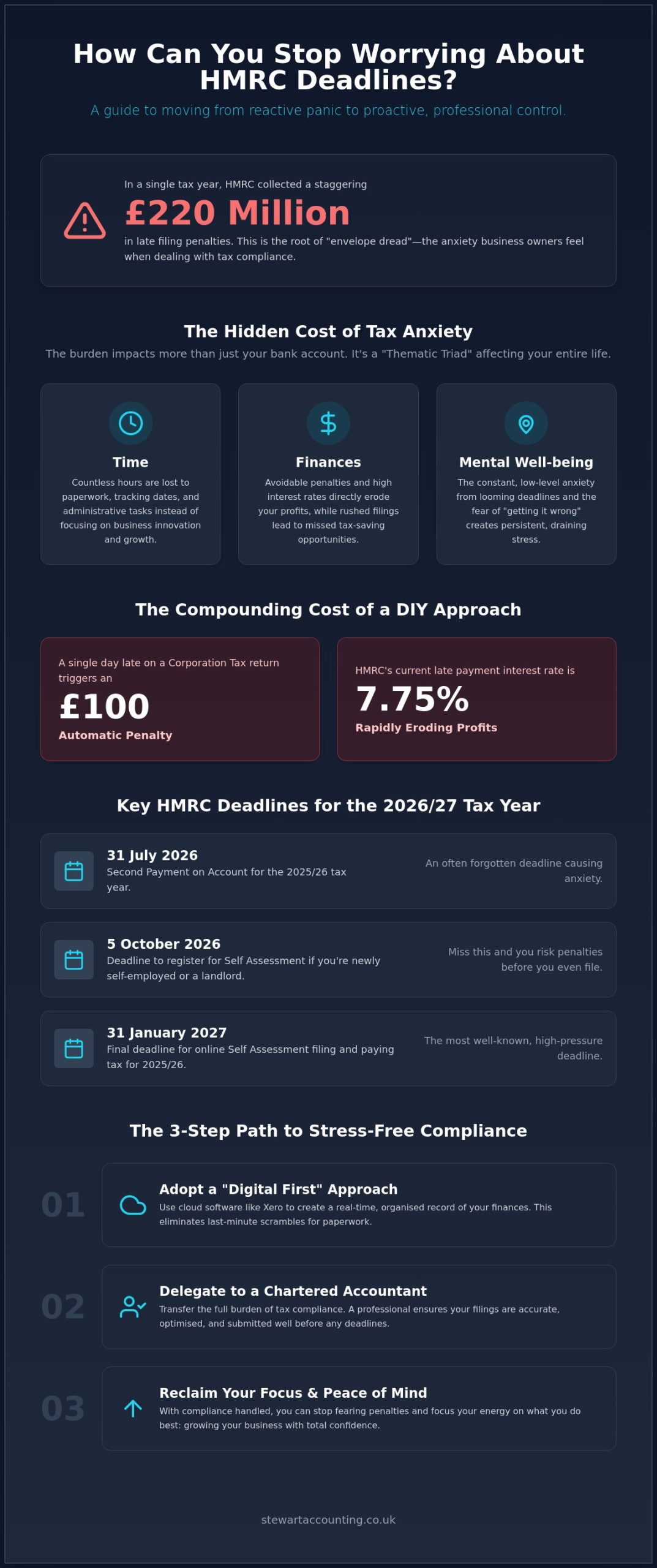
Did you know that HMRC collected £220 million in late filing penalties in a single tax year? It is a staggering figure that explains why so many business owners in Central Scotland feel a sense of “envelope dread” whenever official mail arrives. If you are tired of the constant low-level anxiety that comes with tracking dates or the confusion surrounding the 2026 Making Tax Digital (MTD) for Income Tax rules, it is time for a change. You really can stop worrying about HMRC deadlines by moving from reactive panic to proactive, professional control.
We believe that your mental well-being is just as important as your balance sheet. This article reveals how you can eliminate tax-related anxiety and reclaim your peace of mind through structured planning and the total delegation of your compliance tasks. We will look at how moving these burdens to a chartered accountant ensures your filings are accurate and submitted well before the clock runs out. By following this approach, you can stop fearing the £100 automatic penalty and start focusing your energy on growing your business with total confidence.
Key Takeaways
- Understand how to protect your mental well-being by identifying the root causes of “envelope dread” and tax-related anxiety.
- Identify the critical 2026/27 deadlines for Self Assessment and Corporation Tax to ensure your business remains fully compliant.
- Discover how adopting a “digital first” approach with cloud software like Xero creates a real-time record of your finances.
- Learn how professional delegation to a Chartered Accountant allows you to stop worrying about HMRC deadlines for good.
- Explore the simple handover process that transfers the full burden of tax compliance from your shoulders to a dedicated expert.
Why Do HMRC Deadlines Cause So Much Stress for Business Owners?
For many small business owners in Central Scotland, the sight of a brown envelope with the HMRC logo triggers an immediate physiological response. This “envelope dread” is a genuine fight-or-flight reaction. It stems from the high stakes involved in the UK tax return system, where even a small administrative oversight can lead to significant financial consequences. When you constantly track dates for VAT, payroll, and annual accounts, your mental bandwidth is slowly drained. This is the hidden cost of tax anxiety; every hour spent worrying about a filing is an hour you aren’t using to innovate or grow your business.
The complexity of the UK tax code is another major barrier. It is far too vast for a busy entrepreneur to master alone while also managing day-to-day operations. We often talk about the “Thematic Triad” to describe how this burden impacts your life. It isn’t just about the money you pay in tax. It is about the time lost to paperwork, the finances lost to avoidable penalties, and the mental well-being lost to persistent stress. To truly stop worrying about HMRC deadlines, you have to address all three areas of this triad.
To better understand the impact of missing these dates, watch this helpful video:
The Psychological Weight of Compliance
Modern tax requirements are “always on.” Between quarterly VAT returns and monthly payroll submissions, there is rarely a quiet month in the financial calendar. This creates a cycle of constant pressure. Even when you file on time, the fear of “getting it wrong” often lingers. You might wonder if you claimed the right expenses or if a new regulation has changed the way you should report income. This is why we focus on “delegation imagery.” By physically and legally handing over the responsibility for your Self Assessment Tax Returns to a professional, you remove that weight from your shoulders entirely.
The Real Financial Risk of the “Do It Yourself” Approach
Attempting to handle everything yourself often leads to expensive mistakes. HMRC late filing penalties are designed to be compounding. For example, a single day of lateness for a Corporation Tax return results in an automatic £100 fine. If you don’t act, these charges escalate quickly. Furthermore, the current late payment interest rate of 7.75% can rapidly erode your hard-earned profit margins. Beyond penalties, a rushed DIY approach often means you miss out on legitimate tax planning opportunities. When you are simply scrambling to meet a deadline, you don’t have the time to look for ways to optimize your Year End Accounts Preparation and keep more of what you earn.
What Are the Key HMRC Deadlines for 2026?
Understanding the tax calendar is the first step to regaining control of your business life. While it feels like the rules change every season, the core dates remain relatively stable for most UK businesses. If you want to stop worrying about HMRC deadlines, you need a clear roadmap of what is expected and when. Whether you are a contractor in Stirling or a small business owner in Falkirk, knowing these dates helps prevent the last-minute scramble that leads to errors and stress.
Self Assessment and Personal Tax Deadlines
For new sole traders or landlords in Central Scotland, the first major hurdle is 5 October 2026. This is the date you must register for Self Assessment if you haven’t filed before. Missing this can lead to penalties before you’ve even submitted a return. The most famous date is 31 January 2027, which is the final deadline for online filing and paying the balance of tax for the 2025/26 year. However, the “Payment on Account” system often causes the most anxiety. Many people forget the second payment due on 31 July 2026. Keeping track of these official HMRC deadlines is essential for avoiding the £100 late filing fine. Our team provides expert Self Assessment Tax Returns services to ensure these dates never catch you by surprise.
The Corporate Calendar: Limited Company Obligations
Limited companies face a different set of rules. Unlike personal tax, which follows the fixed tax year, your Corporation Tax depends on your specific accounting period. You generally have 9 months and 1 day after your accounting year ends to pay your tax bill. However, you have 12 months to file your CT600 tax return. This gap between paying and filing is a frequent source of confusion for directors. You also have separate filing obligations for Companies House, which usually fall 9 months after your year end. Managing these overlapping timelines requires precision. We specialise in Year End Accounts Preparation to help businesses in Alloa and across the UK keep their records straight.
Finally, don’t overlook VAT and Payroll. VAT returns typically follow a quarterly cycle, and with the expansion of Making Tax Digital (MTD), digital record-keeping is now mandatory. From April 2026, MTD for Income Tax also begins for those with income over £50,000, adding another layer of digital requirements. Payroll and RTI submissions are even more frequent, occurring every time you pay your staff. If these constant requirements feel overwhelming, you might want to speak with a local expert who can manage the entire schedule for you.
How Can You Stay Organised Throughout the Tax Year?
Staying ahead of the curve involves four practical steps:
- Step 1: Adopt a “Digital First” mentality. Move away from spreadsheets and paper folders. Cloud software provides a single source of truth for your business finances.
- Step 2: Implement a real-time bookkeeping habit. Don’t wait for the end of the quarter. Reconciling accounts weekly prevents a mountain of work from building up.
- Step 3: Set up a dedicated tax reserve. Open a separate bank account and move a percentage of every invoice there. This ensures you always have the liquidity to pay your bill on time.
- Step 4: Automate your reminders. Use calendar syncing and software alerts to flag up official HMRC deadlines months in advance.
Leveraging Online Accounting Services
Modern technology has transformed how we handle compliance. By using Xero training and support, you can connect your bank feeds directly to your accounting software. This means your transactions flow in automatically, and receipt scanning apps can eliminate paper clutter instantly. This digital approach is no longer optional for many; it’s a preparation for the future. From April 2026, Making Tax Digital (MTD) for Income Tax will require self-employed individuals and landlords with income over £50,000 to keep digital records and send quarterly updates. Starting now ensures you are ready long before the mandate arrives.
The Importance of Accurate Bookkeeping
Reliable Bookkeeping Services are the foundation of a stress-free tax year. When your records are accurate and up-to-date, your VAT reviews become a simple check rather than a multi-day ordeal. This precision flows directly into your year-end accounts, making the final submission a non-event. Regular bookkeeping also allows for the production of management accounts. These reports provide a “no surprises” view of your projected tax bill throughout the year. Instead of guessing what you might owe, you’ll have a clear, pragmatic figure to work with. This level of clarity is a key part of the Thematic Triad, protecting your finances and your mental well-being simultaneously.
Can a Chartered Accountant Really Remove the Burden of Tax Compliance?
Delegating your financial compliance isn’t just about outsourcing paperwork. It is about a complete transfer of responsibility. When you appoint a Chartered Accountant as your authorised agent, you effectively step out of the line of fire. We communicate with HMRC on your behalf, handle technical queries, and ensure every filing is meticulously prepared. This shift allows you to stop worrying about HMRC deadlines because the burden no longer rests on your shoulders. You move from a state of “envelope dread” to a state of total confidence.
The Complete Transfer of Responsibility
Knowing an expert is watching the calendar provides a level of peace of mind that a DIY approach can never match. Through the HMRC authorisation process, we gain agent access to your tax accounts. This allows us to monitor your status in real-time and catch issues before they escalate. Many business owners ask if an accountant is worth the cost. When you consider the compounding nature of fines, starting with an automatic £100 for being a single day late, the investment often pays for itself through penalty avoidance alone. Beyond avoiding fines, a proactive partnership means we identify tax savings throughout the year, rather than just reacting to historical data during a year-end scramble. We also offer Tax Investigation Protection, providing an extra layer of security if HMRC ever decides to look closer at your affairs.
Expertise You Can Trust in Central Scotland
Choosing a local partner matters. Our presence in Alloa, Stirling, and Falkirk means we understand the specific economic landscape of Central Scotland. There is a significant difference between a Chartered firm and an uncertified “bookkeeper.” Our Chartered status is a foundation of competence and reliability, ensuring we meet the highest professional standards at all times. This expertise is particularly vital for Contractors navigating complex IR35 rules or Landlords preparing for the 2026 MTD for Income Tax changes. We don’t just file forms; we provide a supportive partnership that protects your time, your money, and your mental well-being. This is the essence of the “Thematic Triad” in action.
If you are ready to reclaim your focus and eliminate tax-related stress, get in touch with our team today for a professional consultation.
How Do You Transition to a Stress-Free Accounting Partnership?
Moving from a state of constant anxiety to a structured, professional partnership is a straightforward process. You don’t have to wait for the start of a new tax year to make the change. In fact, the sooner you delegate these responsibilities, the sooner you can stop worrying about HMRC deadlines and focus on what you do best. We’ve designed our onboarding to be as low-friction as possible, ensuring you feel the benefits of our support from day one. This transition isn’t just about changing who does your books; it is about changing how you feel about your business.
The path to total compliance involves four clear steps:
- Step 1: Consultation. We begin with a thorough assessment of your current compliance status to identify any immediate risks or missed opportunities.
- Step 2: The Handover. This is the moment of delegation. We gather your necessary data with minimal effort from you, taking over the communication with HMRC.
- Step 3: Digital Ecosystem Setup. We help you implement tools like Xero and receipt scanning apps to create a seamless, paperless workflow.
- Step 4: Reclaiming Freedom. Once the system is live, you begin to enjoy the “Thematic Triad” of regained time, optimized finances, and mental freedom.
Getting Started with Stewart Accounting Services
We provide a clear and welcoming onboarding process for Limited Companies and sole traders alike. If you are already behind on your filings, don’t panic. Our first priority is catching up on overdue returns to stop any escalating penalties. Once your current obligations are met, we move toward a proactive model. This includes looking at your long-term objectives. For many clients, developing a robust Business Plan is the next logical step to ensure that your newfound mental bandwidth is used to drive future growth and stability.
The First 90 Days: What to Expect
During the first three months of our partnership, you will notice a significant shift in rhythm. The “deadline dread” you previously felt is replaced by scheduled, calm updates. We don’t just look forward; we also review your previous filings. This allows us to check for errors or overpayments that might be reclaimed. By the end of this period, your digital records will be fully integrated, giving you a real-time view of your liabilities. If you are ready to stop worrying about HMRC deadlines and want to work with a dependable regional expert, we invite you to Contact Us for a local, friendly chat about your business needs.
Reclaim Your Peace of Mind and Focus on Growth
Managing a business is demanding enough without the added weight of shifting tax regulations and impending dates. We have explored how adopting a “digital first” approach and understanding the 2026 MTD requirements can transform your relationship with compliance. The secret to a calm and successful enterprise lies in moving from a reactive scramble to a proactive partnership that prioritises your mental well-being and financial stability.
You really can stop worrying about HMRC deadlines when you have a dependable expert watching the calendar for you. As Chartered Accountants with local offices in Alloa, Stirling, and Falkirk, we provide decades of experience supporting Scottish SMEs through every stage of their journey. Our status as Xero Platinum Partners ensures you have access to the best technology and the most efficient compliance processes available, allowing for a total transfer of responsibility.
Stop worrying and start growing—book your free consultation with Stewart Accounting today.
We are here to help you navigate every financial challenge with clarity and confidence. Your journey toward professional liberty and a stress-free tax year starts with a single conversation.
Frequently Asked Questions
What happens if I miss the HMRC Self Assessment deadline?
If you miss the 31 January deadline, HMRC issues an automatic £100 fine immediately. This applies even if you have no tax to pay or have already paid your bill in full. If the return remains outstanding for three months, daily penalties of £10 begin to accrue for up to 90 days. These compounding costs are a primary reason business owners seek professional help to stop worrying about HMRC deadlines for good.
Can I appeal an HMRC late filing penalty?
You can appeal a penalty if you have a valid reason for the delay. The appeal must typically be submitted within 30 days of the penalty notice date. While the process can be complex, having a Chartered Accountant manage the correspondence significantly improves your chances. We handle the technical arguments and paperwork on your behalf, ensuring your case is presented clearly and professionally to the tax authorities.
What is a “reasonable excuse” for a late tax return?
HMRC defines a “reasonable excuse” as an exceptional circumstance that stopped you from meeting a deadline. Examples include the death of a close relative, an unexpected stay in the hospital, or a serious fire at your business premises. Simple mistakes, like forgetting the date or finding the software too difficult, are rarely accepted. If you are unsure if your situation qualifies, we can assess your circumstances and advise on the best course of action.
How much are the penalties for late Corporation Tax returns?
Late filing for Corporation Tax starts with an automatic £100 penalty if the return is just one day past the deadline. If the delay reaches three months, a second £100 fine is issued. For longer delays of six to twelve months, HMRC will estimate your tax bill and add a penalty equal to 10% of the unpaid tax. These costs can quickly erode your business profits if left unmanaged by a professional team.
Do I need to register for Making Tax Digital (MTD) in 2026?
From April 2026, you must comply with MTD for Income Tax if you are self-employed or a landlord with a qualifying income over £50,000. This requires you to keep digital records and send quarterly updates using compatible software like Xero. Preparing for this shift now is a vital step to stop worrying about HMRC deadlines in the future. We specialise in transitioning local Scottish businesses to these digital systems smoothly and efficiently.
How can I pay my HMRC tax bill if I don’t have the funds right now?
If you cannot pay your tax bill in full, you should contact HMRC as soon as possible to discuss a “Time to Pay” arrangement. This allows you to spread the cost over a series of monthly instalments. It is crucial to set this up before the payment deadline to avoid additional late payment penalties. We often assist clients in negotiating these plans, providing the financial evidence required to secure a sustainable agreement for their business.
Will an accountant deal with HMRC on my behalf if I am fined?
Yes, as your authorised agent, we take over all direct communication with HMRC regarding penalties or enquiries. This is a core part of our complete transfer of responsibility. We review the penalty notice, identify any grounds for appeal, and submit the necessary documentation. This service removes the stress of dealing with official correspondence, allowing you to focus on your day-to-day operations while we resolve the issue with the tax authorities.
How early should I start preparing for my Year End accounts?
You should ideally maintain your records in real-time throughout the year. However, we recommend starting the formal preparation process at least two months before your filing deadline. This provides ample time to resolve queries, categorise expenses correctly, and identify tax-saving opportunities. Early preparation ensures that your final accounts are accurate and submitted well ahead of time, completely eliminating the risk of last-minute panic or avoidable fines for your company.