

How to Buy Limited Companies in the UK: A Practical Guide

You're probably in one of three positions right now. You've found a business that looks promising, someone has offered you a ready-made limited company, or you've decided starting from scratch is too slow. In each case, the same mistake shows up early. Buyers focus on the mechanics of transfer before they've settled the structure of the deal.
That's backwards.
If you want to buy limited companies sensibly, you need to decide what you're buying, what liabilities you're willing to inherit, and how the tax outcome changes the price you should pay. The limited company is the dominant UK business vehicle, with 5,275,466 private limited companies representing 92.22% of all corporate bodies on the register in the Companies House statistical release for April 2025 to March 2026, which is why most SME acquisitions sit inside this structure rather than elsewhere (Companies House statistics).
Most online guides stop at “buy the shares” or “buy the assets”. That's not enough. The share versus asset decision often decides whether you inherit old tax problems, whether reliefs survive, and whether the seller's price expectation is realistic after the Business Asset Disposal Relief rate change to 18% from 6 April 2026 for qualifying gains, up from 14% in the prior year (BADR helpsheet).
Decide What Kind of Limited Company You Actually Need
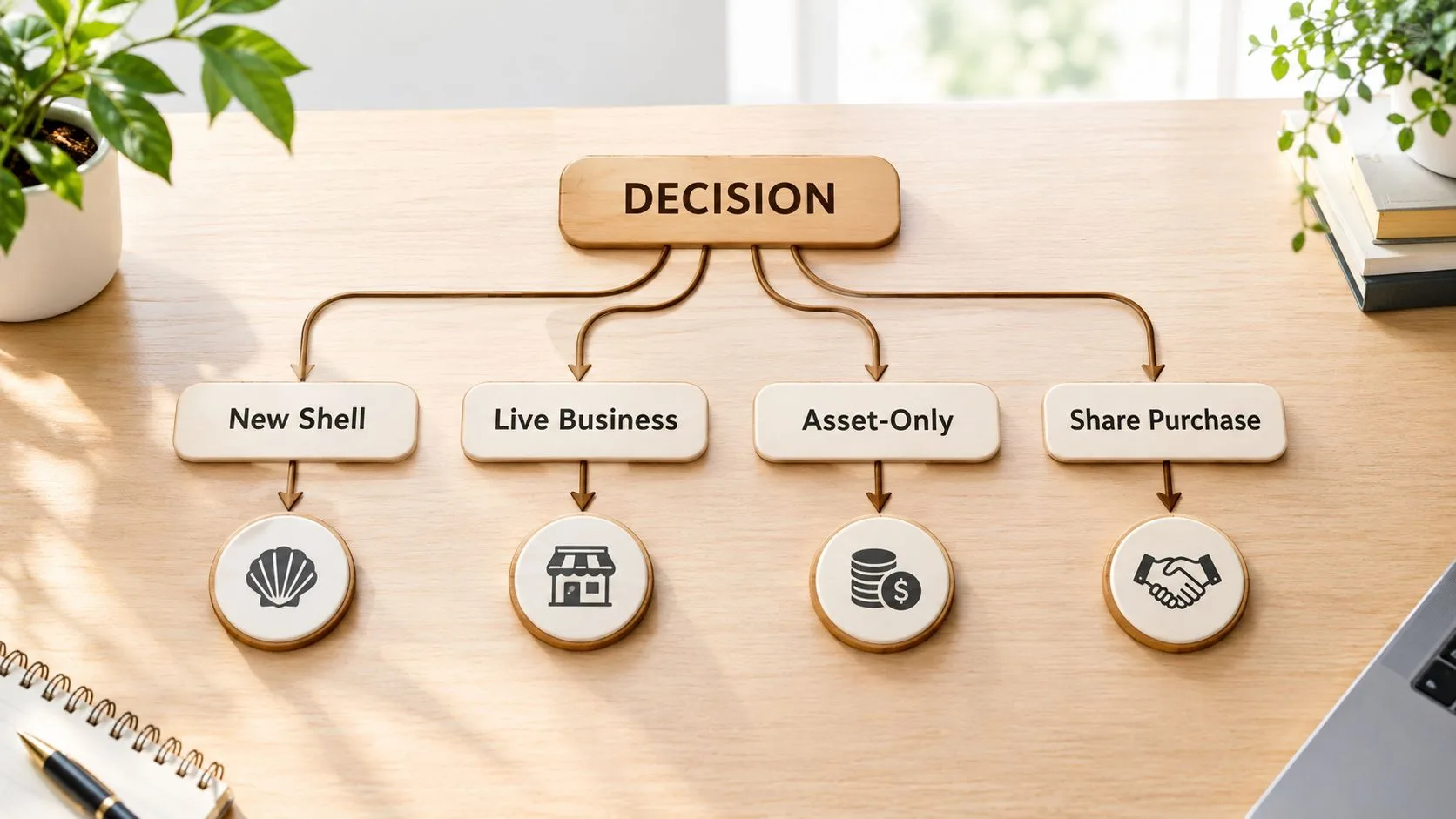
Buying a company isn't one decision. It's four. If you don't answer them before you speak to a broker, seller, or solicitor, you waste time looking at the wrong targets.
The first question is simple. Do you need a clean company shell, or do you need a trading business? A dormant shelf company gives you a company number, incorporation date, and legal structure. It doesn't give you trading history worth paying for. A live trading company gives you customers, staff, systems, and momentum. It also gives you baggage.
Start with the use case
I tell buyers to pin down the commercial reason first. The legal route follows from that.
- Need corporate presence quickly: A shelf company can work if you want to tender for work, open a business bank account, or trade through a company immediately.
- Need revenue from day one: You're looking at a share purchase of an existing trading company.
- Need selected assets only: An asset purchase is usually safer when the seller's history looks untidy.
- Need brand, team, and contracts together: That usually points back to buying shares, because assets alone may not transfer the relationships cleanly.
A useful external primer if you're comparing routes at a commercial level is this buying a business guide from Lighthouse Consultants. It's helpful before you get buried in deal documents.
The three routes buyers confuse
Searching for how to buy limited companies often mixes up three different transactions.
Shelf company purchase
You buy a dormant private limited company from a formation agent. This route suits someone who wants a corporate vehicle but doesn't need existing trade, customers, or staff.
That can be useful for a new venture, a side business, or a new trading arm. But don't over-romanticise “aged” companies. Banks, lenders, and counterparties often care more about activity, ownership, and filings than the incorporation date alone.
Common failure point: the buyer assumes an old incorporation date gives instant credibility, but the company has no meaningful trading substance.
Share purchase of a trading company
You buy the shares in the company itself. The company continues to own the bank account, contracts, employees, VAT history, tax record, and liabilities.
This is the right route when continuity matters. If the company's contracts, licences, or customer relationships are hard to move, buying the shares may be the only practical route.
It's also where buyers lose money fastest. Hidden tax arrears, weak bookkeeping, unresolved director loans, and stale filings don't vanish because the seller says the business is “clean”.
Practical rule: If you buy shares, assume every historic filing matters until proven otherwise.
Asset purchase
You buy selected assets from the company or business. That can include stock, plant, goodwill, brand assets, domain names, or intellectual property. Liabilities usually stay with the seller unless the contract pushes some of them across.
This route works well when you want the value but not the history. It's often the cleaner answer where records are poor or the company has had compliance issues.
The catch is transfer friction. Key contracts may need consent. Some supplier arrangements can't be moved. Staff issues also need careful handling if the transaction amounts to a transfer of the business operation.
Settle four choices before discussing price
Buyers get sharper once these four decisions are fixed.
Shell or live trade
If you only need a company wrapper, don't pay for goodwill you can't verify.Shares or assets
This drives tax, legal risk, and financing. It should be settled early, not after a headline price is agreed.Sole control or partners
If you're buying with others, shareholder terms matter from the start. Equal ownership without a proper agreement is asking for deadlock.Seller exit or handover
Decide whether the seller leaves on completion or stays for a transition. A business built around one owner is worth less if they disappear immediately.
Buyers usually overpay when they buy optimism instead of structure.
Match the route to your risk appetite
There isn't a heroic answer here. There's a practical one.
If you can tolerate historic liabilities because continuity matters, a share purchase may be right. If you want a lower-risk entry and don't need the exact company wrapper, assets are often cleaner. If you want to start trading under a company banner, a shelf company may be enough.
The key point is this. Don't start with “what's available”. Start with “what problem am I solving?”. That one shift filters out most bad opportunities before you spend money on advisers.
Valuation and Pricing for a UK Limited Company
A small UK company isn't worth what the seller hopes. It isn't worth what last year's profit suggests either. It's worth what a buyer can justify after adjusting the accounts into something commercially maintainable.
The first thing I want is the filed accounts and the latest management numbers. Buyers should verify at least three years of statutory accounts, management accounts, VAT returns, and bank statements, then normalise EBITDA into maintenance cash flow because accounting profit can overstate value in a company purchase (purchase Ltd company guidance).
Move from profit to maintainable cash flow
Reported profit is rarely clean enough to price a deal. Owner-managed companies often run personal or one-off items through the business. That distorts the earnings figure.
Typical adjustments include:
- Owner pay adjustments: Directors may pay themselves in a way that doesn't reflect market replacement cost.
- One-off costs: Legal disputes, aborted projects, or unusual repairs shouldn't always depress maintainable earnings.
- Related-party charges: Rent, management charges, or family payroll costs may not be on arm's-length terms.
- Sustaining spend: Buyers need to deduct the capital expenditure required to keep current turnover going.
That last point matters. A business can show profit and still be cash-hungry.
Multiples are a guide, not a verdict
A sensible valuation is a range. It shifts once concentration risk, working capital, and debt-like items are understood.
| Sector | Typical EBITDA Multiple | Notes |
|---|---|---|
| Established general trading business | 3x to 5x maintainable EBITDA | Often the starting range for owner-managed SME deals |
| Niche specialist or asset-light model | Higher than the general trading range | Usually justified only where earnings quality and defensibility are strong |
| Distressed or messy sale | Lower than the general trading range | Buyers discount for uncertainty, weak controls, or urgency |
For a deeper framework on normalisation and pricing logic, this business valuation guide is a sensible reference point.
Red flags that should change the price
I've seen buyers fixate on turnover and miss the points that damage value:
- Customer concentration above 20%
- Recurring director's loan balances
- Deferred corporation tax
- Pending HMRC enquiries
Those items don't always kill a deal. They do change what a prudent buyer should pay, and sometimes how the deal should be structured.
Valuation only becomes meaningful once you know whether you're buying shares or assets. The same business can justify two very different prices depending on which route you choose and which liabilities stay behind.
Legal and Financial Due Diligence in Practice
Most failed acquisitions don't collapse because someone argued over a small pricing point. They collapse because diligence starts too late, runs in sequence instead of in parallel, or uncovers issues after legal costs have already piled up.
For UK limited-company acquisitions under roughly £2 million, a practical workflow is to run financial, legal, operational and people workstreams in parallel inside a 4 to 8 week diligence window after heads of terms are signed. A sensible sequence is to sign an NDA, pull the Companies House record immediately, request three years of accounts plus the latest management accounts, issue a structured diligence questionnaire, then complete site visits and management interviews before warranties and indemnities are drafted (UK business acquisition due diligence checklist).
Day one documents and searches
I want the data room opened straight away. If the seller dribbles out information, assume the timetable will slip.
Key items should include:
- Financial records: filed accounts, management accounts, VAT returns, PAYE records, bank statements, loan statements
- Legal records: Companies House extracts, charges, material contracts, leases, insurance, litigation details
- Operational files: supplier terms, customer agreements, licences, systems notes
- People documents: payroll reports, contracts, handbooks, director service agreements
A structured checklist helps. Stewart Accounting Services is one option for buyers who need support testing financial records, tax exposure, and deal structure before completion. Their financial due diligence checklist is a useful starting point.
What the four workstreams should produce
| Workstream | Lead Advisor | Key Deliverable | Common Red Flag |
|---|---|---|---|
| Financial | Accountant | Earnings quality and working capital review | Profit doesn't convert into cash |
| Legal | Solicitor | SPA risk points, title, contracts, charges review | Hidden security or weak assignability |
| Operational | Buyer and specialist adviser | Site findings and process review | Owner dependence or undocumented systems |
| People | HR adviser or solicitor | Employment risk summary | Unclear contracts or unresolved disputes |
If you want a solicitor's perspective on diligence scope and legal risk, this Kons Law business purchase advice is worth reading alongside the financial review.
Pull the Companies House file first. Mismatched status, omitted charges, stale officer records, and PSC issues often tell you more in ten minutes than a glossy information memorandum tells you in ten pages.
Treat findings properly
Not every issue should end the transaction. Some should reduce the price, tighten the warranty package, or justify a retention.
Undisclosed creditors, aged debtors, owner drawings buried in overheads, and poor stock records are usually price chips. A serious tax exposure, defective title to assets, or disputed ownership of shares is different. Those points can make the structure itself wrong.
Tax Considerations When Buying Shares or Assets
This is the part buyers leave too late, and it's where they do the most damage.
The share versus asset decision isn't just legal form. It changes who pays tax, what liabilities move, whether reliefs apply, and what price the seller can accept without feeling ambushed at the end.
Why the BADR change matters now
Business Asset Disposal Relief is only available to individuals or some trustees, not to companies, and for qualifying gains the rate moves to 18% from 6 April 2026, up from 14% in the prior year (BADR helpsheet). That rate change matters because many founder-sellers benchmark their minimum acceptable price against what they keep after tax, not the headline deal value.
So if you're negotiating a founder buy-out, don't act surprised when the seller pushes hard on pricing or structure. Their net proceeds may have shifted materially.
Share purchase versus asset purchase
A share purchase keeps the company intact. You inherit its tax history, VAT position, filing record, and any open HMRC risk. The seller usually gets capital treatment if conditions are met. The buyer gets continuity, but also exposure.
An asset purchase lets the buyer cherry-pick what they want. That often means cleaner risk allocation and a fresh base for some assets, but it can create transfer friction and a different tax profile for both sides.
| Tax Area | Share Purchase | Asset Purchase |
|---|---|---|
| Historic tax exposure | Buyer inherits company history | Liabilities usually stay with seller unless assumed |
| Seller treatment | Often capital treatment for individual seller if conditions are met | Can create a different tax result for seller depending on assets sold |
| Buyer tax profile | No step-in reset of the company's tax history | Buyer may obtain deductions depending on asset type and structure |
| Transaction taxes | Stamp implications differ from asset taxes and property elements | Property, VAT, and asset class treatment need separate review |
For a more focused look at how the upcoming rules affect sale planning, this guide on the tax implications of selling a business in 2026 is directly relevant.
The practical buying rule
Model both structures before heads of terms. Don't let the seller or broker push you into discussing only one route because “that's how these deals are usually done”.
If the tax model changes the seller's net proceeds, it changes the negotiation. If the structure changes your inherited risk, it changes the price.
One more point buyers miss: BADR claims have to be made through Self Assessment by the relevant post-year-end deadline under GOV.UK rules. Reliefs are valuable, but only if the seller qualifies and claims correctly. Never price a deal on assumed reliefs that nobody has tested.
Financing Options for Buyers of UK SMEs
Most SME buyers don't fund an acquisition with one neat source of money. They use a mix. Your job is to build a package that survives a bad quarter after completion, not one that only works in a spreadsheet.

The main funding routes
Personal cash is the cleanest source. It gives you control and avoids lender friction. It also concentrates your risk, which many first-time buyers underestimate.
Bank lending can work well for established trading targets with reliable accounts and understandable cash flow. Traditional lenders tend to want tidy records, credible forecasts, and proper security. Alternative lenders may move faster, but you usually pay for that flexibility.
Vendor finance is underused and often sensible. If the seller is confident in the business they're exiting, deferred consideration or loan notes can bridge the gap between your cash and their expectations.
- Buyer equity: Strongest signal to lenders and sellers, but hardest on your own liquidity.
- Senior debt: Useful where the target has stable cash generation and assets or contracts lenders can get comfortable with.
- Vendor consideration: Helpful when the valuation gap is real but not fatal.
- Earn-out structures: Best used when future performance is uncertain and both sides disagree rather than strategically.
What lenders and sellers both look for
They want to know whether the business can service the deal structure after completion. That means clear historic accounts, realistic forecasts, and evidence you understand the operating model.
If you're still shaping your buying criteria and lender conversations, this guide for business buyers gives a useful overview of how finance discussions are framed, even though you'll still need UK-specific advice and lending contacts.
A short explainer can also help if you're new to acquisition funding structures:
My view on funding discipline
Don't borrow to the point where one weak trading period puts you into panic mode. A deal that looks affordable at peak performance can become very uncomfortable once normal setbacks arrive. The strongest buyer isn't the one who extracts the largest facility. It's the one who still has room to operate after completion.
Share Transfer, Completion, and the First 30 Days
Completion day is administrative, legal, and operational all at once. Buyers who treat it like a signature exercise usually spend the next month unpicking avoidable mess.
What has to happen at completion
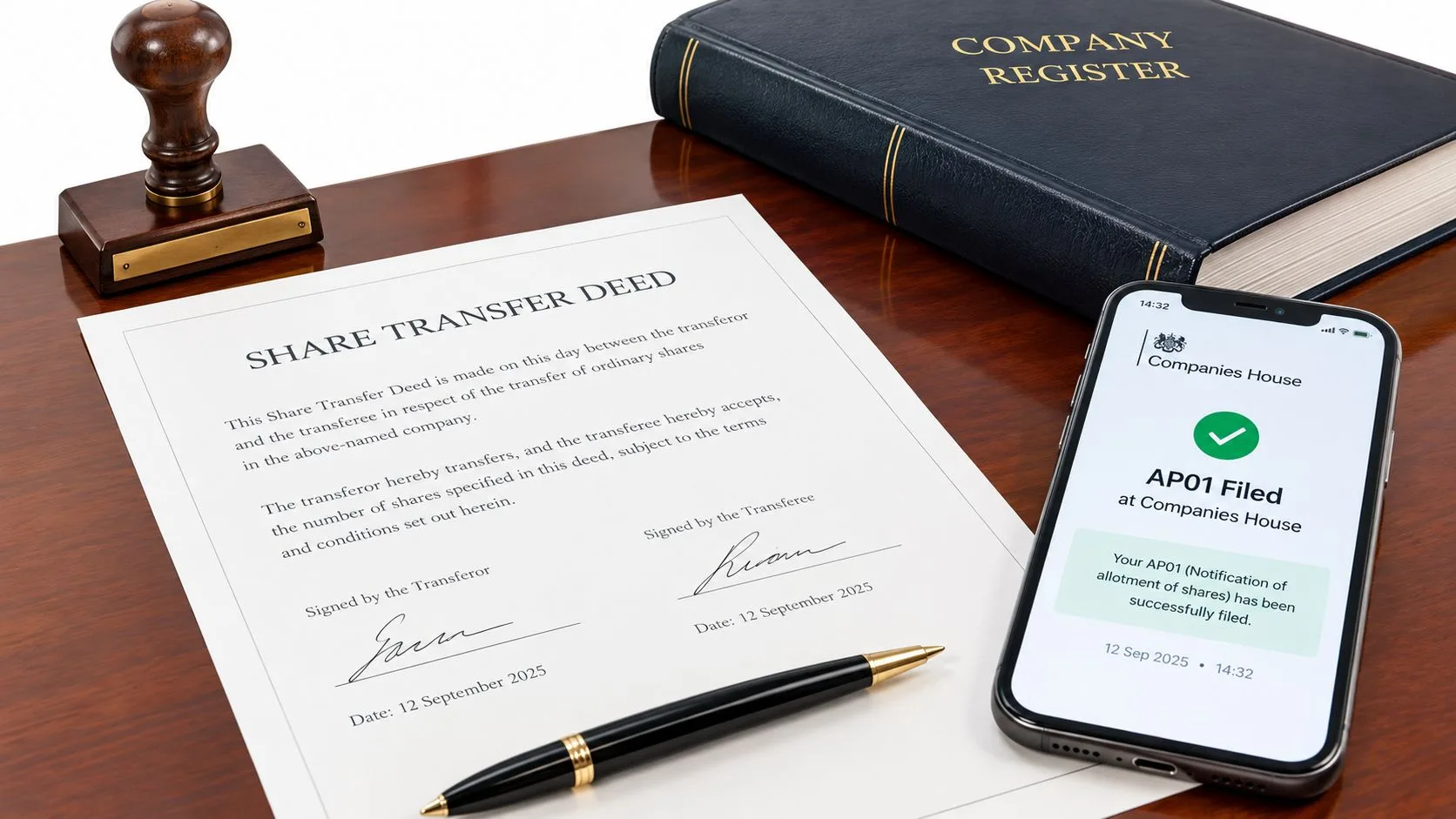
In a share deal, the transfer paperwork needs to line up with the company's internal records and the agreed completion mechanics. That usually means executed stock transfer documentation, board minutes approving the transfer, updated statutory registers, and the release or confirmation of any deal conditions tied to payment.
The legal documents matter, but so do the practical handover items. If online banking, payroll access, insurance control, and supplier contacts are still in the seller's hands after completion, you don't really control the business yet.
A basic completion checklist should include:
- Bank mandate updates: Get signing authority and online access sorted immediately.
- Insurance review: Confirm cover remains in place and reflects the post-sale position.
- Customer and supplier notices: Decide who needs notification and when.
- Shareholder loan position: Confirm what is being repaid, left in, or assigned.
- Disclosure letter and completion accounts: Make sure you receive the agreed papers promptly.
The first month is operational triage
The first month is where ownership becomes real. Payroll has to run properly. VAT processes need checking. Financial controls need resetting. If there are transferring staff or outgoing directors, responsibilities must be documented clearly.
I usually want these issues addressed quickly:
Control of cash
Reconcile opening bank balances and lock down payment authority.Tax administration
Review VAT position, PAYE operation, and any immediate HMRC correspondence.Systems access
Remove old logins, add new users, and preserve accounting records.People communication
Staff uncertainty damages performance faster than most buyers expect.
The first 30 days after completion decide whether you bought a workable business or inherited a daily firefight.
Errors that keep showing up
The common execution mistakes are boring, but expensive. Buyers miss register updates, rely on the seller to tidy paperwork later, fail to align payroll responsibility, or discover too late that key counterparties weren't told about the ownership change.
The cure is simple. Use a completion checklist that treats legal transfer, tax administration, banking control, and staff communication as one coordinated process rather than four separate jobs.
How an Accountant Supports the Post-Acquisition Phase
A good accountant shouldn't appear three months later asking for the bank statements. They should be involved immediately after completion, and ideally before it.
The reason is simple. Post-acquisition errors don't look dramatic at first. They look like a VAT setting left unchanged, an opening balance posted badly, a payroll scheme running under the wrong assumptions, or a warranty claim missed because nobody isolated the issue in time.
The first tasks after completion
Inside the first days, the finance function needs stabilising. That means opening or restructuring ledgers, checking the chart of accounts, confirming payroll treatment, and reviewing whether the existing VAT scheme still makes sense under the new ownership and trading pattern.
The accounting team should also verify that the opening numbers reflect the deal. If debt, cash, stock, accruals, or director balances were adjusted at completion, those entries need to be posted correctly from the start.
Typical priority actions include:
- Opening balance review: Match the books to the completion statement.
- Payroll reset: Make sure RTI reporting and director treatment are right.
- VAT review: Confirm whether the current setup still fits the business.
- Control rebuild: Put approval limits, reconciliations, and reporting routines in place.
Medium-term work buyers often neglect
Post-deal accounting isn't just compliance. It's where value gets protected or lost.
| Stage | Core deliverables | Buyer risk if missed |
|---|---|---|
| Immediate post-completion | Opening balances, control of ledgers, payroll and VAT setup | Misstated books and early filing errors |
| First reporting cycle | Monthly management accounts, cash tracking, variance analysis | Slow reaction to underperformance |
| Year-end preparation | Year-end adjustments, tax planning, evidence for warranties or claims | Overpaid tax and weak claim support |
| Integration stage | Chart of accounts alignment, inter-company treatment, finance process standardisation | Confused reporting and duplicated cost |
Why this matters commercially
A buyer who treats the accountant as an afterthought usually ends up paying for the same problem twice. First through weak information at acquisition. Then again through poor post-deal decisions.
An accountant who's engaged early can test whether the historical numbers were reliable, help convert the completion terms into accurate opening records, and spot issues that may support a warranty or indemnity claim before the window closes. That's not back-office tidying. That's part of preserving deal value.
If you're planning to buy limited companies, settle the structure before you settle the price. Decide whether you need a shell, shares, or assets. Test the tax outcome early. Treat due diligence as a parallel process, not a formality. Then make sure completion and post-acquisition accounting are handled as one continuous job. That's how buyers avoid inheriting the seller's problems at the buyer's price.
Recent Posts
21 Nov, 2026
20 Nov, 2026