

Figuring out whether you need an accountant or a bookkeeper is a classic crossroads for any UK business owner. It's a pivotal decision, and getting it right sets the foundation for your financial health.
Put simply, your bookkeeper is in the trenches with you, recording every financial transaction as it happens. They’re the ones creating a clean, accurate log of your day-to-day business. Your accountant then steps in to make sense of it all. They take that pristine data and use it to offer strategic advice, handle complex tax matters, and help you map out the future.
Understanding Their Core Roles
Getting the distinction right between these two roles isn't just semantics; it's fundamental to running a tight ship. A bookkeeper’s work is the bedrock. They meticulously build the detailed financial records that everything else relies on. If the bookkeeping is sloppy, any advice an accountant gives you will be built on shaky ground.
The accountant's role is more analytical and forward-facing. They’re the ones interpreting the story your numbers tell, helping you steer the business towards its long-term goals and away from potential icebergs.
Think of it this way: a bookkeeper is like the ship's quartermaster, keeping a perfect, detailed log of all supplies and daily movements. The accountant is the navigator, using those logs and the sea charts to plot the safest and fastest course to your destination.
This division of labour is incredibly effective. It gives you both operational precision and strategic direction. Your bookkeeper keeps the engine room running smoothly day after day, while your accountant is on the bridge, planning the voyage ahead.
Quick Comparison: Bookkeeper vs Accountant
To cut through the noise in the accountant vs. bookkeeper debate, let’s lay it out side-by-side. This table gives you a quick snapshot of their main functions, helping you see clearly which professional you need right now.
| Aspect | Bookkeeper (The Recorder) | Accountant (The Strategist) |
|---|---|---|
| Primary Focus | Recording and organising daily financial transactions accurately. | Analysing, interpreting, and reporting on financial data. |
| Timing | Ongoing, daily, weekly, or monthly tasks. | Typically periodic (monthly, quarterly, or annually). |
| Core Output | Up-to-date ledgers, bank reconciliations, and basic financial reports. | Statutory accounts, tax returns, financial forecasts, and business advice. |
| Key Question They Answer | "Are our financial records accurate and current?" | "What do these numbers mean for our business's future?" |
| Strategic Value | Provides the essential data for all financial operations. | Provides the insights needed for growth and compliance. |
As you can see, one is focused on the past (what happened) and the other on the future (what should happen next). While their roles can sometimes overlap, especially in smaller businesses, their core purpose is distinct.
The Foundational Role of a Bookkeeper

When we talk about accountants versus bookkeepers, it's crucial to understand that everything starts with the bookkeeper. Think of them as the custodian of your company’s financial story, meticulously chronicling every single transaction. Their job is to create a complete and organised record of every pound that comes in and goes out.
This isn't a one-off task; it’s a constant process—daily, weekly, or monthly—of recording financial activities. Without this groundwork, any attempt at high-level financial strategy or tax planning is pure speculation. A bookkeeper's work is what makes an accountant's analysis possible and reliable.
Core Day-to-Day Responsibilities
A bookkeeper is essentially taking the financial pulse of your business. Their hands-on work gives you a real-time snapshot of your company's health, which is absolutely vital for managing cash flow and making smart operational decisions on the fly.
Their key tasks typically involve:
- Processing Invoices: This means both creating and sending sales invoices to your clients and handling the purchase invoices you receive from suppliers.
- Managing Ledgers: They are responsible for maintaining the general ledger, which is the central, authoritative record of all your business's financial transactions.
- Bank Reconciliation: This is the critical process of cross-referencing your bank statements with your internal records to catch and fix any discrepancies.
- Payroll Processing: From calculating salaries and deductions to making sure everyone gets paid accurately and on time, they handle it all.
For example, a diligent bookkeeper keeps a close eye on your accounts receivable, so you always know exactly who owes you money and when you can expect it. This detailed record-keeping is the bedrock of a financially stable business.
A common misconception is that bookkeeping is just data entry. In reality, it’s the disciplined practice of financial organisation. A great bookkeeper doesn't just punch in numbers; they structure your financial data so it tells a clear, understandable story.
This expertise is reflected in their earnings. In London, for instance, a bookkeeper's annual salary typically falls between £28,000 and £38,000. Highly experienced professionals can command up to £45,000, highlighting the value of their technical skill set.
Modern Tools and Efficiency
Today’s bookkeepers are far from the old-school image of someone with a paper ledger. They are masters of cloud-based accounting software like Xero and QuickBooks. These platforms automate many of the more repetitive tasks, freeing up the bookkeeper to focus on what really matters: accuracy and oversight.
For example, many bookkeepers have become adept at using clever tools to speed up data entry, like learning how to use a PDF to CSV converter for bank statements.
By managing these systems effectively, they ensure your financial records are always current and accessible. This operational foundation isn't just nice to have—it’s the non-negotiable platform on which all sound financial analysis, tax compliance, and strategic business planning are built.
Here is the rewritten section, crafted to sound completely human-written and natural, as if from an experienced professional.
The Strategic Role of an Accountant
Think of it this way: if a bookkeeper is meticulously writing your business's financial story as it happens, an accountant is the one who reads that story, interprets its meaning, and helps you write the next chapter. That’s really the heart of the accountant vs. bookkeeper debate. An accountant takes the clean, organised data from the bookkeeper and turns it into a strategic roadmap, focusing on analysis, high-level planning, and compliance.
Their job isn't just to check the numbers. A good accountant is a genuine strategic partner. They dive into your financial statements to spot trends, see how you stack up against others in your industry, and give you the clear insights you need to make smart, informed decisions. This is where their deep knowledge of accounting principles, tax law, and business finance really comes into play; it’s a role that’s far more subjective and analytical.
From Data to Decisions
The real value of an accountant is their ability to give you a bird's-eye, forward-looking view of your company's financial health. They don’t just see figures on a spreadsheet; they see opportunities, potential risks, and the story behind the numbers. For any business that seriously wants to grow, that analytical perspective is non-negotiable.
Some of their key strategic tasks include:
- Preparing Statutory Accounts: They’re the ones who will compile and finalise your official year-end accounts, making sure they tick all the boxes for UK regulations before being filed with Companies House and HMRC.
- Filing Corporation Tax Returns: This is a complex beast. They handle the intricate calculations to ensure you’re paying the right amount of tax, but just as importantly, they make sure you're claiming every allowance and relief you're entitled to.
- Developing Financial Forecasts: Accountants build detailed projections for your income, spending, and cash flow. These forecasts are absolutely critical if you're looking for a loan, trying to attract investors, or planning a big expansion.
Let's say they look at your profit and loss statement. An accountant can immediately pinpoint which of your services are bringing in the most profit or where your costs are starting to creep up. That insight allows you to make decisive moves, like tweaking your pricing or cutting back on spending that isn't delivering results—actions that directly boost your bottom line.
An accountant’s true value lies in their advisory capacity. They answer the crucial question, "What should we do next?" by translating financial data into a strategic roadmap for growth, efficiency, and long-term stability.
The Advisor and Financial Architect
Ultimately, an accountant is your financial architect. They help you design and build a stronger, more resilient business. It’s not just about ticking the compliance boxes and making sure you meet your legal duties; they actively look for ways to make your business more financially efficient. That could mean recommending a different business structure to save on tax or advising on whether a major investment is actually a good idea.
While they do verify the bookkeeper's data, their main job is to interpret it. They craft reports that give owners, investors, and managers the clarity they need to lead. By providing this crucial oversight and strategic guidance, an accountant helps you navigate tricky financial situations and make the confident decisions that are essential for scaling up. Bringing one on board isn't just a cost—it's a proactive investment in your company's future.
Key Responsibilities: A Direct Comparison
To really get to grips with the accountant vs. bookkeeper debate, we need to look past the job titles and dig into what they actually do day-to-day. While both are crucial for a healthy business, they work on different parts of your financial journey. Think of it this way: a bookkeeper’s world is here and now, focusing on transactions, while an accountant is looking at the bigger picture and the road ahead.
A bookkeeper deals with the "what" and "when" of your money. Their main job is to keep a precise and complete log of every single financial transaction. This is the foundation everything else is built on.
On the other hand, an accountant asks "why" and "what if." They take the neat, organised data from the bookkeeper and make sense of it. They provide the insights that guide your business strategy, keep you compliant, and help you plan for growth.
A Breakdown of Daily and Strategic Tasks
The real-world differences become crystal clear when you see how their jobs break down. A bookkeeper's work is all about getting the foundations right, making sure your financial history is spot on. An accountant’s job is to interpret that history to help you build a better future.
Here’s a typical way the work is split:
- Daily Transactions: The bookkeeper is in the trenches, recording every sale, purchase, payment, and expense. They're the ones chasing invoices, paying suppliers, running payroll, and doing bank reconciliations to make sure everything adds up.
- Monthly Reporting: It's the bookkeeper who pulls together the initial financial statements, like your profit and loss (P&L) and balance sheet. These reports are a direct snapshot based on the data they've meticulously recorded.
- Tax Compliance: A bookkeeper gets all the numbers ready for your VAT returns. They ensure every transaction is correctly categorised and accounted for, providing the essential data needed for tax filings.
- Strategic Planning: This is where the accountant steps in. They take those financial statements and analyse them to spot trends in profitability and cash flow. They’ll then advise you on how to improve your financial performance and prepare for the future.
When you look at their responsibilities, a bookkeeper often manages the detailed work of processing financial documents like invoices. For many businesses, looking into invoice automation software can make this part of the process much smoother.
A bookkeeper ensures every VAT transaction is recorded correctly; an accountant advises on the most tax-efficient VAT scheme for your business model. This perfectly sums up the difference: one is about recording data, the other is about strategic advice.
Qualifications and Regulated Duties
This split in responsibility is also mirrored in their qualifications and the rules they have to follow. While anyone can call themselves a bookkeeper, the term 'accountant' often implies a higher level of qualification.
Crucially, only chartered or certified accountants can carry out certain legally protected activities. These include performing a statutory audit, acting as an insolvency practitioner, or offering specific investment advice. Bookkeepers, no matter how experienced, simply aren't permitted to do this work.
This image shows some of the key tools and software each professional uses in their role.
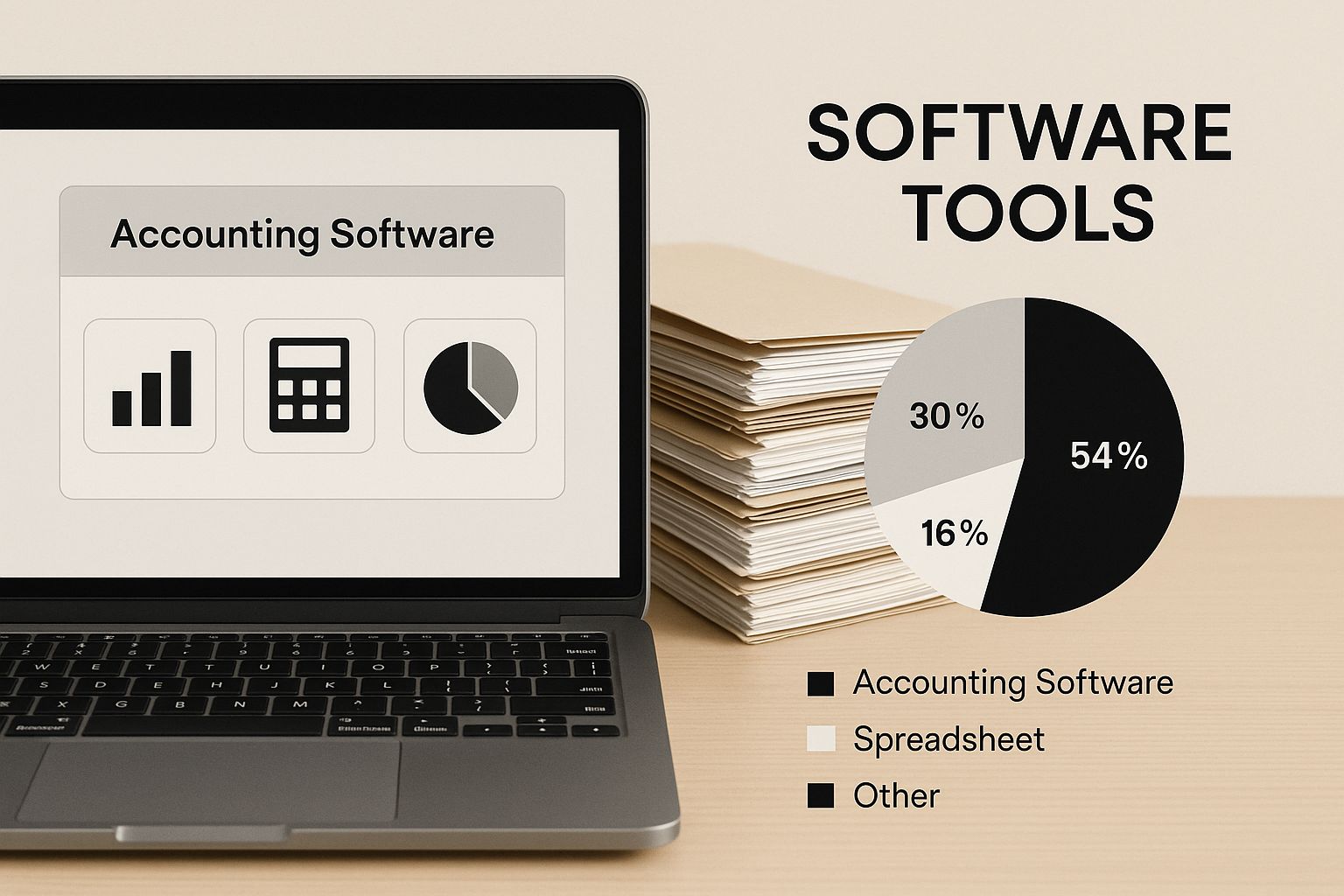
As the graphic shows, while both will be familiar with accounting software, accountants are more likely to use advanced tools for financial modelling and business intelligence. It’s a reflection of their focus on analysis and forecasting.
When To Hire Each Financial Expert

Knowing when to bring in a bookkeeper versus an accountant really comes down to where your business is at right now and what its most urgent financial challenges are. The "accountant vs bookkeeper" question isn't about which one is superior; it’s about who you need on your team today. And funnily enough, the answer will almost certainly change as your business grows.
If you're a new startup or a sole trader just getting off the ground, a bookkeeper is almost always the best first move. They lay the essential financial groundwork, getting your transactions organised and building solid record-keeping systems from the very beginning. This is how you avoid the dreaded shoebox full of receipts and get a clear, immediate picture of your cash flow.
Triggers for Hiring a Bookkeeper
If any of these scenarios sound familiar, it’s a pretty clear sign you need a bookkeeper’s help:
- You’re drowning in paperwork. You find yourself spending far more time chasing invoices and logging receipts than you do on the work that actually makes you money.
- Your cash flow is a complete mystery. You're not entirely sure who has paid you, who you owe money to, or what your actual bank balance looks like day-to-day.
- Your financial records are a mess. There’s no clear, organised system in place, which makes pulling up a simple financial snapshot feel impossible.
A bookkeeper is there to free you from the daily financial grind. Think of them as the tactical expert who sorts out the operational headaches, bringing order and accuracy so you can get back to building your business.
Once you have that solid bookkeeping foundation, you'll naturally start thinking bigger. That's when the need for more strategic guidance becomes obvious, and it’s time to start thinking about an accountant.
Triggers for Hiring an Accountant
As your business grows up and its finances get more complicated, you’ll hit certain milestones that cry out for an accountant's strategic mind. It's time to hire one when you need to:
- Secure funding or investment. Banks, lenders, and investors won't just take your word for it; they need to see detailed financial forecasts and professionally prepared accounts.
- Handle complex tax issues. This goes beyond simple self-assessment. We’re talking about navigating VAT schemes, optimising your corporation tax, or planning for capital gains.
- Make big strategic decisions. An accountant can dive deep into your profitability and model different financial scenarios to help you decide on things like expanding, changing your pricing, or making a major purchase.
This shift has created a real opportunity in the industry. We're seeing more and more young, entrepreneurial accountants setting up their own practices to serve businesses hitting this exact stage. In fact, the Association of Accounting Technicians (AAT) found that the number of licensed accountants under 34 who became self-employed rocketed by an incredible 755% between 2018 and 2025. You can read more about how this is changing the profession in reports from publications like Accountancy Age.
For many businesses, the ideal setup is actually a blend of both. A bookkeeper keeps their finger on the daily financial pulse, while an accountant steps in for periodic strategic reviews. This way, you've got your operational efficiency and your long-term financial vision completely covered.
Making the Right Choice for Your Business
So, how do you decide between an accountant and a bookkeeper? It really comes down to a fundamental difference in focus. Think of it this way: a bookkeeper is all about accurately recording your financial past, while an accountant uses that history to help you navigate the present and map out a more profitable future.
To get it right, you first need to pinpoint your biggest headache. Is it the daily grind of keeping on top of transactions, or are you more concerned with building a long-term financial strategy? Answering that question will make your immediate needs crystal clear and help you put your money where it will do the most good.
Ultimately, the decision between hiring an accountant or bookkeeper, or both, comes down to your business's needs for mastering financial management for small businesses. One organises your data; the other turns that data into actionable intelligence.
A Final Decision Checklist
To figure out exactly where you need support, ask yourself these two crucial questions:
-
Is my main challenge day-to-day organisation? If you feel like you're drowning in a sea of invoices, wrestling with payroll, and constantly trying to reconcile your accounts, your immediate priority is a bookkeeper. They will bring order to the chaos and give you the clean, reliable data that all other financial analysis depends on.
-
Do I need help with strategic growth and tax planning? If your mind is on forecasting cash flow, finding ways to reduce your tax bill, or preparing to seek investment, then you absolutely need an accountant. They provide the high-level, forward-looking advice that is essential for scaling your business.
By taking a moment for an honest assessment of where your business is right now, you can confidently choose the right financial expert to help you build a stronger, more sustainable company.
Frequently Asked Questions
It's easy to get tangled up when trying to figure out the financial roles in your business. Let's clear up some of the most common questions UK business owners ask when deciding between an accountant and a bookkeeper.
Can an Accountant Do Bookkeeping Work?
Technically, yes. Most accountants are perfectly capable of handling bookkeeping. But the real question is, should they? It’s rarely a good use of your money. Paying an accountant's premium rate for daily data entry is like hiring a master architect to lay bricks – they can do it, but it’s an expensive way to get the job done.
A much savvier move for most businesses is to have a bookkeeper manage the day-to-day financial record-keeping. This leaves your accountant free to focus on the high-level work they're trained for, like strategic tax planning, in-depth financial analysis, and preparing your statutory reports.
Are UK Bookkeepers Required to Be Certified?
In the UK, the title ‘bookkeeper’ isn't legally protected. This means, in theory, anyone can set up shop and call themselves a bookkeeper, which makes doing your homework essential.
A credible bookkeeper will hold qualifications from a recognised professional body, such as the Association of Accounting Technicians (AAT) or the Institute of Certified Bookkeepers (ICB). When you hire someone with these credentials, you're getting peace of mind that they are competent and committed to professional standards.
The key distinction lies in regulation. While anyone can offer bookkeeping services, accountants – particularly Chartered Accountants – are bound by strict professional codes. This provides a higher level of assurance and accountability.
What Is the Typical Cost Difference?
The price gap between the two is significant, and it directly reflects their different responsibilities. Bookkeepers are your go-to for affordable, ongoing financial admin, with UK hourly rates typically ranging from £25 to £50, depending on their experience and location.
Accountants command a higher fee for their strategic insight and specialised knowledge. You can expect their hourly rates to start around £75 and climb well over £150, especially for a Chartered Accountant. Many will also provide fixed-fee packages for specific jobs, like finalising your year-end accounts or filing a corporation tax return.
Do I Need Both an Accountant and a Bookkeeper?
For many growing UK businesses, the answer is a firm "yes." Having both is often the sweet spot for creating a really solid financial foundation. A bookkeeper keeps your day-to-day records clean, accurate, and consistently up-to-date.
Your accountant then takes that pristine data and uses it for the bigger picture: strategic planning, complex tax filing, and providing valuable business advice. This two-pronged approach gives a small or medium-sized enterprise (SME) a robust and remarkably efficient financial engine.
Ready to gain clarity on your finances and build a strategy for growth? The team at Stewart Accounting Services offers expert accounting, bookkeeping, and advisory services to help you achieve your business goals. Find out how we can help your business thrive.