

When you run a limited company, certain costs you incur are considered "allowable expenses." Think of these as the essential, day-to-day costs of doing business. The brilliant part is that you can subtract these expenses from your company's income before you calculate your tax bill.
This simple act reduces your company's taxable profit, which means you pay less Corporation Tax. It’s not a loophole; it's a fundamental part of the UK tax system designed to help businesses thrive.
What Are Allowable Expenses and Why Do They Matter?
Running a company’s finances isn't a million miles away from managing a household budget, but it comes with a significant business advantage. The entire concept of an allowable expense limited company is built on one simple idea from HMRC: if you spend money to keep your business running and help it grow, you shouldn't have to pay tax on that money.
By carefully tracking and deducting every legitimate cost, you lower your company's profit on paper. This isn't about cooking the books; it's about accurately reflecting the true cost of being in business. The direct result is a smaller Corporation Tax bill, a core strategy for keeping your business financially healthy.
The Golden Rule of Business Expenses
So, how do you know what counts? HMRC has a clear test for any expense: was it incurred "wholly and exclusively" for business purposes? This is the golden rule. It means the cost must be purely for business reasons, without any personal benefit mixed in.
If your laptop is used 100% for work, its cost is an allowable expense. But if you use it 50% for work and 50% for watching Netflix, things get a bit more complicated—only the business portion can be claimed. You can see this rule in action by learning how to manage your limited company expenses properly.
Key Takeaway: Getting a handle on your allowable expenses isn't just about bookkeeping. It's a strategic move. Every pound you correctly claim is a pound that stays in your company's bank account instead of going to the taxman.
To give you a clearer picture, let's quickly compare what typically gets the green light from HMRC and what doesn't.
Allowable vs. Disallowable Expenses at a Glance
This table offers a quick summary of common expenses, helping you see the difference between what your limited company can usually claim and what it can't.
| Expense Category | Generally Allowable | Generally Disallowable |
|---|---|---|
| Office Costs | Rent for your office, stationery, business phone bills | Rent for your home (unless claiming for use of home as office) |
| Travel | Business mileage, train tickets to a client meeting, hotel stays for business trips | Your regular commute from home to your permanent workplace |
| Staff Costs | Employee salaries, employer's National Insurance, pensions | Your own salary drawings (they are handled via PAYE) |
| Marketing | Website hosting, advertising campaigns, professional association fees | Entertaining clients, event hospitality |
| Legal & Financial | Accountant fees, business insurance, bank charges | Legal fees for personal matters, fines for breaking the law |
| Equipment | Laptops, printers, specialist software needed for your trade | A new TV for your living room (even if you watch business news) |
Remember, this is a general guide. The "wholly and exclusively" rule always applies, and some items can be complex.
Understanding the Financial Impact
Failing to claim all your legitimate expenses is like giving HMRC an unnecessary tip. For any business, but especially a growing one, this can seriously squeeze your cash flow. It can mean the difference between hiring a new team member or not, or funding that marketing campaign you know will bring in new customers.
On the other hand, getting it right leads to some powerful benefits:
- Better Profitability: A lower tax bill means higher net profit. Simple as that.
- Stronger Cash Flow: More cash in the bank gives you the flexibility to react to opportunities and challenges.
- Clearer Financial Picture: Your accounts will show the true cost of your operations, helping you make smarter decisions.
- Peace of Mind: Knowing you're compliant with HMRC's rules means no nasty surprises down the line.
With this foundation in place, you’re ready to look at specific expense categories and confidently identify every deductible cost your business has.
Core Business Expenses Your Company Can Claim
Right, let's move from the theory to the practical stuff. Think of this as your essential checklist for deductions. Most of the allowable expenses for a limited company fit into a few key categories directly related to your day-to-day operations. Getting these core areas right is the first step to making sure you claim everything you're entitled to and don't end up leaving money on the table for the taxman.
These costs are the real engine room of your business—the money you have to spend to keep the lights on, look after your customers, and pay your team. Once you understand the "why" behind each deduction, you can look at your own spending with confidence and get your tax bill as low as legally possible.
Staff and Payroll Costs
For most businesses, the biggest single outgoing is their people. HMRC gets this, which is why a wide range of staff-related costs can be deducted from your profits before you calculate your tax. This is a massive area of allowable expenses for a limited company, so it pays to get it right.
The most obvious deduction is the gross salary you pay your employees, but it definitely doesn't stop there. Here are the other key payroll costs you can claim:
- Employer's National Insurance Contributions: Those Class 1 contributions you have to pay on your team's earnings are fully deductible.
- Employer Pension Contributions: The payments your company makes into your employees' workplace pensions are also allowable.
- Bonuses and Commissions: Any performance-related pay is treated just like a regular salary, so it's deductible too.
- Benefits in Kind: The cost of providing perks like private health insurance or a company car can often be claimed, though be aware they might attract other taxes for the employee.
Essentially, if it's a direct cost of having your team on board, it's almost certainly a legitimate business expense. This makes sure the true cost of your workforce is reflected in your accounts, which in turn directly reduces your Corporation Tax bill.
Crucial Insight: While employee salaries are a straightforward deduction, how directors pay themselves is a bit different. A director's salary paid through PAYE is an allowable expense, but dividends are not. Dividends are a distribution of profit after tax has already been calculated.
Office, Premises, and Equipment Costs
Whether you're in a slick city-centre office, a workshop, or even working from home, the costs of your physical workspace are a major category of allowable expenses. These are the fundamental overheads you need to simply give your business a place to exist and operate.
This image gives you a quick visual breakdown of the main office and utility costs you can claim.
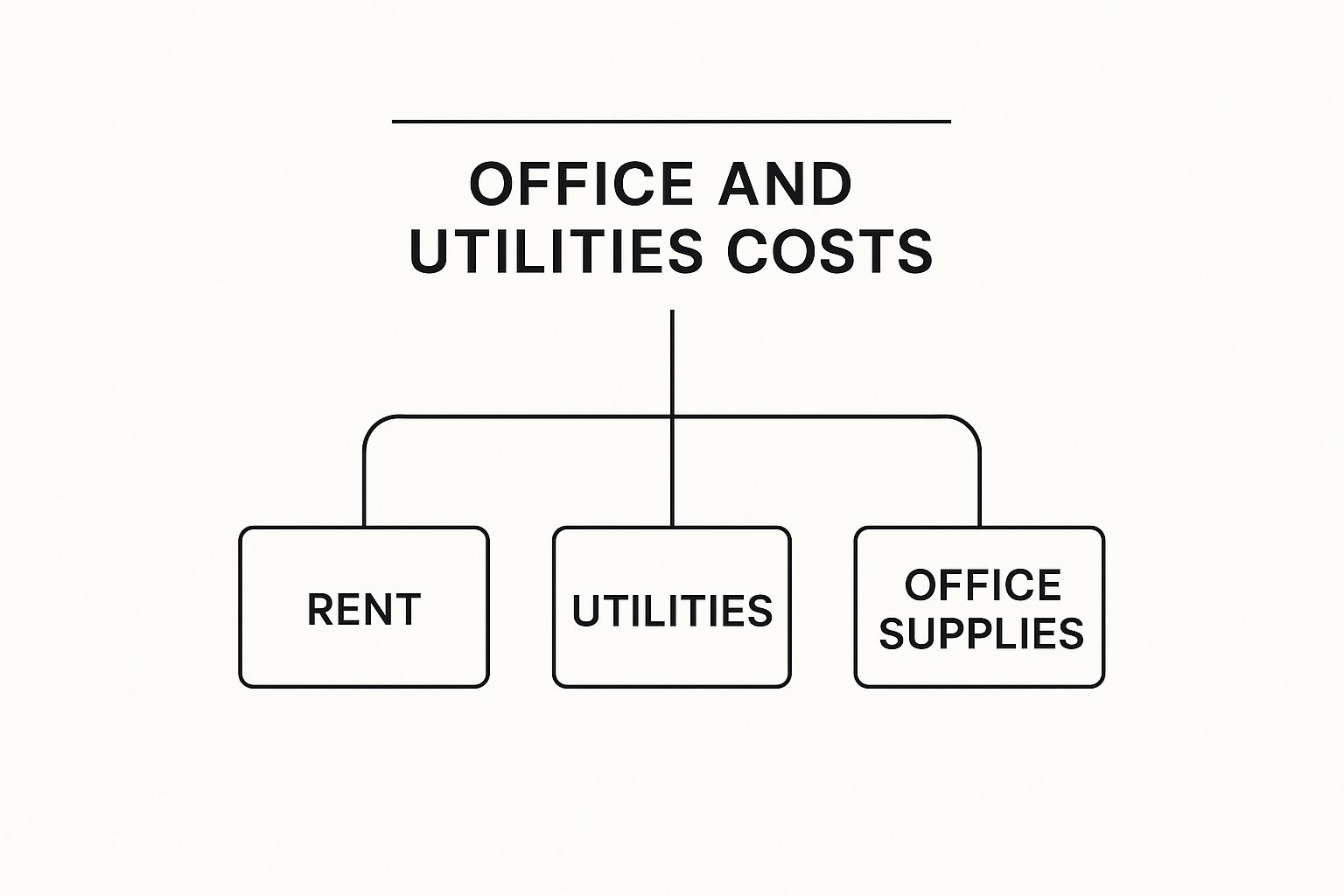
As you can see, it all stems from the basic need for a workspace. The main expenses you can claim for your premises include:
- Rent: If you're renting a commercial property, those monthly or quarterly payments are fully deductible.
- Business Rates: The tax you pay to your local council for your non-domestic property is an allowable expense.
- Utilities: Your business electricity, gas, water, and broadband bills are all classic deductible costs.
- Repairs and Maintenance: The cost of keeping your premises in good shape, like fixing a leaky roof or getting the boiler serviced, can be claimed.
It’s really important to know the difference between these day-to-day running costs and bigger, one-off investments.
Differentiating Supplies from Assets
When you buy things for the business, HMRC sees them in two different ways: everyday consumables and long-term purchases.
Office Supplies: These are the small, disposable items you get through all the time. Think pens, A4 paper, printer ink, and stamps. These are simple allowable expenses that you just deduct from your profit in the same year you buy them.
Capital Allowances: This is where it gets a bit different. Bigger purchases like a new laptop, office desks, or machinery are seen as business assets. You don't get to claim the full cost in one go. Instead, you claim tax relief through a system called capital allowances, which effectively spreads the deduction over several years. This is because the item has a lasting value to your business.
As you get a handle on your core expenses, don't forget to track the smaller operational costs, like payment processing fees. You can use tools like a Stripe fee calculator to get a clearer picture of these charges. By carefully separating your everyday supplies from your long-term assets, you make sure your accounting is spot-on and compliant, getting the most tax relief you can, both now and in the future.
How to Claim Travel and Subsistence Costs Correctly

For many company directors, figuring out the rules for travel expenses can feel like navigating a maze. But it’s one of the most important parts of managing your allowable expenses limited company. Get this right, and you can make a real dent in your tax bill. Get it wrong, and you could be looking at an unwanted enquiry from HMRC.
The fundamental rule is actually quite simple. You can claim for journeys you have to make for work. You can't claim for your everyday commute.
Think of it this way: driving from your home to your main office is just a part of having that job. It’s a personal journey. But driving from your office to a client's site for a crucial meeting? That's a business necessity, and that's the distinction HMRC really cares about.
What Is a Business Journey?
To be considered an allowable expense, your travel must be to what HMRC calls a ‘temporary workplace’. This is simply a place you go to for a limited time to get a specific task done.
Here are a few classic examples of what counts as a business journey:
- Popping over to a client's office for a project update.
- Travelling to a supplier's warehouse to check on an order.
- Attending an industry conference or a professional training course.
- Making a one-off trip to another one of your company's sites for a particular reason.
Each of these trips is essential for the business to function and bring in revenue. In contrast, that daily slog to your main base of operations is classed as ‘ordinary commuting’ and, unfortunately, is not tax-deductible.
Claiming Mileage and Other Travel Costs
When you do make a legitimate business journey, you can claim a few different costs back from the company. The one non-negotiable part of this is keeping meticulous records for every single trip.
Using Your Personal Vehicle
If you use your own car or van, you can claim a standard mileage rate. These are HMRC’s approved mileage allowance payments (AMAPs), and they’re designed to cover not just fuel but also the general wear and tear on your vehicle.
- Cars and Vans: You can claim 45p per mile for the first 10,000 business miles you drive in a tax year.
- After 10,000 Miles: The rate then drops to 25p per mile for any further business miles.
- Motorcycles: The allowance is a flat 24p per mile.
You absolutely must keep a detailed mileage log. It needs to show the date, the purpose of the trip, where you started and finished, and the total miles. Without this proof, HMRC is very likely to throw out your claim.
Public Transport and Accommodation
If you take a train, bus, or plane for business, the ticket cost is a fully allowable expense. The same straightforward rule applies to your accommodation.
HMRC’s View on Accommodation: If a business trip requires an overnight stay, the cost of a hotel or other suitable lodging is tax-deductible. The key word here is "reasonable"—the expense shouldn't be over-the-top or extravagant.
Understanding Subsistence Costs
When you’re away from your normal place of work on a business trip, the company can also cover your meals and other necessary day-to-day costs. This is what’s known as subsistence.
These costs are allowable because you wouldn't be spending this money if it weren't for the business travel. You can claim for:
- Breakfast, lunch, and dinner.
- The cost of drinks, including an alcoholic one with a meal.
- Parking fees and road tolls.
- Business-related phone calls or printing costs while you're away.
The golden rule is that the amounts must be reasonable. HMRC doesn’t publish a fixed daily rate, but they expect your claims to be sensible. A claim for a nice three-course meal with a glass of wine is almost always fine. A claim for a bottle of vintage champagne, on the other hand, would definitely raise some eyebrows.
By understanding the clear line between commuting and business travel and by keeping immaculate records, you can confidently claim these common expenses and run your company in the most tax-efficient way possible.
Right, let's talk about two of the most common expense areas for company directors: working from home and keeping your skills sharp. Since so many of us now run our businesses from a home office, getting this right is more important than ever. The same goes for professional development – investing in yourself is investing in your business.
HMRC gets this. They know that having a proper place to work and staying on top of your game are fundamental to running a successful company. That’s why they allow you to claim these costs, which in turn lowers your Corporation Tax bill. It’s a win-win, but you have to play by the rules.
Working From Home Without the Headache
When your home is also your office, you're entitled to claim back some of your household running costs. The key is choosing the method that works best for you.
1. The Simple Flat-Rate Method
If you want to keep things incredibly simple, HMRC offers a flat rate. You don't need to sift through utility bills or do complicated sums. It’s designed to be quick and hassle-free.
Here’s what you can claim based on the hours you work from home each month:
- 25-50 hours: Claim £10 per month.
- 51-100 hours: Claim £18 per month.
- 101+ hours: Claim £26 per month.
It's straightforward, yes, but let's be honest: these amounts are pretty small. For most people, this method means you’re probably missing out on a much bigger, more accurate claim.
2. The Actual Costs Method
This route takes a bit more number-crunching, but it nearly always results in a larger expense claim. You’ll be calculating the actual business-use portion of your household bills.
This is the crucial part: You can only claim for the extra costs you incur because you're working from home. Think about the additional heating you need on a cold winter's day or the extra electricity powering your work setup. You can't claim for fixed costs like mortgage interest, rent, or council tax, because you’d be paying those anyway, office or not.
So, how do you work it out? You need a reasonable system. A popular way is to figure out what percentage of your home is used as an office (say, one room out of eight makes it 12.5%) and then apply that percentage to your variable bills like gas, electricity, and maybe water.
Investing in Your Professional Growth
Your knowledge is the engine of your business. Any money you spend to maintain or upgrade your skills is usually an allowable expense, as long as it’s directly tied to what your company already does.
Training and Development
You can absolutely claim for courses that update your existing skills or make you better at running your business. A graphic designer taking an advanced course in animation software? That’s allowable. A business consultant taking a course on financial modelling? Also fine.
What you can't do is claim for training that would let you pivot to a whole new line of business. The training has to be about enhancing the company you have now, not starting a new one.
Subscriptions and Publications
Keeping up with your industry is vital, and the costs associated with it are claimable. This includes:
- Professional Body Memberships: Your annual fees to an organisation relevant to your trade, like an architect's membership with RIBA.
- Trade Publications: Subscriptions to industry magazines, specialist websites, or academic journals that keep you informed.
These rules didn’t just appear overnight; they've been shaped over decades. Since Corporation Tax was introduced back in 1965, the official stance on allowable expenses for limited companies has constantly adapted. The boom in remote work forced clearer guidance on home office claims, while the digital age brought in tougher record-keeping standards to combat errors and fraud. Understanding this history helps explain why HMRC is so focused on clear, justifiable records for every single claim you make. You can get a deeper sense of this evolution and find more examples on company expense regulations at factorialhr.co.uk.
Navigating Grey Areas and Keeping Flawless Records
While some costs, like office rent or staff salaries, are clearly business expenses, other areas can feel a bit murky. These "grey areas" are where business owners, even with the best intentions, can stumble over the finer points of HMRC's rules. It’s rarely about dishonesty, but more about misunderstanding the nuances.
Getting a handle on these tricky spots is crucial for staying compliant and making sure you're not paying more tax than you need to. Two of the most common pitfalls are client entertainment and expenses that blur the line between business and personal use. Knowing exactly where HMRC draws the line is your best defence against rejected claims and unwelcome penalties.
The Strict Rules on Entertainment
We all know that building relationships is part of business, but when it comes to claiming expenses for it, who you're entertaining makes all the difference. HMRC is crystal clear on this, and the tax implications are significant.
-
Client Entertainment: Thinking of taking a prospective client for a fancy lunch or a day at the races? While it might be great for business, it's almost never an allowable expense for Corporation Tax. You should definitely track these costs in your company's books, but you can’t deduct them from your taxable profit. HMRC simply sees this as business hospitality, not a tax-deductible activity.
-
Staff Entertainment: Now, this is a different story. You can get tax relief for throwing staff parties or social events, as long as you play by the rules. The most famous of these is the exemption for an annual event, like a Christmas do or a summer barbecue.
HMRC’s Annual Party Exemption: The magic number here is £150 per head (VAT included) per year for an annual event for your team. Stay within this budget, and the cost is a fully allowable expense. Better yet, it's not a taxable benefit for your staff. But be careful—if you go over that limit by even a single penny, the entire cost becomes a taxable perk.
Mastering the "Duality of Purpose" Rule
This is one of the most fundamental concepts in the world of business expenses. The "duality of purpose" rule gets right to the heart of the "wholly and exclusively" test. In simple terms, if a cost has a mixed benefit—partly for business, partly for personal use—HMRC will often disallow it completely.
The classic example is a sharp suit. You might buy it specifically for important client meetings, which is a clear business purpose. However, you could just as easily wear that same suit to a friend's wedding, which is personal. Because of this potential dual use, the cost of the suit is not an allowable expense. The only real exceptions are for branded uniforms or essential protective clothing that you couldn't reasonably wear elsewhere.
To stay on the right side of this rule, always ask yourself one simple question: "Is this expense only for the benefit of my business?" If there's any doubt, it's likely not claimable.
The Ultimate Defence: Flawless Record-Keeping
At the end of the day, even the most legitimate expense claim is worthless without proof. Keeping meticulous records isn't just good business sense; it's a legal requirement. Without solid evidence to back up your claims, HMRC can—and will—reject them, leaving you with an unexpectedly higher tax bill.
Think of your records as your ultimate line of defence. Should HMRC ever launch an enquiry, your organised collection of invoices, receipts, and bank statements is the evidence that proves your claims are accurate and above board. Properly claiming various IRS tax forms and UK equivalents is impossible without a clear paper trail, making conversations with your accountant far more productive.
So, what should you be holding onto?
HMRC Record-Keeping Requirements
The table below breaks down the essential documents you need to keep and, crucially, for how long.
| Type of Record | Examples | Minimum Retention Period |
|---|---|---|
| Proof of Expense | Invoices from suppliers, itemised till receipts, contracts | 6 years from the end of the financial year |
| Proof of Payment | Business bank statements, company credit card statements | 6 years from the end of the financial year |
| Sales Records | Copies of invoices you've issued to clients, sales ledgers | 6 years from the end of the financial year |
| Mileage Logs | Dated logbook showing journey purpose, start/end points, and miles driven | 6 years from the end of the financial year |
Failing to maintain adequate records can lead to some hefty penalties, starting from £3,000. By embracing a robust system for your paperwork, you're not just protecting your business from risk—you're building a solid foundation for its long-term financial health.
Common Questions About Allowable Expenses Answered
Even when you've got a handle on the rules, certain everyday situations can still make you second-guess what’s allowed. The world of allowable expenses for a limited company is full of grey areas, so it's only natural to have questions. Getting them right is the key to staying on HMRC's good side and running a tax-efficient business.
Let's dive into some of the most common questions we hear from company directors. We’ll give you straight, practical answers to help you navigate these tricky spots with confidence.
Can I Claim My Daily Commute to the Office as a Business Expense?
This is probably the number one question we get asked, and HMRC's answer is a clear and simple "no." Your regular trip from home to your main office or workshop is classed as 'ordinary commuting'. In HMRC's eyes, that’s just a personal cost of getting to your job, not a business journey.
But things change completely when you're travelling to a temporary workplace. A journey becomes an allowable expense when it’s for a specific business reason that takes you away from your usual base of operations.
- Not Allowable: Driving from your house to your main office every morning. This is just your commute.
- Allowable: Travelling from your office to a client's site for a vital meeting.
- Allowable: Heading to another city for a one-day training course.
The difference is everything. An allowable journey is one you wouldn't make if not for that specific business need. A commute is just part of your daily routine.
What Happens If I Make a Mistake and Claim a Non-Allowable Expense?
Don't panic—honest mistakes happen. But it's important to know what follows if HMRC spots an error during a compliance check. They will simply disallow the expense, which has a knock-on effect.
First, the disallowed amount gets added back to your profits. This, in turn, increases your Corporation Tax bill, so you'll have to pay the extra tax you owe.
Important to Know: It doesn't always stop there. On top of the extra tax, HMRC can charge interest on the underpaid amount, backdated to when it was originally due. They can also issue a penalty, which can be a hefty percentage of the unpaid tax, depending on whether the mistake was just carelessness or something more deliberate.
If you realise you've made a mistake, the best thing you can do is tell HMRC straight away. Being proactive and correcting an error usually leads to a much smaller penalty, and sometimes none at all.
Can I Pay for My Mobile Phone Bill Through the Company?
Yes, you absolutely can, and it's usually the best way to do it. The trick lies in how the contract is set up. If the mobile phone contract is in the company's name and paid directly from the business bank account, the whole bill is an allowable expense. Simple as that.
This is treated as a tax-free benefit for you as a director or for your employee. HMRC doesn't expect you to keep a log of personal versus business calls. It’s a clean, straightforward deduction.
Things get fiddly if you try to claim for business use on your personal mobile. You’d have to painstakingly track your usage to separate the business portion of calls and data, and then be prepared to justify it. Honestly, it's an administrative headache. Putting the contract in the company's name from the start saves time and gets you full tax relief.
Are Bank Charges and Interest on a Business Loan Allowable Expenses?
They certainly are. Any costs you incur to finance your business are almost always allowable. This includes a whole range of common financial fees.
Here’s a quick breakdown:
- Business Bank Charges: Your monthly account fees, charges per transaction, and overdraft fees are all fully deductible.
- Interest on Business Loans: The interest you pay on a loan taken out for a proper business reason—like buying equipment or managing cash flow—is an allowable expense. Think of it as a direct cost of keeping your company funded.
Just be careful to separate the interest from the capital. While the interest element is tax-deductible, paying back the actual loan amount (the capital) is not. You're just returning money you borrowed, which doesn't reduce your company's profit for tax purposes.
Navigating the complexities of allowable expenses is just one part of maintaining a financially healthy limited company. To ensure you're maximising tax efficiency and building a robust growth strategy, expert guidance is invaluable. Stewart Accounting Services offers tailored accounting and business support to help you move from where you are to where you want to be. Free up your time, improve your profitability, and gain peace of mind by letting us handle the details. Discover how our expert services can benefit your business today.