

Understanding the correct wage for an apprentice can feel complicated, especially with rates changing and different rules applying based on age and experience. For employers, paying the right amount is a legal duty; for apprentices, it’s about being paid fairly for your work. This guide provides a clear, simple breakdown of the correct apprentice wage for a 19-year-old in the UK, covering whether you’re in your first year of training or have moved beyond it.
The Two Key Wage Rates for a 19-Year-Old Apprentice
The wage a 19-year-old apprentice is entitled to depends on one simple but crucial factor: are you in the first year of your apprenticeship, or have you already completed it? The answer determines which minimum wage rate applies. Let’s break down both scenarios with the official figures to remove any confusion.
Please note: The rates mentioned below are effective from 1st April 2024. These are reviewed annually, and the rates for 2025/26 will be confirmed by the government in due course.
Scenario 1: You are 19 and in your first year
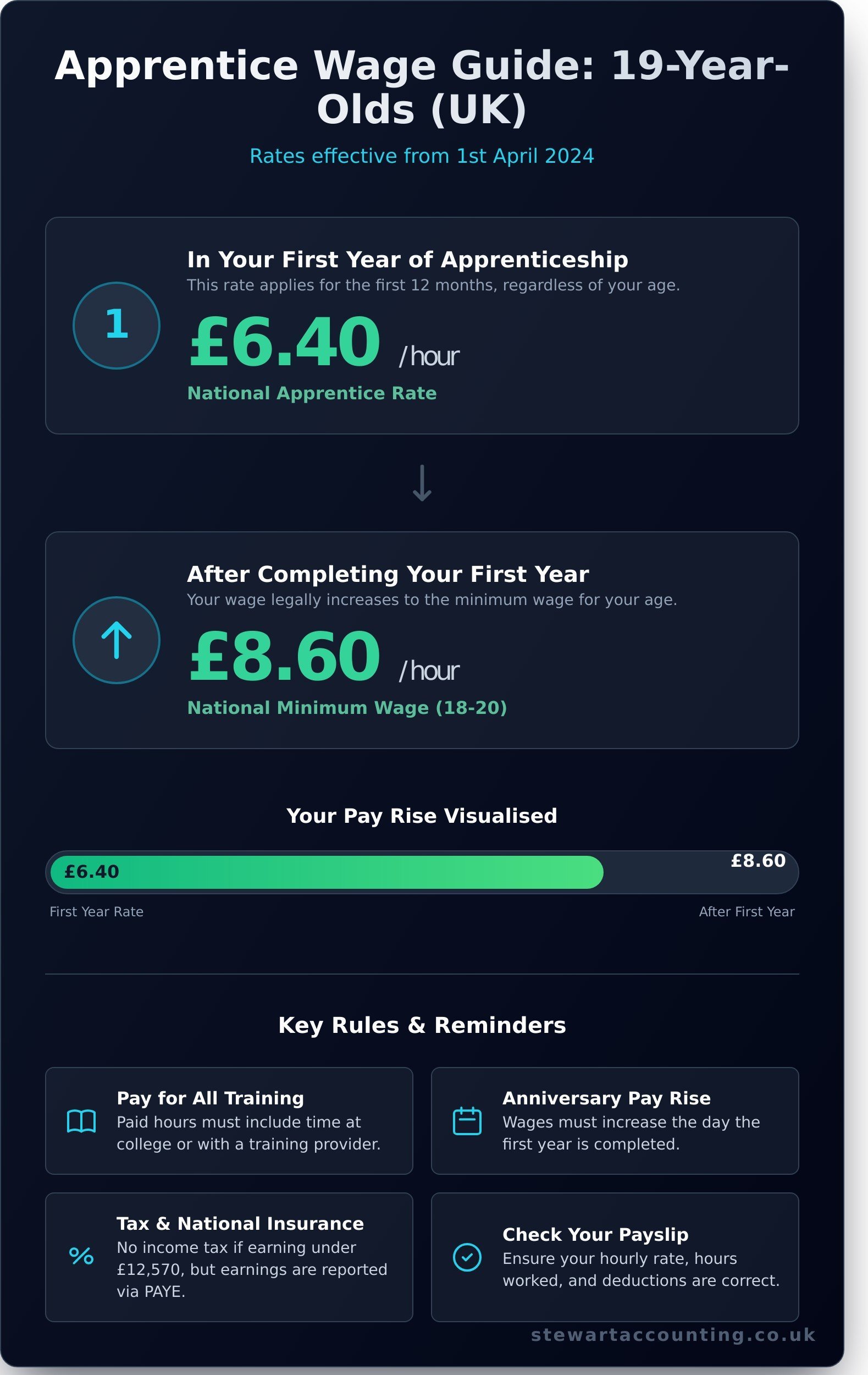
If you are 19 years old and are currently in the first 12 months of your apprenticeship contract, you are legally entitled to be paid at least the National Minimum Wage for apprentices. Here’s what that means:
- You must be paid the apprentice rate, which is £6.40 per hour (from April 2024).
- This specific rate applies for the entire first year of your apprenticeship, regardless of your age. So, even though you are 19, this rate overrides the standard minimum wage for your age group during this initial period.
- Example: A 19-year-old who starts a two-year plumbing apprenticeship will be paid the apprentice rate of £6.40 per hour for their entire first year.
Scenario 2: You are 19 and have completed your first year
Once you have completed the first year of your apprenticeship, your wage must increase to the full National Minimum Wage rate appropriate for your age. This is a significant and legally required pay rise.
- Your wage must increase to the National Minimum Wage for your age group. For a 19-year-old, this is £8.60 per hour (from April 2024).
- This increase is a legal requirement as soon as you start the second year of your apprenticeship.
- Example: The same 19-year-old plumbing apprentice, upon starting their second year, must see their hourly pay increase from £6.40 to at least £8.60.
What Employers Need to Know About Apprentice Pay
As an employer, paying the correct wage is a fundamental legal responsibility. Understanding these rules not only ensures you are compliant but also helps you avoid potentially costly mistakes and penalties from HMRC. Here’s how to manage apprentice pay correctly within your payroll system.
What time must you pay for?
An apprentice’s paid hours are not just for the time they spend on-site. You must pay them for all their normal working hours, which legally includes the time spent on training or study that forms part of their apprenticeship. This training must make up at least 20% of their contracted hours. Forgetting to pay for college days or study time is a common error that can lead to underpayment. Finding payroll complex? We can take it off your hands.
Common Payroll Mistakes to Avoid
Several common errors can lead to accidentally underpaying an apprentice. Be sure to avoid these pitfalls:
- Forgetting the birthday or anniversary: The most common mistake is failing to increase the apprentice’s wage to the age-appropriate rate once they complete their first year. Set a calendar reminder for this date.
- Not paying for training time: You must pay for time spent at college or with a training provider if it’s part of the official apprenticeship.
- Unlawful deductions: Any deductions for things like tools, uniforms, or other expenses cannot take an employee’s pay below the National Minimum Wage.
Tax and National Insurance for Apprentices
Like all employees, apprentices are subject to the same rules for Income Tax and National Insurance. Their wages must be processed through a PAYE payroll system. However, because many apprentices earn below the annual tax-free Personal Allowance (currently £12,570), they may not actually pay any income tax. Despite this, you must still report their earnings to HMRC on or before each payday. Keeping accurate financial records is essential here — our bookkeeping services can help ensure every transaction is correctly logged and your business stays fully compliant.
A Quick Guide for Apprentices
Knowing your rights is the first step to ensuring you are being paid fairly for your hard work and dedication. Your employer is legally required to provide you with an itemised payslip for every pay period. Here’s what to look for and what to do if you think something is wrong.
How to Check Your Payslip
Your payslip contains important information. When you receive it, take a moment to check the following:
- Hourly Rate and Hours: Look for your hourly pay rate and the total number of hours you worked.
- Check the Gross Pay: Multiply your hours worked by your hourly rate. Does this match the ‘gross pay’ figure on your payslip?
- Check Deductions: Look for any deductions, such as Income Tax or National Insurance contributions. If you earn below the threshold, these should be zero.
What to Do if You Think You’re Being Underpaid
If you’ve checked your payslip and believe your pay isn’t correct, don’t panic. First, have a friendly and professional conversation with your employer or line manager-it could be a simple administrative error that is easily fixed. If that doesn’t resolve the issue, you can seek free, confidential advice from Acas (Advisory, Conciliation and Arbitration Service) or, if necessary, report the underpayment directly to HMRC.
Frequently Asked Questions
What is the apprentice wage in the UK for 2025/26?
The government reviews the National Minimum Wage and apprentice rates every year. The new rates, which will apply from 1st April 2025, are typically announced in the Autumn Statement towards the end of the previous year. You should always check the official GOV.UK website for the most current figures.
Do apprentices get paid for their college days?
Yes. If attending college or a training provider is a formal part of your apprenticeship, your employer must pay you for this time at your normal hourly rate. This is considered part of your working hours.
What is the difference between the National Minimum Wage and the National Living Wage?
The National Minimum Wage (NMW) has different rates for various age groups (e.g., 18-20 year olds). The National Living Wage (NLW) is the highest rate of the minimum wage, and it currently applies to workers aged 21 and over.
Do I have to pay tax on my apprenticeship wage?
You only pay Income Tax if your total annual earnings are more than the Personal Allowance, which is £12,570 for the 2024/25 tax year. Many apprentices earn less than this and therefore do not pay tax, but you will still see tax deductions if you earn over the threshold.
What happens to my apprentice wage when I turn 20?
If you are still in the first year of your apprenticeship when you turn 20, your wage remains at the apprentice rate (£6.40 per hour). If you turn 20 after completing your first year, your wage must be at least the National Minimum Wage for a 20-year-old (£8.60 per hour).
Are apprentices entitled to holiday pay?
Yes. Apprentices are entitled to the same rights as other employees, including paid holidays. For a full-time role, this is at least 28 days per year, which can include bank holidays.
Managing payroll and staying on top of changing wage rates can be a significant burden for any business owner. If you want to ensure your apprentice payroll is always accurate and compliant without the stress, our team is here to help. Need help managing your business payroll? Contact our experts today. We can handle the details, giving you more time to focus on what you do best-running your business.