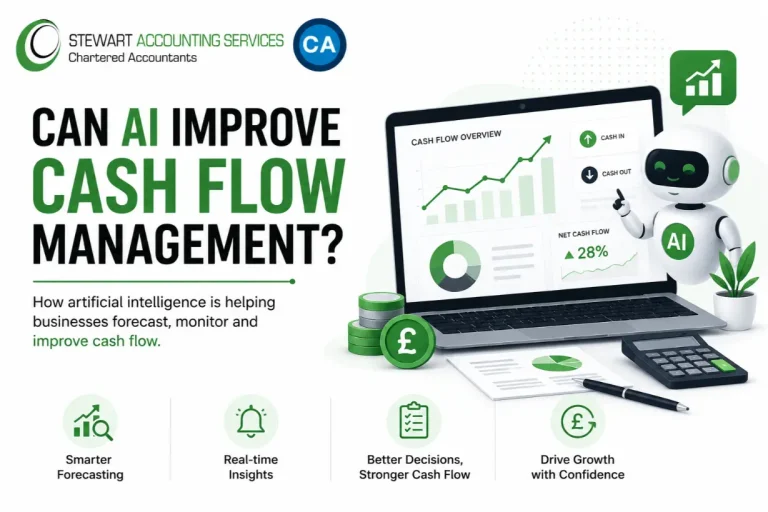
UK businesses are turning to artificial intelligence to tackle one of their oldest headaches — keeping cash flowing. Here’s what you actually need to know.
Poor cash flow management kills more profitable UK businesses than any recession. You can have a healthy order book, loyal customers, and a growing turnover — yet still find yourself staring at a bank account that refuses to keep up. For decades, the only fix was hiring a finance director, building complex spreadsheets, and spending hours on manual reconciliations. Artificial intelligence is now changing that equation in ways that are genuinely practical for businesses of all sizes.
This guide cuts through the hype. We’ll look at exactly where AI delivers, where it falls short, and what any UK business owner or finance leader should consider before adopting it.
Why Cash Flow Is Still the Number One Business Killer
The statistics are sobering. Research consistently shows that cash flow problems — not lack of profitability — are at the root of most small business failures in the United Kingdom. You might be generating revenue, but if customers pay late, seasonal dips hit unexpectedly, or a large invoice sits unpaid for 90 days, the whole operation can unravel remarkably fast.
of UK SME failures are linked to poor cash flow management
average amount owed in late payments to UK small businesses
days — average wait for invoice payment by UK SMEs
Traditional cash flow management relies on backwards-looking data: last month’s bank statements, last quarter’s P&L. By the time a crisis is visible in a spreadsheet, you’re already in it. The promise of AI is simple — to move from reactive to predictive, so problems surface weeks before they become emergencies.
“The best time to fix a cash flow problem is three months before it happens. AI makes that kind of foresight possible for businesses that couldn’t afford a CFO.”
What AI Actually Does Differently
When people talk about “AI in finance,” they often mean one of three things: machine learning (systems that learn patterns from historical data), natural language processing (understanding invoices, contracts, or emails), and predictive analytics (making probabilistic forecasts). In cash flow management, all three come together.
Unlike a spreadsheet formula, an AI model doesn’t just project last year’s pattern forward. It ingests data from your accounting software, bank feeds, payment history, seasonal trends, and even external signals like industry data or credit scores — and updates its predictions continuously. The result is a living, breathing cash flow forecast rather than a static snapshot that goes stale the moment you close the tab.
Core capabilities AI brings to cash flow
- Continuous ingestion of real-time bank and transaction data, eliminating manual data entry
- Pattern recognition across thousands of historical transactions to spot anomalies instantly
- Late payment prediction based on customer behaviour and industry benchmarks
- Dynamic rolling forecasts that update automatically as new data arrives
- Natural language alerts and explanations — not just numbers, but plain-English insight
Smarter Forecasting: Beyond the Spreadsheet
Cash flow forecasting has traditionally been a mix of educated guesses and manual effort. Finance teams copy numbers from accounting systems, apply assumptions, and produce a 13-week forecast that may already be wrong by the time it reaches the board. AI-powered forecasting tools automate this loop entirely.
How machine learning improves forecast accuracy
Machine learning models can identify subtle seasonal patterns you’d never spot manually — for instance, that your largest clients in the professional services sector tend to pay slower in August and December, or that invoices over £10,000 to retail clients carry a 40% chance of being queried and delayed. Once the model has seen enough of your data, it bakes these patterns in automatically.
Tools like Float, Fluidly, and Dryrun connect directly to Xero, QuickBooks, or Sage and build rolling 90-day forecasts with confidence intervals. Rather than a single projected cash balance, you see a range — “likely £42,000–£58,000 in week six” — which is far more useful for making decisions than a false-precision single figure.
Automated Invoicing and Collections
One of the most tangible — and immediate — improvements AI delivers is in the invoice-to-cash cycle. Late payments cost UK businesses billions each year, and the problem is largely administrative: following up, chasing, escalating. AI handles this without awkwardness or inconsistency.
Intelligent payment chasing
Modern AI-powered accounts receivable tools don’t just send generic reminders. They analyse each customer’s payment behaviour — how long they typically take, which communication channels they respond to, whether they’ve queried invoices in the past — and tailor the timing and tone of each chase accordingly. A long-standing client who’s usually reliable but now running two weeks late gets a gentle nudge. A new customer with no payment history gets a firmer prompt on day seven.
What automated AR looks like in practice
- Day 1 after due date: personalised email reminder, sent automatically
- Day 7: follow-up with payment link and one-click dispute option
- Day 14: escalation to account manager if still unpaid, flagged in dashboard
- Day 30+: credit risk scoring updated; recommended next action surfaced to human team
The result is faster payment cycles with less human time spent on admin — and no awkward phone calls from staff who don’t feel comfortable chasing. Businesses using AI-assisted collections consistently report reductions in debtor days of 15–30%, which can have a transformative effect on working capital.
Real-Time Scenario Planning
One of the most genuinely exciting applications of AI in cash flow management is scenario modelling. Traditionally, building a “what if” model required a skilled financial analyst and hours of spreadsheet work. AI-powered tools can generate multiple scenarios in seconds.
Want to know what happens to your cash position if you hire two new members of staff in Q3, a key client delays payment by 30 days, and your supplier increases prices by 8%? A good AI tool gives you that answer — with probability weightings — before your morning coffee goes cold.
This capability is particularly valuable for UK businesses navigating economic uncertainty. Rather than planning for a single projected future, you can make decisions that hold up across a range of plausible scenarios — what strategists call “robust planning.”
UK Tools Worth Exploring
The market for AI-assisted cash flow tools in the UK has matured significantly. Here are some of the platforms gaining traction with British businesses:
Float
Integrates with Xero, QuickBooks & FreeAgent for rolling visual forecasts with scenario planning.
ForecastingFluidly
AI-native cash flow intelligence designed for UK accountants and their SME clients.
AI-NativeChaser
Automated AR and payment chasing with smart personalisation and payment portal.
CollectionsSatago
Late payment risk scoring, automated chasing, and invoice finance in one UK platform.
Risk + FinanceDryrun
Scenario-based cash flow modelling with drag-and-drop forecasting for SMEs.
Scenario PlanningXero + AI
Xero’s native analytics and its AI-partner integrations now cover much of the SME base.
Accounting SuiteThe Honest Pros and Cons
No technology is a silver bullet. Here’s a balanced view of where AI in cash flow management genuinely delivers — and where you should manage your expectations.
What Works Well
- Saves hours of manual data entry and reconciliation
- Forecasts improve over time as the model learns your data
- Automated chasing reduces debtor days reliably
- Surfaces problems weeks earlier than manual reviews
- Accessible price points for SMEs (£30–£200/month)
- Integrates natively with UK accounting platforms
Limitations to Know
- Requires clean, consistent historical data to perform well
- Cannot predict truly unprecedented events (black swans)
- Human judgement still needed for relationship-sensitive decisions
- Implementation takes time; benefits aren’t instant
- Some tools require accountant involvement to set up well
- Data privacy obligations under UK GDPR must be considered
How to Get Started Without Getting Overwhelmed
The worst approach is to rip out your existing systems and replace everything at once. The best implementations are incremental. Here’s a practical route map for a UK business starting from scratch:
A sensible four-step approach
- Step 1 — Clean up your data.AI tools are only as good as your inputs. Before evaluating any platform, ensure your accounting software has accurate, up-to-date records, categorised transactions, and a complete debtor list.
- Step 2 — Start with forecasting.Plug in a forecasting tool like Float or Fluidly first. The low-risk, high-visibility improvement to your cash flow visibility will build confidence before you automate anything else.
- Step 3 — Automate collections.Once your forecasting is working, add an automated AR tool. The ROI is typically measurable within 60–90 days in reduced debtor days.
- Step 4 — Add scenario planning.With your baseline under control, use scenario modelling to support bigger decisions: hiring, investment, new contracts, and financing options.
Most businesses find they can meaningfully improve their cash flow visibility for under £100 per month — often less than the cost of one hour of their accountant’s time. The return on that modest investment, when measured in reduced late payments, fewer overdraft fees, and better decision-making, is almost always positive within the first quarter.
“AI doesn’t replace financial judgement — it gives you better data so your judgement is worth more.”
Yes — AI can meaningfully improve cash flow management, and for most UK businesses, the tools are now affordable, well-integrated, and genuinely useful. They won’t eliminate every cash flow problem, and they work best when a human being is still looking at the numbers with curiosity and context. But as a way of moving from reactive panic to proactive planning, the technology has arrived — and it’s no longer just for large enterprises.
If you’re still managing your cash flow purely through a spreadsheet updated once a week, you’re operating with one hand tied behind your back. The businesses outperforming you aren’t necessarily smarter — they just have better tools, and they’re using them.