

Master Your Cash Flow Forecast for Small Business Today
Think of a cash flow forecast as your business's financial crystal ball. It’s a living document that estimates the money flowing in and out of your company over a set period—say, the next 12 weeks or 12 months. More than just numbers on a page, it’s an early warning system that tells you exactly when you might have too little cash (a shortfall) or a healthy surplus, allowing you to plan ahead instead of reacting to financial fires.
Why a Cash Flow Forecast Is Your Business Lifeline
Let’s be honest. For most small business owners in the UK, managing the money side of things is the biggest source of stress. There's a common and dangerous misconception that profit equals cash in the bank. I’ve seen it time and again: a business can look incredibly healthy on its profit and loss statement but still go under simply because it couldn't pay its suppliers or staff on time.
This is precisely where a solid cash flow forecast for a small business proves its worth. It’s not just a box-ticking exercise for your accountant; it’s your strategic roadmap for navigating the unpredictable tides of business finance. It helps you look forward, not just back at historical reports, giving you the clarity to make smart, confident decisions.
A well-prepared forecast gives you a powerful understanding of your business's financial health. Here’s a quick look at the core benefits.
Core Benefits of Cash Flow Forecasting
| Benefit | Impact on Your Business |
|---|---|
| Problem Identification | See potential cash shortages months in advance, giving you time to act. |
| Strategic Decision-Making | Know when you can afford to hire, invest in new equipment, or expand. |
| Improved Lender Relations | A solid forecast demonstrates financial control, making it easier to secure loans or investment. |
| Better Supplier Management | Plan payments strategically and negotiate better terms when you know your cash position. |
| Stress Reduction | Move from financial anxiety to a feeling of control over your business's destiny. |
Ultimately, these advantages combine to build a more resilient and successful business, ready for whatever comes its way.
From Reactive Panic to Proactive Planning
Operating without a forecast is like driving a car with the windscreen blacked out. You’re flying blind. An unexpected tax bill, a major client paying late, or a sudden equipment failure can instantly throw you into crisis mode, forcing a desperate scramble for funds.
A forecast completely flips that script.
Imagine you run a small café. Your forecast shows a serious cash dip coming in three months' time, right after you buy a new coffee machine and just as the slower winter season begins. Armed with this knowledge, you’re in the driver's seat. You could:
- Speak to the equipment supplier and negotiate paying in instalments.
- Run a 'Winter Warmer' promotion to drive sales during the quiet period.
- Apply for a small business overdraft with your bank, giving yourself a buffer well ahead of time and likely securing better rates.
That’s the difference. You’re no longer just putting out fires; you’re preventing them from even starting.
A forecast transforms your financial management from a source of stress into a position of strength. It’s the difference between hoping you can pay your bills and knowing you can.
A Critical Tool in a Challenging Economy
With the current economic pressures, smart financial planning isn’t just good practice—it’s essential for survival. Recent studies paint a stark picture, revealing that nearly half (47%) of UK small businesses have run into cash flow problems. To make matters worse, 57% of these businesses expect their costs to keep climbing.
The anxiety is real, with 64% of owners worried about how these financial strains will affect their operations. You can read the full report on SME financial pressures on Accountancy Age.
At the end of the day, a regularly updated forecast gives you the confidence not just to survive tough times, but to spot and grab opportunities. Whether you're thinking of hiring a new team member, launching a marketing campaign, or adding a new service, your forecast is the tool that tells you when you have the financial green light to go for it.
Getting the Right Data for an Accurate Forecast
Any forecast is only as good as the information you feed it. If you rely on guesswork, you’re setting yourself up for nasty surprises down the line. The first, most crucial part of this whole process is to get your hands on solid, real-world numbers.
The good news? You’re not starting from scratch. All this information is already sitting in your bank statements, sales records, and accounting software. It's just a matter of pulling it all together. Think of it like gathering your ingredients before you start cooking – you need a clear picture of what’s coming in (your cash inflows) and what’s going out (your cash outflows). Nailing these two sides of the equation is the foundation of a reliable cash flow forecast for your small business.
Identifying Your Cash Inflows
First, let's look at the money coming into the business. And I don’t just mean your total sales figures. For a cash flow forecast, what truly matters is when the money actually lands in your bank account, not the date you send an invoice.
You'll need to pull together every source of incoming cash. For most businesses, the list looks something like this:
- Sales Revenue: This is the big one. Look at your past sales data and, more importantly, your customers' payment habits. If they consistently pay in 30 or even 60 days, your forecast has to reflect that reality.
- Customer Deposits: Do you take upfront payments for projects or custom orders? These are immediate cash injections you can count on.
- Loans or Grants: If you’ve secured funding, the date you expect those funds to clear is a major cash inflow.
- Asset Sales: Have you sold off old equipment or a company vehicle? The money from that sale counts as an inflow for that month.
- Owner Investment: Any cash you're personally putting into the business needs to be recorded here.
Going through this exercise forces you to be honest about your payment cycles. A history of late payments is a trend, and your forecast must account for it to be useful.
Pinpointing Your Cash Outflows
This is where many small businesses get caught out. It’s easy to remember the big monthly bills, but the less frequent expenses are the ones that can trip you up. Your goal here is to create a complete list of every single cost that takes cash out of your business. Your bank statements and accounting software like Xero are your best friends for this task.
Most of your outgoings will fall into a couple of key categories:
- Fixed Costs: These are your predictable, regular payments. Think rent, salaries, insurance premiums, and software subscriptions. They're usually the same month to month.
- Variable Costs: These costs move up and down with your level of business. This includes things like payments to suppliers, raw material costs, shipping fees, and payments to freelance contractors.
- Tax Obligations: This is a huge one for UK businesses and absolutely cannot be forgotten. You must plan for your quarterly VAT payments, PAYE and National Insurance for your staff, and your annual Corporation Tax bill.
Don’t just account for monthly bills. Dig deep for those less frequent but significant expenses that can drain your cash reserves unexpectedly, such as annual insurance renewals, accountancy fees, or equipment maintenance. Missing just one of these can derail an otherwise accurate forecast.
Building Your First Cash Flow Forecast
Alright, you've done the hard work of gathering all your financial data. Now it's time to put those numbers to work. This is the part where you translate a jumble of figures into a clear, forward-looking map for your business. Don't be intimidated; creating a cash flow forecast for your small business is more straightforward than you might think.
You've got two main paths you can take here. The first is the classic spreadsheet. It's a fantastic, hands-on way to get started because it forces you to really get to grips with the nuts and bolts of your finances. On the other hand, you could go with modern accounting software. Tools like Xero or Sage can automate a lot of the heavy lifting and offer some pretty powerful insights. Honestly, either route is fine for your first go. The most important thing is to pick the one you’ll actually use consistently.
This visual breakdown gives a great overview of the process, from pulling together your data to making the final calculations.
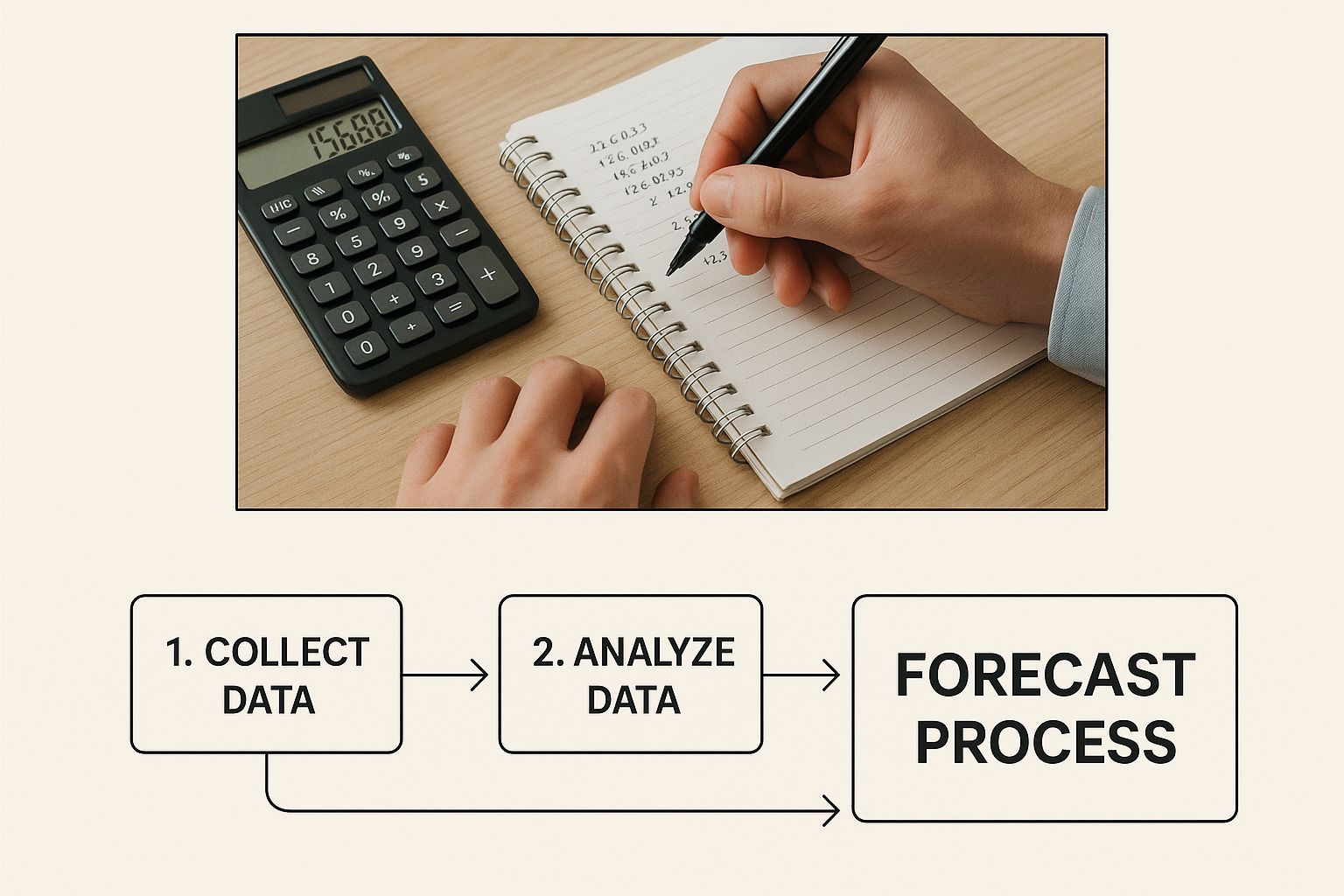
As you can see, it's a logical journey. You start with your inputs (what you know) and end with the outputs (what you can predict), giving you a solid grasp of your future cash position.
Choosing Your Forecasting Method and Timeframe
As you start, you might hear terms like 'direct' and 'indirect' methods thrown around. Let's keep it simple: for a small business, the direct method is almost always the way to go. It's a practical approach where you simply list all the cash you expect to come in and all the cash you expect to go out. No complicated accounting adjustments, just a real-world view of your money's movement.
Next up, you need to decide on your timeframe. A monthly forecast is the standard for most businesses, as it offers a nice balance between detail and practicality. But what if your business has big seasonal swings or you're in a period of rapid growth? In that case, a weekly forecast will give you the tighter control you need to navigate those choppier waters.
Think about a small gift shop in Stirling, for example. A monthly forecast works perfectly for most of the year. But come October, in the run-up to the Christmas rush, switching to a weekly view would be a savvy move. It would help them juggle the big payouts for festive stock and temporary staff against the surge in sales, making sure they don't get caught short during their most critical trading period.
Structuring Your Forecast
Whether you're in a spreadsheet or using software, the basic structure is the same. It's a simple, repeatable calculation for each period—be it a week or a month.
Here's how it breaks down:
- Opening Bank Balance: Start with what's actually in your bank account at the beginning of the period.
- Add Cash Inflows: List and sum up every bit of cash you anticipate receiving during that time.
- Subtract Cash Outflows: Do the same for all the payments you expect to make.
- Calculate Net Cash Flow: This is simply your inflows minus your outflows. A positive number is great—more cash came in than went out. A negative number means you spent more than you earned in that period.
- Calculate Closing Bank Balance: Take your opening balance and add the net cash flow. This final number is your projected cash position at the end of the period.
The closing balance is the most important number you'll calculate. It's not just the end of one month; it's the starting point for the next, creating a continuous, rolling forecast of your financial health.
For UK businesses, this process can be particularly tricky. We're often navigating a complex financial environment where things like currency fluctuations and supply chain timings, especially post-Brexit, can make accurate predictions a real challenge. It's surprising how many companies still rely on manual spreadsheets, which can be prone to errors when you're dealing with so many variables. You can find out more about these UK-specific hurdles and the software built to address them over on Nomentia's blog.
Turning Your Forecast into Smart Business Decisions
So, you’ve built your cash flow forecast. Great. But don't just file it away and forget about it. A forecast collecting digital dust is useless; its real power comes alive when you use it to steer your business. This is the moment you stop just tracking numbers and start actively shaping your company's future.
Think of your forecast as the story of your business's financial heartbeat. The first skill is learning to read that story. Look for the rhythms and patterns in your cash coming in and going out. Can you spot a potential cash gap looming in three months? Is a steady surplus building up that you could be putting to better use? Spotting these things early is what separates reactive panic from proactive management.
Stress-Testing Your Business with Scenarios
This is where the real fun begins. One of the most powerful things you can do with your cash flow forecast for a small business is to play a game of ‘what-if’. Treat it like a financial fire drill for your business—it lets you see how you'd cope with common challenges without the stress of them actually happening.
Start asking some tough questions and watch what happens to your projected bank balance:
- What if our biggest client pays 60 days late instead of 30? You might suddenly realise you need to be firmer with your invoice chasing or perhaps arrange a small overdraft just in case.
- Can we genuinely afford that new hire next quarter? The forecast will give you the unvarnished truth, showing you precisely how that extra salary and National Insurance will eat into your cash reserves each month.
- What happens if our main supplier jacks up their prices by 10%? This could be the nudge you need to finally research alternative suppliers or find cost savings elsewhere.
By running these stress tests, you can build contingency plans before you need them. No more nasty surprises.
Your forecast is your early warning system. Use it to spot potential trouble on the horizon, giving you ample time to steer your business to calmer waters instead of being forced into a panicked reaction.
From Insight to Actionable Strategy
When your forecast flags a potential problem—or an opportunity—that’s your cue to act. If you see a cash crunch on the horizon, you can implement proactive strategies to improve your business's cash flow. This could mean getting serious about your credit control and chasing overdue invoices with more rigour. It might also be the perfect time to review your pricing or have a chat with suppliers about better payment terms.
On the flip side, seeing a healthy surplus isn’t just a nice feeling; it's a green light for strategic growth. That's your signal that you can confidently invest in new equipment, launch that marketing campaign you’ve been dreaming of, or simply build up a war chest for future opportunities. This is what true business confidence looks like.
Just look at what's driving optimism for other small businesses in the UK.
As the data shows, having a good handle on cash flow is a massive driver for a positive outlook.
In fact, recent research found that 74% of UK small businesses felt positive about their future, and for 24% of them, that optimism was directly linked to better cash flow management. You can dive deeper into these UK small business trends from Xero. It all points to the same conclusion: turning your forecast from a static report into a living, breathing part of your decision-making process is absolutely vital for thriving, not just surviving.
Right, let's talk about the hurdles. Even with the best intentions, it's easy to stumble when you're putting together a cash flow forecast. Knowing where the common traps are is half the battle, turning your forecast from a hopeful guess into a tool you can actually rely on.
One of the biggest blunders I see is basing sales projections on pure optimism. We all want to believe every month will be a record-breaker, but hope isn't a strategy. This is where your history becomes your best guide.
Instead of just plucking a number out of the air, look at what you actually sold this time last year. That’s your baseline. From there, you can make realistic adjustments. Did you just launch a new marketing campaign? Maybe nudge the numbers up a bit. Lost a major client? You’ll need to factor that in, too. Grounding your forecast in reality like this makes it infinitely more dependable.
Forgetting Those "Out of Sight, Out of Mind" Costs
Here’s another classic mistake: forgetting about the bills that don't pop up every single month. You've got your rent and payroll down pat, but what about that annual software licence, the quarterly VAT bill, or your accountant's yearly fee? These lump sums can hit your bank account like a sledgehammer if you haven't prepared for them.
My advice is always the same: sit down with your last 12 months of bank and credit card statements. Go through them line by line and highlight every non-monthly expense. Pop them into a calendar. Suddenly, they're not nasty surprises; they're predictable outflows you can plan for.
Keep an eye out for these culprits:
- Annual insurance premiums: Often a hefty one-off payment.
- Corporation Tax or VAT bills: These are non-negotiable and can be substantial.
- Professional fees: That yearly bill from your solicitor or accountant.
- Equipment servicing or vehicle MOTs: Essential costs for keeping the business running.
The Profit vs. Cash Trap
This is the big one. Honestly, if you only take one thing away from this, let it be this: profit is not the same as cash. It’s the single most critical concept to grasp, and where so many businesses get into trouble.
Your Profit & Loss (P&L) statement might be glowing, showing a fantastic profit for the quarter. But that doesn't mean you have the physical cash to pay your suppliers or your team. Profit is an accounting figure. It includes things like invoices you've sent but haven't been paid for yet.
Cash is the lifeblood. It's the actual money moving in and out of your bank account. You can be wildly profitable on paper but go under because your clients are slow to pay. A cash flow forecast ignores the accounting theory and deals with the cold, hard reality of your bank balance.
Let’s say you’re a consultant and you finish a £5,000 project in January. Your P&L shows that revenue, making you look profitable. But your client has 60-day payment terms. The cash won't actually hit your account until March. In the meantime, you still have to pay your own bills in January and February. Your forecast must show this two-month gap. Getting this right is the absolute foundation of good financial planning.
Your Cash Flow Questions Answered
We’ve covered a lot of ground, but it's completely normal to still have a few questions rattling around. To help you get started with real confidence, let's walk through some of the most common queries I hear from small business owners when they first tackle cash flow forecasting.
Think of this as the practical bit – the real-world stuff that trips people up.
How Often Should I Update My Forecast?
For most small businesses, getting into a monthly rhythm is perfect. It’s frequent enough to spot any deviations between your plan and reality, giving you time to react without feeling like you’re constantly buried in spreadsheets. It keeps the forecast a relevant, useful tool.
That said, one size never truly fits all in business. If you’re running a highly seasonal operation (think a coastal ice cream parlour or a Christmas shop), growing at a rapid pace, or dealing with a very high volume of daily transactions, you’ll want to tighten that up to a weekly update.
The goal is to have a living document that guides your decisions, not a dusty report you file away and forget about.
What Is the Difference Between Cash Flow and Profit?
This is probably the single most important concept to grasp in small business finance. Getting this wrong is a common and often painful mistake.
-
Profit is what you see on your Profit & Loss (P&L) statement. It’s an accounting figure that includes things that aren't cash, like depreciation. Crucially, it also includes sales you've invoiced but haven't actually been paid for yet.
-
Cash Flow is the literal money moving in and out of your bank account. It’s what you use to pay your staff, your suppliers, and your rent. It’s the lifeblood of the business.
You can be incredibly profitable on paper but have no money in the bank. A huge invoice paid 60 days late looks great on your P&L, but it can leave your bank account empty and you struggling to pay the bills. Your cash flow forecast tells the real story.
Should I Include VAT in My Cash Flow Forecast?
Yes, absolutely. If you're a VAT-registered business in the UK, this is non-negotiable. VAT is real money you collect for HMRC, and it’s real money you pay out on your expenses.
Your forecast has to reflect this reality. You need to track the VAT coming in from customers as a cash inflow and the VAT going out to suppliers as an outflow. Most importantly, that quarterly VAT payment to HMRC needs to be scheduled as a significant cash outflow. Forgetting to budget for the VAT bill is one of the quickest ways to find yourself in a sudden cash crunch.
Feeling a bit overwhelmed by the numbers? You don't have to figure this all out on your own. The team at Stewart Accounting Services can help you build a robust cash flow forecast, turning financial data into clear, actionable strategies for growth. Let's talk about securing your business's financial future.
Recent Posts
22 Oct, 2026