

Making the leap from a sole trader to a limited company is a big step, but it's a natural one for a growing business. It’s a move often prompted by hitting certain milestones, wanting to protect your personal finances, or simply looking to level up your professional image.
So, when is the right time? I find most business owners start seriously considering it once their profits start pushing past the £30,000-£40,000 mark. At that point, the tax advantages can really kick in.
Knowing When to Change Your Business Structure
Deciding to switch from a sole trader to a limited company is a huge moment. It’s more than just paperwork; it’s a fundamental change in how your business operates. You go from a setup where you and the business are legally the same thing to creating a completely separate legal entity. That separation is really the heart of the matter and the main reason people make the change.

It's a well-trodden path. In the UK, while sole traders are the most common structure at around 3.2 million (56%), there are also about 2 million (37%) limited companies. This shows you just how many businesses incorporate as they scale to unlock new opportunities.
Key Triggers for Making the Change
What are the tell-tale signs that it's time to incorporate? It's rarely one single thing. It’s usually a mix of commercial, financial, and even personal reasons coming together. Spotting these triggers helps you pinpoint the perfect moment to evolve.
Look out for these key indicators:
- You're Hitting a Profitability Sweet Spot: Once your annual profits are consistently topping £30,000, it's time to do the maths. The combination of Corporation Tax on profits and taking dividends can often work out much better than paying higher-rate Income Tax as a sole trader.
- You Want to Protect Your Personal Assets: This is a big one. As a sole trader, if the business gets into debt, your personal assets—your house, your car—are on the line. A limited company creates a legal wall between you and the business, so your liability is limited to what you’ve invested. We dig into this in more detail in our guide on the benefits of having a limited company.
- You Need to Boost Your Professional Image: Let's be honest, having 'Ltd' after your company name just looks more established. It can make all the difference when you're pitching for bigger contracts, looking for investment, or applying for finance, as many larger clients and lenders prefer to deal with incorporated businesses.
To help you visualise the main differences, here's a quick comparison.
Sole Trader vs Limited Company Key Differences at a Glance
| Feature | Sole Trader | Limited Company |
|---|---|---|
| Legal Status | You and the business are one legal entity. | The company is a separate legal entity from you. |
| Liability | Unlimited personal liability for business debts. | Liability is limited to the value of your shares. |
| Taxation | Pay Income Tax and National Insurance on all profits. | Pays Corporation Tax on profits; you pay tax on salary/dividends. |
| Admin Burden | Simpler. Annual Self Assessment tax return. | More complex. Requires annual accounts, confirmation statement, etc. |
| Credibility | Can be perceived as smaller or less established. | Often seen as more professional and credible. |
| Privacy | Financial details are private. | Company details and accounts are public on Companies House. |
This table lays out the core trade-offs you'll be making. While being a sole trader is simpler, a limited company offers protection and potential tax efficiencies that are hard to ignore as you grow.
For many founders, the turning point is when the fear of personal financial risk outweighs the simplicity of being a sole trader. This is when limited liability stops being an abstract concept and becomes a tangible necessity for future growth and peace of mind.
To get a complete picture, it’s worth spending some time understanding various business structure types, including their pros and cons. This will help you weigh everything up properly. Remember, making the switch isn't just an admin task—it's a strategic move that sets your business up for its next chapter.
The Financial Tipping Point for Incorporation
So, when do the numbers actually start to make sense? This is often the biggest question on a sole trader's mind when thinking about going limited. While the ideas of limited liability and looking more professional are great, it’s usually the financial argument that seals the deal.
Let's get straight to it. There isn't a single magic number that fits everyone, but there's a widely accepted rule of thumb. When your annual profits as a sole trader start creeping past the £30,000 to £40,000 mark, it’s time to seriously consider incorporation. Why? Because the tax savings typically begin to outweigh the extra admin costs. As a sole trader, your profits are hit with both Income Tax and National Insurance, which can get pretty steep. A limited company, on the other hand, pays a flat rate of Corporation Tax, giving you much more control over how you take your money out.
This shift in tax structure is where the real advantage lies. Instead of all your profits being treated as your personal income, the business pays its own tax first. You then have the flexibility to draw the rest out in the most tax-efficient way for you.
Sole Trader Tax vs Company Director Tax
If you're a sole trader, your tax is quite straightforward. Your profit (sales minus expenses) is your income. After your personal allowance, it's all subject to Income Tax and National Insurance Contributions (NICs). The more you earn, the higher the rate you pay. Simple, but it can be punishing.
For a company director, the approach is completely different – it's more strategic. The most popular and tax-savvy method is to take a small salary and top it up with dividends.
- Director's Salary: You'd typically pay yourself a small salary, usually up to the National Insurance threshold. This clever move means you don't pay any NI, but the company can still claim the salary as an expense, which lowers its Corporation Tax bill.
- Dividends: After the company pays Corporation Tax on its profits, you can distribute the remainder to shareholders (which is usually just you) as dividends. The huge plus here is that dividends are not subject to National Insurance, which is where the biggest savings are found. Dividend tax rates are also much kinder than income tax rates.
This salary-and-dividend cocktail is the secret to making your business structure work harder for you. You can get into the nitty-gritty of this by reading our guide on taking cash from your limited company vs a sole trader structure.
A Practical Scenario: Profit Comparison
Let’s put this into perspective with an example. Imagine Sarah, a sole trader, and David, a limited company director. Both of their businesses make a very healthy profit of £50,000 this year.
- Sarah (Sole Trader): Her entire £50,000 profit is treated as her personal income. After her personal allowance, she'll pay Income Tax and, crucially, Class 4 National Insurance on a large chunk of that money.
- David (Limited Company): His company has a £50,000 profit and pays Corporation Tax on it. He pays himself a tax-efficient salary of £12,570 (which is tax-free) and then draws the rest of the post-tax profit out as dividends. These dividends benefit from a separate tax-free allowance and are taxed at a lower rate.
When you do the sums, David will almost certainly have more money in his pocket at the end of the year than Sarah, even after factoring in the extra costs of running his limited company.
The real power of incorporation lies in the flexibility it gives you. You're no longer just earning an income; you're strategically managing company profits to maximise your personal take-home pay in the most tax-efficient way possible.
Weighing Up the Costs of Incorporation
Of course, these tax savings don't come for free. Running a limited company brings new costs you need to be aware of before making the leap. The beautiful simplicity of being a sole trader is that it’s cheap, but investing in a corporate structure often pays for itself many times over.
Here are the typical ongoing costs you'll need to budget for:
- Accountancy Fees: This will be your biggest new expense. A good accountant is worth their weight in gold here. Expect to pay anywhere from £80-£250+ per month for a package that covers your annual accounts, Corporation Tax return, payroll, and ongoing advice.
- Confirmation Statement: This is an annual filing with Companies House, just to confirm your company’s details are correct. It's a fixed fee of £34.
- Software Subscriptions: You'll almost certainly need accounting software like Xero or QuickBooks. Budget around £20-£40 per month for this.
- Business Bank Account: While some free accounts exist, many business bank accounts for limited companies come with monthly fees.
All in, you could be looking at an annual cost of £1,200 to £3,500+. But for a business turning over £50,000 or more in profit, the tax you save will comfortably cover these fees, making it a very smart financial move.
Getting Your New Company Registered
So, you've weighed the pros and cons and decided that incorporating is the right path for your business. The next stage is the practical bit: registering your new limited company with Companies House. This might feel like a huge leap, but it’s a well-trodden path that countless business owners navigate successfully.
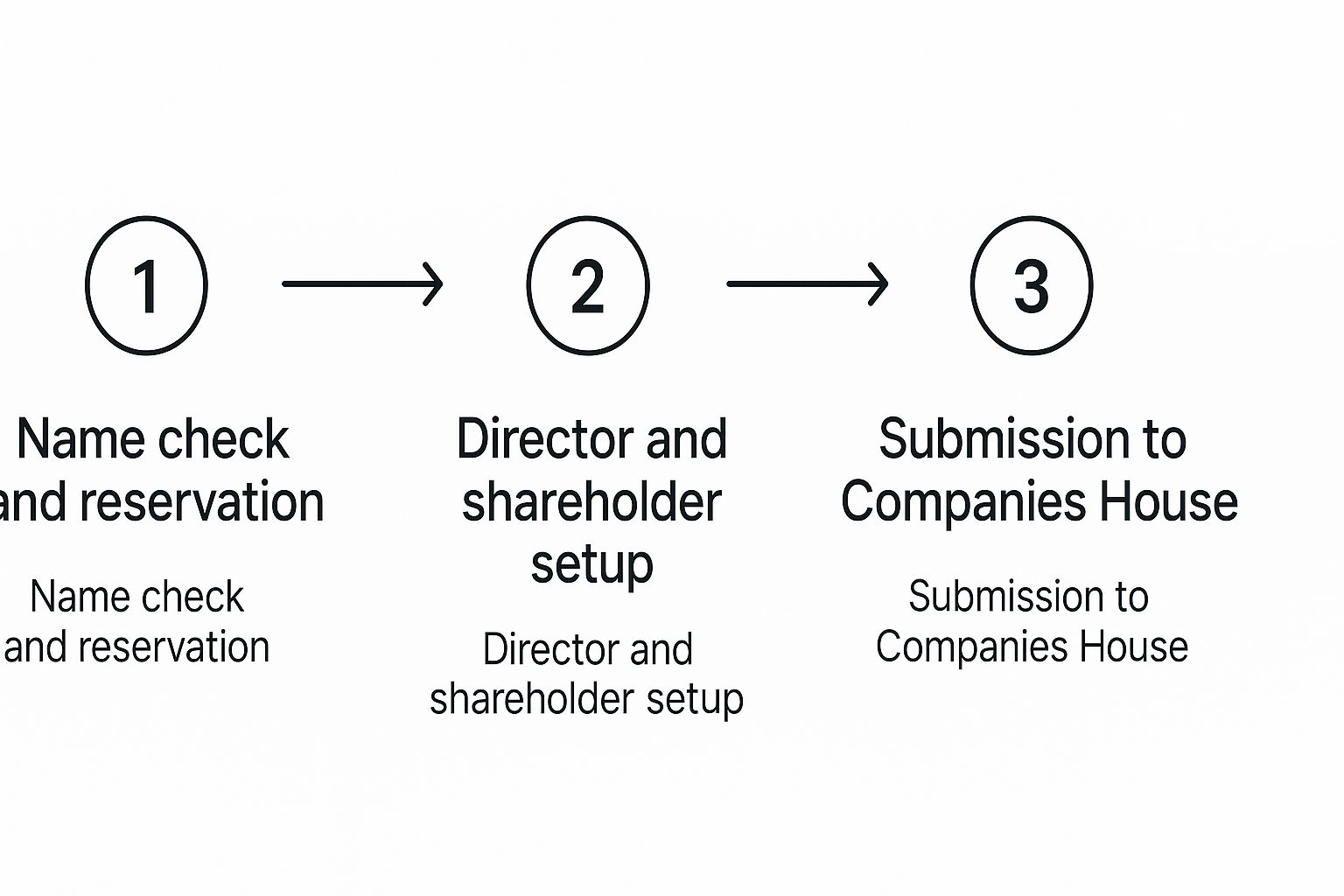
Think of it less as a mountain of paperwork and more as a series of straightforward steps, starting with picking a unique name and ending with that all-important certificate of incorporation in your hands. It's all about getting your information lined up before you dive in.
First, Settle on a Company Name
Before anything else, your new company needs a name. This isn't just about branding; you’ve got to play by the rules set by Companies House. Your chosen name must be unique—it can't be identical or even too similar to one that's already on the register.
You also have to be careful about using 'sensitive' words or expressions. Things like 'Royal', 'King', 'Chartered', or 'Accredited' can’t be used without official permission because they might suggest a false connection to a government or professional body. It’s always worth checking the official list first.
I always tell my clients to think of their company name as its digital fingerprint. Using the Companies House name checker isn't optional; it's essential. A quick search there can save you the massive headache of a rejected application and having to start the whole process from scratch.
Once you have a couple of ideas, pop them into the free Companies House online tool. This simple check is your first, and most critical, step.
Getting All Your Information in One Place
Before you sit down to register, you'll need to gather some key details. Having everything ready to go will make the application process feel much smoother and faster.
To get started with the company formation, you'll need to have the following information and documents prepared. This checklist covers the essentials for a smooth registration with Companies House.
Company Formation Checklist
| Task | Details Needed | Quick Tip |
|---|---|---|
| Choose a Name | Your unique, compliant company name. | Have a backup or two, just in case your first choice is taken. |
| Registered Office | A physical UK address for official mail. | This is public record. Consider using your accountant's address for privacy. |
| Appoint Director(s) | Full name, DOB, nationality, and address. | You must have at least one director. This can be you. |
| Appoint Shareholder(s) | Name, address, and number of shares. | For many small businesses, the director is also the only shareholder. |
| Define Shares | The number of shares and their value (e.g., 100 shares at £1 each). | Keeping it simple (like £1 per share) is usually best when you're starting out. |
| Select a SIC Code | A 5-digit code describing your business activity. | You can pick up to four. Find the right one on the official list. |
Having these details organised beforehand is a real game-changer. It turns what could be a confusing task into a simple exercise of filling in the blanks.
Here's the official starting page on the GOV.UK website. As you can see, it's designed to guide you straight to the registration portal.
The Registration Process Itself
Once you have all your information ready, it’s time to make it official. The easiest and cheapest way is to register online directly through the Companies House portal. The current fee is £50, and it’s usually all done and dusted within 24 hours.
You'll be guided through the online application (known as the IN01 form), where you'll enter the details you’ve prepared—directors, shareholders, share structure, and so on. If you want a more detailed breakdown of this part, our guide walks you through the steps to register a new company in the UK.
Another option is to use a company formation agent. They'll handle the process for you for an extra fee, and many offer useful add-ons like a registered office address service. If you're feeling a bit daunted by the paperwork, the peace of mind an agent provides can be well worth the cost.
After your application is submitted and approved, you’ll receive your Certificate of Incorporation. This is your new company’s official birth certificate, complete with its unique registration number. And that's it – you've successfully formed your limited company
Getting Your Ducks in a Row After Incorporation
So, your Certificate of Incorporation has landed in your inbox. Congratulations! Your limited company is now officially a real thing. It’s a great feeling, but before you pop the champagne, there are a few crucial admin tasks to sort out. Getting these right from the start is absolutely key to making a clean break from your sole trader days and staying on the right side of HMRC.
Think of it like moving house. You’ve got the keys to the new place, but now you need to set up the utilities, redirect the mail, and tell everyone your new address. Nailing these fundamentals now will save you a world of headaches down the line.
Sort Out Your Company's Finances First
Your very first job is to open a business bank account in your new company's name. I can't stress this enough – it's not optional. As a sole trader, the lines between your personal and business cash might have been a bit blurry. As a limited company, that line is a solid brick wall. The company is its own legal entity, and its money is not your money.
Every penny the company earns must go into this account, and every business expense must come out of it. This clear separation is vital for your accounting and for proving to HMRC that the business is a distinct entity. Thankfully, most high street and online banks make this a pretty painless process for new companies.
Once the account is up and running, you'll need to formally transfer any assets from your old business. This means selling things like your work laptop, tools, or existing stock from yourself (the individual) to your new company. You'll want to document this with a simple 'sale agreement' at a fair market value. It might feel a bit strange selling things to yourself, but it's an essential paper trail for your accounts.
Letting HMRC Know What's Happening
With the company ready to go, it's time to officially close the book on your life as a sole trader. This means telling HMRC you've stopped being self-employed. You have until the 5th of October in the tax year after you file your final Self Assessment return to do this.
It's a straightforward process you can do on the GOV.UK website. It’s a step that’s easily missed, but failing to do it can lead to all sorts of confusion and demands for tax you no longer owe.
Here’s a look at the page you'll need to find to get this done.

This quick form gets your records updated and stops HMRC from expecting any more Self Assessment tax returns from your old sole trader business.
A common mistake I see is people assuming that registering a new company automatically tells HMRC they've stopped being a sole trader. It doesn't. You have to take this extra step to formally draw a line under your old status.
Next up, you need to get your new company registered for the right taxes.
- Corporation Tax: You've got three months from when you start trading to register for Corporation Tax. "Trading" can be anything from buying your first bit of stock to launching an advertising campaign. Once registered, HMRC will issue a Unique Taxpayer Reference (UTR) for the company.
- VAT: If your sole trader business was VAT registered, you'll need to de-register it. Then, if your new company is expected to hit the turnover threshold (currently £90,000), you'll need to register it for VAT. It's often possible to transfer your existing VAT number, which can make life a bit easier.
- PAYE (Pay As You Earn): If you plan to draw a salary from the company (or hire staff), you must register as an employer with HMRC before the first payday. This is how you'll handle Income Tax and National Insurance deductions.
Updating Your Clients and Suppliers
The last piece of the admin puzzle is telling everyone you do business with about the change. This isn't just good manners; it’s a legal requirement. All your official paperwork needs to reflect your new company details.
Here’s a quick checklist to work through:
- New Invoices: All invoices must now come from the limited company. Make sure they clearly show the full registered name, company number, and registered office address.
- Tell Your Clients: Send a clear, professional email or letter to all your clients. Let them know you’re now trading as a limited company and, crucially, give them your new business bank account details for all future payments.
- Check Your Contracts: Any ongoing contracts with clients or suppliers will need updating. They’ll likely need to be re-issued in the new company's name to remain legally valid.
- Update Your Footers: Don't forget the small stuff! Update your website footer, email signatures, and any business cards or letterheads with the new company information.
Working through this admin methodically is the best way to ensure a smooth transition. It cements the legal and financial separation you went to the trouble of creating and gets your new limited company off to a clean, compliant, and successful start.
Getting to Grips With Your New Director Duties
When you make the leap from sole trader to limited company director, your role changes in a big way. You're not just the business owner anymore; you're now an officer of the company, and that comes with a whole new set of legal and financial responsibilities. It’s a move that can unlock huge potential, but it definitely demands a more structured approach to how you run things.

This isn't a niche move, either. It’s a well-trodden path for UK businesses looking to grow. The numbers show a clear trend: between 2010 and 2024, the number of companies in the UK shot up by 793,000—a 62% increase. In that same period, sole proprietorships only grew by 12%. You can dig into the full stats in the government's UK business population estimates.
What on Earth are "Fiduciary Duties"?
At the heart of your new role, you'll hear the term fiduciary duties a lot. It sounds like complex legal jargon, but it boils down to one simple idea: you must always act in the best interests of the company. It's about promoting its success for the benefit of all shareholders, not just yourself.
In practical, day-to-day terms, this means you need to:
- Stick to the rules: You have to operate within the powers laid out in your company's articles of association—think of it as the company's internal rulebook.
- Use your own judgement: You can—and should—take advice, but the buck stops with you. You can't just blindly follow someone else's instructions.
- Steer clear of conflicts of interest: You've got to declare any personal interest, whether direct or indirect, in any deal the company is considering.
- Don't accept special favours: You can't accept benefits from third parties just because of your position as a director.
These duties aren't just suggestions; they're legally binding. Ignoring them can land you in serious hot water, so it's crucial to understand how they shape your decisions.
The biggest mindset shift when changing from sole trader to ltd is realising the company's money isn't your money. Your fiduciary duty is to manage those funds for the company's benefit, not as an extension of your personal bank account.
Your Annual To-Do List for Compliance
On top of these guiding principles, you'll have a specific, recurring list of admin tasks that are absolutely non-negotiable. These are your formal reporting duties to Companies House and HMRC, and they’re what keep your company on the right side of the law.
Here are the main jobs you’ll have on your plate every year:
- File Annual Accounts: Each year, you need to prepare and send a set of statutory accounts to Companies House. This is a public record of your company's financial health.
- Submit a Confirmation Statement: Think of this as an annual check-in with Companies House to confirm that the details they have for your company—directors, office address, and so on—are still accurate.
- File a Company Tax Return: Your company has its own tax bill. You'll need to file a CT600 tax return with HMRC and pay any Corporation Tax owed.
These all come with strict deadlines. Missing them means automatic penalties and a black mark on your company's public record.
As a director, your legal workload expands significantly. Many founders find that outsourcing legal services is a smart move to manage these new demands. It helps you stay compliant without getting swamped by the paperwork, freeing you up to focus on what you do best: running and growing your business.
Got Questions About Going Limited?
Even with the best plan, moving from a sole trader to a limited company can throw up some tricky questions. It's completely normal to get stuck on the finer points that the big guides often miss. Let's tackle some of the most common queries I hear from business owners making this very same switch.
What Happens to My Old Business Debts?
This is a big one, and it trips a lot of people up. When you set up a limited company, you’re creating a brand new legal entity. That means your new company is not automatically responsible for any debts you racked up as a sole trader. Those debts are still yours, personally.
You can't just hand them over to the new company. If you've been using personal credit cards or loans to fund things, you'll have to keep paying them yourself from your own pocket. My best advice? Try to clear as much of your sole trader debt as you can before you officially stop trading. It makes for a much cleaner start.
Do I Really Need to Tell My Clients I've Changed?
Yes, you absolutely must. This isn't just about being professional; it’s a legal requirement. You need to let your clients know that you're now a limited company, and here’s why:
- Invoicing: All new invoices have to come from the limited company, complete with its registered name and number.
- Payments: They'll need to start paying into your new business bank account, not your personal or old sole trader one.
- Contracts: Any ongoing contracts you have might need to be 'novated'—a formal way of transferring the agreement from you as an individual to the new company.
Honestly, a quick, professional email explaining the change is all it takes. It shows you’re on top of things and helps you avoid awkward payment delays or contract mix-ups down the line.
"A common oversight is failing to update payment details with clients. One founder I worked with forgot to inform a major client, resulting in a five-figure payment going to their old, soon-to-be-closed sole trader account. It caused a significant cash flow headache that was entirely avoidable with a simple email."
Can I Keep My Old Business Name?
For the most part, yes you can, as long as it's available and fits Companies House rules. When you register, you can simply add "Ltd" or "Limited" to your existing trading name. So, if you've been operating as "Cheshire Web Design," you could register "Cheshire Web Design Ltd."
The crucial first step, though, is to check the Companies House register. If another limited company has already snagged that name (or one that’s too similar), you’ll have to think of something else. This is actually a major reason many people incorporate—to protect their brand name so no one else can use it.
What Should I Do With My Existing Business Assets?
Things like your work laptop, office desk, tools, or even intellectual property don't just become company property by magic. You need to officially transfer ownership.
The standard way to do this is to 'sell' them from yourself to your new company for their fair market value. You'll literally create an invoice from you (the individual) to the company, and the company then 'buys' the assets from you. This creates a proper paper trail for your accounts and makes sure the company legally owns its equipment right from the get-go.
Making the switch from sole trader to a limited company has a lot of moving parts. At Stewart Accounting Services, we specialise in guiding UK businesses through this process, making sure every last legal and financial detail is handled correctly. Let us help you start your company's next chapter with confidence.