

CIS Monthly Return Example Explained

You're preparing payroll, the subcontractor invoices are spread across emails, and someone asks whether the quiet month still needs a CIS filing. The answer matters. Under the 2026 HMRC approach, contractors must deal with every month, not only the months when money went out. A missed nil return can create the same kind of deadline problem as an active return left unfinished.
A reliable CIS monthly return example should therefore show more than figures. It should show the tax-month dates, the subcontractor information, the treatment of materials, the deduction position, and the decision you make when no subcontractors were used. The process is manageable once those controls become part of month-end bookkeeping.
Understanding the CIS Tax Month and Filing Deadline
The CIS calendar catches contractors who work from ordinary calendar-month reports. A CIS tax month runs from the 6th to the 5th, and the return must reach HMRC by the 19th of the following month, as set out in HMRC's monthly return guidance. Payments made during the tax month ending on the 5th therefore need to be reviewed, approved and filed before the 19th arrives.
That deadline creates a narrow operational window. If your bookkeeper waits for every invoice to be chased after the 5th, the business may be trying to verify subcontractors, separate materials, reconcile payments and submit the return at the same time. The safer approach is to treat the 5th as the end of the reporting period, not the start of the preparation process.

Build the timetable around an internal cut-off
Set an internal approval date before the statutory deadline. A same-day pre-19th internal cut-off gives the responsible person time to correct a missing UTR, query an invoice or deal with an unexpected payment before the HMRC submission is due.
Use a simple calendar entry for each cycle:
- 6th to 5th: identify payments belonging to the CIS tax month.
- After the 5th: reconcile the ledger against bank payments and subcontractor records.
- Before the 19th: approve and submit the return, including a nil return where applicable.
Contractors also need to keep CIS planning separate from broader business decisions. If a change in ownership, property use or family succession affects how the business operates, a succession tax planning guide can provide useful wider context, but it doesn't replace the monthly CIS control.
For a concise reference to the statutory date, keep this CIS return deadline guide beside the bookkeeping checklist. The practical lesson is simple: don't wait until the 19th to discover what happened during the tax month.
What to Include on Your CIS Return
Start with the ledger, not the online form. Filter payments made to subcontractors for construction operations during the relevant CIS tax month, then inspect each invoice and payment record before entering anything.
For each reportable subcontractor, prepare the information HMRC needs to identify the payer and the payment. That normally means the subcontractor's name and UTR, the gross payment, the amount treated as materials, the deduction and the payment status returned through verification. Gross Payment Status must still be reported, even though the deduction shown is nil.

Separate construction payments from excluded spending
The key question isn't whether the supplier worked near a building. Ask whether the payment is for construction operations that fall within CIS and whether the payer has contractor or deemed-contractor responsibilities.
HMRC's guidance on payments by deemed contractors draws an important boundary. A deemed contractor must report payments for construction operations, but spending on property used solely for the business itself falls outside the scheme and doesn't need to be included.
That distinction becomes difficult with mixed-use property or refurbishment work. Don't classify the entire project from the address alone. Record the purpose of the property, the nature of the work and the contractual payment route, then ask for specialist advice if the facts don't fit neatly.
Check the figures before submission
Use this order:
- Match the subcontractor: Confirm the name and UTR against your CIS records.
- Review the invoice: Identify the gross amount and any properly supported materials figure.
- Confirm the status: Use the HMRC verification result held for the subcontractor.
- Reconcile the deduction: Make sure the return agrees with the payment and deduction statement.
- Review the period: Check that the payment belongs to the correct CIS tax month.
A useful CIS tax return guide for UK subcontractors can sit alongside this review, particularly where invoices contain labour, materials and unusual project costs. What doesn't work is copying the total from a supplier ledger without checking what the payment represents.
Handling Nil Returns and Inactivity Requests
The 2026 update changes the quiet-month decision. HMRC now says contractors must file a monthly return every month, including a nil return when no subcontractors were used, or submit a 6-month inactivity request, as explained in the June 2026 Employer Bulletin.
Silence is therefore not a filing strategy. A contractor may have no live site, no subcontractor invoices and no CIS deductions, but the monthly obligation still needs an explicit response. Either submit the nil return or tell HMRC that subcontractor activity has stopped through the inactivity process.
Choose the correct response
A nil return fits a month in which no subcontractors were used but the business remains active or expects to use subcontractors again. It confirms the position for that month and closes the filing task.
An inactivity request suits a pause in subcontractor activity. It isn't a way to ignore the return because the accounts are incomplete. Before using it, check that the business has stopped using subcontractors and that the proposed period reflects the expected pause.
Keep evidence for the decision. A short internal note can record:
- whether any subcontractor was paid;
- whether any construction operation was carried out through a subcontractor;
- who reviewed the bank and purchase ledger;
- whether a nil return or inactivity request was submitted.
Why the update changes month-end routines
Older internal habits often treated CIS as payment-led compliance. Someone checked the ledger, found no subcontractor payments and closed the task. That process no longer gives enough assurance for a contractor who remains within the CIS filing population.
Add a separate nil-or-inactivity decision to the monthly checklist. The person preparing the accounts should answer it before the deadline, and another person should review it where the business has multiple payment channels or projects. This prevents a quiet month from disappearing between payroll, bookkeeping and site administration.
For wider responsibilities, keep a separate construction industry scheme responsibilities checklist so that the return decision isn't confused with other contractor duties.
A Practical CIS Monthly Return Example
Use a controlled worksheet before entering data into HMRC's service or commercial CIS software. The figures below are an illustrative layout, not a claim about a real contractor. They show how a return can display different verification outcomes while keeping the gross payment, materials and deduction fields distinct.
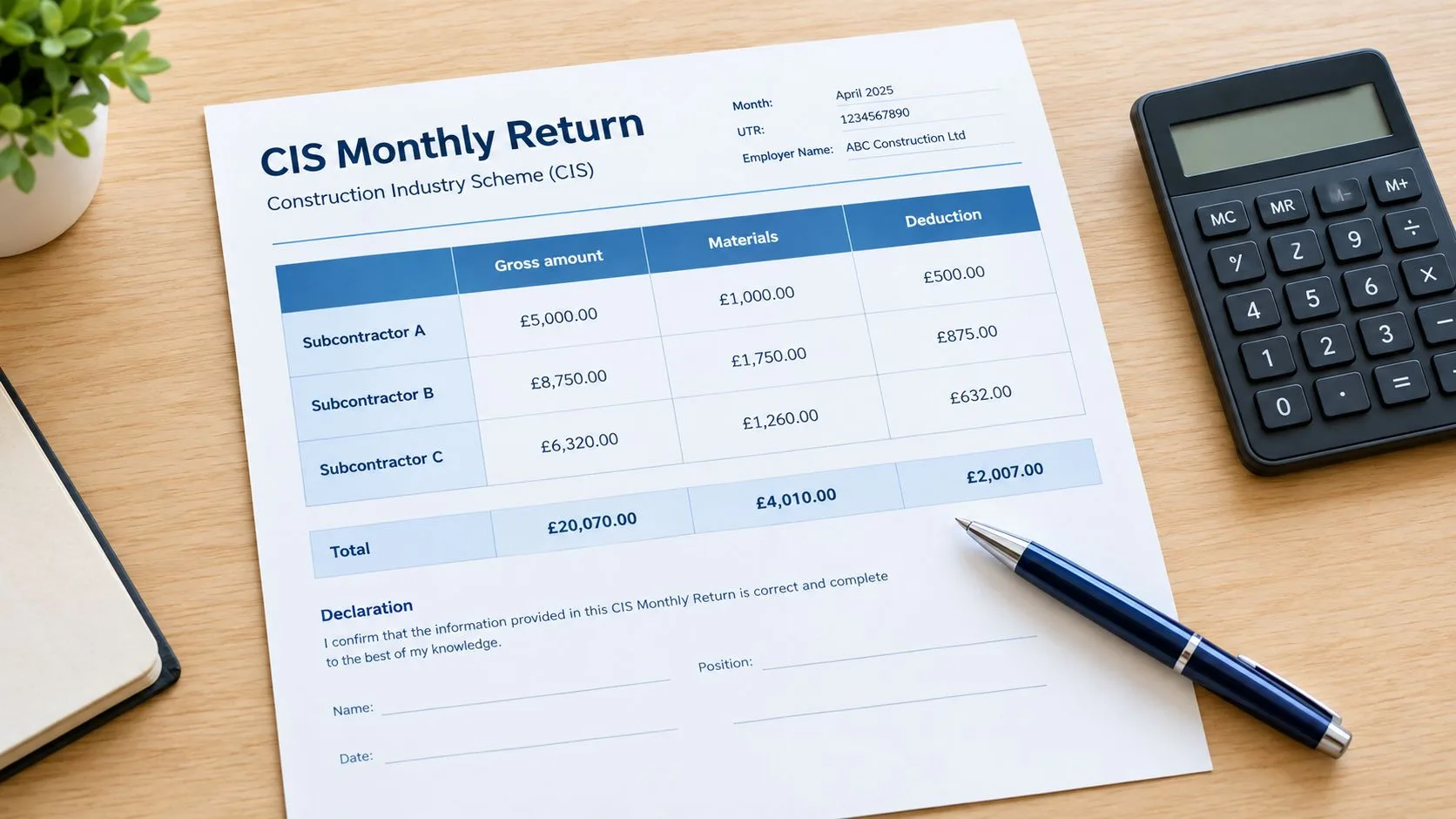
Sample CIS Monthly Return Data
| Subcontractor Name | Verification Status | Gross Payment (£) | Materials (£) | Deduction (£) |
|---|---|---|---|---|
| Northbank Brickwork | Gross Payment Status | 2,400 | 700 | 0 |
| Calder Joinery | Standard deduction | 1,800 | 500 | 260 |
| Forth Groundworks | Higher-rate treatment | 1,500 | 300 | 360 |
The table is designed to make the review questions visible. Northbank Brickwork has a gross status, so the deduction is shown as £0. Calder Joinery has a standard deduction, and Forth Groundworks has a higher-rate treatment. The materials figures are displayed separately rather than being folded into the deduction base.
Don't accept the table without supporting records. For each line, retain the subcontractor's UTR, verification information, invoice, payment record and deduction statement. The return should be the final expression of those records, not the place where missing information gets guessed.
Walk through the submission
First, select the correct tax month and confirm that every listed payment falls within it. Next, enter the subcontractor identity and payment figures exactly as they appear in the reconciled worksheet.
Then compare the deduction field against your calculation and payment statement. A gross-status line should not accidentally carry a standard deduction, while a higher-rate line should be checked particularly carefully because an incorrect status can affect the amount withheld.
Finally, review the complete return before submission. Check for duplicate subcontractors, omitted payments, implausible materials entries and lines that belong to a different tax month. A second review is especially useful when the data came from more than one bank account or bookkeeping file.
Practical rule: Treat the worksheet, invoice file, verification record and payment statement as one evidence chain.
The exact figures in an example help you test the shape of your software output. They don't remove the need to confirm status and classification of each subcontractor.
The True Cost of Late or Missing Returns
The first missed deadline can look like a modest administrative problem. HMRC's penalty schedule shows why that view is unsafe: a return filed 1 day late triggers a £100 fixed penalty, while a return 2 months late increases this to £200. At 6 months late, HMRC can add £300 or 5% of the CIS deductions, whichever is higher, and at 12 months late another £300 or 5% can apply, according to HMRC's CIS late-filing penalty guidance.
The risk is asymmetric. The initial charge is fixed, but continued delay introduces tax-geared penalties. In the most serious cases, HMRC may charge up to £3,000 or 100% of the CIS deductions, so leaving a return unresolved can create exposure far beyond the original administrative oversight.
The record problem behind the deadline problem
Contractors often focus on the date and overlook the data. Missing or incorrect subcontractor records can produce an incomplete return, and a nil return can be missed when a project pauses. HMRC's compliance position means filing obligations continue until the return is received, so a skipped period can become a sequence of outstanding periods rather than a single isolated error.
Use three controls:
- Close the ledger: reconcile subcontractor payments against invoices and bank records.
- Check identity and status: duplicate-check names, UTRs and gross payment status.
- Approve early: impose a same-day internal cut-off before the 19th.
These controls work because they address the cause, not only the symptom. Waiting for an automated reminder doesn't fix an unverified subcontractor or a payment posted to the wrong period.
If a return is already late, bring the filing position up to date promptly and review every subsequent month. Don't assume that submitting the latest return resolves earlier omissions. The earlier the records are reconstructed, the easier it is to distinguish a genuine nil period from an active period with missing payments.
Building a Bulletproof Monthly Filing Workflow
A dependable process assigns each task to a date and an owner. The bookkeeper gathers the records, the contractor or authorised reviewer resolves classification issues, and the final filer submits the return before the statutory deadline.

Use this recurring checklist
- Review the period: Confirm the CIS tax month and collect payments made up to the 5th.
- Reconcile records: Match invoices, bank payments and subcontractor statements.
- Check classification: Separate reportable construction operations from excluded business-property spending.
- Verify status: Confirm the recorded treatment for each subcontractor.
- Decide the quiet-month route: Submit a nil return or make an inactivity request where appropriate.
- Approve early: Complete the internal review before the 19th, not on it.
- File and retain evidence: Save the submission confirmation with the supporting records.
Cloud bookkeeping can reduce duplicated entry when the bank feed, purchase ledger and CIS records are kept in one controlled process, but automation doesn't decide whether a mixed-use refurbishment falls within CIS. Stewart Accounting Services is one option for contractors that want support with subcontractor verification, monthly reconciliation and digital CIS return submission alongside payroll services.
The workflow matters more than the software brand. Give one person ownership, keep a visible deadline, and require a documented nil-or-inactivity decision every quiet month.
If your CIS records are currently managed around payment dates rather than the CIS tax month, review the process before the next 19th deadline. Reconcile the latest subcontractor payments, test your nil-return decision and set an internal approval cut-off today.
Recent Posts
08 Oct, 2026
07 Oct, 2026
06 Oct, 2026
2 comments