

Cloud Accounting for Small Business A Guide to Smarter Finances

At its heart, cloud accounting for small businesses is about swapping old-school desktop programs for modern, internet-based software. It’s less like a dusty ledger chained to your office desk and more like having your entire financial world at your fingertips—on any device, anywhere, anytime. This simple change gives you real-time financial data, paving the way for smarter, faster business decisions.
What Is Cloud Accounting and Why Should You Care?
Let's cut through the jargon. With traditional accounting, your software is installed on one computer. All your data—every invoice, expense, and report—lives on that single machine. This approach creates data silos, makes teamwork a pain, and essentially ties you to your desk.
Need to check your cash flow from home? You’ll be emailing files back and forth. Want your accountant to review the books? Get ready for a headache of version control issues and potential mistakes. It’s a clunky, outdated way of working.
Cloud accounting flips this model completely. It works on a simple but powerful idea: centralisation. Instead of being trapped on your hard drive, your financial data is stored securely on remote servers—what we call "the cloud." You, your team, and your accountant can all log in and see the exact same information through a web browser or a mobile app. It's that simple.
A Fundamental Shift in Financial Management
This isn't just a small tech upgrade; it's a completely different way of interacting with your business finances. The moment you make a sale, pay an invoice, or log an expense, your financial records update instantly for everyone.
For a small business owner, this real-time view is a game-changer. You’re no longer making critical decisions based on last month’s figures. Instead, you have an accurate, up-to-the-minute picture of your financial health, empowering you to be proactive rather than reactive. As you think about this, it’s worth exploring the broader question of whether moving to the cloud is worth it, because the benefits usually go far beyond just your accounts.
The core value of cloud accounting lies in transforming your financial data from a historical record into a live, strategic tool. It closes the gap between action and insight, allowing you to manage your business with confidence and clarity.
The Power of Real-Time Collaboration
One of the biggest wins is how easily it lets you work with others. Imagine asking your accountant a question, and instead of digging out a spreadsheet, they can log in and see the exact same screen you’re looking at. This dynamic turns your accountant from a once-a-year compliance box-ticker into a genuine, real-time partner in your business.
This new way of working is a major part of a much bigger trend, which you can read about in our guide on the impact of digital transformation on UK accounting practices. For UK businesses, this approach unlocks some key advantages:
- Instant Access: Check your business performance from anywhere, whether you're meeting a client or on holiday.
- Improved Decision-Making: Base your next move on current cash flow, profitability, and outstanding invoices, not old data.
- Streamlined Compliance: Simplify VAT returns and stay ahead of HMRC's Making Tax Digital (MTD) requirements with ease.
- Enhanced Security: Your data is often far safer in a secure, professionally managed data centre than on a single computer in your office.
Ultimately, bringing cloud accounting into your small business is about gaining freedom—freedom from the office, freedom from mind-numbing admin, and the freedom to focus on what you do best: growing your business.
The Real-World Benefits of Moving Your Finances to the Cloud

Shifting your finances to the cloud isn't just about keeping up with technology; it's about what that tech actually does for you as a business owner. When we peel back the layers, the real advantages of cloud accounting for small business boil down to gaining three crucial things: more time, more money, and a whole lot more peace of mind.
These aren't just buzzwords. They're tangible results that tackle the everyday headaches of running a small business in the UK. Let's dig into how making the switch delivers on each of these promises.
Winning Back Your Time with Automation
Think about all the hours that just seem to evaporate into financial admin. Manually creating invoices, chasing down late payments, and the soul-destroying task of matching bank transactions to your books—it all adds up.
This is exactly where cloud accounting software comes in and changes the game. It automates these repetitive jobs. You can set up recurring invoices for your regular customers, schedule automatic payment reminders to give late payers a nudge, and link your business bank account for a live feed that matches up transactions as they happen.
The difference this makes is huge. A report by the Open Banking Implementation Entity (OBIE) found that UK businesses using these cloud tools saw up to 59% in internal cost savings and a 64% cut in external expenses. Why? Mostly because they got back the time that admin used to steal. You can read more about these accounting trend predictions and findings here.
That recovered time is your most precious asset. It’s more time to spend with customers, develop new ideas, or just take a well-earned break, knowing your finances are running smoothly in the background.
Unlocking More Money Through Financial Clarity
Cash flow is the lifeblood of any small business. The problem with traditional accounting is that it often feels like you’re driving by only looking in the rearview mirror. By the time you get your monthly reports, the numbers are already old news, making it impossible to manage your cash proactively.
This is where the real-time nature of cloud accounting gives you a direct financial edge. Instead of a historical snapshot, you get a crystal-clear, live view of your cash position whenever you look.
With a live dashboard, you can see exactly who owes you money, which bills are due, and what your profit margins are today, not last quarter. This visibility is the key to making smarter financial decisions.
This clarity empowers you to:
- Boost Cash Flow: See outstanding invoices instantly and chase them sooner, dramatically cutting down the time it takes to get paid.
- Control Your Spending: Spot rising costs or unexpected bills as they happen, letting you act before they spiral into bigger issues.
- Grab Opportunities: Feel confident investing in new stock or equipment because you know precisely what funds you have available.
It’s not just about tidier bookkeeping; it’s about taking active control of your finances to keep more money in your business.
Before we move on, let's quickly compare the old way with the new.
Traditional Accounting vs Cloud Accounting
The table below breaks down the fundamental differences between being tied to a desktop and the freedom of the cloud.
| Feature | Traditional Accounting (Desktop Software) | Cloud Accounting (e.g., Xero) |
|---|---|---|
| Accessibility | Tied to a single computer in the office. No access on the go. | Access your data anywhere, anytime, on any device with an internet connection. |
| Cost Structure | High upfront cost for a software licence, plus paid-for annual updates. | Low monthly subscription fee. All updates and new features are included and happen automatically. |
| Collaboration | Difficult. Requires sending files back and forth, risking version control issues. | Easy and real-time. You and your accountant can work on the same live data simultaneously. |
| Data Accuracy | Prone to manual entry errors. Data is often out of date. | Live bank feeds and automation drastically reduce errors. Data is always up-to-the-minute. |
| Backups & Security | Your responsibility. A computer crash or theft could mean total data loss. | Handled by the provider with bank-level security and automatic, regular backups. |
As you can see, the shift is less of an upgrade and more of a complete transformation in how you manage your business finances.
Gaining Peace of Mind with Compliance and Accuracy
Finally, let’s talk about the mental weight of financial stress. The nagging worry about whether your numbers are right, the dread of the next VAT return, and the anxiety of making big decisions on a hunch—it's exhausting.
Cloud accounting for your small business lifts this burden by creating one reliable source of truth for all your financial data. Since information is entered once and flows through the system automatically, the risk of human error from typing in numbers multiple times is virtually eliminated.
What’s more, these platforms are built from the ground up to meet UK regulations. They are fully compliant with HMRC's Making Tax Digital (MTD) rules, making digital record-keeping and VAT submissions straightforward. A massive compliance headache, simply gone.
The result? A clearer mind. You get the confidence that comes from knowing your numbers are accurate, your business is compliant, and every decision you make is backed by solid, real-time data. That kind of certainty is perhaps the most valuable benefit of all.
Is My Financial Data Really Safe in the Cloud?
Let's be honest, the idea of handing over your company’s financial data to a third-party platform can feel like a massive leap of faith. For many business owners, the thought of their most sensitive numbers living "somewhere on the internet" is a major stumbling block. But here's the reality: your financial data is almost certainly safer with a major cloud accounting provider than it is on that single laptop in your office.
Think of it like storing your money. Keeping a wad of cash under the mattress feels secure because you can see and touch it. But we all know a bank vault—with its reinforced walls, professional security, and 24/7 monitoring—is infinitely safer. Cloud accounting platforms operate with that same bank-level security mindset; it's a core part of their design, not just an add-on.
A Fortress of Digital Defences
Leading platforms like Xero don’t rely on a single padlock. They build a fortress, with multiple, overlapping layers of defence working together around the clock to protect your information. It’s a level of security that would be incredibly complex and expensive for a small business to build and manage on its own.
Here’s a look at what’s going on behind the scenes:
- Data Encryption: Your data is essentially scrambled into an unreadable code, both while it's travelling across the internet and when it's stored on their servers. Even if a cybercriminal somehow managed to intercept it, it would be complete gibberish to them.
- Secure Data Centres: This isn't just a server in a back room. Your data is housed in highly secure, geographically diverse data centres with physical security like biometric scanners, CCTV, and on-site staff.
- Constant, Automatic Backups: Your information is continuously backed up in multiple locations. If one server goes down, another one kicks in instantly. This protects you from data loss whether it’s from a hard drive failure, an office theft, or even a fire.
- Proactive Threat Monitoring: Dedicated security teams are always on the lookout for suspicious activity. They run regular security audits and hire ethical hackers to try and find weaknesses, so they can fix them before anyone else does.
This relentless focus on security infrastructure provides a degree of protection that a local hard drive or a simple server can't hope to match. It’s a huge reason why cloud accounting for small business has become the gold standard for financial management.
Staying on the Right Side of UK Regulations
Beyond protecting your data from bad actors, cloud platforms are built to keep you compliant with UK law, especially HMRC’s Making Tax Digital (MTD) rules. MTD is a legal requirement for businesses to keep digital records and submit tax returns using compatible software, a move designed to make tax administration simpler and more accurate.
Making Tax Digital isn’t a suggestion—it's the law. Using MTD-compliant cloud software is the simplest and most effective way to meet your obligations, avoid penalties, and take the stress out of your tax returns.
Cloud accounting isn't just a nice-to-have anymore; it's the foundation of tax compliance for most UK businesses. The shift was kicked into high gear by HMRC's MTD rollout, which began in 2019 for VAT-registered businesses and continues to expand. The MTD features built into these platforms handle digital submissions and calculations automatically, ensuring your quarterly reports are spot on. It's a critical function, especially when you consider that an estimated 75% of UK accounting firms are planning to invest more heavily in cloud technology by 2025. You can get more insight into the state of UK small business accounting on dext.com.
The Real Advantage of Cloud Security
At the end of the day, moving to a cloud-based system isn't just about ticking boxes for security and compliance. It's a strategic move that makes your business more resilient. It lifts the burden of managing data security, running manual backups, and worrying about software updates right off your shoulders.
When you entrust your data to the experts, you free up your time and mental energy to focus on what you do best: running and growing your business. The peace of mind you get from knowing your financial information is secure, always backed up, and compliant is one of the most powerful—and often overlooked—benefits of making the switch.
Choosing the Right Software and Planning Your Migration
So, you’ve decided to move your small business finances to the cloud. That’s a fantastic first step. The next part – the actual move – might seem daunting, but with a bit of planning, it’s far less of a headache than you might think. This isn't about flipping a switch and hoping for the best; it's a calm, methodical process that will pay dividends for years.
The whole journey begins with picking the right software. It's easy to get bogged down by flashy features, but the best platform is simply the one that fits how you work today and has room for you to grow tomorrow.
What to Look for in a Cloud Accounting Platform
Think of choosing your software like hiring a new, incredibly efficient team member. It needs to make your life easier, not give you more to worry about. Focus on platforms built for business owners, not just accountants.
Here are the non-negotiables to look for:
- An Intuitive User Interface: You shouldn't need a degree in accounting just to send an invoice. Look for a clean dashboard that shows you your key numbers at a glance.
- Scalability for Growth: The software that works for you as a one-person band should still work when you've got a team of ten. Check that it has different tiers or add-ons you can activate as your business expands.
- A Strong App Ecosystem: Your accounting software can’t be a silo. The best platforms, like Xero, plug into hundreds of other tools you probably already use, from payment gateways like Stripe to your CRM.
- Robust Reporting: Good software does more than just spit out a basic profit and loss. You need customisable reports that let you track the specific numbers—the KPIs—that really matter to your business's health.
For most businesses here in the UK, the choice often boils down to a couple of major players. Our guide offers a detailed comparison of Xero vs QuickBooks in the UK to help you see exactly how they stack up.
Your Step-by-Step Migration Checklist
Once you've picked your platform, a clear plan is your best friend. Follow these steps, and the whole process becomes straightforward.
- Gather Your Essential Documents: Get all your financial paperwork in one place. This means recent bank statements, all outstanding sales and supplier invoices, payroll details, and your latest trial balance.
- Pick the Perfect Start Date: The cleanest way to switch is at the start of your new financial year or a fresh VAT quarter. This makes entering your opening balances much simpler and avoids messy mid-period changeovers.
- Set Up Your Chart of Accounts: This is the skeleton of your bookkeeping system. A good accountant can help you tailor this to match your specific income and spending, which is absolutely vital for getting reports that actually mean something.
- Connect Your Bank Feeds: This is where the magic happens. Securely link your business bank and credit card accounts so transactions flow directly into your software. No more manual data entry.
- Enter Your Opening Balances: This is a critical step. You need to tell the new system where your finances stood on your start date—what customers owed you, what you owed suppliers, and your bank balances.
- Train Your Team: A new tool is only useful if everyone knows how to use it. Make sure anyone who'll be touching the software gets proper training, focusing on the tasks they’ll be doing day-to-day.
This diagram gives a simple overview of how your financial data is kept safe in the cloud.
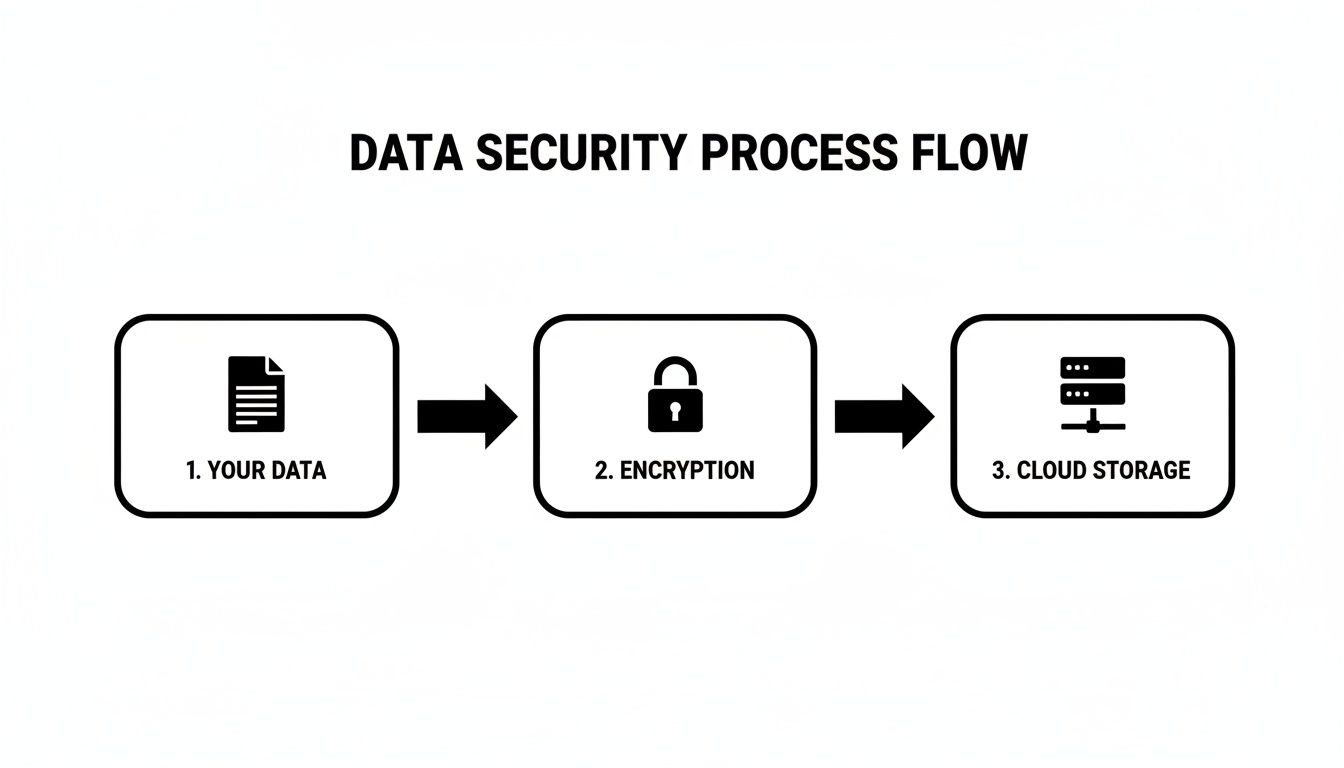
As you can see, from the moment you input your data, it’s encrypted and then stored securely. It’s a multi-layered approach to protection that’s built right into the system.
Key Takeaway: A successful migration isn't a race. It's a deliberate process of planning, preparation, and execution. Partnering with an expert ensures each step is handled correctly, guaranteeing data integrity and a stress-free transition.
Building an Automated Financial Workflow for Your Business
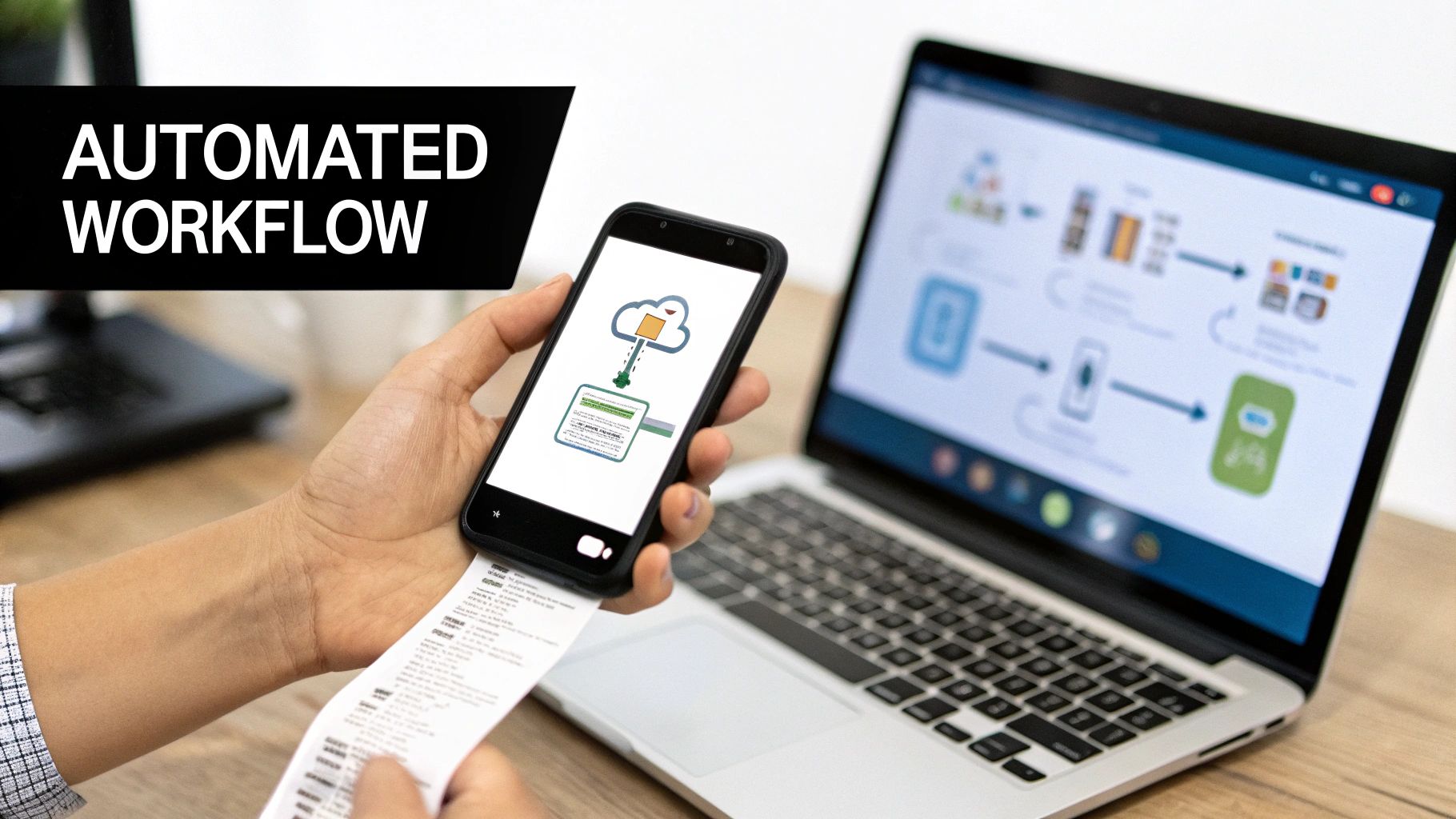
Once your cloud accounting software is up and running, its real value starts to shine. It stops being just a digital logbook and becomes the command centre for your business finances. The true game-changer isn't just storing numbers online; it's about creating smart, automated workflows that give you back hours of your week and practically wipe out costly human errors.
Think about it: a world where your finances almost run themselves. Bank transactions get categorised on their own. Receipts are digitised and filed with a quick photo. Payroll takes a few clicks, not a whole afternoon. This isn't some far-off dream—it's exactly what a properly set-up cloud accounting for small business system delivers today.
This level of automation frees you from the daily grind of financial admin. Instead of getting bogged down in paperwork, you can put your energy where it matters most: planning for growth and looking after your customers.
The Power of the App Ecosystem
Your accounting software is the core of your financial world, but you can unlock its full potential by connecting it to other specialist tools. This web of connected applications is often called an "app ecosystem," and its purpose is to create a seamless flow of information across your business.
It’s a bit like building with LEGO. Your accounting software is the big baseplate. Each extra app—whether for payments, stock control, or project management—is a specialised brick that clicks perfectly into place. Data moves between them automatically, creating one unified system without you having to do the heavy lifting.
By connecting the tools you already use, you create a powerful, automated workflow where data is entered once and then flows everywhere it needs to go, without any manual re-keying.
For instance, when you link a payment processor like Stripe or GoCardless, customer payments are automatically recorded and matched against the right invoices in your accounting software. That one simple connection saves huge amounts of time and gives you a much clearer, real-time view of your cash flow.
A Real-World Automation Scenario
Let's walk through a concrete example of how this all fits together for a small online shop.
- A customer makes a purchase: They buy something from your website, which is built on a platform like Shopify.
- The integration kicks in: Because Shopify is talking to your Xero account, a sales invoice is instantly created in your books. You don't have to lift a finger.
- Inventory is updated: At the same time, your inventory management app gets the message and deducts the item from your stock count. Your records are always spot-on.
- Payment is reconciled: The customer’s payment through Stripe comes through. The live bank feed in Xero spots this transaction and, because it recognises the amount and reference, it automatically matches the payment to the invoice.
- The invoice is marked as paid: With everything matched up, the invoice is closed. This all happens quietly in the background.
This entire sequence—from the moment of sale to the final reconciliation—is completely hands-off. It’s a brilliant example of how a connected workflow doesn't just save time; it ensures your numbers are accurate every step of the way. It also helps you avoid common mistakes, like forgetting to invoice a client or chasing up a bill they've already paid. For a closer look, check out our guide on how to automate invoice reminders using accounting software for more practical advice.
Essential Integrations for Your Business
While there are hundreds of apps you could connect, a few key types deliver the biggest bang for your buck for most small businesses. As you build your workflow, it's also worth considering how specialized expense management software can link up with your main accounting platform to solve another major headache.
Here are some of the most useful integrations to start with.
Essential Xero App Integrations for Small Businesses
Connecting the right apps to Xero can solve some of the most common challenges small businesses face. Below is a handful of popular tools that can streamline everything from getting paid to managing expenses.
| App Category | Example App | How It Helps Your Business |
|---|---|---|
| Payment Processing | Stripe, GoCardless | Lets you accept online card payments and set up Direct Debits, making it easier for customers to pay you on time. Payments are automatically reconciled. |
| Expense Tracking | Dext, AutoEntry | Scans receipts and supplier invoices using your phone's camera, pulling out the key data and saving you from endless manual entry. |
| Inventory Management | Unleashed, Cin7 | Gives you a live view of your stock levels across all sales channels, which is vital for retailers and e-commerce businesses needing to avoid overselling. |
| Project Management | WorkflowMax, Trello | Helps service-based businesses track time and costs against specific jobs, giving you a clear picture of profitability and making client billing accurate. |
By choosing and connecting the right tools, you’re not just automating tedious tasks. You’re building a solid, reliable system that gives you richer, more accurate information to make smarter decisions for your business.
Partnering with an Accountant for Cloud Success
A powerful tool is only as good as the person using it. Making the switch to cloud accounting for your small business is a fantastic decision, but the software itself is really just the beginning. The true magic happens when you combine that technology with the right professional guidance.
An expert accounting partner does so much more than just get you set up on Xero. They turn what could be a simple digital record-book into a powerful tool for growing your business, making sure you see a real return on your investment right from the start.
Ultimately, this partnership is all about turning raw financial data into clear, actionable business intelligence. Without an expert to help you read between the lines, even the most advanced real-time dashboard can feel more confusing than helpful.
Beyond Software Setup and Training
At Stewart Accounting Services, our work starts long before you ever log in. We know that every business is different, so a "one-size-fits-all" approach just won't cut it. Instead, we map out a custom migration plan that fits your specific operations, making the transition as smooth and stress-free as possible.
That hands-on support continues with training for you and your team. We zero in on the features that will actually make a difference to your daily work, so you can feel confident using the software. Our aim isn't just to get you compliant; it's to make you comfortable and capable.
Technology is brilliant at handling the "what," but you need a trusted advisor to help with the "so what?" Your accountant's role is to help you understand what the numbers are actually saying so you can build a more profitable and resilient business.
This ongoing strategic support is what really makes a partnership valuable. We don't just get you started and then disappear. We're there with you for the long haul, ready to help you navigate challenges and grab opportunities as your business evolves.
Supercharging Your Financial Operations
Once you're up and running, the combination of cloud tech and expert oversight really puts your finances into high gear. Outsourced jobs like bookkeeping, payroll, and VAT management become incredibly efficient and completely transparent.
Here’s a look at how this partnership enhances key areas:
- Outsourced Bookkeeping: We look after your books in real-time, which means your data is always accurate and current. This gives you a crystal-clear picture of your financial health whenever you need it.
- Proactive Payroll: Cloud payroll systems make everything from payments to pension contributions a breeze. We manage the whole process, ensuring your team is paid correctly and on time, every single time.
- Stress-Free VAT Management: Because the software links directly to HMRC, we can prepare and submit your VAT returns with pinpoint accuracy. Drawing on live data helps us minimise errors and keep you fully compliant with Making Tax Digital.
This integrated way of working means we can offer proactive advice based on live information. We can spot a potential cash flow issue before it becomes a real problem, or flag a rising cost that needs looking into. It’s about using technology not just to report on the past, but to look ahead and plan for the future.
The takeaway is simple: technology automates the process, but a dedicated accountant provides the wisdom.
Still Have a Few Questions?
Thinking about moving your accounts to the cloud is a big step, and it's natural to have questions. Here are some honest answers to the things we get asked most often by business owners.
Is My Financial Data Really Secure in the Cloud?
Absolutely. It’s a common worry, but the reality is your data is likely much safer in the cloud than on your office computer. Leading platforms like Xero protect your information with the same level of encryption that banks use.
Think of it this way: your laptop could be stolen or the hard drive could fail, wiping out everything. Cloud systems, on the other hand, store your data in highly secure centres with multiple backups. That means your financial records are protected from physical theft, damage, and digital threats far more effectively than a standard desktop setup ever could be.
What’s This Going to Cost Me?
The pricing is usually a flexible monthly subscription, so you only pay for what you need. For a sole trader just starting out, a basic plan might be around £10-£15 a month. A growing limited company needing more features would typically look at plans in the £25-£60 per month range.
When you work with us at Stewart Accounting Services, we often roll the software subscription right into your monthly accounting package. This usually works out to be better value and saves you the hassle of managing another bill. Plus, we make sure you're on the perfect plan for your specific business from day one.
Am I Going to Lose Control of My Own Books?
It’s actually the complete opposite – you gain more control because you have a clearer, real-time picture of your finances. You decide who gets access and what they can see. It's not about handing over the keys; it's about having a co-pilot.
This is all about partnership. You can keep managing the day-to-day things you're comfortable with, like sending invoices, while we handle the complex compliance and offer strategic advice based on the exact same up-to-the-minute data.
Instead of losing control, you get empowered. You’ll be making decisions based on live information, with an expert right there to guide you whenever you need it.
Ready to see how cloud accounting can give you back more time, money, and peace of mind? Stewart Accounting Services can help you make the switch smoothly and get the most out of it. Contact us today for a free consultation.