

That brilliant business idea is ready to launch, but the path to becoming a legally recognised company can feel like a maze of confusing jargon and potential pitfalls. From understanding ‘Articles of Association’ to ensuring you’re compliant from day one, the process can add unnecessary stress when you should be focused on growth. This is where professional company formation services Scotland can take the weight off your shoulders, transforming a complicated task into a smooth, straightforward process.
In this complete 2026 guide, we will walk you through everything you need to know to set up your limited company in Scotland correctly and confidently. We’ll break down the essential legal requirements, clarify your ongoing responsibilities as a company director, and help you build your business on a solid, compliant foundation. Consider this your roadmap to protecting your personal assets and confidently establishing your professional presence, all with the support of Stewart Accounting Services.
Key Takeaways
- Understand the core benefit of a limited company: creating a separate legal entity to protect your personal assets from business debts.
- Our guide breaks down the registration process, showing how professional company formation services Scotland can handle the entire setup for you.
- Discover your key legal and financial responsibilities after formation, including annual accounts and confirmation statements, to ensure you stay compliant.
- Learn the crucial differences between cheap online agents and a full chartered accountant service to avoid costly mistakes and set your business up for success.
Why Form a Limited Company in Scotland? Key Pros and Cons
Deciding to start a business in Scotland is an exciting step, but choosing the right legal structure can feel complicated. A limited company is a popular choice because it creates a ‘separate legal entity’. This simply means the business is legally distinct from its owners, which has significant implications for your personal finances and professional standing.
The primary advantage is limited liability. If the company incurs debts it cannot pay, your personal assets, like your home and savings, are protected. This peace of mind is invaluable for ambitious business owners. Furthermore, operating as a ‘Ltd’ often enhances your professional credibility with clients, suppliers, and lenders, and can offer greater tax efficiency compared to being a sole trader.
On the other hand, running a limited company involves more administration. You are legally required to file annual accounts and a confirmation statement with Companies House, and key details about your company become public record. While this sounds daunting, it’s a standard part of the Company formation process in the UK and is designed to ensure transparency. With the right support, these duties are straightforward to manage.
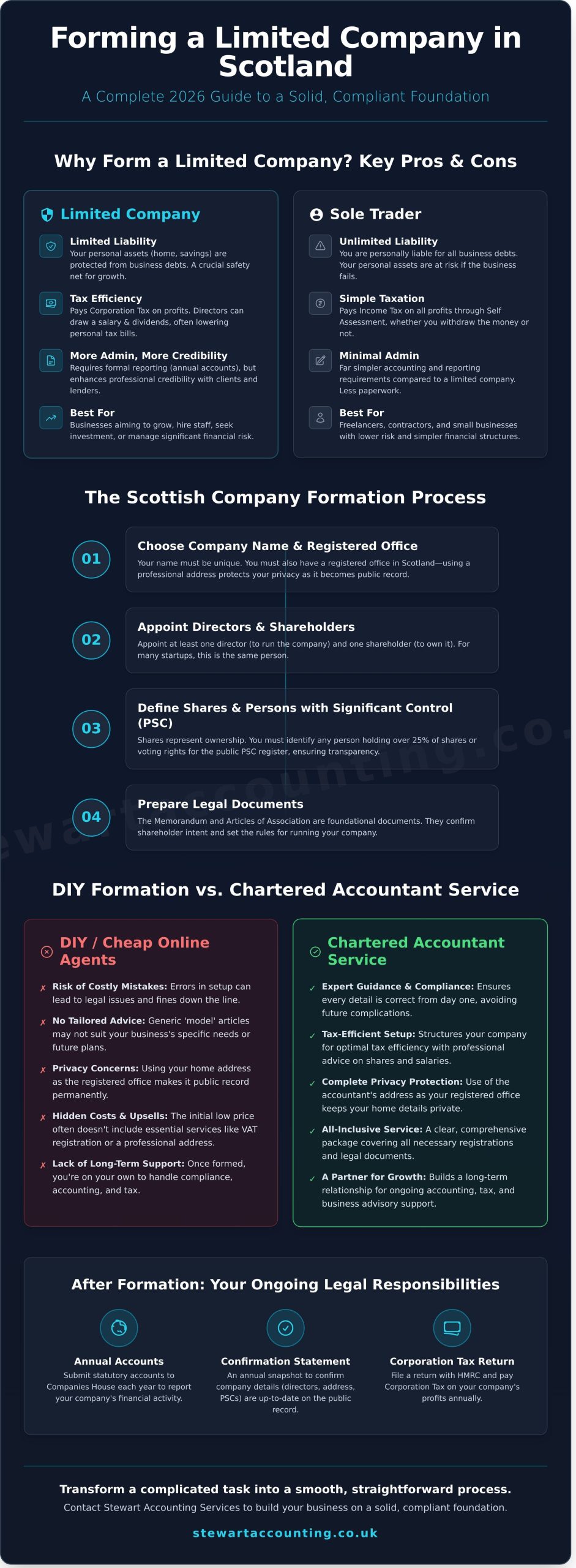
Limited Company vs. Sole Trader in Scotland
Understanding the key differences helps you make the right choice for your circumstances. Here’s a simple breakdown:
- Liability: A limited company protects your personal assets. As a sole trader, you are personally liable for all business debts.
- Tax: Limited companies pay Corporation Tax on profits. Sole traders pay Income Tax on all profits through Self Assessment.
- Admin: Limited companies have more formal reporting requirements. Sole traders have simpler accounting needs.
- Best For: A limited company is often ideal for businesses aiming to grow, hire staff, or seek investment. A sole trader structure is perfect for freelancers and small businesses with lower risk.
Tax Implications of Incorporating Your Business
When you incorporate, your business pays Corporation Tax on its profits. As a director, you can then pay yourself through a combination of a modest salary and dividends paid from post-tax profits. This structure can be highly tax-efficient. In contrast, a sole trader is taxed on all business profits, whether they take the money out or not. Navigating these options is a key part of our expert company formation services Scotland, ensuring your business is set up for financial success from day one.
The Scottish Company Formation Process: A Step-by-Step Checklist
Forming a limited company in Scotland involves a clear, structured process. While it might seem daunting, each step is a logical building block for creating a legally sound business. Getting these details right from the start is crucial for avoiding complications later on. All official registrations are handled by Companies House, which has its main Scottish office in Edinburgh.
The good news? You don’t have to navigate this alone. A key part of our company formation services Scotland is managing this entire process for you, ensuring every detail is handled correctly and efficiently, giving you complete peace of mind.
Step 1: Choosing Your Company Name and Registered Office
Your company name must be unique and cannot be the ‘same as’ an existing name on the Companies House register. It also can’t be offensive, and certain sensitive words (like ‘Royal’ or ‘Accredited’) require official permission. You must also have a registered office address in Scotland. While using your home address is an option, it becomes public record. Using our address provides a professional image and protects your privacy.
Step 2: Appointing Directors and Shareholders
Every limited company needs at least one director and one shareholder. Directors are responsible for the day-to-day running of the company, while shareholders own it. For many new businesses, the founder is the sole director and shareholder. As a director, you have legal duties, including acting in the company’s best interests and keeping accurate company records.
Step 3: Defining Shares and Control (PSC Register)
Shares represent ownership of the company. You must also identify any ‘Persons with Significant Control’ (PSC). A PSC is anyone who holds more than 25% of the shares or voting rights, or otherwise has significant influence over the company. This information is recorded on the public PSC register to ensure transparency.
Step 4: Preparing Key Legal Documents
Two key documents establish your company’s legal foundation. The Memorandum of Association is a statement from all initial shareholders agreeing to form the company. The Articles of Association are the rules for running the company. While the UK government’s step-by-step guide outlines standard ‘model’ articles, we can help you decide if custom articles are better for your situation. You’ll also choose a Standard Industrial Classification (SIC) code, which tells Companies House what your business does.
After Formation: Your Ongoing Legal and Financial Responsibilities
Successfully registering your new company is an exciting first step. The next stage involves fulfilling your ongoing duties as a director. Far from being a burden, these legal and financial responsibilities are the foundation of a credible and well-run business. Meeting them consistently not only ensures you are compliant but also builds a strong track record for your company.
Failing to keep up with these obligations can lead to significant penalties, fines, or even legal action from Companies House and HMRC. This is where having a professional accountant provides invaluable peace of mind, letting you focus on growth while we handle the compliance.
Annual Filing with Companies House
Every year, you must file two key documents with Companies House. The Confirmation Statement (previously the Annual Return) confirms that the information held about your company is up-to-date. You must also file statutory annual accounts to report your financial activity. Strict deadlines apply, and late filing results in automatic financial penalties that increase over time, so it’s crucial to stay organised.
Tax Obligations with HMRC
As a limited company, you are required to manage your tax affairs with HMRC. This involves registering for Corporation Tax and filing a Company Tax Return (CT600) each year. You must calculate and pay Corporation Tax on your taxable profits. Depending on your turnover and whether you have employees, you may also need to register for VAT and operate a PAYE (Pay As You Earn) scheme for payroll.
Maintaining Statutory Records
UK law requires every limited company to maintain certain statutory records, often called the company’s ‘statutory books’. These must be kept at the company’s registered office and be available for inspection. Our expert team can take this task off your hands, ensuring your records are always accurate and compliant. Key records include:
- A register of members (shareholders)
- A register of directors and secretaries
- A register of People with Significant Control (PSCs)
- Minutes of all board meetings
While our company formation services Scotland help you launch your business correctly, our ongoing accounting support ensures you run it smoothly. Let us manage these essential duties for you, giving you more time, more money, and less stress. To learn more, get in touch with the team at Stewart Accounting Services today.
DIY Formation vs. Using a Chartered Accountant Service
When starting a new business, it’s tempting to opt for the cheapest online formation agents, some advertising services for as little as £12. While this initial saving seems attractive, it often overlooks the long-term value and security that comes with professional guidance. The choice isn’t just about registering a name with Companies House; it’s about building a solid, compliant, and tax-efficient foundation for your future success.
The Risks of the DIY Approach
A cheap, automated service is simply a form-filling exercise. It lacks the crucial context and advice needed to avoid common pitfalls that can cost you dearly down the line. The main risks include:
- Costly Mistakes: Simple errors in the application, such as an incorrect share structure or wrong information for directors, can lead to rejection or future legal and accounting complications.
- Lack of Strategic Advice: DIY services won’t advise you on the most tax-efficient way to structure your company, set up share classes, or plan for dividends and salaries. This is where real savings are made.
- Ongoing Compliance Burden: Once your company is formed, you are left alone to navigate the complex world of Corporation Tax, Annual Accounts, and Confirmation Statements. Missing these deadlines results in significant penalties.
The Benefits of Using Stewart Accounting Services
Choosing a chartered accountant is an investment in peace of mind. We don’t just register your company; we partner with you to ensure its long-term health and success. Our approach is designed to give you more time, more money, and less stress.
- Peace of Mind: We ensure everything is set up correctly from the very start, giving you the confidence that your business is fully compliant and built on a solid legal footing.
- Holistic, Expert Advice: We go beyond the basics to provide guidance on the best company structure for your personal and business goals, helping you maximise tax efficiency from day one.
- Seamless Transition: Our support doesn’t end once you’re registered. We provide the comprehensive company formation services Scotland-based entrepreneurs need, then seamlessly transition to managing your ongoing accounts, tax, and bookkeeping. We take it all off your hands.
- Local Expertise: As a CA firm with offices in Alloa, Stirling, and Falkirk, we have a deep understanding of the business landscape in Central Scotland.
Ultimately, the small initial fee for a DIY service pales in comparison to the long-term value of expert advice. Let us take the stress out of company formation and set your new venture on the right path.
Start Your Scottish Business Journey on the Right Foot
Forming a limited company in Scotland is an exciting step, but it’s a journey that requires careful navigation. From understanding your legal responsibilities to managing ongoing compliance, getting the foundation right is crucial for long-term success. While the DIY route is an option, engaging professional company formation services Scotland ensures every detail is handled correctly, saving you time and preventing future complications.
At Stewart Accounting, we do more than just register your company; we take the entire complex process off your hands. Our goal is to give you the peace of mind to focus on what you do best: growing your new business.
Ready to start your business? Let our expert accountants handle your company formation.
As Fully Qualified Chartered Accountants with local offices in Alloa, Stirling, and Falkirk, we provide more than a one-off transaction. We offer expert, ongoing support for your entire business journey, helping you achieve more time, more money, and less stress. Your success is our priority, and we’re here to help you build it from day one.
Frequently Asked Questions About Company Formation in Scotland
How much does it cost to set up a limited company in Scotland?
The direct fee paid to Companies House for standard online registration is very modest, currently just £12. Our service packages are designed to handle this process for you, ensuring all documents are filed correctly to avoid costly mistakes. This small investment provides complete peace of mind, taking the administrative stress off your hands so you can focus on building your new business. We offer tailored packages to suit your specific needs.
How long does the company formation process take?
Once your application is submitted to Companies House, the approval process is typically very quick, often taking less than 24 hours. The key to a speedy setup is ensuring your application is accurate and complete from the start. By using our expert service, we help prevent common errors that can cause significant delays, ensuring your Scottish limited company is ready to trade as swiftly as possible.
Do I need a business bank account for a new limited company?
Yes, it is essential. A limited company is a distinct legal entity from its owners, and you are legally required to keep its finances separate from your personal funds. Opening a dedicated business bank account is a crucial first step. It not only ensures you remain compliant with the law but also simplifies your bookkeeping and makes managing your accounts much more straightforward, saving you time and stress later on.
Can I form a Scottish company if I don’t live in Scotland?
Absolutely. You do not need to be a resident in Scotland to form a company here. The main legal requirement is that your company must have a registered office address located in Scotland. As part of our comprehensive company formation services Scotland, we can provide you with a registered Scottish office address, allowing you to establish your business here regardless of where you live in the UK or abroad.
What is a SIC code and how do I choose the right one?
A Standard Industrial Classification (SIC) code is a five-digit number that describes your company’s primary business activities to Companies House. Choosing the correct one is important for official records. You can find a condensed list on the Companies House website. Don’t worry if this seems complicated; as part of our service, we will help you identify the most appropriate SIC code for your new venture to ensure your registration is accurate.
Can I be the sole director and shareholder of my company?
Yes, you can. It is very common for a new limited company to be set up with just one person who acts as both the sole director and the single shareholder. This is a perfectly valid and straightforward structure, particularly for consultants, contractors, and small business owners. This setup gives you complete control over the company’s operations and ownership, simplifying the decision-making process as you get started.
What’s the difference between a Scottish and an English limited company?
The key difference is legal jurisdiction. A Scottish limited company must have its registered office in Scotland and is governed by Scots law. Similarly, a company registered in England or Wales must have its address there and falls under English law. While they operate under the same UK-wide corporation tax system and can trade anywhere in the UK, any legal proceedings involving the company would take place in the respective country’s courts.